Brief summary of issue / Description of requested feature:
excess whitespace after regex "line end" character breaks patterns invisibly
Steps to reproduce the issue / Reasons for adding feature:
- player asked in Discord, why does alias not work
- player suspected pattern wrong, because command wasn't recognized, but sent to game instead
- building the same alias anew with same pattern worked fine indeed
- nobody noticed there was an excess space character after the original pattern (besides demonnic who assumed such)
Error output / Expected result of feature
activate alias with excess whitespace, but show hint above "did you really want to do that?"
Extra information, such as Mudlet version, operating system and ideas for how to solve / implement:
same goes for triggers, etc. all places with regex and not only alias like this example.
excess space can sometimes happen unintentionally when copy/pasting..
example alias:
<?xml version="1.0" encoding="UTF-8"?>
<!DOCTYPE MudletPackage>
<MudletPackage version="1.001">
    <AliasPackage>
        <Alias isActive="yes" isFolder="no">
            <name>Wavecall Distance</name>
            <script>send("invoke wavecall " .. matches[2] .. " " .. matches[3])

--I want to type wcn5 and have it send "invoke wavecall n 5"</script>
            <command></command>
            <packageName></packageName>
            <regex>^wc(\w+)(\d+)$ </regex>
        </Alias>
    </AliasPackage>
</MudletPackage>
Can't be recognized in screenshot:
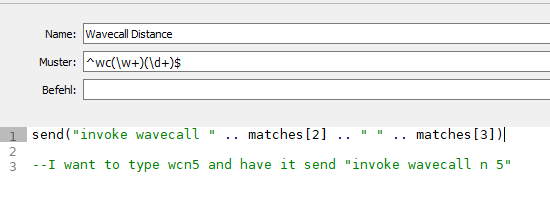
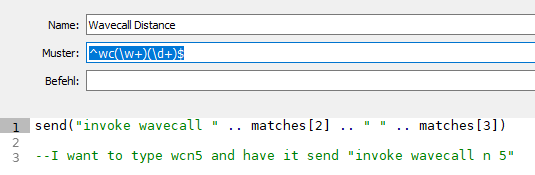
Workaround: click at the end of pattern line and "mark all" (Ctrl+A):

You could then see there is too much white space, should be like this instead:
Or just have people copy/paste their alias in chat for comparison
 Kebap
Kebap
All 18 comments
Though very unlikely it is not impossible for a regex to end with \$ so just looking for trailing spaces after a $ is not 100% foolproof.
:bulb: It would be nice if we could apply QTextOption::ShowTabsAndSpaces but as the dlgTriggerPatternEdit::lineEdit_pattern element is a QLineEdit it does not have the capability to have that option...
 SlySven
on 23 Dec 2020
SlySven
on 23 Dec 2020
💡 It would be nice if we could apply
QTextOption::ShowTabsAndSpaces
Doesn't sound quite nice to me..
Though _very_ unlikely it is not _impossible_ for a regex to end with
\$so just looking for trailing spaces after a$is not 100% foolproof.
Hence we don't block that usage but only inform: Did you really?
Kebap
on 23 Dec 2020
So that could lead to the first use of the (void) dlgTriggerEditor::showWarning(const QString& error) method... :grinning:
SlySven
on 23 Dec 2020
What if the regex needs to end in a space - Mudlet quietly whittling spaces off - and not providing a work-around would be even worse.
Mudlet says: NO! you can not have whitespace at the beginning or end of your "regexp" triggers.
SlySven
on 23 Dec 2020
You very much still can, via \s+ or \s{,4} and similar others... Many ways to skin the regex cat.
Having been an implication-based usage for so long, "fixing" it would just break UX. Thus I redacted my last comment.
 itsTheFae
on 23 Dec 2020
itsTheFae
on 23 Dec 2020
Thus I redacted my last comment.
Well that wrangled continuity somewhat for future readers, so just for the record, SlySven above reacted to the suggestion of adding a QString::trimmed() to the pattern text.
Kebap
on 23 Dec 2020
Mangled may be the word you're looking for. The deleted Comment is as follows:
Why not apply QString::trimmed() to the pattern text?
Regex has character classes, as well as the typical escape sequences to match characters. Isn't it better to force explicit patterns than to allow for ambiguous or implied ones?
itsTheFae
on 23 Dec 2020
Only just spotted that you are talking about aliases - of course the same issue is present in several of the trigger types...
SlySven
on 23 Dec 2020
Does a space after $ really make sense in our context? I don't think it does, we should just strip it automatically for better UX.
 vadi2
on 24 Dec 2020
vadi2
on 24 Dec 2020
Well if it's a literal escaped $ then SlySven has a point for example.
I can't be sure if there could be other cases still, so I didn't suggest it.
Kebap
on 24 Dec 2020
Since we already have to make sure the last character before any spaces is $ would it be that much more difficult to make sure the one before it is not \, and thus it's not an escaped $?
Strip spaces if the last two characters are (anything but \)$ and if the last two characters before the spaces are \$ then don't strip them.
 demonnic
on 25 Dec 2020
demonnic
on 25 Dec 2020
Do we only have this problem after unescaped dollar signs or do we need to tackle any and all surrounding whitespace?
Kebap
on 25 Dec 2020
Yeah, I think we can all agree to do it automatically if it a case of a literal line ending. Similarly same for ^. In cases where what the user might want is at least a little bit ambiguous we can throw a warning, but this is pretty foul proof.
Not with my laptop atm to code it, but if anyone else want to give it a go feel free.
vadi2
on 25 Dec 2020
Since we already have to make sure the last character before any spaces is $ would it be that much more difficult to make sure the one before it is not
\, and thus it's not an escaped $?
Well I am no regex pro but clearly the character before that could be another slash, rendering the second slash a literal slash and the dollar sign an end of line marker again..
Then again, the suggested solution seems better than status quo indeed.
Kebap
on 25 Dec 2020
then check one more character back if it is a backslash. Just means we have to take it one step further.
demonnic
on 25 Dec 2020
Consider ^\\\\\\\\\\$
Kebap
on 25 Dec 2020
I mean yeah, we could continue to craft unlikely examples we might miss, but let's not lose track of the actual goal of making things better =)
demonnic
on 25 Dec 2020
While trimming automatically would solve issue for $, still some triggers and aliases might have space at the end, unintentionally. I would say that in most cases this will be undesired... Universal solution would be to add some hint.
Another option, maybe not prettiest, but definitely will give good hint, would be to give actual text some background different than underlying one. Possibly only when it ends or start with whitespace characters.
 Delwing
on 26 Dec 2020
Delwing
on 26 Dec 2020
Related issues
 wiploo
·
3Comments
vadi2
·
8Comments
wiploo
·
3Comments
vadi2
·
8Comments
 jacben
·
7Comments
jacben
·
7Comments
 xekon
·
8Comments
xekon
·
8Comments
 zesstra
·
6Comments
zesstra
·
6Comments
Most helpful comment
I mean yeah, we could continue to craft unlikely examples we might miss, but let's not lose track of the actual goal of making things better =)