Mlj.jl: Issues with some regression models [tbc]
using MLJ, RDatasets, DataFrames;
#Load & make model list.
@inline function load_m(model_list)
    @inbounds for (i, model) in enumerate(model_list)
        load(model.name, pkg=model.package_name, verbosity=0) #
    end
end
# Load all models ONCE!
drop_pkg = ["NaiveBayes", "ScikitLearn"];
models(m -> m.package_name ∉ drop_pkg) |> load_m
#
@inline function one_hot_encode(d::DataFrame)
    encoded = DataFrame()
    @inbounds for col in names(d), val in unique(d[!, col])
        lab = string(col) * "_" * string(val)
        encoded[!, Symbol(lab) ] = ifelse.(d[!, col] .== val, 1, 0)
    end
    return encoded
end
#AZ: convert Strings & Count to OHE.
@inline function AZ(X)
    sch = schema(X);
    #ty = [CategoricalString{UInt8}, CategoricalString{UInt32}, CategoricalValue{Int64,UInt32}]
    tn = [Int, Float16, Float32, Float64]
    vs = [];
    @inbounds for (name, type) in zip(sch.names, sch.types)
        if type ∉ tn  #∈ ty #∉ [Int32, Int64, Float64]
            #println(:($name) , "  ", type)
            push!(vs, :($name) )
            #global X = coerce(X, :($name) =>Continuous);
        end
    end
    #
    Xd= DataFrame(X);
    X_ohe = one_hot_encode( Xd[:, vs]  )
    Xd = hcat( X_ohe, select(Xd, Not( vs )) )
    Xd = coerce(Xd, autotype(Xd, :discrete_to_continuous))
    #sch= schema(Xd);
    #@show sch.scitypes;
    #
    X=Xd
    return X
end
#Train & Score.
#NOTE: if we do target engineering we need to transform Y back to compare score.
@inline function train_m(m, X, y, train, test, pr, meas; invtrans=identity)
    t1 = time_ns()
    m = m.name
    println(m)
    if m =="XGBoostRegressor"
        mdl  = eval(Meta.parse("$(m)(num_round=500)"))
    elseif m=="LGBMRegressor"
        mdl  = eval(Meta.parse("$(m)(num_iterations = 1_000, min_data_in_leaf=10)"))
    elseif m=="EvoTreeRegressor"
        mdl  = eval(Meta.parse("$(m)(nrounds = 1500)"))
    else
        mdl  = eval(Meta.parse("$(m)()"))
    end
    #
    mach = machine(mdl, X, y)
    fit!(mach, rows=train, verbosity=0) #, verbosity=0
    #ŷ = MLJ.pr(mach, rows=test)
    ŷ = pr(mach, rows=test)
    ŷ = invtrans.(ŷ)
    y = invtrans.(y)
    #AZ Custom oos-R2
    if meas==rmsl
        s = meas(abs.(ŷ), abs.(y[test]) )  #abs.() for rmsl AMES.
    else
        s = meas(ŷ, y[test])
    end
    t2 = time_ns()
    return [m,round(s, sigdigits=5), round((t2-t1)/1.0e9, sigdigits=5)]
end
#
@inline function f(X, y, train, test, pr, meas; pr_type = [:deterministic, :probabilistic])
    X = AZ(X)
    dropm = ["ARDRegressor"]; drop_pkg = ["NaiveBayes", "ScikitLearn"];
    m_match = models(matching(X, y),
            x -> x.prediction_type ∈ pr_type,
            x -> x.package_name ∉ drop_pkg,
            x -> x.name ∉ dropm);
    sc = Array{Any}(undef, size(m_match, 1), 3)
    @inbounds for (i,m) in enumerate(m_match)
        sc[i,:] .= try
            train_m(m, X, y, train, test, pr, meas)
        catch
            m.name, 10_000,10_000
        end
    end
    df= DataFrame(Model = sc[sortperm(sc[:,2]), 1],
                SCORE = sc[sortperm(sc[:,2]), 2],
                Time = sc[sortperm(sc[:,2]), 3])
    #showtable(df)
    #
    return df
end
Now apply to Boston data (eg):
X, y =  @load_boston;
train, test = partition(eachindex(y), .7, rng=333);
df = f(X, y, train, test, predict, rmsp, pr_type = [:deterministic])
The model LinearRegressor doesn't work.
Note: I dropped all modes in ["NaiveBayes", "ScikitLearn"]
 azev77
All 14 comments
The model LinearRegressor doesn't work
Please report the error, stack trace, and ideally a minimum working example.
 ablaom
on 21 Jun 2020
ablaom
on 21 Jun 2020
When I run my code to train all (deterministic regression) models the only two (out of 50) that give errors are:
MLJLinearModels.LinearRegressor() & ScikitLearn.LinearRegressor()
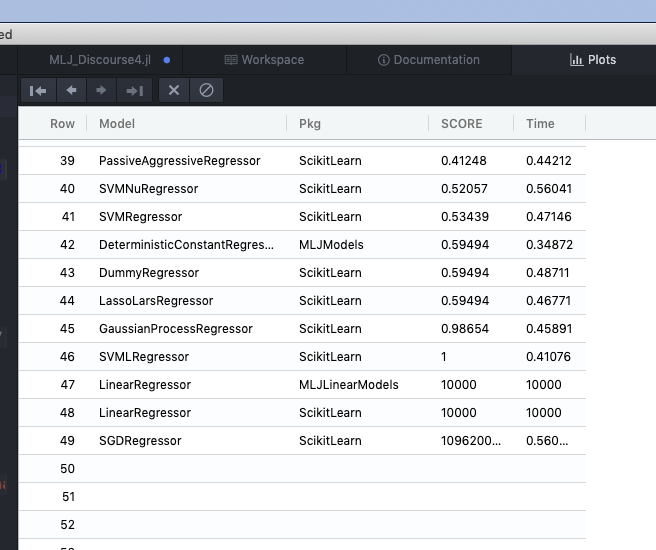
When I run the code separately (restarting Julia):
using MLJ
X, y = @load_boston
train, test = partition(eachindex(y), .7, rng=333);
```julia
julia> @load LinearRegressor
ERROR: LoadError: ArgumentError: Ambiguous model name. Use pkg=... .
The model LinearRegressor is provided by these packages:
["MLJLinearModels", "GLM", "ScikitLearn"].
Stacktrace:
[1] info(::String; pkg::Nothing) at /Users/AZevelev/.julia/packages/MLJModels/uSKTW/src/model_search.jl:80
[2] load(::String; pkg::Nothing, kwargs::Base.Iterators.Pairs{Symbol,Any,Tuple{Symbol,Symbol},NamedTuple{(:modl, :verbosity),Tuple{Module,Int64}}}) at /Users/AZevelev/.julia/packages/MLJModels/uSKTW/src/loading.jl:81
[3] @load(::LineNumberNode, ::Module, ::Any, ::Vararg{Any,N} where N) at /Users/AZevelev/.julia/packages/MLJModels/uSKTW/src/loading.jl:125
in expression starting at none:1
It appears there are 3 pkg w/ `LinearRegressor()`, `["MLJLinearModels", "GLM", "ScikitLearn"]`, w/ GLM `probabilistic` the other two `deterministic`.
```julia
#
@load LinearRegressor pkg = MLJLinearModels
mdl = LinearRegressor()
mach = machine(mdl, X, y)
fit!(mach, rows=train, verbosity=0)
ŷ = predict(mach, rows=test)
rmsp(ŷ, y[test])
#
@load LinearRegressor pkg = ScikitLearn
mdl = LinearRegressor()
#mdl = ScikitLearn.LinearRegressor()
mach = machine(mdl, X, y)
fit!(mach, rows=train, verbosity=0)
ŷ = predict(mach, rows=test)
rmsp(ŷ, y[test])
For reasons I can't understand: LinearRegressor works separately, but not through my framework to train all models. (before it worked fine though...)
I'm gonna have to think more about this.
azev77
on 21 Jun 2020
A few other points:
- this was discussed before: multiple models w/ the same name creates problems.
Perhaps:MLJLinearModels.LinearRegressor(),ScikitLearn.LinearRegressor(),GLM.LinearRegressor() - yesterday @OkonSamuel made
ScikitLearn.jlwork on mac again. We are lucky to have him onboard.
azev77
on 21 Jun 2020
Wait now they're working (I think you have to restart Juno a couple times...)
It's no longer working, this may be specific to my stuff, I'll have to work on it some more.
Btw, the exercise above provides a sanity check:
- the top-5 models are the boosted trees
│ Row │ Model                                │ Pkg               │ SCORE     │ Time      │
│     │ Any                                  │ Any               │ Any       │ Any       │
├─────┼──────────────────────────────────────┼───────────────────┼───────────┼───────────┤
│ 1   │ EvoTreeRegressor                     │ EvoTrees          │ 0.13985   │ 6.662     │
│ 2   │ GradientBoostingRegressor            │ ScikitLearn       │ 0.14363   │ 0.65507   │
│ 3   │ XGBoostRegressor                     │ XGBoost           │ 0.14375   │ 1.7388    │
│ 4   │ ExtraTreesRegressor                  │ ScikitLearn       │ 0.15092   │ 0.68245   │
│ 5   │ LGBMRegressor                        │ LightGBM          │ 0.15601   │ 3.2093    │
│ 6   │ RandomForestRegressor                │ ScikitLearn       │ 0.16037   │ 0.0062503 │
│ 7   │ RandomForestRegressor                │ DecisionTree      │ 0.16325   │ 0.63957   │
- Huber models give the same score
│ 11  │ HuberRegressor                       │ MLJLinearModels   │ 0.22567   │ 3.2882    │
│ 12  │ HuberRegressor                       │ ScikitLearn       │ 0.22567   │ 0.011471  │
- (Deterministic) Linear models give the same score (GLM is probabilistic & omitted here)
│ 18  │ LinearRegressor                      │ MLJLinearModels   │ 0.25235   │ 0.17905   │
│ 19  │ LinearRegressor                      │ ScikitLearn       │ 0.25235   │ 0.0013115 │
- three Ridge models give the same score
│ 28  │ RidgeRegressor                       │ MLJLinearModels   │ 0.26502   │ 2.423     │
│ 29  │ RidgeRegressor                       │ MultivariateStats │ 0.26502   │ 0.0025984 │
│ 30  │ RidgeRegressor                       │ ScikitLearn       │ 0.26502   │ 0.0054935 │
- Two Lasso & two EN:
│ 36  │ LassoRegressor                       │ MLJLinearModels   │ 0.32835   │ 0.78851   │
│ 37  │ LassoRegressor                       │ ScikitLearn       │ 0.32835   │ 0.054286  │
│ 38  │ ElasticNetRegressor                  │ MLJLinearModels   │ 0.32837   │ 1.9358    │
│ 39  │ ElasticNetRegressor                  │ ScikitLearn       │ 0.32837   │ 0.008472  │
- Two constant regressors give the same score:
│ 43  │ DeterministicConstantRegressor       │ MLJModels         │ 0.59494   │ 0.3227    │
│ 44  │ DummyRegressor                       │ ScikitLearn       │ 0.59494   │ 0.48613   │
- some models have suboptimal default HP:
│ 45  │ LassoLarsRegressor                   │ ScikitLearn       │ 0.59494   │ 0.42588   │
│ 46  │ PassiveAggressiveRegressor           │ ScikitLearn       │ 0.6607    │ 0.45705   │
│ 47  │ GaussianProcessRegressor             │ ScikitLearn       │ 0.98654   │ 0.48546   │
│ 48  │ SVMLRegressor                        │ ScikitLearn       │ 1.0       │ 0.46353   │
│ 49  │ SGDRegressor                         │ ScikitLearn       │ 3.3938e12 │ 0.47502   │
@tlienart I'm ready to start working on a tutorial.
azev77
on 22 Jun 2020
@azev77 Cool
 OkonSamuel
on 22 Jun 2020
OkonSamuel
on 22 Jun 2020
Nice!
Re multiple models with same name, please add any wishes to the discussion here: https://github.com/alan-turing-institute/MLJModels.jl/issues/242#issuecomment-647755073 . May get to this soon.
ablaom
on 23 Jun 2020
@azev77 So can we close this?
ablaom
on 24 Jun 2020
@ablaom can you give me a bit more time to get to the bottom of this?
azev77
on 24 Jun 2020
Sure - no worries! Appreciate the investigation.
ablaom
on 24 Jun 2020
@azev77 Still unresolved?
ablaom
on 23 Jul 2020
@ablaom
can we close this issue once we finish creating the tutorial: https://github.com/alan-turing-institute/DataScienceTutorials.jl/issues/47
azev77
on 23 Jul 2020
@azev77 this is unrelated, if you can run the script please kindly close this issue as the name is fairly ominous! Thanks :)
 tlienart
on 24 Jul 2020
tlienart
on 24 Jul 2020
@tlienart
- I have a program to automatically train all relevant models on a given dataset
- Previously it worked for all models
- One day a few of the models didn’t work, in my script, so I opened this issue.
- Those models still work individually, outside my script.
Not sure why. - Once we get to bottom of this & publish tutorial, I’d feel easier closing this issue.
You’re right, the title of this issue is ominous/misleading/unfair to MLJ.
I learned this trick from our leader (potus)...
azev77
on 24 Jul 2020
Yes that analysis is fine however
- the tutorial will take some time to get integrated
- the present issue is currently not super helpful because it doesn't point to a clear problem that we could open a PR for
So I suggest
- closing this for now
- working on your suggestion in DST (which I'm very grateful for)
- flagging specific issues from there
but it's fine; I'll just change the title here.
tlienart
on 24 Jul 2020
Related issues
 mllg
·
6Comments
mllg
·
6Comments
 CameronBieganek
·
6Comments
CameronBieganek
·
6Comments
 aviatesk
·
7Comments
aviatesk
·
7Comments
 juliohm
·
7Comments
juliohm
·
7Comments
 caseykneale
·
6Comments
caseykneale
·
6Comments
Most helpful comment
Wait now they're working (I think you have to restart Juno a couple times...)
It's no longer working, this may be specific to my stuff, I'll have to work on it some more.
Btw, the exercise above provides a sanity check:
@tlienart I'm ready to start working on a tutorial.