Migrate: [Preview 14] Migrate error - ambiguous self relation detected
Related to prisma/prisma2#488 and prisma/prisma2#671
Prisma2 version:
[email protected], binary version: 188a379c9b8c6650e5812f9bdb7407d7b197692f
Schema:
model Game {
  id           String   @id @default(cuid())
  createdAt    DateTime @default(now())
  updatedAt    DateTime @updatedAt
  title        String
  handle       String
  description  String
  expansions   Game[]   @relation("Expansion")
  expands      Game[]   @relation("Expansion")
  relatedGames Game[]  👈 this is the problem
}
Notes:
When I try to perform prisma2 lift up I get "ambiguous self relation detected" due to the relatedGames field. If I try to add the @relation directive, I get an error when I try to perform prisma lift save in which the schema can't be validated bc Named relations require an opposite field. In my model, the expansions/expands fields are different, because a Game can either have expansions, or it itself can be an expansion for several other games (meaning it will have several Games in its expands field). The relatedGames field doesn't have any concept of different roles in a relationship like expansions and expands, it's simply a way to model that games can be "related" to each other, i.e. for similar game recommendations. What should I do to resolve this?
 nhuesmann
All 15 comments
@pantharshit00 Please triage this and if this is a bug, apply the candidate label to it 🙏
 divyenduz
on 14 Oct 2019
divyenduz
on 14 Oct 2019
I can confirm this bug. Strangely enough prisma2 dev works but prisma2 lift save throws the reported bug.
Also, adding the directive also throws an error:
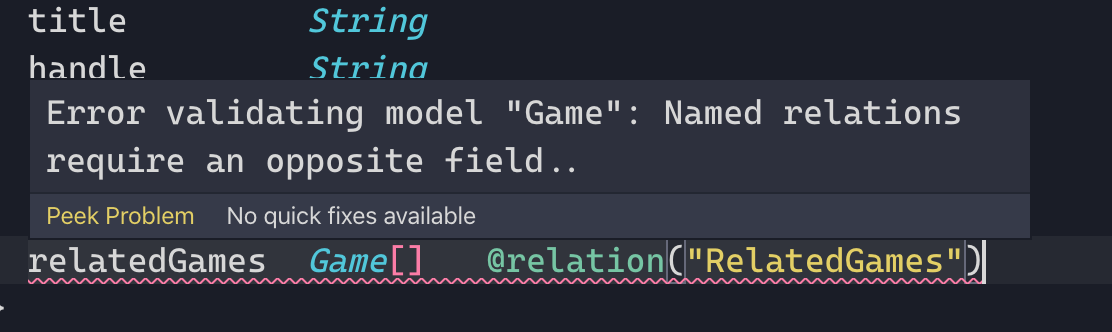
Reproduction: https://github.com/harshit-test-org/prisma-prisma2-752
 pantharshit00
on 14 Oct 2019
pantharshit00
on 14 Oct 2019
@nhuesmann:
The solution is to to provide an opposite field:
model Game {
id String @id @default(cuid())
createdAt DateTime @default(now())
updatedAt DateTime @updatedAt
title String
handle String
description String
expansions Game[] @relation("Expansion")
expands Game[] @relation("Expansion")
relatedGames Game[] @relation("RelatedGames")
relatedGamesBack Game[] @relation("RelatedGames")
}
 mavilein
on 15 Oct 2019
mavilein
on 15 Oct 2019
@nhuesmann:
The solution is to to provide an opposite field:model Game { id String @id @default(cuid()) createdAt DateTime @default(now()) updatedAt DateTime @updatedAt title String handle String description String expansions Game[] @relation("Expansion") expands Game[] @relation("Expansion") relatedGames Game[] @relation("RelatedGames") relatedGamesBack Game[] @relation("RelatedGames") }
what does it mean Back relation? is it required in the future?
 abdusamadtv
on 15 Oct 2019
abdusamadtv
on 15 Oct 2019
NOTE: I accidentally tapped "close and comment" rather than "comment" as I'm writing this on my phone. Ignore those GitHub status updates please.
@mavilein Interesting...
Say I have a Game with id 1. If I add Games with ids 2, 3, and 4 to Game 1's relatedGames field, will Games 2, 3, and 4 have Game 1 in their relatedGamesBack field? If so, that is not how Prisma 1 works, and that is not how previous Prisma2 previews have worked. I really would like to maintain the functionality of:
- Games added to Game 1's
relatedGamesfield also have Game 1 added to _their_relatedGamesfields.
I see other developers with the same requirements. Issue prisma/prisma2#671 is the same thing—aUsermodel with afriends: User[]field. It would make sense that all User records connected via thefriendsfield would have references to their back connection in that very same field. There's no sense of relational direction/hierarchy in afriendsfield, just like myrelatedGamesfield.
If I'm wrong, and functionality I mentioned I needed is still present, please let me know. Either way, I'd recommend making that clearer in the docs if possible. As I said I've seen other devs in other issues express the expectation that they'd be able to have a single field that references the model it's a part of, so I don't think I'm alone in the confusion.
@divyenduz @pantharshit00 feel free to hop in if you have a good answer to this question as well.
nhuesmann
on 18 Oct 2019
@nhuesmann : Your observation is correct that we introduced a behavioral change at some point. But i am fairly certain that we introduced this change already with Prisma 1. So i am a bit confused that you are saying that even some Prisma 2 previews had the old behavior.
However it was a conscious decision to change it. There were 2 reasons for this:
- It was also not possible to opt out of this behavior at all from a semantic perspective. (Some people want
relatedGamesandrelatedGamesBackto be separate) - This feature incurred a performance cost for every query query no matter you wanted that behavior or not.
Before the change this kind of relation was a special thing and behaved differently from all other relations in our system.
What i would recommend here is to explicitly handle this usecase in your application layer. If you want this behavior you should select the fields relatedGames and relatedGamesBack in your query and union those arrays.
mavilein
on 21 Oct 2019
@mavilein Thanks for your reply. Regarding when this change occurred, I can't say exactly when it was, however I will say that I'm running preview 10 and still have the single relatedGames field and no issues. When I upgrade to any later preview version, I encounter the ambiguous self relation issue.
I understand the reasoning behind changing it. Have to admit I'm a little bummed about it, but I get that you can't satisfy every user desire and every use case, and that you're optimizing for performance. Thanks again for the clarification and recommendations, I appreciate it.
nhuesmann
on 23 Oct 2019
@mavilein I just thought of another question / potential issue with this approach. Say I have a User model that looks like this:
model User {
id ID
name String
friends User[]
...
}
Based on your last recommendation, the User model also needs a friendsBack field to serve as the opposite field to friends, and queries would just need to fetch both the friends field and friendsBack field then union the results.
Let's assume I have some UI that lets a User view their friends list (alphabetized), and that I want to only fetch the first 20 results then lazy load more as the user approaches the end of the list. I would ideally run a query that fetches the logged in user's friends field and passes limit and offset variables (and sortBy to sort alphabetically). However, if I have to fetch friends and friendsBack then join the arrays, doesn't this use case break? What if friends contains users with names starting with A - M, and friendsBack contains users with names starting with N - Z? If I'm trying to present an alpha-sorted list of friends, the first batch of results will have names starting with A followed by names starting with N—then when a user scrolls far enough to trigger the lazy load data fetching, the offset will be passed, resulting in users with names potentially beginning with B being added (after we've already displayed the N's).
Please let me know if this makes sense, and if you understand why I fear this may actually end up being a problem. I don't want to have to write my own subpar implementations of awesome Prisma features like sortBy, limit and offset. I believe that having a self-relation that is a _single_ field without a separate "back" field is a pretty common use case (i.e. a "friends" field), and may even be necessary for a scenario like this. Please let me know if you have any suggestions for how to handle this scenario given the current planned architecture of Prisma2. Thank you in advance!
nhuesmann
on 4 Nov 2019
@nhuesmann : Your concerns are right about this one. This still does not warrant the introduction of such a feature in my opinion since it occurs a performance cost for every relation.
I understand that the solution of joining the arrays of both relation fields feels cumbersome. My advice in this case is to lift this relation into a proper model in your application. I would introduce a model called Friendship that contains two relation fields pointing to the befriended users. This would enable you write a query that gets you all friendships for a user. This would relieve you from joining those arrays manually.
Example schema
model User {
  id Int @id
  friendships  Friendship[]
  ...
}

model Friendship {
  id Int @id
  user1 User
  user2 User
}
Example Photon call: (This is best effort code. Maybe this does not work exactly like that. Should convery the idea though)
const friendships: Friendship[] = await photon.friendships.findMany({
  where: {
      OR: [
          { user1: { id: 'abc' }},
          { user2: { id: 'abc' }},
      ]
  },
});
This approach makes the prisma2 CLI crash (#976).
 jderrough
on 23 Nov 2019
jderrough
on 23 Nov 2019
@nhuesmann : Your concerns are right about this one. This still does not warrant the introduction of such a feature in my opinion since it occurs a performance cost for every relation.
I understand that the solution of joining the arrays of both relation fields feels cumbersome. My advice in this case is to lift this relation into a proper model in your application. I would introduce a model calledFriendshipthat contains two relation fields pointing to the befriended users. This would enable you write a query that gets you all friendships for a user. This would relieve you from joining those arrays manually.Example schema
model User { id Int @id friendships Friendship[] ... } model Friendship { id Int @id user1 User user2 User }Example Photon call: (This is best effort code. Maybe this does not work exactly like that. Should convery the idea though)
const friendships: Friendship[] = await photon.friendships.findMany({ where: { OR: [ { user1: { id: 'abc' }}, { user2: { id: 'abc' }}, ] }, });
@mavilein I just ran into this issue while trying to implement a Friendship model. My model is very similar to the example you provided in the quoted comment above. My simplified schema:
model User {
  id          Int          @id @default(autoincrement())
  friendships Friendship[]
  ...
}

enum FriendshipStatus {
  PENDING
  ACCEPTED
  DECLINED
  BLOCKED
}

model Friendship {
  id             Int              @id @default(autoincrement())
  status         FriendshipStatus @default(PENDING)
  user1          User
  user2          User
  lastActionUser User
}
Schema parsing fails with the following message:
Error validating model "Friendship": Ambiguous relation detected. The fields
user1anduser2in modelFriendshipboth refer toUser. Please provide different relation names for them by adding `@relation().
It doesn't make sense to differentiate user1 and user2 with relation names since they both point to the same field (friendships) on the User model and contain references to 2 different User records. As discussed previously, this feels like a very common use case. I can get the model "working" by just storing strings in user1, user2, and lastActionUser, however if I wanted to retrieve a user's friends, I'd have to make a similar query to what you listed above to find the friendships, then I'd have to make a separate query for the user data for each friendship since only the plain string ids are stored.
I can even do without having the friendship field on the User model, I can build that resolver functionality easily. I really just need the ability for a Friendship to have 3 fields that each point to a User record.
I'd love to hear your/anyone else from Prisma team's thoughts, thanks!
nhuesmann
on 13 Jan 2020
@divyenduz @mavilein I just wanted to follow up after a few weeks to see if this was going to be in any upcoming sprints. This is an important feature for me, as I need to model a friendship and currently can't (unless I figure out some undesirable workarounds, but they'd ultimately be subpar solutions).
nhuesmann
on 30 Jan 2020
@divyenduz @mavilein Hi guys, just following up again after a few more weeks to see if there are any plans to fix this bug. I have a feature that depends heavily on this functionality. Thanks!
nhuesmann
on 17 Feb 2020
@nhuesmann : There are no plans to change this behavior. My suggestion was more pseudo a spontaneous idea and i just realized that it won't work like that. The following schema should work:
model User {
  id Int @id
  friendships1  Friendship[] @relation("Friendship1")
  friendships2  Friendship[] @relation("Friendship2")
}

model Friendship {
  id Int @id
  user1 User @relation("Friendship1")
  user2 User @relation("Friendship2")
}
This schema should enable the query i sketched in an earlier comment.
mavilein
on 18 Feb 2020
@mavilein Thanks for the reply. I'll admit I'm a little bummed about having to set up these arbitrary back relation fields, but I understand there's a perf reason behind Prisma's decision to do this. I'll just hope that down the road there might be a slightly cleaner solve for this, but in the mean time I think this will take care of what I need. Thanks again.
nhuesmann
on 18 Feb 2020
Related issues
 ff-anthony-soto
·
3Comments
ff-anthony-soto
·
3Comments
 sameoldmadness
·
4Comments
sameoldmadness
·
4Comments
 janpio
·
3Comments
janpio
·
3Comments
 julien1619
·
4Comments
julien1619
·
4Comments
 RafaelKr
·
3Comments
RafaelKr
·
3Comments
Most helpful comment
@mavilein I just ran into this issue while trying to implement a
Friendshipmodel. My model is very similar to the example you provided in the quoted comment above. My simplified schema:Schema parsing fails with the following message:
It doesn't make sense to differentiate
user1anduser2with relation names since they both point to the same field (friendships) on theUsermodel and contain references to 2 differentUserrecords. As discussed previously, this feels like a very common use case. I can get the model "working" by just storing strings inuser1,user2, andlastActionUser, however if I wanted to retrieve a user's friends, I'd have to make a similar query to what you listed above to find the friendships, then I'd have to make a separate query for the user data for each friendship since only the plain string ids are stored.I can even do without having the
friendshipfield on theUsermodel, I can build that resolver functionality easily. I really just need the ability for aFriendshipto have 3 fields that each point to aUserrecord.I'd love to hear your/anyone else from Prisma team's thoughts, thanks!