Micronaut-core: Performance: handleRouteMatch
Profiling:
public class App {

  @Controller("/service")
  public static class Control {

    @Get
    public CompletionStage<String> handle(Optional<String> str) {
      return CompletableFuture.completedFuture(str.orElse("nop"));
    }
  }

  public static void main(String[] args) {
    Micronaut.run(App.class, args);
  }
}
With:
ab -c 10 -n 10000000 -k http://localhost:8080/service?str=asd
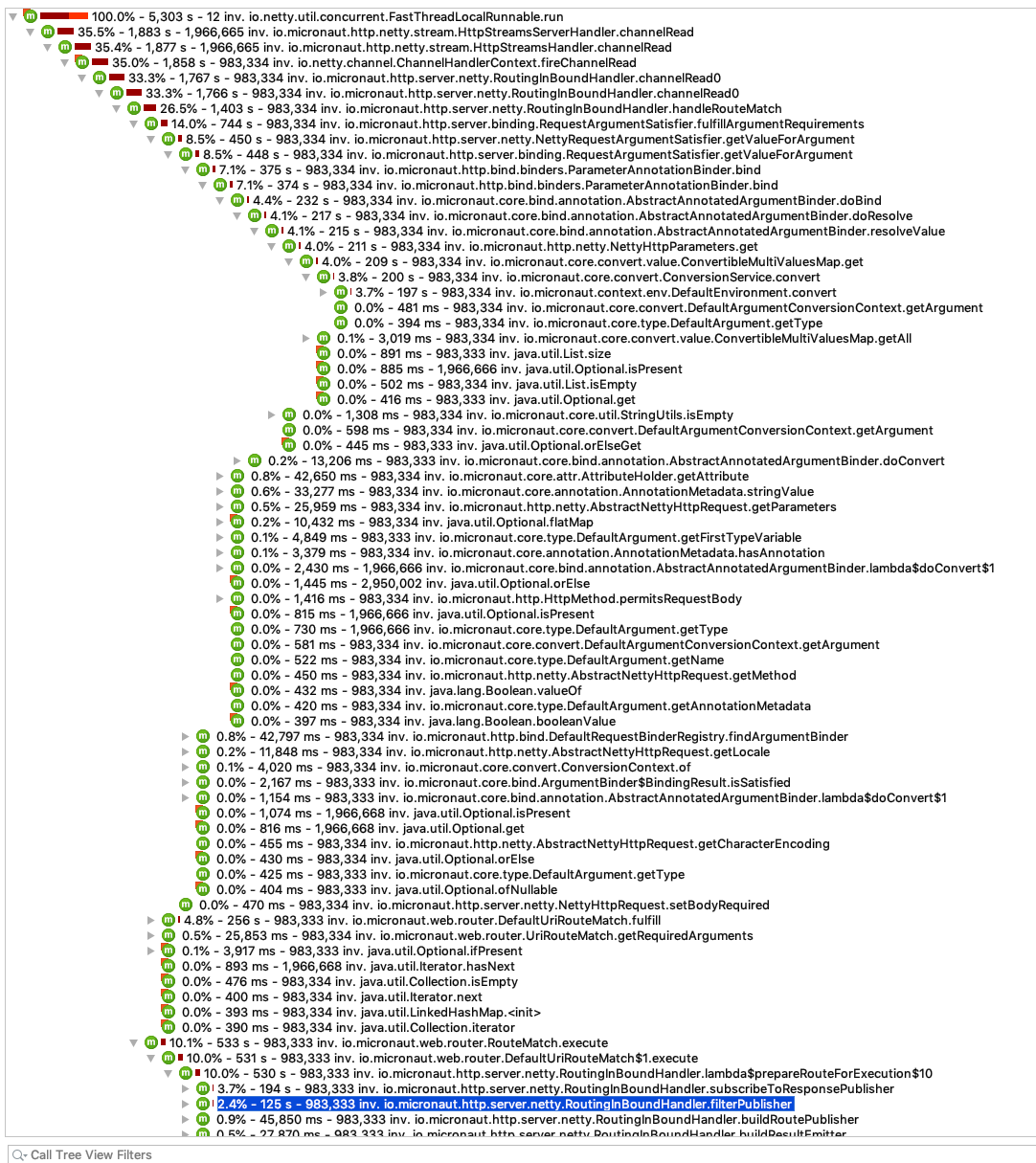
Jprofiler with full instrumentation shows:
- 36% of cpu time is spent in channelRead0 with:
- 26% spent in
handleRouteMatch
- 14% in
RequestArgumentSatisfier.fullfilArgumentRequirements - 10% in
RouteMatch.execute - 2% in
RoutingInBoundHandler.prepareRouteForExecution
- 14% in
- 3% spent in
AbstractNettyHttpRequest.getPath(2% fromgetContentType) - 2% spent in
findAllClosest
- 26% spent in
- 23% of cpu time spent in the ExecutorScheduler reactive call stack (see: https://github.com/micronaut-projects/micronaut-core/issues/2338)
This is just an example of course.
The real use case is that I am trying to upgrade a pure Netty app to Micronaut. The service is very lightweight: it only has a few GET endpoints and returns data cached in-memory. I am obviously expecting overhead from micronaut when "upgrading" from pure Netty, but CPU usage (more than) doubling (with a cpu distribution very similar to what presented here) isn't on my list of acceptable criteria.
Using micronaut 1.3.0.M1 & Oracle JDK 11.
 fabienrenaud
All 12 comments
fabienrenaud
on 25 Nov 2019
Any code change suggestions are welcome
 jameskleeh
on 26 Nov 2019
jameskleeh
on 26 Nov 2019
I wouldn't mind but this seems like a rather big change (no single hot function) and I don't have that kind of time on my hands to deep-dive into the project (unfortunately)... Detailed architecture docs would help understand how it is set up and why.
I also question the heavy utilization of streams for core functionalities in this project. In my experience, using streams over tiny collections does not perform well at scale.
fabienrenaud
on 26 Nov 2019
I agree on the fundamental usage of streaming. It is not meant to be a replacement over simple iterations especially on small collections and when data is already available.
 Klaus-Nji-sp
on 26 Nov 2019
Klaus-Nji-sp
on 26 Nov 2019
If there are any places where you think the usage of a stream can be replaced with iteration and it would not impact the readability or maintainability of the code and it can be determined that it is in part responsible for performance issues, please let me know so we can change it.
jameskleeh
on 26 Nov 2019
I will look at this when I get back next week. I have some ideas and it was an area on my todo list to optimize anyway
 graemerocher
on 27 Nov 2019
graemerocher
on 27 Nov 2019
Pretty small optimization, but just overridding the methods in EmptyAnnotationMetadata results in a 50% performance improvement for RequestArgumentSatisfier.fullfilArgumentRequirements
graemerocher
on 16 Dec 2019
With https://github.com/micronaut-projects/micronaut-core/commit/4c6ffe3a4d3bd30638067018d1cd14f17760a5e4 we're currently looking at a 125% performance improvement in RequestArgumentSatisfier.fullfilArgumentRequirements
graemerocher
on 16 Dec 2019
handleRouteMatch is no longer appearing as a hotspot, at least not in YourKit, so closing this for the moment. There are probably other areas we can improve, but those are separate issues
graemerocher
on 17 Dec 2019
@graemerocher What code did you use for your benchmark? Is the performance gain still there when the endpoint requires/accepts query parameters, headers or body of various types?
fabienrenaud
on 17 Dec 2019
graemerocher
on 17 Dec 2019
I upgraded to 1.3.0.M2 and run the same benchmark. This is the new call stack profile for handleRouteMatch:
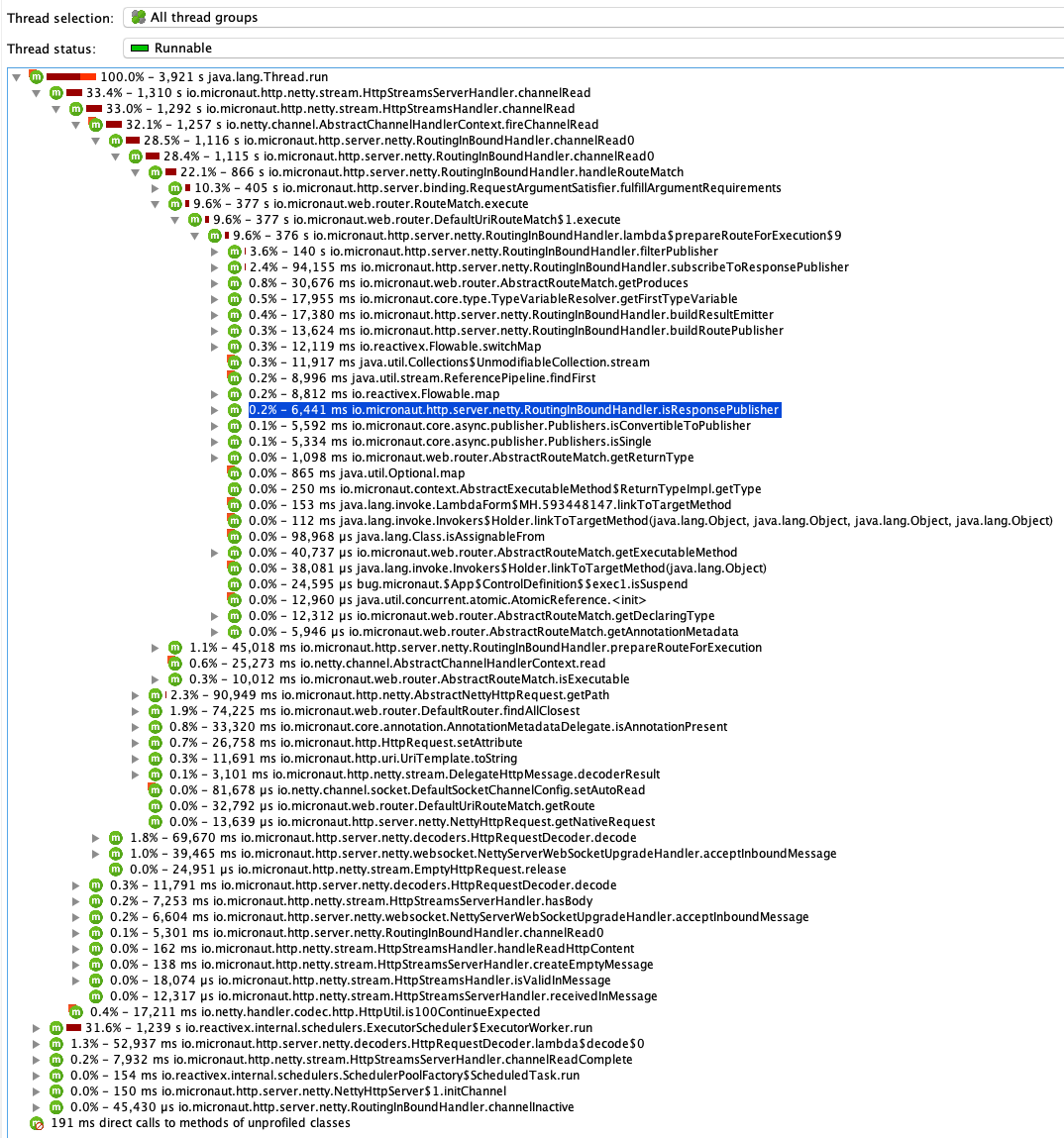
It seems slightly better but out of the 33% of cpu used in this call stack:
- 10% is still from
fulfillArgumentRequirements - 6% is from
filterPublisher+subscribeToResponsePublisher - 0.8% is from
getProduces - 0.5% is from
getFirstTypeVariable - 0.3% is from
stream - 0.2% is from
map - 0.3% is from
switchMap
etc.
BesidesfulfillArgumentRequirements, it seems there is a little bit of overhead everywhere...
fabienrenaud
on 24 Dec 2019
Related issues
 jisikoff
·
3Comments
jisikoff
·
3Comments
 davidkron
·
5Comments
davidkron
·
5Comments
 markjfisher
·
5Comments
markjfisher
·
5Comments
 Jhraumg
·
4Comments
Jhraumg
·
4Comments
 sdelamo
·
3Comments
sdelamo
·
3Comments
Most helpful comment
With https://github.com/micronaut-projects/micronaut-core/commit/4c6ffe3a4d3bd30638067018d1cd14f17760a5e4 we're currently looking at a 125% performance improvement in
RequestArgumentSatisfier.fullfilArgumentRequirements