Micronaut-core: Exception Trying To Get EmbeddedServerInstance
Task List
- [x] Steps to reproduce provided
- [x] Stacktrace (if present) provided
- [x] Example that reproduces the problem uploaded to Github
- [x] Full description of the issue provided (see below)
Steps to Reproduce
- Create a new application
- In a controller method, paste the code from the documentation located in the section titled "Using Cloud Instance Metadata" (https://docs.micronaut.io/latest/guide/index.html#cloudConfiguration)
The code in question inside my controller method:
@Get("/")
ConvertibleValues<String> index() {
    EmbeddedServerInstance embeddedServerInstance = applicationContext.getBean(EmbeddedServerInstance.class)
    return embeddedServerInstance.getMetadata()
}
- Run the app and invoke the controller method.
Expected Behaviour
The controller method should return the embedded server instance metadata.
Actual Behaviour
I receive an exception when trying to retrieve the EmbeddedServerInstance bean:
Unexpected error occurred: Error instantiating bean of type  [io.micronaut.http.server.netty.NettyEmbeddedServerInstance]

Message: Missing bean arguments for type: io.micronaut.http.server.netty.NettyEmbeddedServerInstance. Requires arguments: String id,NettyHttpServer nettyHttpServer

io.micronaut.context.exceptions.BeanInstantiationException: Error instantiating bean of type  [io.micronaut.http.server.netty.NettyEmbeddedServerInstance]

Message: Missing bean arguments for type: io.micronaut.http.server.netty.NettyEmbeddedServerInstance. Requires arguments: String id,NettyHttpServer nettyHttpServer

    at io.micronaut.context.DefaultBeanContext.doCreateBean(DefaultBeanContext.java:1441)
    at io.micronaut.context.DefaultBeanContext.getScopedBeanForDefinition(DefaultBeanContext.java:1895)
    at io.micronaut.context.DefaultBeanContext.getBeanForDefinition(DefaultBeanContext.java:1807)
    at io.micronaut.context.DefaultBeanContext.getBeanInternal(DefaultBeanContext.java:1785)
    at io.micronaut.context.DefaultBeanContext.getBean(DefaultBeanContext.java:561)
    at codes.recursive.compute.TestController.index(TestController.groovy:25)
    at codes.recursive.compute.$TestControllerDefinition$$exec1.invokeInternal(Unknown Source)
    at io.micronaut.context.AbstractExecutableMethod.invoke(AbstractExecutableMethod.java:144)
    at io.micronaut.context.DefaultBeanContext$BeanExecutionHandle.invoke(DefaultBeanContext.java:2618)
    at io.micronaut.web.router.AbstractRouteMatch.execute(AbstractRouteMatch.java:236)
    at io.micronaut.web.router.RouteMatch.execute(RouteMatch.java:122)
    at io.micronaut.http.server.netty.RoutingInBoundHandler.lambda$buildResultEmitter$16(RoutingInBoundHandler.java:1324)
    at io.reactivex.internal.operators.flowable.FlowableCreate.subscribeActual(FlowableCreate.java:71)
    at io.reactivex.Flowable.subscribe(Flowable.java:14805)
    at io.reactivex.Flowable.subscribe(Flowable.java:14752)
    at io.micronaut.reactive.rxjava2.RxInstrumentedFlowable.subscribeActual(RxInstrumentedFlowable.java:68)
    at io.reactivex.Flowable.subscribe(Flowable.java:14805)
    at io.reactivex.internal.operators.flowable.FlowableMap.subscribeActual(FlowableMap.java:37)
    at io.reactivex.Flowable.subscribe(Flowable.java:14805)
    at io.reactivex.Flowable.subscribe(Flowable.java:14752)
    at io.micronaut.reactive.rxjava2.RxInstrumentedFlowable.subscribeActual(RxInstrumentedFlowable.java:68)
    at io.reactivex.Flowable.subscribe(Flowable.java:14805)
    at io.reactivex.internal.operators.flowable.FlowableSwitchIfEmpty.subscribeActual(FlowableSwitchIfEmpty.java:32)
    at io.reactivex.Flowable.subscribe(Flowable.java:14805)
    at io.reactivex.Flowable.subscribe(Flowable.java:14752)
    at io.micronaut.reactive.rxjava2.RxInstrumentedFlowable.subscribeActual(RxInstrumentedFlowable.java:68)
    at io.reactivex.Flowable.subscribe(Flowable.java:14805)
    at io.reactivex.Flowable.subscribe(Flowable.java:14755)
    at io.micronaut.http.context.ServerRequestTracingPublisher.lambda$subscribe$0(ServerRequestTracingPublisher.java:52)
    at io.micronaut.http.context.ServerRequestContext.with(ServerRequestContext.java:52)
    at io.micronaut.http.context.ServerRequestTracingPublisher.subscribe(ServerRequestTracingPublisher.java:52)
    at io.reactivex.internal.operators.flowable.FlowableFromPublisher.subscribeActual(FlowableFromPublisher.java:29)
    at io.reactivex.Flowable.subscribe(Flowable.java:14805)
    at io.reactivex.Flowable.subscribe(Flowable.java:14752)
    at io.micronaut.reactive.rxjava2.RxInstrumentedFlowable.subscribeActual(RxInstrumentedFlowable.java:68)
    at io.reactivex.Flowable.subscribe(Flowable.java:14805)
    at io.reactivex.Flowable.subscribe(Flowable.java:14752)
    at io.reactivex.internal.operators.flowable.FlowableSubscribeOn$SubscribeOnSubscriber.run(FlowableSubscribeOn.java:82)
    at io.reactivex.internal.schedulers.ExecutorScheduler$ExecutorWorker$BooleanRunnable.run(ExecutorScheduler.java:288)
    at io.reactivex.internal.schedulers.ExecutorScheduler$ExecutorWorker.run(ExecutorScheduler.java:253)
    at java.base/java.util.concurrent.ThreadPoolExecutor.runWorker(ThreadPoolExecutor.java:1167)
    at java.base/java.util.concurrent.ThreadPoolExecutor$Worker.run(ThreadPoolExecutor.java:641)
    at java.base/java.lang.Thread.run(Thread.java:844)
Environment Information
- Operating System: MacOS High Sierra
- Micronaut Version: 1.1.0RC2
- JDK Version: 1.8.0_201
Example Application
 recursivecodes
All 5 comments
Additional info: I'd love to test this out so that I can (attempt) to contribute an OracleCloudComputeInstanceMetadata implementation to the project. :)
recursivecodes
on 11 Apr 2019
I'm not sure if the docs or implementation is incorrect, however you could still get the instance metadata.
You could listen for the ServiceStartedEvent in your controller and set a field on the controller.
@Controller
public class Controller {

    private ServiceInstance serviceInstance;

    @EventListener
    void onServiceStarted(ServiceStartedEvent event) {
        serviceInstance = event.getSource();
    }

}
 jameskleeh
on 12 Apr 2019
jameskleeh
on 12 Apr 2019
the documentation is incorrect, you currently need to use an event listener for this case.
 graemerocher
on 12 Apr 2019
graemerocher
on 12 Apr 2019
Thanks - I'll give that a shot.
recursivecodes
on 12 Apr 2019
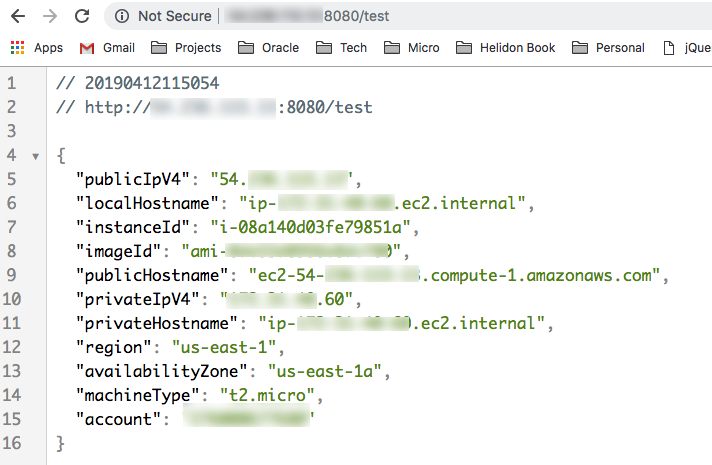
Follow up for anyone finding this via Google search:
Confirmed way to obtain metadata:
@CompileStatic
@Controller("/test")
class TestController {

    final static Logger logger = LoggerFactory.getLogger(TestController.class)
    private ServiceInstance serviceInstance

    @EventListener
    void onServiceStarted(ServiceStartedEvent event) {
        serviceInstance = event.getSource()
    }

    @Get("/")
    ConvertibleValues<String> index() {
        return serviceInstance.metadata
    }
}
Deployed to an Amazon EC2 instance results in:
recursivecodes
on 12 Apr 2019
Related issues
 Jhraumg
·
4Comments
Jhraumg
·
4Comments
 denbilyk
·
3Comments
denbilyk
·
3Comments
 akozel
·
3Comments
akozel
·
3Comments
 ggservice007
·
5Comments
ggservice007
·
5Comments
 johanhaleby
·
4Comments
johanhaleby
·
4Comments