Mask_rcnn: Improvement - Faster Training of Mask R-CNN by Focusing on Instance Boundaries
This is not an issue but rather a suggestion of improvement.
I saw the publication of a paper in September showing great improvements for Mask R-CNN performance called https://arxiv.org/abs/1809.07069. Besides accelerating the training process (29% faster according to the paper), it enables to have better edges and less false positves, and seems not to be complex to implement, starting from the implementation of Mask R-CNN.
Shall we add this as an improvement?
 Paulito-7
All 4 comments
@Paulito-7 I was reading the same paper a few days ago too. The idea sounds good. I hope someone adds this improvement.
 fastlater
on 3 Oct 2018
fastlater
on 3 Oct 2018
+1
 chengchu88
on 10 Oct 2018
chengchu88
on 10 Oct 2018
Our implementation is available here: https://github.com/FlashTek/mask-rcnn-edge-agreement-loss
We only had to make minor adjustments to the code, mainly here for the edge agreement loss and here to register it as an additional loss.
 JulienSiems
on 8 May 2019
JulienSiems
on 8 May 2019
Our implementation is available here: https://github.com/FlashTek/mask-rcnn-edge-agreement-loss
We only had to make minor adjustments to the code, mainly here for the edge agreement loss and here to register it as an additional loss.
How to config model.py for high accuracy boundaries ? you have example @JulienSiems
Now i try follow this link https://github.com/FlashTek/mask-rcnn-edge-agreement-loss but have bad boundaries like this
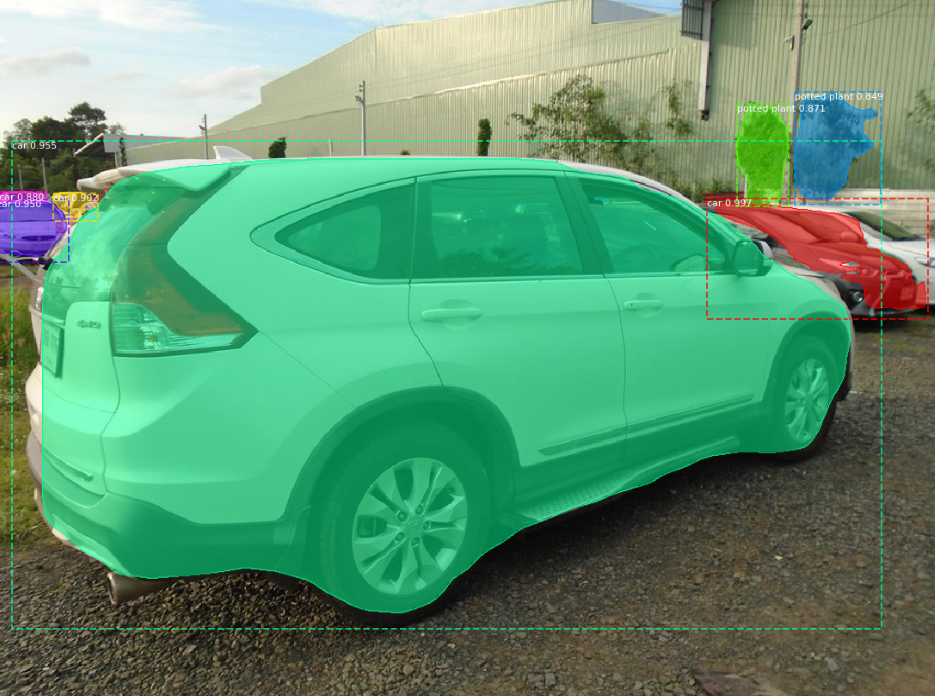
 nicejava
on 21 Apr 2020
nicejava
on 21 Apr 2020
Related issues
 aytackanaci
·
3Comments
aytackanaci
·
3Comments
 Mabinogiysk
·
3Comments
Mabinogiysk
·
3Comments
 techjjun
·
4Comments
techjjun
·
4Comments
 PaulChongPeng
·
4Comments
PaulChongPeng
·
4Comments
 LifeBeyondExpectations
·
4Comments
LifeBeyondExpectations
·
4Comments
Most helpful comment
Our implementation is available here: https://github.com/FlashTek/mask-rcnn-edge-agreement-loss
We only had to make minor adjustments to the code, mainly here for the edge agreement loss and here to register it as an additional loss.