Lnpopupcontroller: Best practices for using popupPresentationState
Description
This is simply a question about best practices using your library. I updated to library version 2.10.25 which updated the enum popupPresentationState. I successfully made the changes, but I have a question:
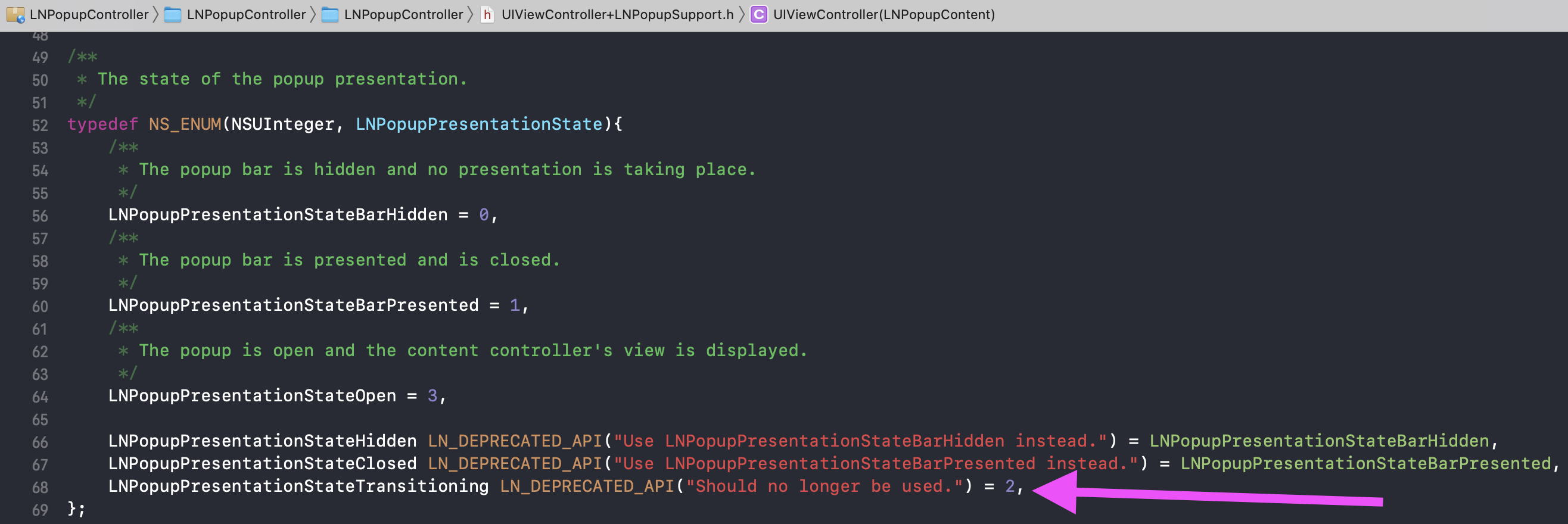
How should I handle the transitioning case? I want to make my switch statement exhaustive and in order to do so, the compiler adds transitioning. The problem is that this is now deprecated based on your docs. I could use default to cover this case, but I would prefer to use @unknown default. However, if I use @unknown default without adding transitioning then the compiler gives a warning Switch must be exhaustive.
Any thoughts on how to best handle this?
Example code of what I am doing (with comments for explanation):
func demoOfSwitchStatement() {
    switch tabBarController.popupPresentationState {
    case .open, .barPresented, .barHidden:
        // This is supported.
        break

    case .transitioning:
        // The docs state: "Should no longer be used." However, to make this switch exhaustive, I need to have it here.
        break

    @unknown default:
        // This is here to get rid of the compiler warning: "Switch covers known cases, but 'LNPopupPresentationState' may have additional unknown values:
        break
    }
}
Docs which show transitioning is deprecated:
Steps to Reproduce
Use a switch statement on the property popupPresentationState
Device, OS and Xcode Versions
Xcode 12.2
iOS 13 and iOS 14
LNPopupController 2.10.25
 johnswifttt
All 5 comments
Ufff 🤦♂️
Good question. I didn’t want to break existing API usage by removing that case, and it is actually used internally. But for the user-facing property, that transitioning case will never be seen. It’s used internally for in between cases. This was the only compromise I found.
I think you can also expect the enum to not change in the future, so a default statement is likely good enough. You can also use the delegate methods instead of relying on the enum; with KVO, the state changes should be equivalent to the delegate callbacks.
I will remove the deprecated APIs eventually. I had plans for a 3.0, with a major presentation revamp, but I doubt it will happen. So, we’ll see when an actual 3.0 hits.
 LeoNatan
on 6 Dec 2020
LeoNatan
on 6 Dec 2020
If you have suggestions how to hide this enum from the compiler, by some magic annotation, I’d happily add it. How does Apple do it for their own deprecated enum cases?
LeoNatan
on 6 Dec 2020
@LeoNatan I took some time to look at your question, but unfortunately don't know how Apple does it. Sorry I couldn't be of more help.
To move forward on this, I believe you said that a _default statement is likely good enough_. Is this ok then?
    func demoOfSwitchStatement() {
        switch tabBarController.popupPresentationState {
        case .open, .barPresented, .barHidden:
            // This is supported. Handle these cases.
            break
        default:
            // Don't need to handle right now since it is a placeholder for **transitioning** deprecated case.
            break
        }
    }
Please see comment above: // Don't need to handle right now since it is a placeholder for **transitioning** deprecated case.
johnswifttt
on 7 Dec 2020
Yes, looks good
LeoNatan
on 7 Dec 2020
got it, thank you!
johnswifttt
on 7 Dec 2020
Related issues
 nhatduong
·
7Comments
nhatduong
·
7Comments
 RajChanchal
·
3Comments
RajChanchal
·
3Comments
 funkenstrahlen
·
3Comments
funkenstrahlen
·
3Comments
 chauhan130
·
8Comments
johnswifttt
·
5Comments
chauhan130
·
8Comments
johnswifttt
·
5Comments
Most helpful comment
Yes, looks good