Lizardfs: bonnie++ meets LizardFS: drastic I/O error
Dear developers!
LizardFS is under evaluation on my machine. I have setup some VirtualBox VMs with the same settings:
RAM: 1024 MiB
SATA hard drive for OS: 8 GiB
SATA hard drive for distributed file system: 8 GiB
OS: CentOS 7
LizardFS version 3.12
Three chunkserver VMs are running. Each one has one dedicated 8 GiB hard drive
for storing chunk data. Master runs in its separate VM. When this setup is started, LizardFS reports free available storage space of 12 GiB. I don't know why 12 GiB but OK. Trashtime is disabled, i.e. zero.
When I invoke bonnie++ on a folder of the mounted LizardFS, bonnie++ fails:
Delete files in sequential order ... Bonnie: drastic I/O error (rmdir): Directory not empty
See attached screenshots for more details!
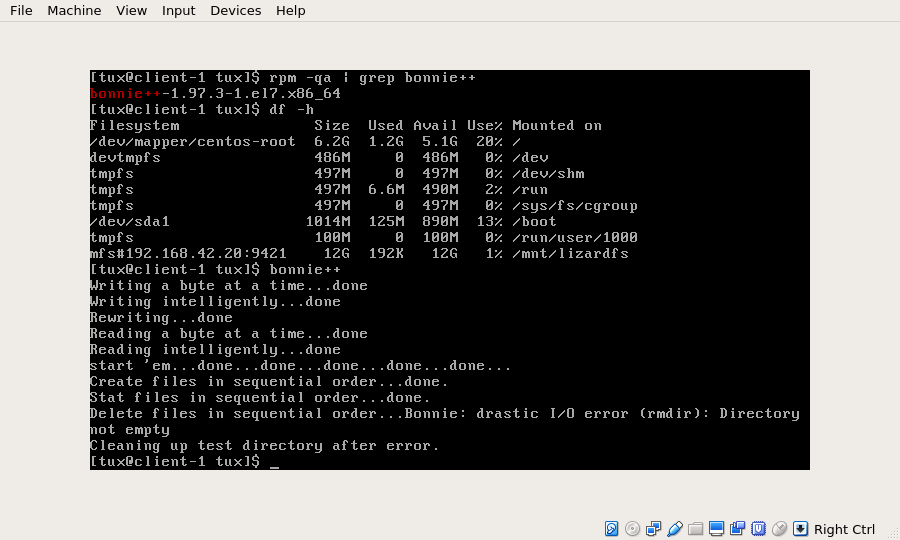

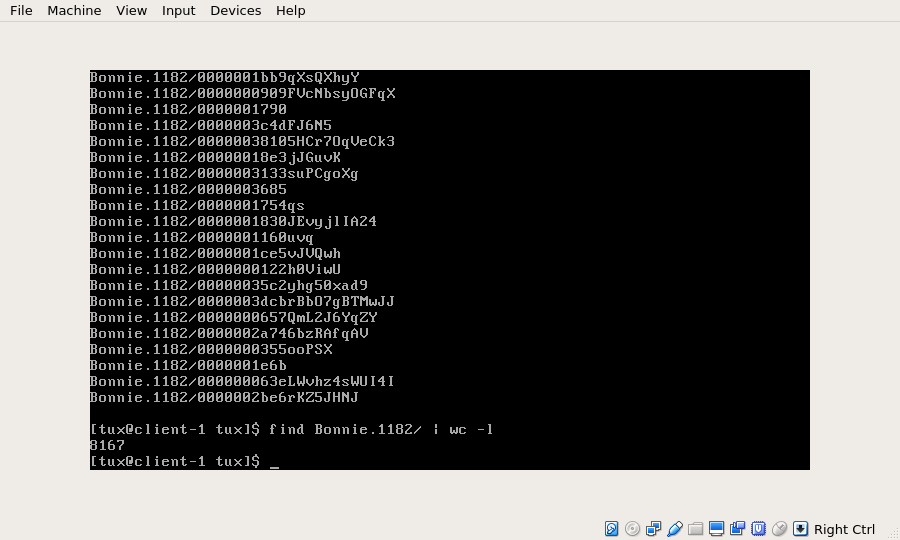
Do you have any idea what went wrong exactly? Are able to reproduce it?
Thank in advance again!
 greensquirrel
All 13 comments
Um, bonnie++ met LizardFS a long while ago and always worked fine. I just ran it on your setup though, and indeed I saw this rm error with non-empty directory on CentOS. I'll check it out soon.
Still, can you try changing some mount options related to metadata caching and see if your problem disappears? By some options I mean these:
~
-o mfsattrcacheto=SEC set attributes cache timeout in seconds (default: 1.00)
-o mfsentrycacheto=SEC set file entry cache timeout in seconds (default: 0.00)
-o mfsdirentrycacheto=SEC set directory entry cache timeout in seconds (default: 0.25)
-o mfsdirentrycachesize=N define directory entry cache size in number of entries (default: 100000)
~
 psarna
on 8 Feb 2018
psarna
on 8 Feb 2018
None of those parameters make any difference. Problem is easily reproducible by deleting few thousand files from directory...
 onlyjob
on 10 Mar 2018
onlyjob
on 10 Mar 2018
Any progress here? This is not an abstract issue - quite often I have to retry deletion due to errors during removal of git repositories, etc.
onlyjob
on 2 Aug 2018
No improvement in 3.13.0~rc1...
onlyjob
on 27 Aug 2018
FUSE3 client is affected...
onlyjob
on 11 Nov 2018
Hey. I reproduced your problem and also made some interesting observations about the bug bonnie++ stumbled upon in LizardFS. strace was very helpfull here.
As @onlyjob previously mentioned mfsmount parameters for disabling cache do not make any difference.
Minimal reproduction steps using bonnie++:
bonnie++ -s 0 -n 1
-s 0 disables writing-rewriting-reading benchmark which does not participate in the error,
-n 1 tells bonnie to operate on 1024 files (instead of default 16 * 1024) in the create-stat-unlink benchmark, which is of interest here.
The "drastic I/O" error arises in the delete(unlink) sequentially phase of the create-stat-unlink benchmark, which in short looks like this:
while (files = readdir(testdir)):
  for each (file in files):
    unlink(file)
chdir(..)
rmdir(testdir)
and it's not present in the delete randomly phase (I commented-out the sequential-ops code in bonnie++ to check that):
for each (file in file_list):
  unlink(file)
chdir(..)
rmdir(testdir)
which does not use file listing via readdir function. Instead it loops over all the filenames held in a collection maintained by bonnie++.
It means that Lizard's readdir() tells there are no more files in the test directory, when in fact there are. So the loop exits prematurely, leaving unlisted files not deleted.
The stat sequentially phase looks the same - the only difference being stat() call instead of unlink(), and in this case readdir() lists all the files correctly.
Thus I think the implementation of Lizardfs's readdir and/or unlink operation(s) (invoked by FUSE) can be at fault here.
This bug may resemble the "delete items while iterating over a collection with element-auto-rearrange" implementation problem (that's my guess at the moment).
An interesting insight here is that this delete sequentially phase deletes roughly 50% of files each time (tested for 1024 and 16*1024 files as for now).
I'll keep you updated on progress in this issue.
About those 8167 files left in the test directory after benchmark from the third @greensquirrel's screenshot:
There is a minor bug in bonnie++ (version 1.98) - after failing the unlink stage (see pseudocode above) it does not chdir back into the testdir to delete all the (remaining) files "by hand", so it performs the unlink+rmdir one directory level in the filesystem tree above the testdir.
After adding the missing chdir bonnie++ cleans up properly after failed unlink benchmark.
I already notified the creator of bonnie++ about it ;)
 Peperzastey
on 26 Aug 2019
Peperzastey
on 26 Aug 2019
quite often I have to retry deletion due to errors during removal of git repositories, etc.
Problem is easily reproducible by deleting few thousand files from directory...
@onlyjob what commands did you use to delete the files?
I don't see any problem when using rm / rm -r (which, on a side note, works in a similar fashion to the second pseudocode from my previous comment)
Peperzastey
on 28 Aug 2019
Just delete a large folder from mc. git is also unhappy with removing files on large repositories.
We have seen random failures with partially removed leftover work directories when building various software from source.
onlyjob
on 29 Aug 2019
I can confirm the problems with directory deleting using mc. This issue is virtually the same as with bonnie++ - both delete roughly 50% of the files in the directory provided that this dir is large enough.
"Large enough" technically: when the number of directory entries (dirents, e.g. files) is greater than the number of entries fetched at once by calling Lizard's readdir() registered handler (called by FUSE).
mc deletion failure is really easy to reproduce:
- create some folder with N files named 0..N-1 within it (any N greater than 128 should be enough - but that may depend on your specific platform and OS)
- try to delete this folder using
mc- should fail leaving some files undeleted (ca.50% of them when the number of files is an even multiple of ~128 or simply is much larger than 128)
I haven't yet managed to reproduce this error using git but I'll look further into it after the weekend. I'm expecting to see 50% of successful removals here as well ;)
I have, however, found the part of code causing this trouble. The problem lies in the __master__, in iteration by index over direntries when interleaving readdir() and unlink() operations (only in this scenario this iteration is defective). Client's readdir() implementation expects this index (off parameter in the libfuse docs) to uniquely determine the dirent to return, but the master implementation changes indices of dirents XYZ when other dirents in the same directory stream _before_ those XYZ dirents are deleted from this directory. The first not-deleted dirent will have the index of 0 after this operation, when the client expects it to have index e.g. 128.
For more implementation details one may look at the data structures holding dirents.
Thus each subsequent readdir() call after an unlink() skips some entries - roughly the number of entries deleted in this unlink, and skips every second bundle of them (bundle fetched from readdir()). Which gives us, in fact, (about) 50% of expected file deletions; ta-dah!
Note that the first unlink() must also happen after a readdir() - so that the next direntry index we want to read after having read whole first dirent bundle is greater than 0.
This bug is not connected to the DirEntryCache.
__TL;DR:__ I found the cause of this bug ;)
I started working on a fix. I'll post here on updates.
Peperzastey
on 30 Aug 2019
Update on the issue
I have already come up with a couple of possible solutions and have planned to test and compare them "in the real code" to choose one offering best performance and(/or) smallest memory consumption - both of which are important for code run on a master machine.
It may take a week or two before we push the fix into master (git branch) as we want to make sure it doesn't lower master and client performance more than is necessary for them to work correctly and doesn't break anything else.
Short, much less technical issue description:
The problem with "holey" dirent iteration stems from the lack of a true dirent index on master. This index is currently created artificially (in the easiest way possible, which is fine) and becomes inconsistent when the dirent container is modified during iteration over it. At this point, the dirent indices on master and client stop matching and we get holes in iteration.
For read-only directory operations the present approach works fine, and also is very efficient, as there is no need to store any extra data.
So, as you might have guessed, the solution is all about introducing dirent indexing consistent on both client and master that will keep the code as much performant as possible.
Peperzastey
on 10 Sep 2019
Update
We have 2 working Proof of Concepts that we are currently improving and testing on edge cases.
The first one is about creating a dirent_index -> dirent mapping beside the already existing filename_handle -> dirent mapping. The drawbacks of this solution are that it will increase the size of the directory nodes nearly 2 times (by having to store and maintain two mappings instead of just one) and it requires some additional data to be synchronized between master and shadows and to be stored and restored to/from the metadata.mfs file (which will additionally require conversion from old to updated metadata store format on all master/shadow machines in all Lizard installations).
Its advantage is that it doesn't suffer from the drawback of the second PoC.
The second PoC is about treating filename_handle (the key of the already existent mapping in directory nodes) as the dirent index. These values are unique for each dirent so everything is fine and great. But they are not preserved on master restart / switch-to-shadow, and there is really no way to make them stay the same as they depend on external implementations.
This issue is problematic in scenarios when there is an open directory stream (some program operating on mounted LizardFS is between opendir() and closedir() calls in its execution) AND a master failure (restart/switch-to-shadow) occurs AND there is a call to readdir() after the master is restored AND this call doesn't result in any dirent already cached by the FUSE kernel module. Under these circumstances the readdir() call may tell the program that it reached the end of directory (already enumerated all files in this directory) when, in fact, there are some more files to enumerate.
It's only an extreme edge case. But then again, there is no way to ensure that it won't happen - for example, there may be an ongoing long-running directory scan in the background when master fails and restores.
We are now trying to mitigate this drawback.
This PoC is much more promising than the first one, as it requires only minimal changes in code, doesn't change the metadata.mfs format and doesn't incur much additional overhead, so we are focusing on improving this one.
Peperzastey
on 25 Sep 2019
Thanks, @Peperzastey.
onlyjob
on 31 Oct 2019
No problem. Glad I could help.
Peperzastey
on 31 Oct 2019
Related issues
 eleaner
·
8Comments
onlyjob
·
4Comments
eleaner
·
8Comments
onlyjob
·
4Comments
 biocyberman
·
4Comments
onlyjob
·
13Comments
biocyberman
·
4Comments
onlyjob
·
13Comments
 mcassaniti
·
7Comments
mcassaniti
·
7Comments
Most helpful comment
Update on the issue
I have already come up with a couple of possible solutions and have planned to test and compare them "in the real code" to choose one offering best performance and(/or) smallest memory consumption - both of which are important for code run on a master machine.
It may take a week or two before we push the fix into master (git branch) as we want to make sure it doesn't lower master and client performance more than is necessary for them to work correctly and doesn't break anything else.
Short, much less technical issue description:
The problem with "holey" dirent iteration stems from the lack of a true dirent index on master. This index is currently created artificially (in the easiest way possible, which is fine) and becomes inconsistent when the dirent container is modified during iteration over it. At this point, the dirent indices on master and client stop matching and we get holes in iteration.
For read-only directory operations the present approach works fine, and also is very efficient, as there is no need to store any extra data.
So, as you might have guessed, the solution is all about introducing dirent indexing consistent on both client and master that will keep the code as much performant as possible.