Lexikjwtauthenticationbundle: 401 JWT Token not found
Hello everyone, I need a help.
I will be very happy if someone helps me, because I am already on my second day over this problem.
Thanks a lot.
I provided two versions of the security.yaml file. The second version according to API Platform documentation. API Platform sends to the creation a custom user provider. For the second option security.yaml recommended at API Platform docs, need to create two additional files, I did not attach them to the topic, but if necessary, attach.
But I think that problem it is in JWT.
Environment:
- node v8.9.4
- chrome 64.0.3282.119
- Ubuntu 16.04
- axios version: 0.16.2
- Vue.js 2.4.2
- vue-axios 2.0.2
- api-platform/api-pack: 1.0
- Symfony 4.0.4
User.php
-
<?php

namespace App\Entity;

use Doctrine\ORM\Mapping as ORM;
use Symfony\Component\Security\Core\User\UserInterface;

/**
 * @ORM\Table(name="app_users")
 * @ORM\Entity(repositoryClass="App\Repository\UserRepository")
 */
class User implements UserInterface, \Serializable
{
    /**
     * @ORM\Column(type="integer")
     * @ORM\Id
     * @ORM\GeneratedValue(strategy="AUTO")
     */
    private $id;

    /**
     * @ORM\Column(type="string", length=25, unique=true)
     */
    private $username;

    /**
     * @ORM\Column(type="string", length=64)
     */
    private $password;

    /**
     * @ORM\Column(type="string", length=60, unique=true)
     */
    private $email;

    /**
     * @ORM\Column(name="is_active", type="boolean")
     */
    private $isActive;

    public function __construct() // add $username
    {
        $this->isActive = true;
    }

    public function getUsername()
    {
        return $this->username;
    }

    public function getSalt()
    {
        // you *may* need a real salt depending on your encoder
        // see section on salt below
        return null;
    }

    public function getPassword()
    {
        return $this->password;
    }

    public function getRoles()
    {
        return array('ROLE_ADMIN');
    }

    public function eraseCredentials()
    {
    }

    /** @see \Serializable::serialize() */
    public function serialize()
    {
        return serialize(array(
            $this->id,
            $this->username,
            $this->password,
            // see section on salt below
            // $this->salt,
        ));
    }

    /** @see \Serializable::unserialize() */
    public function unserialize($serialized)
    {
        list (
            $this->id,
            $this->username,
            $this->password,
            // see section on salt below
            // $this->salt
        ) = unserialize($serialized);
    }
}
First option security.yaml
-
security:

    encoders:
        App\Entity\User:
            algorithm: bcrypt

    providers:

        our_db_provider:
            entity:
                class: App\Entity\User
                property: username

    firewalls:
        dev:
            pattern: ^/(_(profiler|wdt)|css|images|js)/
            security: false

        login:
            pattern:  ^/api/login
            stateless: true
            anonymous: true
            form_login:
                check_path:               /api/login_check
                success_handler:          lexik_jwt_authentication.handler.authentication_success
                failure_handler:          lexik_jwt_authentication.handler.authentication_failure
                require_previous_session: false

        api:
            pattern:   ^/api
            stateless: true
            provider: our_db_provider
            guard:
                authenticators:
                    - lexik_jwt_authentication.jwt_token_authenticator

    access_control:
        - { path: ^/admin, roles: ROLE_ADMIN }
        - { path: ^/api/login, roles: IS_AUTHENTICATED_ANONYMOUSLY }
        - { path: ^/api,       roles: IS_AUTHENTICATED_FULLY }
Second option security.yaml
-
security:

    encoders:
        App\Entity\User:
            algorithm: bcrypt

        App\Security\User\WebserviceUser: bcrypt

    providers:

        our_db_provider:
            entity:
                class: App\Entity\User
                property: username

        webservice:
            id: App\Security\User\WebserviceUserProvider

    firewalls:
        dev:
            pattern: ^/(_(profiler|wdt)|css|images|js)/
            security: false

        login:
            pattern:  ^/api/login
            stateless: true
            anonymous: true
            provider: webservice
            form_login:
                check_path:               /api/login_check
                success_handler:          lexik_jwt_authentication.handler.authentication_success
                failure_handler:          lexik_jwt_authentication.handler.authentication_failure
                require_previous_session: false

        api:
            pattern:   ^/api
            stateless: true
            provider: our_db_provider
            guard:
                authenticators:
                    - lexik_jwt_authentication.jwt_token_authenticator
    access_control:
        - { path: ^/admin, roles: ROLE_ADMIN }
        - { path: ^/api/login, roles: IS_AUTHENTICATED_ANONYMOUSLY }
        - { path: ^/api,       roles: IS_AUTHENTICATED_FULLY }
Headers
-
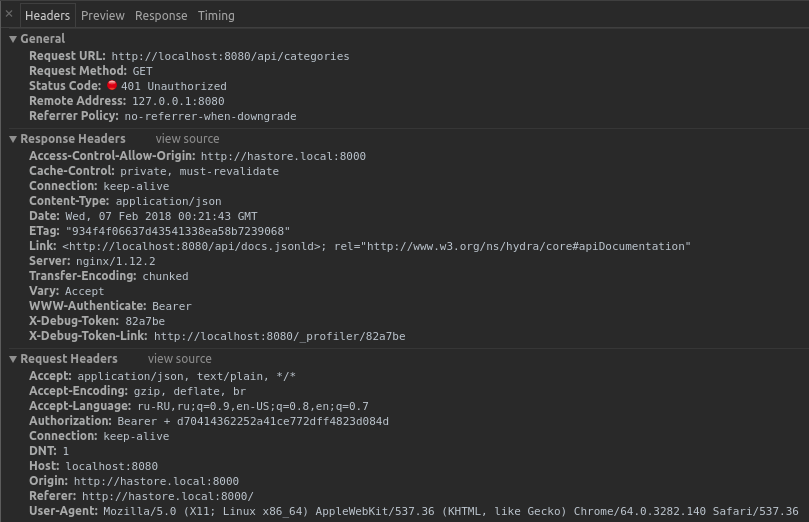
curl
-

In browser
-
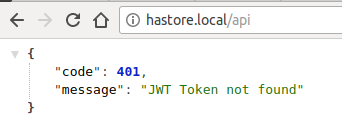
.env
-
###> lexik/jwt-authentication-bundle ###
# Key paths should be relative to the project directory
JWT_PRIVATE_KEY_PATH=var/jwt/private.pem
JWT_PUBLIC_KEY_PATH=var/jwt/public.pem
JWT_PASSPHRASE=d70414362252a41ce772dff4823d084d
###< lexik/jwt-authentication-bundle ###
lexik_jwt_authentication.yaml
-
lexik_jwt_authentication:
    private_key_path: '%kernel.project_dir%/%env(JWT_PRIVATE_KEY_PATH)%'
    public_key_path:  '%kernel.project_dir%/%env(JWT_PUBLIC_KEY_PATH)%'
    pass_phrase:      '%env(JWT_PASSPHRASE)%'
 reducio
All 4 comments
Solution:
reducio
on 9 Feb 2018
Closing as solved :)
 chalasr
on 10 Feb 2018
chalasr
on 10 Feb 2018
Solution "JWT Token not found" in Symfony 4
Error
{"code":401,"message":"JWT Token not found"}
Solution
Implement HTTP_AUTHORIZATION code in the path {projectSymfony}/public/.htaccess
RewriteCond %{HTTP:Authorization} .
RewriteRule ^ - [E=HTTP_AUTHORIZATION:%{HTTP:Authorization}]
Document complete .htaccess
# Use the front controller as index file. It serves as a fallback solution when
# every other rewrite/redirect fails (e.g. in an aliased environment without
# mod_rewrite). Additionally, this reduces the matching process for the
# start page (path "/") because otherwise Apache will apply the rewriting rules
# to each configured DirectoryIndex file (e.g. index.php, index.html, index.pl).
DirectoryIndex index.php

# By default, Apache does not evaluate symbolic links if you did not enable this
# feature in your server configuration. Uncomment the following line if you
# install assets as symlinks or if you experience problems related to symlinks
# when compiling LESS/Sass/CoffeScript assets.
# Options FollowSymlinks

# Disabling MultiViews prevents unwanted negotiation, e.g. "/index" should not resolve
# to the front controller "/index.php" but be rewritten to "/index.php/index".
<IfModule mod_negotiation.c>
    Options -MultiViews
</IfModule>

<IfModule mod_rewrite.c>
    RewriteEngine On

    # Determine the RewriteBase automatically and set it as environment variable.
    # If you are using Apache aliases to do mass virtual hosting or installed the
    # project in a subdirectory, the base path will be prepended to allow proper
    # resolution of the index.php file and to redirect to the correct URI. It will
    # work in environments without path prefix as well, providing a safe, one-size
    # fits all solution. But as you do not need it in this case, you can comment
    # the following 2 lines to eliminate the overhead.
    RewriteCond %{REQUEST_URI}::$1 ^(/.+)/(.*)::\2$
    RewriteRule ^(.*) - [E=BASE:%1]

    # Sets the HTTP_AUTHORIZATION header removed by Apache
    RewriteCond %{HTTP:Authorization} .
    RewriteRule ^ - [E=HTTP_AUTHORIZATION:%{HTTP:Authorization}]

    # Redirect to URI without front controller to prevent duplicate content
    # (with and without `/index.php`). Only do this redirect on the initial
    # rewrite by Apache and not on subsequent cycles. Otherwise we would get an
    # endless redirect loop (request -> rewrite to front controller ->
    # redirect -> request -> ...).
    # So in case you get a "too many redirects" error or you always get redirected
    # to the start page because your Apache does not expose the REDIRECT_STATUS
    # environment variable, you have 2 choices:
    # - disable this feature by commenting the following 2 lines or
    # - use Apache >= 2.3.9 and replace all L flags by END flags and remove the
    #   following RewriteCond (best solution)
    RewriteCond %{ENV:REDIRECT_STATUS} ^$
    RewriteRule ^index\.php(?:/(.*)|$) %{ENV:BASE}/$1 [R=301,L]

    # If the requested filename exists, simply serve it.
    # We only want to let Apache serve files and not directories.
    RewriteCond %{REQUEST_FILENAME} -f
    RewriteRule ^ - [L]

    # Rewrite all other queries to the front controller.
    RewriteRule ^ %{ENV:BASE}/index.php [L]
</IfModule>

<IfModule !mod_rewrite.c>
    <IfModule mod_alias.c>
        # When mod_rewrite is not available, we instruct a temporary redirect of
        # the start page to the front controller explicitly so that the website
        # and the generated links can still be used.
        RedirectMatch 307 ^/$ /index.php/
        # RedirectTemp cannot be used instead
    </IfModule>
</IfModule>
Document {projectSymfony}/config/packages/security.yaml
security:
    encoders:
        # ...
        usuarios:
            class: App\Entity\Usuarios
            algorithm: plaintext

    providers:
        # ...
        usuario:
            entity:
                class: App\Entity\Usuarios
                property: usuario

    firewalls:
        # ...
        login:
            pattern:  ^/api/login
            stateless: true
            anonymous: true
            provider: usuario
            form_login:
                check_path:               /api/login_check
                success_handler:          lexik_jwt_authentication.handler.authentication_success
                failure_handler:          lexik_jwt_authentication.handler.authentication_failure
                require_previous_session: false
        api:
            pattern:   ^/api
            stateless: true
            anonymous: false
            provider: usuario
            guard:
                authenticators:
                    - lexik_jwt_authentication.jwt_token_authenticator

    access_control:
        # ...
        - { path: ^/api/login_check,        roles: IS_AUTHENTICATED_ANONYMOUSLY }
        - { path: ^/api/login,              roles: IS_AUTHENTICATED_ANONYMOUSLY }
        - { path: ^/api,                    roles: IS_AUTHENTICATED_FULLY }
Document {projectSymfony}/config/packages/lexik_jwt_authentication.yaml
lexik_jwt_authentication:
    secret_key: '%env(resolve:JWT_SECRET_KEY)%'
    public_key: '%env(resolve:JWT_PUBLIC_KEY)%'
    pass_phrase: '%env(JWT_PASSPHRASE)%'
    token_ttl: '%env(JWT_TOKENTTL)%'
    # token encoding/decoding settings
    encoder:
        # token encoder/decoder service - default implementation based on the lcobucci/jwt library
        service:            lexik_jwt_authentication.encoder.lcobucci

        # encryption algorithm used by the encoder service
        signature_algorithm: RS256

    # token extraction settings
    token_extractors:
        # look for a token as Authorization Header
        authorization_header:
            enabled: true
            prefix:  Bearer
            name:    Authorization
        # check token in a cookie
        cookie:
            enabled: false
            name:    BEARER

        # check token in query string parameter
        query_parameter:
            enabled: false
            name:    bearer
Add in document {projectSymfony}/.env
###> lexik/jwt-authentication-bundle ###
JWT_SECRET_KEY=%kernel.project_dir%/config/jwt/private.pem
JWT_PUBLIC_KEY=%kernel.project_dir%/config/jwt/public.pem
JWT_PASSPHRASE='your_secret_passphrase'
JWT_TOKENTTL=3600
###< lexik/jwt-authentication-bundle ###
Guie Basic Implementation JWT
https://www.franciscougalde.com/2018/02/19/como-construir-un-restful-api-con-symfony-4-jwt-parte-1/
https://www.franciscougalde.com/2018/02/19/construir-restful-api-symfony-4-jwt-parte-2/
https://www.franciscougalde.com/2018/02/19/construir-restful-api-symfony-4-jwt-parte-3/
Note
Thanks ;)
 stivenbr
on 30 Nov 2018
stivenbr
on 30 Nov 2018
I had this error for a very different reason.
It looks like Symfony throws a BadCredentialsException when you try to encode a very large password. And this bundle converts any BadCredentialsException into a MissingTokenException ("JWT Token not found" ) with a 401 response.
So I fixed it by validating the password length before trying to create a new User.
 MarkEhr
on 8 Aug 2020
MarkEhr
on 8 Aug 2020
Related issues
 astronati
·
5Comments
astronati
·
5Comments
 ghost
·
5Comments
ghost
·
5Comments
 evaldoprestes
·
3Comments
evaldoprestes
·
3Comments
 tahina4
·
4Comments
tahina4
·
4Comments
 kamran-jabbar
·
4Comments
kamran-jabbar
·
4Comments
Most helpful comment
Solution "JWT Token not found" in Symfony 4
Error
{"code":401,"message":"JWT Token not found"}Solution
Implement
HTTP_AUTHORIZATIONcode in the path{projectSymfony}/public/.htaccessDocument complete
.htaccessDocument
{projectSymfony}/config/packages/security.yamlDocument
{projectSymfony}/config/packages/lexik_jwt_authentication.yamlAdd in document
{projectSymfony}/.envGuie Basic Implementation JWT
https://www.franciscougalde.com/2018/02/19/como-construir-un-restful-api-con-symfony-4-jwt-parte-1/
https://www.franciscougalde.com/2018/02/19/construir-restful-api-symfony-4-jwt-parte-2/
https://www.franciscougalde.com/2018/02/19/construir-restful-api-symfony-4-jwt-parte-3/
Note
Thanks ;)