Lemmy: [Minor UI Tweak] Use consistent syntax for displaying users and communities
Is your proposal related to a problem?
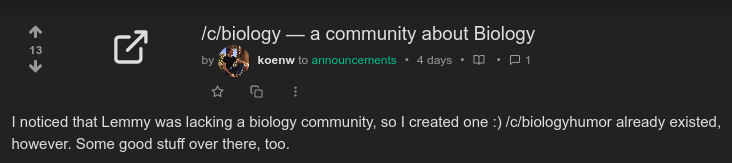
Lemmy currently does a poor job communicating that the proper convention for linking to a community is [email protected]. Users often assume that the proper convention is /c/community.
Describe the solution you'd like
Simply, wherever a user or community is displayed in the UI, they should be prefixed with a ! and a @ respectively.

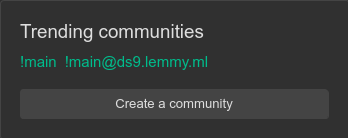
The most common argument I see against of this approach concerns aesthetics. In my personal opinion, however, the screenshots above don't look half bad at all. Even if you think that it looks subjectively worse, this does not outweigh the objective benefits that it provides to the user—the added clarity for users.
A common argument I see for using ! at all to refer to communities is that this syntax is unnatural for users. However, with this tweak, ! on Lemmy will become as intuitive as r/ on Reddit or @ on Mastodon.
Additional context
Reddit consitently prefixes subreddits with r/, and users with u/ in its UI.

 kolgza
All 10 comments
Not a fan of the reddit UI in general, but my fav looking mobile app, boost, does it like this:

I don't want to use /u/ or /c/ in the UI really at all, only for urls. The @ and ! aren't too necessary when you have posted to X by X, and they're confusing looking at first glance for post-listings.
I also have user names a different font-weight, and communities as the bootstrap primary color, so they're already standing out that way.
 dessalines
on 18 Jul 2020
dessalines
on 18 Jul 2020
Reddit uses these prefixes to enable a user to easily discern if it's a community, a user or a random hyperlink. It's actually really user friendly.
Like, did archlinux post this to akerro? Archlinux has an avatar and comes first. You can't assume a user knows.
But I agree that putting ! in front of a community name is just weird. It looks like a templating error or something and @ is used for mentioning a user, so that doesn't really apply either.
Another nitpick. Lemmy's usage of time notation is a weird mix between verbose like reddit and abbreviated.


a day, what? While reddit writes it out in full. I'd say choose either '3 hours ago' or 3hr, 1d, 1m, 2y and use it consistently.
 Datdus
on 18 Jul 2020
Datdus
on 18 Jul 2020
The
@and!aren't too necessary when you haveposted to X by X
It's true that the @ and ! would be redundant, but that's the entire point of adding them.
Prefixing communities and users with @ and ! would not make it any easier to identifying communities and users. However, by putting @ and ! in this context, you are communicating to them the convention for referring to users and communities.
You would be telling them that typing ! in a comment/body will return a list of communities to autocomplete to, without having to refer them to the guide page in the docs.
kolgza
on 18 Jul 2020
I agree, its not as clear as what Lemmy is currently doing, which is why I include the by and to:

When we add community icons as well, it will stay clear.
3hr, 1d, 1m, 2y and use it consistently.
That's an english only shortening, that doesn't exist for most languages, at least with moment.js, and we have to import a LOT of time locales. I took off the ago, because it overflowed a lot on mobile.
dessalines
on 18 Jul 2020
In other words, for post listings:
by user to community(what Lemmy currently uses) communicates who posted where, but fails to communicate what the correct syntax is.@user • !community(vaguely what Reddit uses) makes it somewhat ambiguous at first glance which is the community, and which is the user.by @user to !communitycommunicates both who posted where, and what the correct syntax is.
kolgza
on 18 Jul 2020
I agree. But I far prefer 1 to 3, mainly because I don't see a reason why autocomplete syntax has to exactly match up how things are visually represented on the site.
dessalines
on 18 Jul 2020
It's better to teach users the autocomplete syntax without them having to look it up. 3 does this, but 1 does not.
kolgza
on 18 Jul 2020
I agree with this proposal, using @user and !community everywhere would make things much easier to understand for new users. Federation is already complicated enough, so we shouldnt complicate it more. In fact, @dessalines I dont see any reason why you dislike this proposal, except personal preference.
 Nutomic
on 20 Jul 2020
Nutomic
on 20 Jul 2020
I don't want to use
/u/or/c/in the UI really at all, only for urls.
Currently, Lemmy still uses this scheme both in the page titles for communities, and in the user pages:


kolgza
on 23 Jul 2020
This is done.
dessalines
on 22 Sep 2020
Related issues
Nutomic
·
5Comments
dessalines
·
6Comments
 shirshak55
·
5Comments
shirshak55
·
5Comments
 marek-lach
·
6Comments
Nutomic
·
4Comments
marek-lach
·
6Comments
Nutomic
·
4Comments