Ldaprecord-laravel: [Support] Route Model Binding and Pagination ala Laravel
Hi @stevebauman, are that possible to add route model binding feature in Laravel to LDAPRecord and add pagination via Collection API that Laravel has?
So far, for handling pagination I convert LDAPRecord model to collection and install spatie/laravel-collection-macros to call paginate method.
 satyakresna
All 12 comments
Hi @satyakresna! Another great question.
I believe you should be able to accomplish this by creating your own LdapRecord model and adding the getRouteKey() and resolveRouteBinding() method:
namespace App\Ldap;

use LdapRecord\Models\ActiveDirectory\User as BaseUser;

class User extends BaseUser
{
    public function getRouteKey()
    {
        return $this->getObjectGuid();
    }

    public function resolveRouteBinding($value, $field = null)
    {
        return $this->findByGuid($value);
    }
}
Then, in your Laravel controllers/routes, it should be resolved through type-hints when you supply the users Object GUID as a URL parameter:
use App\Ldap\User;

Route::get('/ldap/users/{user}', function (User $user) {
    // ...
});
Can you give that a shot?
 stevebauman
on 22 Apr 2021
stevebauman
on 22 Apr 2021
Hi @stevebauman, I try and it looks like the another values like uid, givenname, cn, mail, etc don't appear when I run dd($user).
Here are my codes:
Web Route
<?php
Route::get('/users/{user}/edit', [UserController::class, 'edit'])->name('users.edit');
Controller
<?php

namespace App\Http\Controllers;

use Illuminate\Http\Request;
use App\Ldap\User;

class UserController extends Controller
{

    public function edit(User $user)
    {
        dd($user);
    }
}
Model
<?php

use LdapRecord\Models\OpenLDAP\User as BaseUser;

class User extends BaseUser
{

    public function getRouteKey()
    {
        return $this->getObjectGuid();
    }

    public function resolveRouteBinding($value, $field = null)
    {
        return $this->findByGuid($value);
    }

}
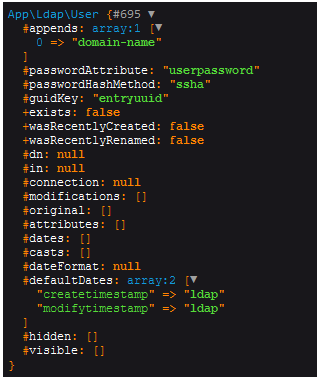
satyakresna
on 26 Apr 2021
Hi @stevebauman, could you please follow up this issue?
satyakresna
on 28 Apr 2021
Hi @satyakresna -- apologies. You're right -- the above doesn't work.
You will have to bind the models explicitly inside of the router using:
Route::model('parameter', Model::class)or;Route::bind('parameter', Closure $callback)(if you want the model resolution logic outside of the model)
You can use either approach. Here's a quick overview of setting up both:
Using Route::model():
App\Providers\RouteServiceProvider.php:
// app/Providers/RouteServiceProvider.php

public function boot()
{
    // ...

    Route::model('ldap-user', \App\Ldap\User::class);
}
App\Ldap\User.php:
<?php
namespace App\Ldap;

use LdapRecord\Models\OpenLDAP\User as BaseUser;

class User extends BaseUser
{
    public function resolveRouteBinding($value)
    {
        return $this->findByGuid($value);
    }
}
routes/web.php:
Route::get('/ldap/users/{ldap-user}', [LdapUserController::class, 'index']);
Using Route::bind():
App\Providers\RouteServiceProvider.php:
// app/Providers/RouteServiceProvider.php

public function boot()
{
    // ...

    Route::bind('ldap-user', function ($value) {
        return \App\Ldap\User::findByGuid($value);
    });
}
routes/web.php:
Route::get('/ldap/users/{ldap-user}', [LdapUserController::class, 'index']);
Then, you should be able to visit the route with a string based GUID (or whichever attribute you use to locate an LDAP object) and it will resolve the model in your controller.
Let me know if you run into any issues! 👍
stevebauman
on 28 Apr 2021
Hi @stevebauman, I try but it throws 404 Not Found. Here's my code. The url in browser looks like this: http://localhost:8002/users/[email protected],ou=users,dc=unud,dc=ac,dc=id/edit
Route
Route::get('/users/{ldap-user}/edit', [UserController::class, 'edit'])->name('users.edit');
Controller
<?php

namespace App\Http\Controllers;

use App\Ldap\User;

class UserController extends Controller
{

    public function edit(User $user)
    {
        dd($user);
    }
}
Model
<?php

namespace App\Ldap;

use LdapRecord\Models\OpenLDAP\User as BaseUser;
use LdapRecord\Query\Model\Builder;

class User extends BaseUser
{

     /**
     * The object classes of the LDAP model.
     *
     * @var array
     */
    public static $objectClasses = [
        'eduPerson',
        'inetOrgPerson',
        'organizationalPerson',
        'person',
        'top',
        'unudPerson',
    ];

    public function getRouteKey()
    {
        return $this->getObjectGuid();
    }

    public function resolveRouteBinding($value)
    {
        return $this->findByGuid($value);
    }
}
Hi @stevebauman, could you please follow up this issue? Thank you.
satyakresna
on 30 Apr 2021
Hey @satyakresna,
I believe your URL is incorrect. You're supplying a full distinguished name, when only the entryuuid should be given, as this attribute is used as the ObjectGUID for OpenLDAP:
Feel free to override the above attribute ($guidKey) if you'd prefer to find users by a different unique identifier for your LDAP environment.
If instead you'd prefer to keep using full distinguished names in the URL, then you will instead have to use the find() method, instead of findByGuid():
<?php
namespace App\Ldap;

use LdapRecord\Models\OpenLDAP\User as BaseUser;

class User extends BaseUser
{
    public function resolveRouteBinding($dn)
    {
        return $this->find($dn);
    }
}
Note, that if you're going to be supplying full DN's inside of the URL, you will have to URLEncode them, because DN's contain comma (,) and equal (=) symbols, which are reserved in URLs for query parameters.
Hope this helps!
stevebauman
on 30 Apr 2021
Hi @stevebauman, I would like use the entryuuid. But, somehow OpenLDAP throws dn instead of entryuuid. Here are the code and screenshots
Model
<?php

namespace App\Ldap;

use LdapRecord\Models\OpenLDAP\User as BaseUser;
use LdapRecord\Query\Model\Builder;

class User extends BaseUser
{

    public function getRouteKeyName()
    {
        return 'entryuuid';
    }

    public function resolveRouteBinding($value)
    {
        return $this->findBy('entryuuid', $value);
    }
}
Service Provider
// app/Providers/RouteServiceProvider.php

public function boot()
{
    // ...

    Route::model('ldap-user', \App\Ldap\User::class);
}
Web Route
Route::get('/users/{ldap-user}/edit', [UserController::class, 'edit'])->name('users.edit');
Blade
<a href="{{ route('users.edit', $user) }}"/></a>
Hover the link
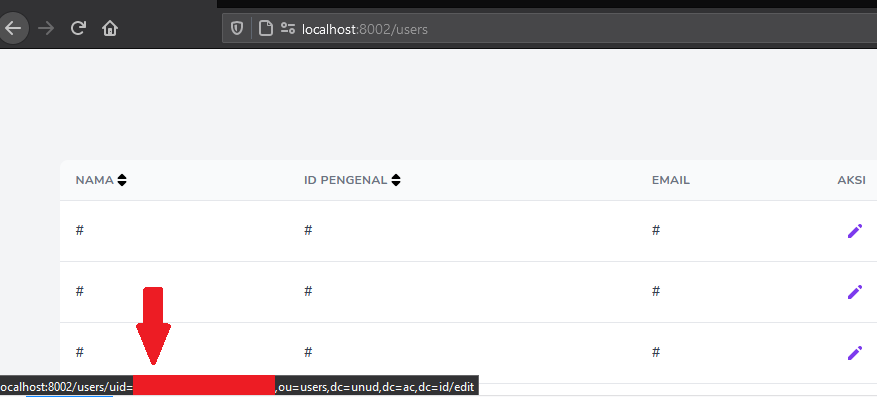
dd($user)
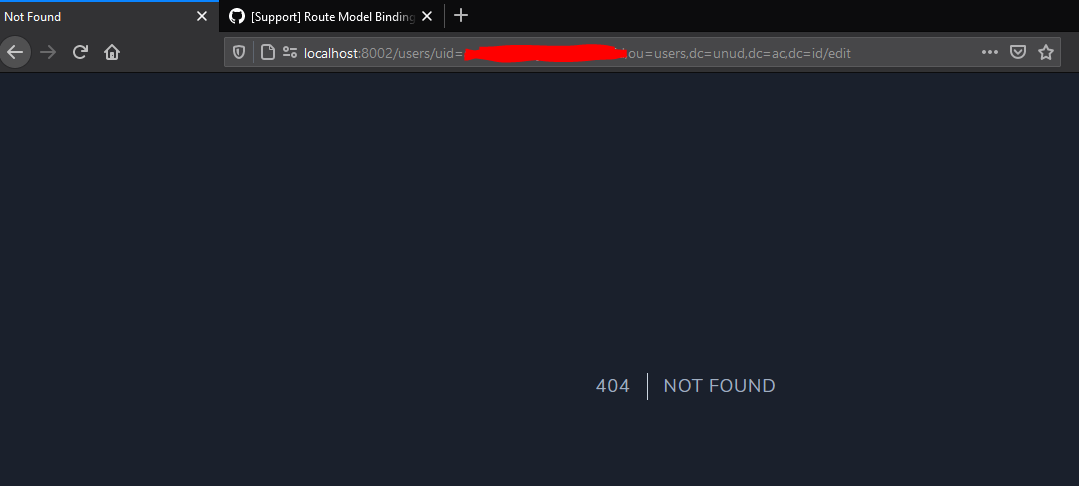
dd($users)
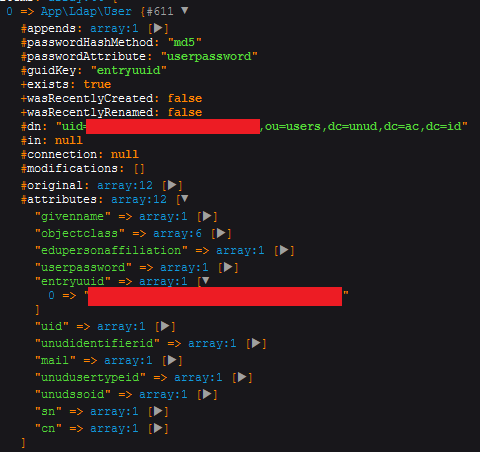
Could you please help about this issue?
satyakresna
on 1 May 2021
Hi @stevebauman, could you please follow up this issue? Thanks.
satyakresna
on 3 May 2021
Hi @satyakresna,
That's because you're passing in an LdapRecord model into blade, and the model is being resolved into a string.
When a model is resolved into a string, it will return the models distinguished name.
For example:
<a href="{{ route('users.show', $ldapUser) }}">View User</a>
Which executes:
<a href="<?php echo route('users.show', $ldapUser->__toString()); ?>">View User</a>
Which then outputs:
<a href="/users/uid=john doe,dc=local,dc=com">View User</a>
You will instead pass the entryUUID manually:
<a href="{{ route('users.show', $ldapUser->getFirstAttribute('entryUUID')) }}">View User</a>
Hi @stevebauman, it works great right now. Thanks a lot for your help. I was confused why it doesn't work and the culprit is the declaration route binding method. Ha ha ha ha.
In the code you given is like this:
// app/Providers/RouteServiceProvider.php

public function boot()
{
    // ...

    Route::model('ldap-user', \App\Ldap\User::class);
}
Route::get('/users/{ldap-user}/edit', [UserController::class, 'edit'])->name('users.edit');
It must be:
// app/Providers/RouteServiceProvider.php

public function boot()
{
    // ...

    Route::model('user', \App\Ldap\User::class);
}
Route::get('/users/{user}/edit', [UserController::class, 'edit'])->name('users.edit');
No problem! Happy to help. Really glad you've worked it out 🎉
stevebauman
on 6 May 2021
Related issues
 AlexH269
·
4Comments
AlexH269
·
4Comments
 jagDanJu
·
8Comments
jagDanJu
·
8Comments
 siegherr
·
6Comments
siegherr
·
6Comments
 brinkonaut
·
6Comments
brinkonaut
·
6Comments
 stephancasas
·
6Comments
stephancasas
·
6Comments