Laravel-permission: There is no role named `admin` ???
my code:
$user_id=1;
$user = User::find($user_id);
$roles = $user->getRoleNames();
$roles->map(function ($role) use ($user) {
$user->removeRole($role);
});
auth file
'defaults' => [
'guard' => 'api',
'passwords' => 'users',
],
'guards' => [
'web' => [
'driver' => 'session',
'provider' => 'users',
],
    'api' => [
        'driver' => 'jwt',
        'provider' => 'users',
    ],
],
roles table

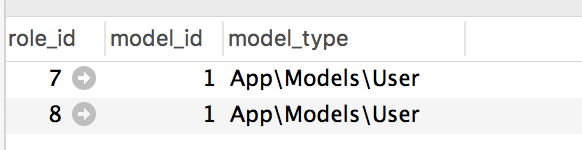
model_has_roles table
 echobool
All 13 comments
Why I add to User Model
Protected $guard_name ='api';
Just fine

auth.php
'defaults' => [
     'guard' => 'api',
     'passwords' => 'users',
], ??????????????
echobool
on 12 Mar 2018
I'm not sure I understand your post.
 drbyte
on 17 Mar 2018
drbyte
on 17 Mar 2018
Problem
OP means, that HasRoles doesn't use default guard from config/auth.php.
I have in config/auth.php:
'defaults' => [
'guard' => 'api',
'passwords' => 'users',
]
and seeder:
$role = Role::create(['name' => 'super-admin']);
$role->givePermissionTo(Permission::all());
The seeder will add "super-admin" role to api guard.
While using $user->assignRole('super-admin'); is throwed error:
There is no role named
super-admin
and need add protected $guard_name = 'api'; to model, to fix it.
Reason
https://github.com/spatie/laravel-permission/blob/master/src/Guard.php#L49
static::getNames($class)->first() returns "web" despite default guard set on "api". Probably User model have guard defaults set on 'web'.
 SzymonLisowiec
on 18 Mar 2018
SzymonLisowiec
on 18 Mar 2018
I had the same issue. Spent 1 hour wondering why it wouldn't find the role.
Like written, defining guard_name on model solves it. But this shouldn't be necessary.
 canvural
on 27 Apr 2018
canvural
on 27 Apr 2018
@canvural wrote:
But this shouldn't be necessary.
I understand, and agree. We're rewriting a number of things for (what might be v3) and aim to improve this... particularly the way it handles guards. (Right now it looks to the model as the primary source of truth, and if not set there then falls back to other options based on configs.)
drbyte
on 27 Apr 2018
This is a bad idea:
$role = Role::create(['name' => 'super-admin']);
$role->givePermissionTo(Permission::all());
Because when new permissions are added, super-admin will not have perm.
It is much better to do this through Laravel Gate:
Gate::before(function (User $user) {
    if ($user->hasRole('super-admin')) {
        return true;
    }
});
 kjdion84
on 2 Sep 2018
kjdion84
on 2 Sep 2018
True, this is better: https://docs.spatie.be/laravel-permission/v2/basic-usage/super-admin/
drbyte
on 2 Sep 2018
@drbyte I am still experiencing this issue in v3 despite setting default guard in my config to api. I still need to add $guard_name to my User model.
Is this intended?
 danvim
on 24 Dec 2019
danvim
on 24 Dec 2019
@danvim wrote:
@drbyte I am still experiencing this issue in v3 despite setting default guard in my config to api. I still need to add
$guard_nameto myUsermodel.Is this intended?
Yes. v3 didn't get those sweeping changes. They haven't been completed yet.
For compatibility with Laravel's semantic numbering change, and other dependencies, we released v3 as basically v2 but with modern dependencies. This also allowed us to remove code required to patch for much older Laravel and PHP versions.
Apologies for any confusion. Numbering is sometimes hard :)
drbyte
on 24 Dec 2019
@drbyte Right. I was just confused since I saw the issue was closed and thought it has been fixed and released. If the issue is tracked somewhere else, that's fine. It's working with $guard_name anyway.
danvim
on 25 Dec 2019
@SzymonLisowiec
I had another guard alongsite api and web.
As you followed to add $guard_name = "web" property in User class, It work with web guard but what about another guard (here my guard name is *customer)?*
customer guard does not work.
 Dictator1999
on 29 Jan 2020
Dictator1999
on 29 Jan 2020
@SzymonLisowiec
I had another guard alongsite api and web.
As you followed to add$guard_name = "web"property in User class, It work with web guard but what about another guard (here my guard name is *customer)?*
customer guard does not work.
Check it: https://docs.spatie.be/laravel-permission/v3/basic-usage/multiple-guards/
SzymonLisowiec
on 29 Jan 2020
I got a solution for this.
- Add
public static $guard_name = "customer"property in User model. - Than before assignRole() method, Just rewrite
$guard_nameproperty like this
User::$guard_name = 'guard name'; - Than you can call assignRole() method.
$user->assignRole("role name");
Make sure the role has valid guard name..
Hope it will help you.
Dictator1999
on 13 Mar 2020
Related issues
 bbdangar
·
4Comments
bbdangar
·
4Comments
 enghelewa
·
4Comments
enghelewa
·
4Comments
 neoreids
·
3Comments
neoreids
·
3Comments
 bhulsman
·
3Comments
bhulsman
·
3Comments
 dylangeorgeharbour
·
3Comments
dylangeorgeharbour
·
3Comments
Most helpful comment
Why I add to User Model
Protected $guard_name ='api';
Just fine
auth.php
'defaults' => [
'guard' => 'api',
'passwords' => 'users',
], ??????????????