Language-tools: Supports union types in props and reactive statement
Is your feature request related to a problem? Please describe.
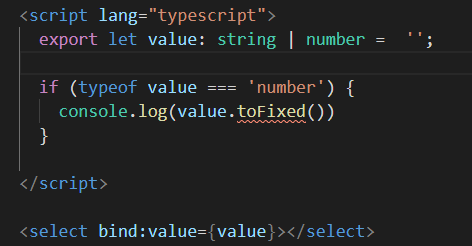
The following code will have a typescript error due to typescript's control flow analysis.
But this is very useful when it comes to a select-wrapper component.
<script lang="typescript">
  export let value: string | number = '';

  if (typeof value === 'number') {
    console.log(value.toFixed())
  }

</script>

<select bind:value={value}></select>
Describe the solution you'd like
In the svelte2tsx, the props and reactive statement $: { } needs to be taken out of the control flow context maybe by wrapping it with a callback like this:
declare function __sveltets_invalidate<T>(getValue: () => T): T

/*export*/ let value: string | number = __sveltets_invalidate(() => '')

let b: 'A' | 'B' = 'A';

() => {
$: {
    console.log(b)
}
}
Additional context
Add any other context or screenshots about the feature request here.
 jasonlyu123
All 28 comments
Good idea with the invalidate-wrapper around props. Maybe we don't even need to add another wrapper to reactive statements then? Or are there any cases where this will throw control flow errors?
 dummdidumm
on 22 Jun 2020
dummdidumm
on 22 Jun 2020
change the export let to let and wrap the statement in $: {} will have the same error
<script lang="typescript">
  let value: string | number = '';

  $: {
    if (typeof value === 'number') {
      console.log(value.toFixed())
    }
  }
</script>
if value got re-assign by event handler. the type of it might chages
jasonlyu123
on 22 Jun 2020
Ah, did not think about that. Thanks!
dummdidumm
on 22 Jun 2020
The function callback for props won't work lol. Needs to find another way.
jasonlyu123
on 23 Jun 2020
By the way, this wrapping can be used in $: variable if we change the first $: label to let like we discussed earlier in the overall strategy thread. Because its type is depending on another let. So it would works.
jasonlyu123
on 23 Jun 2020
Another problem, this union type props will also have a type of string in the exported prop def because of the same reason
jasonlyu123
on 24 Jun 2020
export let someProps : string | number = ''
To
declare function __sveltets__invalidateWithDefault<T>(getValue: () => T | undefined): T;

let someProps: string | number = ''
someProps = __sveltets__invalidateWithDefault(() => someProps);
This works, but kind of hacky
jasonlyu123
on 27 Jun 2020
export let test: string | number = '' as any;
works
 PatrickG
on 27 Jun 2020
PatrickG
on 27 Jun 2020
@PatrickG's solution is better. but both approach would make the props has an undefined type.
export let test: string | number | undefined = '' as any;
test // test is shouldn't be undefined here
Can you get the types from the typescript AST somehow and use that to construct it? Or use some kind of AST traversal/Regex to get the type definition (everything after : and before =) and then put it behind it: export let test: string | number = '' as string | number.
dummdidumm
on 27 Jun 2020
@PatrickG's solution is better. but both approach would make the props has an undefined type.
export let test: string | number | undefined = '' as any;
test // test is shouldn't be undefined here
for me test is string | number. Not undefined.

PatrickG
on 28 Jun 2020
playground example
It'll be undefined if strictNullChecks is enabled (strict: true also enable it)
jasonlyu123
on 29 Jun 2020
playground example
It'll beundefinedifstrictNullChecksis enabled (strict: truealso enable it)
Then it will be string | number | undefined. Where is the problem?
PatrickG
on 29 Jun 2020
Because it can't be undefined when your default value is not undefined. I want to eliminate that undefined type so that users don't have to do an unnecessary null check to suppress the undefined error.
jasonlyu123
on 29 Jun 2020
If you add | undefined to the type, of course it can be undefined and you should check that it is not undefined when you try to invoke a method.
<!-- Component.svelte -->
<script lang="ts">
  export let test: string | undefined = '' as any; // `string | undefined` means it can be undefined.

  test.toUpperCase(); // not safe - because `test` can be `undefined`

  test?.toUpperCase(); // safe
</script>

<!-- Other component -->
<script>
  import Component from './Component.svelte';
</script>

<Componen test={undefined} />
The only Problem I see currently, is that the svelte extension should make the prop optional if it has a initial value.
Instead of checking for undefined in the type here, I think we can use VariableDeclaration.initializer here
PatrickG
on 29 Jun 2020
because svelte compiler compile it to
let { test = '' } = $$props
so test can't be undefined even if you explicitly pass undefined as props. It can only be undefined if you re-assign it to undefined later.
Maybe it would be too complex or impossible to do what I intend to do. And It might be just an edge case that few people would use.
jasonlyu123
on 29 Jun 2020
It still can be undefined if you pass a variable that changes to undefined.
https://svelte.dev/repl/hello-world?version=3.23.2
PatrickG
on 29 Jun 2020
Then it's reactive statement that's possibly undefined? Maybe we should just do reactive and require user to explicitly cast the type of default value.
jasonlyu123
on 29 Jun 2020
export let a: string | number | undefined = '' as string | number
Casting can work. but in js it won't have undefined type in a function
    /**@type { string | number | undefined }*/
    let name = /**@type {string | number} */ ("world"),
        world = '';

    name

    function a() {
        name
    }
Instead of checking for undefined in the type here, I think we can use VariableDeclaration.initializer here
good point! It can differentiate optional props and possibly undefined
jasonlyu123
on 29 Jun 2020
That is what i mean, with the optional props: https://github.com/PatrickG/language-tools/commit/c5f00f75df74c8e3dcfc9842dad4256b9d4f29f2
And with the as any after the initalizer, vscode no longer thinks export let test: string | number = ''; is a string. https://github.com/PatrickG/language-tools/commit/7f630bbf7d66a037590384d3e2a7f8b7314b622c
Can I create a PR with my changes?
PatrickG
on 29 Jun 2020
I think the first one is ok!
Another cons of as any is that It would not get type-check. So maybe it needs to be cast to whatever user has defined.
let a: string | number = true as any;
Also, the casting needs to be done through jsdoc in js. I have tried that today.
About the undefined problem, I give up on it. Since we can't found a generic function that can do the trick. We could only manually check if its initializer is undefined but not if a variable passed in as the initializer is undefined. The false negatives seem to be more important.
jasonlyu123
on 29 Jun 2020
I think the first one is ok!
Another cons ofas anyis that It would not get type-check. So maybe it needs to be cast to whatever user has defined.let a: string | number = true as any;
Oh, right.
What about this:
declare function __sveltets_initialize<T>(value: T): any;
let test: string | number = __sveltets_initialize<string | number>('');
test; // string | number

let test: string | number = __sveltets_initialize<string | number>(true); // error because `true` is not `string` or `number`
Also, the casting needs to be done through
jsdocin js. I have tried that today.
I've not looked into the jsdoc stuff yet
PatrickG
on 29 Jun 2020
update: there is another way to do as any
export let a: number | string = '1',
  b = a;
to
declare function __sveltets_any(dummy: any): any;

let a: number | string = '1'
a = __sveltets_any(a);
let b = a;
No type-assertion needed and the initializer got type-check. So that this would show typing error:
export let a: ISomeInterface = {};
export let b: string | number = true;
I had the re-assignment in my mind too, but wanted to prevent it, because I think it is harder to do^^
Do you implement this?
PatrickG
on 30 Jun 2020
Yes. I have implemented reassign here but still need some works in cleanup and test.
Another one is focusing on $: variable
jasonlyu123
on 30 Jun 2020
@jasonlyu123 is everything the issue was about fixed by your PR? (asking for whether or not I can close this)
dummdidumm
on 6 Jul 2020
Yeah. Thanks
jasonlyu123
on 6 Jul 2020
Related issues
 UltraCakeBakery
·
14Comments
UltraCakeBakery
·
14Comments
 illright
·
39Comments
dummdidumm
·
24Comments
illright
·
39Comments
dummdidumm
·
24Comments
 mgholam
·
46Comments
mgholam
·
46Comments
 limitlessloop
·
22Comments
limitlessloop
·
22Comments