Language-ext: IEnumerable<Either<L,A>>.BindT extension method is eager
BindT extension method both takes and returns IEnumerable type which suggests it'll be lazily evaluated, instead it's processed right away for all the elements.
If it is an expected behavior shouldn't it return a different type instead?
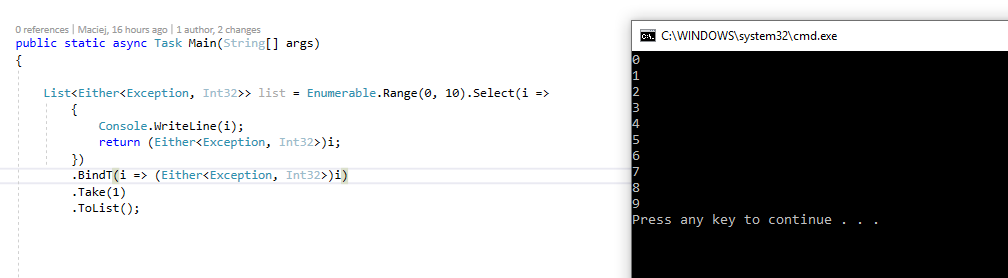
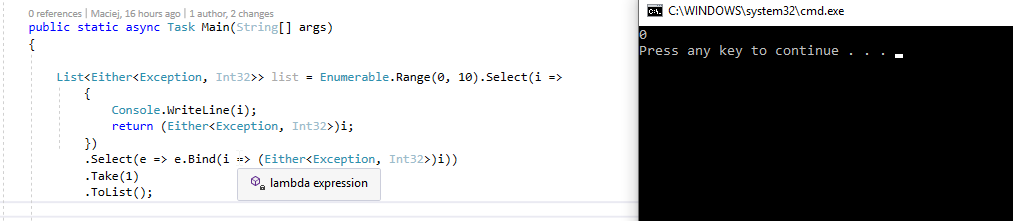

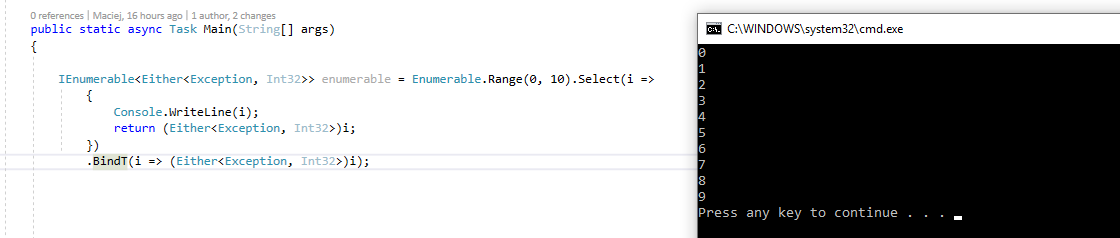
bug
 chyczewski-maciej
All 4 comments
Here is my attempt to simplify your tests. This tests fails but the expectation is that it should pass.
[Fact]
public void IEnumerableOptionBindT_NotEnumerabled_NotEvaluated()
{
    var evaluted = false;
    var list = Seq1(unit)
        .AsEnumerable()
        .Select(_ =>
        {
            evaluted = true;
            return unit;
        })
        .Select(Some)
        .BindT(Some);
    Assert.False(evaluted);
}
 TysonMN
on 8 Mar 2019
TysonMN
on 8 Mar 2019
The HKT functions (with the T suffix) are auto-generated, so this might have something causing the eagerness.
 louthy
on 8 Mar 2019
louthy
on 8 Mar 2019
@bender2k14, here's an even simplier version :)
[Fact]
public static void IEnumerableOptionBindT_NotEnumerabled_NotEvaluated()
{
    new[] { unit }
            .Select<Unit, Option<Unit>>(x => throw new Exception("Some proper message"))
            .BindT(Some);
}
or this
[Fact]
public static void IEnumerableOptionBindT_NotEnumerabled_NotEvaluated()
{
    ThrowOnEnumeration().BindT(Some);

    IEnumerable<Option<Unit>> ThrowOnEnumeration()
    {
        throw new Exception("Some proper message");
        yield return unit; // Do not remove this line. This is required to generate a lazy IEnumerable sequence.
    }
}
👍1
Fixed in the next release
louthy
on 8 Apr 2019
👍1
Was this page helpful?
0 / 5 - 0 ratings
Related issues
 andrevdm
·
4Comments
andrevdm
·
4Comments
 MrYossu
·
5Comments
MrYossu
·
5Comments
 TonyHernandezAtMS
·
5Comments
TonyHernandezAtMS
·
5Comments
 buinauskas
·
4Comments
buinauskas
·
4Comments
 michael-wolfenden
·
5Comments
michael-wolfenden
·
5Comments