Kotlin-native: Slow compilation time
Hi
When compiling even hello world i expect to be fast, but it is really slow
Is there something i am missing when compiling? i followed this https://github.com/JetBrains/kotlin-native/blob/master/README.md
 RUSshy
All 59 comments
How can we reproduce your measurements?
 vvlevchenko
on 11 Jul 2017
vvlevchenko
on 11 Jul 2017
I don't have numbers, but it is over usage, it is just much slower compared to other languages such as C++/Swift or even GO
RUSshy
on 11 Jul 2017
it takes 6 seconds to compile this:
fun main(args: Array<String>)
{
   println("hello")
}
command: kotlinc hello.kt -o hello
platform: windows 10 x64
it should be instant
RUSshy
on 11 Jul 2017
could you please share your code for c++/swift, go, versions of compilers and time <command> results?
vvlevchenko
on 11 Jul 2017
I'm on windows i don't know alternative for time command, i found this on google:
cmd /v:on /c "echo !TIME! & *mycommand* & echo !TIME!"
λ cmd /v:on /c "echo !TIME! & kotlinc hello.kt -o hello & echo !TIME!"
21:44:20,30
KtFile: hello.kt
21:44:26,01
as you can see 5:30 seconds, almost same thing i counted using head
for c++ i don't have toolchain installed so i use built in with clion
c++:
mingw 5
cmake 3.7.2
gdb 7.11.1
this code took ~1-2 seconds to compile and run
#include <iostream>

int main()
{
    printf("hello");
    return 0;
}
cmake_minimum_required(VERSION 3.7)
project(untitled)

set(CMAKE_CXX_STANDARD 11)

set(SOURCE_FILES main.cpp)
add_executable(untitled ${SOURCE_FILES})
thank you for reporting.
vvlevchenko
on 11 Jul 2017
Swift (Windows mingw port): https://github.com/tinysun212/swift-windows
code:
print("hello")
command: swiftc Hello.swift
command for timing: /v:on /c "echo !TIME! & swiftc Hello.swift & echo !TIME!"
result:
22:05:27,32
22:05:27,58
It is instant
RUSshy
on 11 Jul 2017
Any idea on this? it is slow for you too? this is annoying to wait each time i want to change a constant value
RUSshy
on 20 Jul 2017
for d lang:
code:
import std.stdio;

void main()
{
    writeln("hello");
}
command: dub build
command for timing: cmd /v:on /c "echo !TIME! & dub build & echo !TIME!"
result:
16:01:23,51
Performing "debug" build using dmd for x86.
t ~master: building configuration "application"...
Linking...
16:01:24,31
0.4 second only
RUSshy
on 23 Jul 2017
for rust:
code:
fn main()
{
    println!("hello");
}
command: cargo build
command for timing: cmd /v:on /c "echo !TIME! & cargo build & echo !TIME!"
result:
16:07:00,84
   Compiling hello_world v0.1.0 (file:///C:/Users/RUSshy/dev/rust/hello_world)
    Finished dev [unoptimized + debuginfo] target(s) in 0.32 secs
16:07:01,39
0.55 second only (0.32 from cargo info)
RUSshy
on 23 Jul 2017
Mate, you do understand that you are following the development of pre-release software, right? That developers are working on core features, and you are talking about not-that-important at this stage performance? You can revisit #670, where devs themself mentioned that the compiler isn't ready for performance comparisons with other tools (some of which, among those you mentioned, are passed their first release decades ago).
If you've followed Kotlin development itself, you may know that at some point developers started trying to hold on-par both compiler speed and feature-richness of language and toolset, so you can rest assured that as soon as core of Kotlin/Native is done, team will definitely work on performance. Till this point I don't see any reasons to bother them with constantly opening issues on this topic, of which tour's is the third one already, if I recall correctly.
Sorry if I sound mean, you just seem a bit ignorant. It's open-source, you see. If you're picking a tool for you right now to use in production, you should definitely go with something more mature than Kotlin/Native. If you're following development process just for fun, you can either work on pull request to help devs with this issue, or just wait whey they have time to tackle with it themselves. As for priorities, I'm personally more interested in seeing exporting symbols to outside world, so in my opinion you shouldn't try to force developers change their priorities based on your opinion and just let them do their job.
Once again, didn't mean to sound offensive at all, sorry if anything.
 r4zzz4k
on 23 Jul 2017
r4zzz4k
on 23 Jul 2017
I just wanted to give feedback, and to know if they are aware of it, just that, but i think you are right it is too early, i want kotlin native to be successful this is why i opened this issue about this concern
RUSshy
on 23 Jul 2017
https://twitter.com/scala_native/status/893192456002469888
scala native achieved compilation under 1 second, i hope to see same for kotlin native soon
RUSshy
on 4 Aug 2017
What is your plan for this issue?
RUSshy
on 13 Sep 2017
Let me put my 2 cents in:
> kotlin -version
Kotlin version 1.1.51 (JRE 1.8.0_144-b01)

> uname -a
Linux lin-pc 3.19.8-031908-generic #201505110938 SMP Mon May 11 13:39:59 UTC 2015 x86_64 x86_64 x86_64 GNU/Linux
time kotlinc hello.kt

real    0m2.050s
user    0m4.504s
sys 0m0.132s
time javac Test.java

real    0m0.385s
user    0m0.764s
sys 0m0.056s


md5-39fe736bfd8446a0b6c771170bd69106


fun main(args : Array<String>) {
  println("Hello, world!")
}


md5-e1d04da232b5cf88344251237e0e8632


class Test {
  public static void main(String[] args) {
     System.out.println("Hello, world!");
  }
}
Mate, you do understand that you are following the development of pre-release software, right? That developers are working on core features, and you are talking about not-that-important at this stage performance?
Sure, I think the most of people understand this.
But IMHO we should start at least to notice it as soon as possible.
Otherwise, there is a chance the JRuby history will repeat itself.
Its startup time is far more slow that e.g. compared with the groovy which is similar enough.
And the time is being degraded significantly depending on the app size/dependencies number.
Also it is very important for TDD. Which is needed now.
TDD with JRuby is really a pain and I'd like to avoid that with Kotlin which seems very interesting.
P.S. Core i3@3800Mhz (full desktop, not a mobile version), 16GB RAM, SSD.
Linux Mint 17.2
 eugene-nikolaev
on 5 Oct 2017
eugene-nikolaev
on 5 Oct 2017
I can confirm hello world compilation takes ~6 seconds for me (MBP2016, 16Gb RAM, SSD, macos 10.12.6
~/Documents/dev/src/kotlin-native asmirnov$cat ./hello.kt
fun main(args: Array<String>) {
    println("Hello world")
}
~/Documents/dev/src/kotlin-native asmirnov$time kotlinc hello.kt
KtFile: hello.kt

real    0m6.842s
user    0m11.109s
sys 0m0.698s
~/Documents/dev/src/kotlin-native asmirnov$java -version
java version "1.8.0_121"
Java(TM) SE Runtime Environment (build 1.8.0_121-b13)
Java HotSpot(TM) 64-Bit Server VM (build 25.121-b13, mixed mode)
Let me know if i can help in any way
 4ntoine
on 17 Oct 2017
4ntoine
on 17 Oct 2017
Any ETA for when this issue will get adressed? me an team are debating if we use xamarin or kotlin, but right now with compile time slow we can't choose it, but depending on progress we might accept trade off for few moment
RUSshy
on 6 Nov 2017
v0.4:
~/Documents/dev/src/kotlin-native asmirnov$time kotlinc ./hello.kt -o ./hello
KtFile: hello.ktreal 0m6.696s
user 0m12.382s
sys 0m0.574s
~/Documents/dev/src/kotlin-native asmirnov$cat ./hello.kt
fun main(args: Array) {
println("Hello world")
}
4ntoine
on 26 Nov 2017
With master and upgrade to clang 5, build is now 8seconds instead of previous 6seconds, so it is 2s slower :(
RUSshy
on 6 Dec 2017
Any news on this?
RUSshy
on 26 Jan 2018
It's over 10 seconds for me :)
 kennycason
on 1 Feb 2018
kennycason
on 1 Feb 2018
MBP 2014 maxed out, compilation of hello world takes 14 seconds for me.
$ time kotlinc test.kt
kotlinc test.kt  14.04s user 0.60s system 221% cpu 6.619 total
 DarrienG
on 28 Feb 2018
DarrienG
on 28 Feb 2018
Project approaching v1.0 i hope this gonna be improved
RUSshy
on 27 Apr 2018
@RUSshy i am running kotlinc on ubuntu running on virtual machine it is very slow
time kotlinc hello.kt
real 0m7.479s
user 0m10.492s
sys 0m1.104s
rust, c compiles very fast on ubuntu running on virtual machine please fix this issue
 faob-dev
on 30 Apr 2018
faob-dev
on 30 Apr 2018
v0.8.0:
time kotlinc main.kt -o hello -opt

real    0m6.521s
user    0m12.827s
sys 0m0.345s
Friend, you're compiling with JVM Kotlin. In that example you bundle everything into a Jar including the Kotlin runtime (which is like 2MB) which is why it takes a while.
Consider using Gradle for incremental compilation and you should see your build times drop to maybe a second or less.
You should still get 8+ second build times with the native compiler though.
DarrienG
on 19 Jul 2018
@seieewkx Kotlin and Kotlin-native are different projects. This ticket is about Kotlin-native compile time.
4ntoine
on 19 Jul 2018
v0.9
time ./kotlinc main.kt -o test -opt

real    0m10.684s
user    0m0.000s
sys     0m0.122s
It is much much worse than before..
Next version is 1.0, both compile speed and language performance should be the focus in my opinion, or people who waited for 1.0 to evaluate the language will have a really negative opition on it
RUSshy
on 6 Sep 2018
We're past 1.0 and this is still a big issue.
> .\kotlinc-native -version
info: kotlinc-native 1.3.0-rc-190 (JRE 1.8.0_191-b12)
Kotlin/Native: 1.0.2

> Measure-Command { .\kotlinc-native .\hello.kt }
TotalSeconds      : 4.503814
This is again on a 3 line hello world program.
 EhsanKia
on 1 Dec 2018
EhsanKia
on 1 Dec 2018
Please investigate into this. It feels like a eternity re-compiling my project because I've changed a const.
 ghost
on 31 Dec 2018
ghost
on 31 Dec 2018
2019, let's hope this is the year of performance for every developpers in this sad world, we have better hardware than before but software is still regressing year after year
RUSshy
on 4 Jan 2019
For me when running in Kotlin Script file, it took more time. But when i use Intellij built in Kotlin REPL to run code, its actually fast.
 abitgen
on 13 Apr 2019
abitgen
on 13 Apr 2019
Mate, you do understand that you are following the development of pre-release software, right? That developers are working on core features, and you are talking about not-that-important at this stage performance? You can revisit #670, where devs themself mentioned that the compiler isn't ready for performance comparisons with other tools (some of which, among those you mentioned, are passed their first release decades ago).
If you've followed Kotlin development itself, you may know that at some point developers started trying to hold on-par both compiler speed and feature-richness of language and toolset, so you can rest assured that as soon as core of Kotlin/Native is done, team will definitely work on performance. Till this point I don't see any reasons to bother them with constantly opening issues on this topic, of which tour's is the third one already, if I recall correctly.
Sorry if I sound mean, you just seem a bit ignorant. It's open-source, you see. If you're picking a tool for you right now to use in production, you should definitely go with something more mature than Kotlin/Native. If you're following development process just for fun, you can either work on pull request to help devs with this issue, or just wait whey they have time to tackle with it themselves. As for priorities, I'm personally more interested in seeing exporting symbols to outside world, so in my opinion you shouldn't try to force developers change their priorities based on your opinion and just let them do their job.
Once again, didn't mean to sound offensive at all, sorry if anything.
hai
 mgood7123
on 15 Apr 2019
mgood7123
on 15 Apr 2019
What I'm wondering is how something like kotlin server from the try kotlin website is working faster
0.04user 0.00system 0:01.98elapsed 2%CPU (0avgtext+0avgdata 12488maxresident)k
0inputs+0outputs (0major+997minor)pagefaults 0swaps
as compared to javac on my system.
1.71user 0.12system 0:00.74elapsed 245%CPU (0avgtext+0avgdata 74420maxresident)k
0inputs+72outputs (0major+14088minor)pagefaults 0swaps
```
 harsh183
on 18 Apr 2019
harsh183
on 18 Apr 2019
Almost TWO years later still the same problem:
time kotlinc-native hello.kt -o hello
real 0m10,309s
user 0m13,172s
sys 0m0,852s
kotlinc-native -version
info: kotlinc-native 1.3.50-dev-259 (JRE 1.8.0_212-8u212-b03-0ubuntu1.18.04.1-b03)
Kotlin/Native: 1.3-dev
uname -a
Linux ASUS-LAPTOP 4.15.0-50-generic #54-Ubuntu SMP Mon May 6 18:46:08 UTC 2019 x86_64 x86_64 x86_64 GNU/Linux
 davaponte
on 23 May 2019
davaponte
on 23 May 2019
Is it on roadmap to fix this issue ? please comunicate, you've been silent on this one, it is the most commented issue..
RUSshy
on 23 May 2019
Generally there are many activities aiming to improve compilation time on-going both in Kotlin/Native and in general Kotlin.
They include dead code elimination compiler analysis (on review), deserialization optimizations, frontend IR work and probably some other optimizations. Team is focused on compilation time improvements, stay tuned.
 olonho
on 23 May 2019
olonho
on 23 May 2019
Almost TWO years later still the same problem:
time kotlinc-native hello.kt -o hello
real 0m10,309s
user 0m13,172s
sys 0m0,852skotlinc-native -version
info: kotlinc-native 1.3.50-dev-259 (JRE 1.8.0_212-8u212-b03-0ubuntu1.18.04.1-b03)
Kotlin/Native: 1.3-devuname -a
Linux ASUS-LAPTOP 4.15.0-50-generic #54-Ubuntu SMP Mon May 6 18:46:08 UTC 2019 x86_64 x86_64 x86_64 GNU/Linux
On a AMD 3900x, nvme, ECC ..
Its not too bad compared to basic Kotlin
0.1 Hello World, Warm ( Kotlin 1.3 )
real 0m2.106s
user 0m4.864s
sys 0m2.386s
0.2 Hello World, Warm ( kotlin-native 0.9.3 )
And yes, this is done with 0.9.3 because for some reason the Kotlin-Native snap for Ubuntu is not updated in the last year ( 29 September 2018 ).
real 0m4.305s
user 0m8.600s
sys 0m1.886s
Painful is not the right word ( this with warmup / already multiple compiles ).
For fun i ran Swift ( 5.1 ) on Linux:
1.1. Hello World, "Cold":
hello World
real 0m0.175s
user 0m0.009s
sys 0m0.113s
1.2. Hello World, Swift warmed up:
hello Worlds
real 0m0.018s
user 0m0.000s
sys 0m0.018s
1.3. Hello World, Compiled to file
real 0m0.088s
user 0m0.028s
sys 0m0.047s
2.1 Swift with Foundation and other stuff ( import foundation, classes, string manipulation, conditions, ... )
real 0m0.498s
user 0m0.218s
sys 0m0.235s
2.2 Swift with Foundation and other stuff "warmed up"...
real 0m0.133s
user 0m0.120s
sys 0m0.013s
2.3 Swift with Foundation and other stuff Compiled to file
real 0m0.153s
user 0m0.127s
sys 0m0.026s
The difference is ridiculous ... And both are using LLVM. Even Rust and Crystal only hit 0.5 for a basic "Hello World"s, and both are also LLVM backed languages. The amount of compile optimizing needed seems to be huge.
 Indribell
on 1 Oct 2019
Indribell
on 1 Oct 2019
i warned 2 years ago about consequences, nobody listen to me, they see me as troll or someone who know nothing so they ignore my advices.. now they pay the price
be careful because there is work to make swift a crossplatform language, and C# gonna get swift and java interop next year for .net 5.0 + aot compilation with llvm too
there can't be adoption is you need wait 10 seconds to compile hello world or to change the value of a variable.. and there can't be trust if nothing changes in 2 years.. and it is not the only issue with KN..
RUSshy
on 25 Oct 2019
To be fair, there are more reasons not to use Kotlin Native. It has a crazy memory model that decided it should pretend to be rust, but make those memory errors runtime errors rather than compile time errors. I don't know what everyone was thinking with KN. I just wanted to compile my Kotlin to native and it can barely even do that :(
DarrienG
on 25 Oct 2019
I have to admit Kotlin/Native painfully slow compilation time is my top reluctance to prototype ideas, which is required in order to consider making products with it.
I fear having to flip a Boolean when I'm building for Native, that doesn't encourage me to improve working code and taking on new challenges.
You can compare the compilation speed between Android and iOS targets in that module: https://github.com/LouisCAD/Splitties/tree/61508e16f9820f37b732acb868df6e45f2436db1/modules/preferences
Compiling for iOS, or even macOS is many times slower, and it multiplies further as I need to compile for x64, arm32 and arm64 to support down to iPhone 4S-5 and trying the final app in the simulator.
Please, make this your top priority for 1.3.70 or 1.4. If that implies having a slower/unoptimized runtime executable for debug builds, that's fine.
I can't sell Kotlin/Native to my colleagues or my boss when you have Dart that hot reloads in less than one second (Flutter), and allows to iterate and preview the whole thing so much faster than me waiting 1-2 minutes to flip a Boolean.
I personally don't dislike the saner concurrency movement although it's possible that it's currently not in its final form, but waiting so much time to see if your attempts fix the errors you're encountering, not talking about actual feature or APIs development… that sums up to a very hard experience for beginners, and even not so beginners.
 LouisCAD
on 25 Oct 2019
LouisCAD
on 25 Oct 2019
@LouisCAD Agree that compile times are slow, although I'd point out the team has said in multiple places that compile speed is something that will be worked on (see above). I don't know for sure, but I assume the grand compiler rewrite is a blocker on that.
As for Dart/Flutter, there's kind of a habit here where KN gets compared to other things and everybody expects it'll be the best at everything across the board. Dart/Flutter refresh is great. Dart/Flutter integration with existing apps/architecture is garbage. Pluses/minuses. Same thing when runtime performance is compared to JVM. The comparison should be a rewrite in Swift, which often has wildly different numbers. The (my?) general dev flow for Kotlin features is iterating on code in JVM, then compiling and integrating on iOS. If the primary dev flow is "edit a boolean, recompile, open in iOS, repeat" I'd say you need to change the flow for now at least. Flutter specifically is designed to be a UI toolkit (and that's it).
Not saying it's "fine", but there are plenty of teams making it work in production.
@DarrienG Not understanding the memory model doesn't make it "crazy". Everybody knows you can't edit the UI from a background thread. Same thing, more formal. Not liking it is a different discussion.
@RUSshy Pointing out slow compile times doesn't make you a troll. It's more the angry ranting.
For all the doom and gloom, adoption in prod is increasing significantly. My "job" is essentially talking to teams doing that. Compile times are a concern. Memory model is a concern (for new devs). People are using it.
 kpgalligan
on 25 Oct 2019
kpgalligan
on 25 Oct 2019
If we're on the subject of "what are teams worried about", by far the biggest concern is multithreaded coroutines. Just FYI. Well, that and "is this production ready?", which is not a binary question. Depends on the team.
kpgalligan
on 25 Oct 2019
The memory model is a huge divergence from how "standard" Kotlin works. A lot of Kotlin code written for JVM doesn't work for native. I've written quite a bit of Rust and also understand interacting with the UI thread vs other threads, but this is a big detractor from anyone just wanting to try out Kotlin Native with a pure Kotlin project.
If it were like Rust and it were a compile time error then I wouldn't have this complaint (although it would still a nuisance), but my Kotlin code that was working stops working in Native with a fresh new runtime error which is not a good experience.
Anyway I don't want to detract from the conversation about compile times too much. I'm out.
DarrienG
on 25 Oct 2019
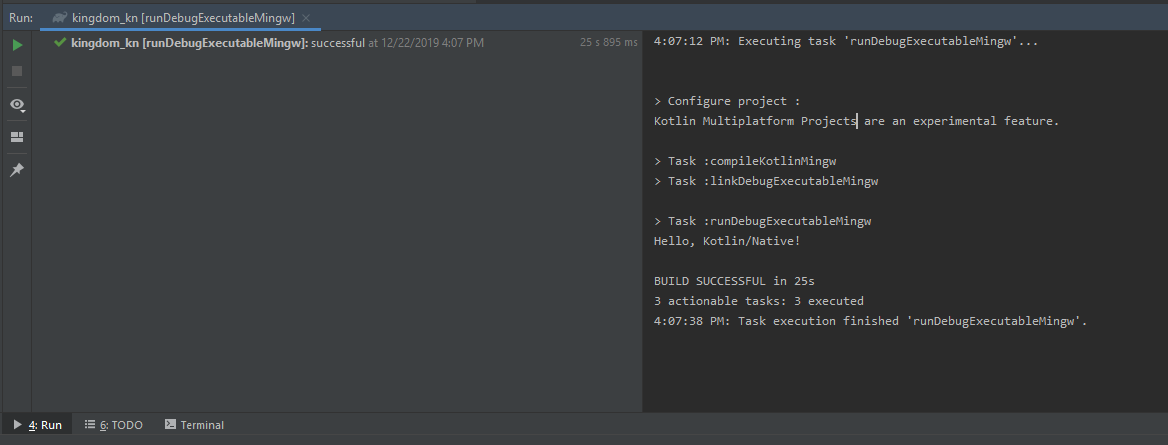
so i decided to give it a try again today, and.. it takes 26 seconds now..
3x slower than before, and it was already incredibly slow..
RUSshy
on 22 Dec 2019
@RUSshy Please, specify the used Kotlin/Native version that you used, for history purposes. Also, why did you close the issue? Was it a mistake?
LouisCAD
on 26 Dec 2019
Gradle: 5.5.1
Kotlin Multiplatform: 1.3.61
with latest 2019.3.1 IntelliJ IDEA Ultimate
That's a project i created directly from IntelliJ
plugins {
    id 'org.jetbrains.kotlin.multiplatform' version '1.3.61'
}
repositories {
    mavenCentral()
}
kotlin {
    // For ARM, should be changed to iosArm32 or iosArm64
    // For Linux, should be changed to e.g. linuxX64
    // For MacOS, should be changed to e.g. macosX64
    // For Windows, should be changed to e.g. mingwX64
    mingwX64("mingw") {
        binaries {
            executable {
                // Change to specify fully qualified name of your application's entry point:
               entryPoint = 'sample.main'
                // Specify command-line arguments, if necessary:
                runTask?.args('')
            }
        }
    }
    sourceSets {
        // Note: To enable common source sets please comment out 'kotlin.import.noCommonSourceSets' property
        // in gradle.properties file and re-import your project in IDE.
        mingwMain {
        }
        mingwTest {
        }
    }
}

// Use the following Gradle tasks to run your application:
// :runReleaseExecutableMingw - without debug symbols
// :runDebugExecutableMingw - with debug symbols
I closed it because it doesn't seems to be a concern for jetbrains
RUSshy
on 26 Dec 2019
We're probably going to have to wait till 1.4, that's a reasonable time to give up.
Mind re-opening? I don't want them to forget (highly unlikely) or someone else to re-create this issue.
 Dominaezzz
on 26 Dec 2019
Dominaezzz
on 26 Dec 2019
Just adding another data point here, this project https://github.com/raniejade/godot-kotlin takes roughly 4 minutes on a clean build. Running the build again after changing a single line of code takes roughly 1 minute and some spare change, which is terribly slow. Hopefully 1.4 would bring some speed up :crossed_fingers:.
 raniejade
on 28 Jan 2020
raniejade
on 28 Jan 2020
Just adding for reference that there's been some improvements in 1.3.70, although many cannot use it as a bug affects kotlinx.coroutines which consequently has not been released with a compatible ABI for 1.3.70.
So, there's ongoing progress, which is encouraging.
LouisCAD
on 22 Mar 2020
Decided to give it a try and i get a huge gradle error
https://gist.github.com/RUSshy/e10dd31e869388e67b82fea6f4b8e59c
Using latest IntelliJ IDEA 2020.1 BETA
I hate gradle, between constant new versions breaking stuff, huge downloads, slow deamon startup, sluggish command line
I'm glad i don't do android development, gradle is not for me, all i want is a C++/GO/C# replacement for desktop/server development
Hopefully JB decide to provide standard toolset similar to Rust/GO for native stuff, why go overly complex for such simple task?
Why need IDE to download all the env?
Why is is still multi GB of files to get started?
Why everything is slow?
Year after year, new solutions are worst than those of the past, gradle is a mistake
RUSshy
on 1 Apr 2020
JVM world really needs an upgrade in their toolings so bad. Even until now, I think kotlin is the most enjoyable and elegant language. But the slow compiler time, sluggish cli toolings, different linters/formatters, makes me cannot enjoy it anymore other than for Android app. Most modern languages nowadays provide a much more streamlined developer tools.
 gnomeria
on 20 Jun 2020
gnomeria
on 20 Jun 2020
This issue is now 3 years old..
So how is the compilation today? let's see:
OS: Windows 10 x64
https://github.com/JetBrains/kotlin/releases/tag/v1.3.72
$ time ./kotlinc-native main.kt -o main

real    0m8.340s
user    0m0.061s
sys     0m0.090s
8.3 seconds.......
When i created this issue, it compiled hello world in 5.3 seconds, 3 YEARS layer, it is now 8.3 seconds.... on same machine
RUSshy
on 8 Jul 2020
1.3.72 is pretty old now. You should be comparing with 1.4-M3 (Maybe even a preview version).
Also, 8.3 seconds is better than some of the other numbers, ideally you should have a graph of how performance has been changing over time.
Especially since the team only recently started focusing on compilation performance.
You should compare the performance now, to when they starting putting work into it, not just when you (and most of us) complained about it.
It's taken a while but it's a big project and a small team.
Dominaezzz
on 8 Jul 2020
In our project https://github.com/utopia-rise/godot-kotlin we can see a big difference in compile time between OSX (~2m30s+) and non-OSX machines (~3m10s+). Going from 1.3.7x to 1.4-rc, non-OSX compile times have increased from 20-30s - while in OSX there is no significant difference. (You can clearly see which platform is priority for KN).
But honestly, the real deal breaker for us is the lack of incremental compilation. We don't mind that the initial compile is longer, as long as the subsequent builds complete way faster. Unfortunately, a single line change still take approximately the same amount of time as a clean build.
raniejade
on 4 Aug 2020
My computer is begging me not to coding with kotlin. Such a shame
 emresahin10
on 24 Sep 2020
emresahin10
on 24 Sep 2020
Hello.
First of all, I'd like to ask everyone to avoid being rude or offensive. Please behave yourselves. Otherwise it is quite hard for us to keep communicating.
During the past years we've been changing our compilation model and libraries format a lot, one of the goals was to achieve binary compatibility guarantees (see https://youtrack.jetbrains.com/issue/KT-42293). And this directly affects compilation time in a couple of ways.
- These changes prevented us from investing more time in compilation performance, because optimizations would complicate the evolution: the more your optimize the system, the more convoluted it becomes. In a way improving compilation time was a premature optimization.
- The changes to the compilation model themselves introduced some performance degradations. For example, at some moment of time we changed klib format from LLVM-bitcode-based to Kotlin-IR-based. This allowed the unrestricted evolution of code generation while keeping possibility for achieving stable ABI for libraries. But after this change the compiler was forced to compile all the dependencies from Kotlin IR to LLVM bitcode (including stdlib!). We are addressing this with compilation caches (see below), but this of course requires additional work. So what’s also important here is that the current compilation model itself makes it harder to have good compilation time. This is also different from Swift and somewhat different from C++, for example.
Anyway, by this moment for some time improving compilation performance is one of our main focuses. We are striving to improve the situation, please stay tuned.
As you may know, in 1.3.70 we've introduced two features for this: compilation caches and compiler daemon. Compilation caches are enabled only for macos_x64 and ios_x64 targets at the moment.
Both caches and daemon features are enabled only when compiling with Gradle. And compilation with Gradle will remain our main focus, because our observations show that most of Kotlin/Native users build with Gradle. Also it is often easier to optimize something in Gradle because it takes care of managing background warmed-up build processes, up-to-date checks, dependency resolution and other high-level build matters.
So measuring compilation time with command-line compiler doesn't make much sense. If your particular case actually requires compiling with command-line compiler, please share your use case with us ([email protected]).
Finally, we clearly understand that compilation time is one of the major pain points with Kotlin/Native at the moment.
I’m closing this ticket because we are migrating issue tracking to YouTrack and because it became too off-topic and unhealthy. Please watch https://youtrack.jetbrains.com/issue/KT-42294.
 SvyatoslavScherbina
on 8 Oct 2020
SvyatoslavScherbina
on 8 Oct 2020
I have a dual socket Xeon machine (Thinkstation P720) and it is a shame that with the latest SDK, it takes 8 seconds to build a simple "hello world". This turns Kotlin impossible to use in my native project.
> Task :compileKotlinNative
w: /home/leitao/IdeaProjects/untitled/src/nativeMain/kotlin/main.kt: (11, 10): Parameter 'args' is never used

BUILD SUCCESSFUL in 8s
 leitao
on 20 Feb 2021
leitao
on 20 Feb 2021
@leitao it is hard to confirm your results without knowing the actual steps you followed.
Here are my experiments on Intel Core i7-3770:
$ cat build.gradle.kts
plugins {
    kotlin("multiplatform") version "1.4.31"
}

kotlin {
    linuxX64 {
        binaries {
            executable()
        }
    }
}
$ cat src/commonMain/kotlin/main.kt
fun main() {
    println("Hello world")
}
$ ./gradlew clean linkDebugExecutableLinuxX64

> Configure project :
Kotlin Multiplatform Projects are an Alpha feature. See: https://kotlinlang.org/docs/reference/evolution/components-stability.html. To hide this message, add 'kotlin.mpp.stability.nowarn=true' to the Gradle properties.


BUILD SUCCESSFUL in 5s
4 actionable tasks: 3 executed, 1 up-to-date
Also, starting from 1.5.0 (M1) with experimental kotlin.native.cacheKind.linuxX64=static in gradle.properties:
$ ./gradlew clean linkDebugExecutableLinuxX64

> Configure project :
Kotlin Multiplatform Projects are an Alpha feature. See: https://kotlinlang.org/docs/reference/evolution/components-stability.html. To hide this message, add 'kotlin.mpp.stability.nowarn=true' to the Gradle properties.


BUILD SUCCESSFUL in 2s
4 actionable tasks: 3 executed, 1 up-to-date
(should be close to current compilation time on macOS).
Also please take a look at some tips to improve compilation time: https://kotlinlang.org/docs/native-improving-compilation-time.html
This issue is closed, please watch or comment https://youtrack.jetbrains.com/issue/KT-42294 instead.
SvyatoslavScherbina
on 10 Mar 2021
Related issues
 dpomada
·
3Comments
dpomada
·
3Comments
 9468305
·
3Comments
9468305
·
3Comments
 msink
·
4Comments
msink
·
4Comments
 tarek360
·
4Comments
tarek360
·
4Comments
 Marcopohlo
·
4Comments
Marcopohlo
·
4Comments
Most helpful comment
Generally there are many activities aiming to improve compilation time on-going both in Kotlin/Native and in general Kotlin.
They include dead code elimination compiler analysis (on review), deserialization optimizations, frontend IR work and probably some other optimizations. Team is focused on compilation time improvements, stay tuned.