Kong: Oauth2 plugin (with postgres) not scaling well
Summary
Our API is protected by the oauth2 plugin. Clients must use the token endpoint to generate an access token using the "client_credentials" grant.
Under a load of about 100req/s, the CPU of our postgres db progressively increase to reach 100%. Kong is very slowed down.
We checked the queries being run and realized that this one is under-optimized:
SELECT "expires_in","authenticated_userid","id","credential_id", "Refresh_token","access_token","token_type","scope", extract(epoch from created_at)::bigint*1000 as created_at
FROM oauth2_tokens LEFT OUTER JOIN ttls ON (oauth2_tokens.id = ttls.primary_uuid_value)
WHERE (ttls.primary_key_value IS NULL OR (ttls.table_name = 'oauth2_tokens' AND expire_at > CURRENT_TIMESTAMP(0) at time zone 'utc')) AND "access_token" = 'xxx';
It looks like it's the query Kong runs when trying to check if the access token in the request header is valid. This query is generated by this piece of code: https://github.com/Mashape/kong/blob/2b71933aefe7852e4bdb4c7ba1e134a62a5b8161/kong/dao/db/postgres.lua#L222
Our ttls table has about 2M records.
Steps To Reproduce
- Setup Kong with postgres, protect an API with the oauth2 plugin
- Generates several millions of access tokens
- Use them to query any API endpoint.
- Observe postgres being very slow when Kong is checking if the token is valid.
Additional Details & Logs
- Kong version: 0.9.3
- Datasource: postgres (db.m4.2xlarge RDS instance on aws)
Side question: why is there a need of a join query, only to fetch a valid token in the oauth2_tokens table?
 PGBI
PGBI
All 8 comments
The same for us here with 0.8.3. ~ 2M of tokens and relative ttls. We first tried to truncate the entire table oauth2_tokens then we deleted all rows from table ttls then in a few seconds the system has restored the normal status.
It is a critical bug for us because in that moment the gateway could not proxy any requests.
 codebien
on 3 Apr 2017
codebien
on 3 Apr 2017
@p0pr0ck5 Do you expect the same behavior in 0.10.x versions?
codebien
on 10 May 2017
No changes were applied to this that would improve performance in any way, so yes, the behavior will be the same in the 0.10.x series.
 thibaultcha
on 10 May 2017
thibaultcha
on 10 May 2017
@thibaultcha Could generate some troubles remove the ttls record when expired?
codebien
on 10 May 2017
Hi guys,
today we have investigated on this. We resolved adding an index on primary_uuid_value column.
Here you can see the CPU usage graph of RDS. We have about 80 req/s.
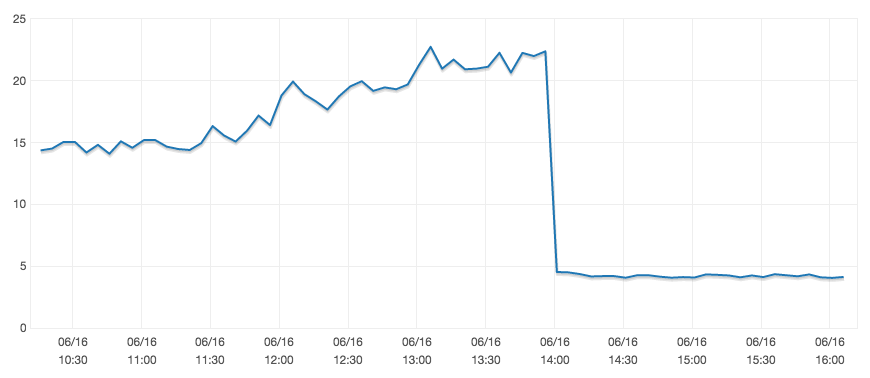
This resolve the issue however we don't understand why you need to store a ttl for tokens. Isn't it enough to have the expires_in field in the access_token table?
In this way we could save disk, cpu and memory of the database.
Thanks
@PGBI @thefosk @thibaultcha
codebien
on 16 Jun 2017
@codebien nice!
The TTL interface is an abstraction that allows us to apply TTLs to data store rows for Postgres (this is a native Cassandra concept we leverage). TTLs here don't apply just to access tokens, but all data store entities. Eventually we want to refactor this approach to use a less heavy method with the joins currently in play.
Adding the index on primary_uuid_value is interesting. I would be curious to see how this interacts with other parts of Kong, and if a large number of writes would cause performance problems to constantly update this index (I suspect the answer is no, but I'd be curious to hear more about your experiences).
 p0pr0ck5
on 16 Jun 2017
p0pr0ck5
on 16 Jun 2017
@codebien Your intuition seems correct. I have opened a PR to create the missing indexes.
 subnetmarco
on 16 Jun 2017
subnetmarco
on 16 Jun 2017
Closing as this has been merged.
p0pr0ck5
on 26 Jun 2017
Related issues
 z843248880
·
3Comments
z843248880
·
3Comments
 hbagdi
·
3Comments
hbagdi
·
3Comments
 luka1983
·
4Comments
luka1983
·
4Comments
 ypscotto
·
3Comments
ypscotto
·
3Comments
 kwahome
·
3Comments
kwahome
·
3Comments
Most helpful comment
Hi guys,
today we have investigated on this. We resolved adding an index on
primary_uuid_valuecolumn.Here you can see the CPU usage graph of
RDS. We have about 80 req/s.This resolve the issue however we don't understand why you need to store a
ttlfor tokens. Isn't it enough to have theexpires_infield in theaccess_tokentable?In this way we could save disk, cpu and memory of the database.
Thanks
@PGBI @thefosk @thibaultcha