Kibana: [APM] Timeline: Indicate that spans are missing within transactions
Following a discussion in apm-server we want to indicate in the UI that spans are missing from the transaction.
 formgeist
All 16 comments
Proposed design implementation where we might show a callout indicating that the current trace sample is missing spans. Span count not matching the shown spans in the Timeline. We probably have to have some documentation that might instruct users what might be happening and options to improve their instrumentation (if that's possible). Otherwise, we might as well remove the documentation link.

cc @elastic/apm-ui
formgeist
on 30 Aug 2018
@simitt @felixbarny Thoughts on implementing this into the design of the Timeline?
formgeist
on 30 Aug 2018
I like it.
Notes on the implementation: the expected and actual number of spans has to be calculated via ES queries. I'm using pseudo SQL here to describe the logic of the queries.
- expected number:
SELECT sum(span_count.total) FROM transaction WHERE transaction.trace_id = $traceId - total number:
SELECT count(*) FROM span WHERE span.trace_id = $traceId
The reason is that in the trace details view, we don't load all spans, but only load them on demand, based on which ones are currently expanded.
 felixbarny
on 30 Aug 2018
felixbarny
on 30 Aug 2018
@felixbarny That's a great help. Minor question, but do you think it's possible we can supply the user with some more background and possible suggestions to their instrumentation to make things better, or is that completely down to individual implementation and frameworks etc.?
formgeist
on 30 Aug 2018
@felixbarny just to further clarify, perhaps adding a docs page either per agent or apm-server that helps the user out a bit.
formgeist
on 30 Aug 2018
There is usually nothing the agent can do to fix that situation. I think the most frequent source of error would be a full APM server queue, which could indicate an ES capacity problem. But it could also be the result of a validation error -> bug in the agent.
Long story short, I think it makes sense to link to a page in the APM server docs, as I don't see that it makes sense to link to an agent-specific documentation.
felixbarny
on 30 Aug 2018
The reason is that in the trace details view, we don't load all spans, but only load them on demand, based on which ones are currently expanded.
@felixbarny
In the current tranaction details view, all spans are loaded up-front. Are you saying this will be an issue with DT, and only the spans/transactions within the viewport should be loaded?
I'm not necessarily talking about loading stack traces for all spans (which is 95% of a span), perhaps just metadata.
If my approach scales it will be possible to calculate missing spans on the client, which is very straightforward.
 sqren
on 30 Aug 2018
sqren
on 30 Aug 2018
I don't have the issue at hand, but I thought we already discussed this somewhere.
Especially in the context of DT, the transactions/spans should be loaded lazily. The performance of the UI should still be acceptable when rendering 10k+ spans.
felixbarny
on 30 Aug 2018
Especially in the context of DT, the transactions/spans should be loaded lazily. The performance of the UI should still be acceptable when rendering 10k+ spans.
Okay, I must have missed that. I agree that we can't draw 10k+ spans without giving the user a bad experience. This will add some complexity both to query spans in a paginated fashion, and how it's lazily loaded as the user scrolls up or down.
I can imagine it also opens up some UX issues. How does a user even navigate and find what they need in waterfall of 10k+ items?
sqren
on 30 Aug 2018
We should probably discuss this in a separate issue.
I've added my thoughts about that here: https://github.com/elastic/kibana/issues/20660
felixbarny
on 30 Aug 2018
In a large trace, it might be quite common that there is a span missing here and there. Another approach would, therefore, be to indicate for a specific transaction that there are spans missing for it. Similar to the design proposal for https://github.com/elastic/kibana/issues/22347.
felixbarny
on 31 Aug 2018
@felixbarny Would it be safe to just do both - show a warning at the top of the trace to inform the user, and indicate for each specific transaction that it has missing spans?
formgeist
on 20 Sep 2018
It would be safe, but might lead to some clutter and would alert users even if nothing really bad happens. If the user doesn't even navigate to the transaction which is missing spans, they would not care anyway.
felixbarny
on 20 Sep 2018
Perhaps incorporating the per transaction warning is better than a callout at the top of the trace as it was proposed in https://github.com/elastic/kibana/issues/22347#issuecomment-417302170. I'll update the design.
formgeist
on 21 Sep 2018
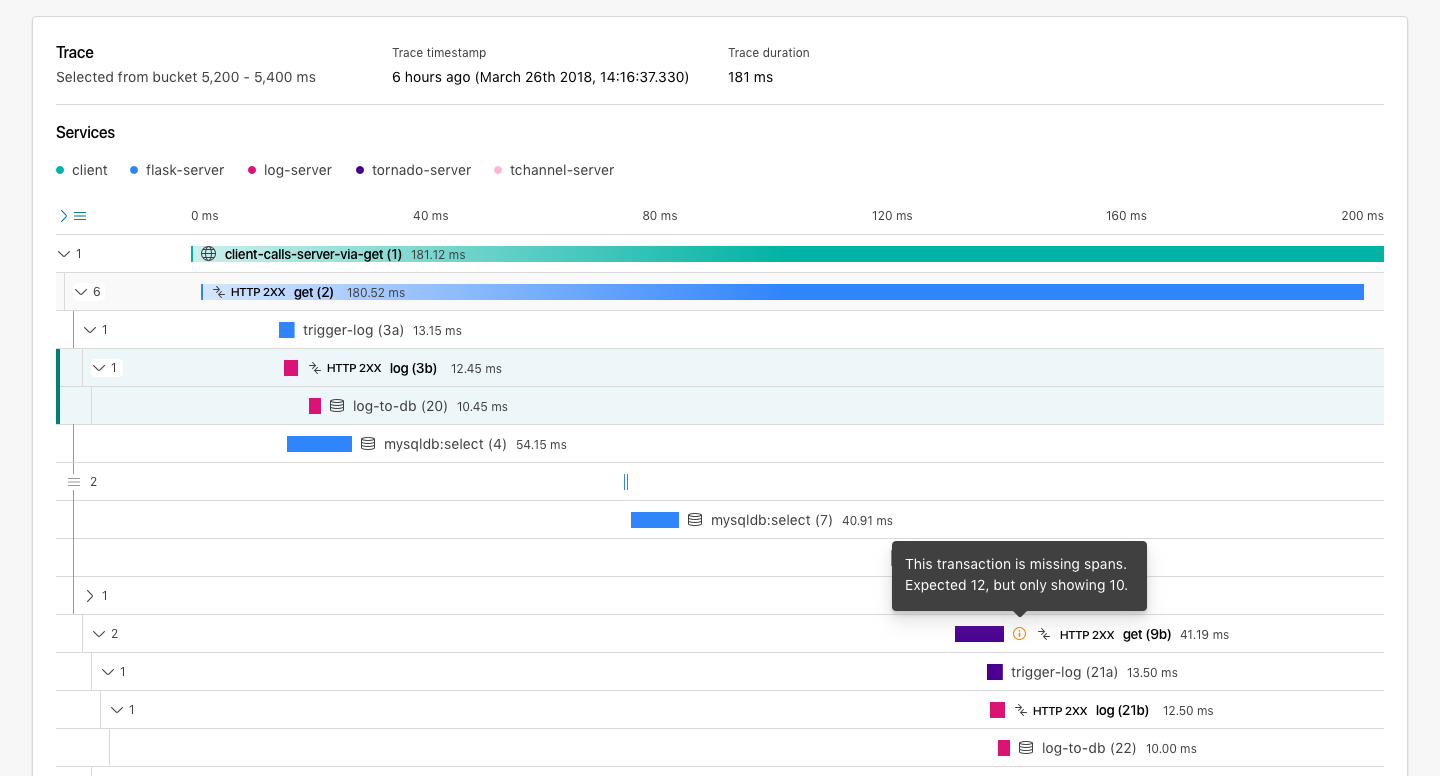
Updated design proposal, moving the warning to transaction level instead of a trace header warning. Makes it more relevant for the individual transaction as suggested previously by @felixbarny
formgeist
on 21 Sep 2018
Moving into implementation https://github.com/elastic/kibana/issues/24320
formgeist
on 22 Oct 2018
Related issues
 MaartenUreel
·
3Comments
MaartenUreel
·
3Comments
 bhavyarm
·
3Comments
bhavyarm
·
3Comments
 ynux
·
3Comments
ynux
·
3Comments
 timroes
·
3Comments
timroes
·
3Comments
 Ginja
·
3Comments
Ginja
·
3Comments
Most helpful comment
Updated design proposal, moving the warning to transaction level instead of a trace header warning. Makes it more relevant for the individual transaction as suggested previously by @felixbarny