Keras: custom metric MAE and RMSE are the same
This is a reproducible example:
consider this
from keras.models import Sequential
from keras.layers import Dense, Activation
import numpy as np


import keras.backend as K

def rmse (y_true, y_pred):
    return K.sqrt(K.mean(K.square(y_pred -y_true), axis=-1))


model = Sequential([
    Dense(32, input_shape=(50,)),
    Activation('relu'),
    Dense(1),
])

model.compile(optimizer='adam', loss='mse', metrics=['mae',rmse])


data = np.random.random((1000, 50))
labels = np.random.randint(2, size=(1000, 1))

model.fit(data, labels, epochs=5, batch_size=64)
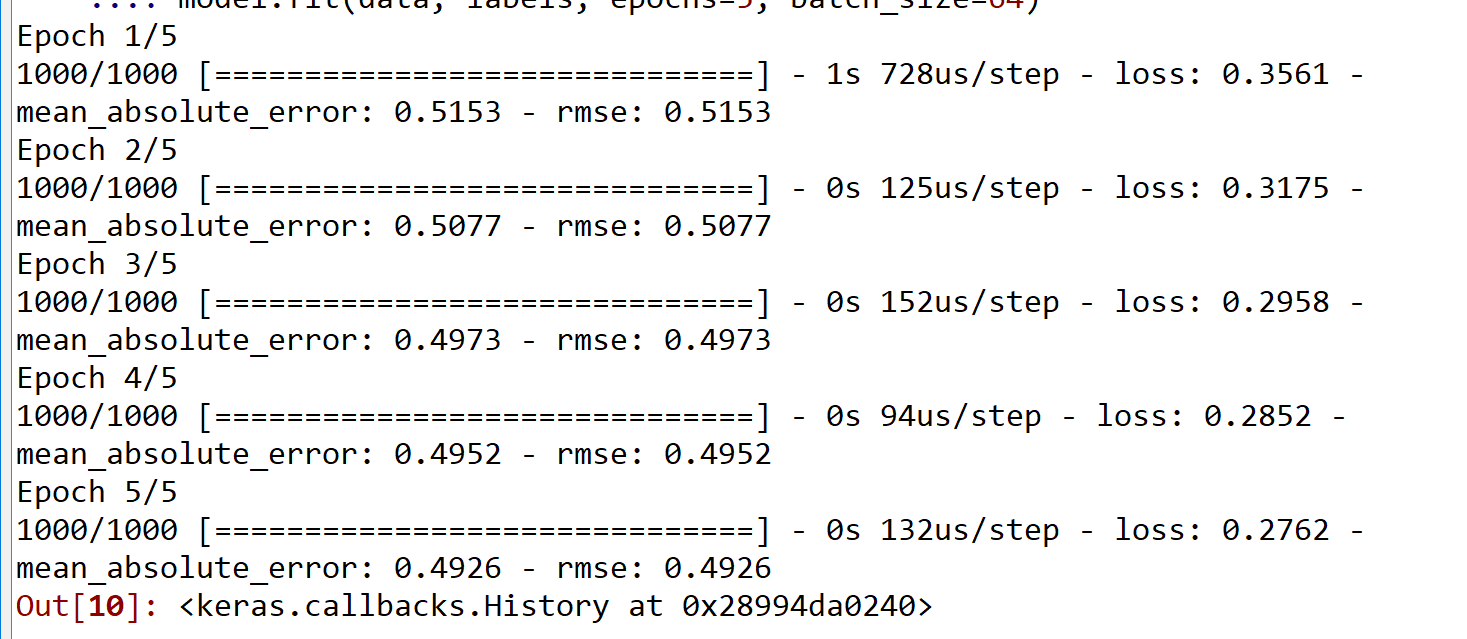
Both RMSE and MAE are the same. This happens when i placed them together. Is there a bug?
the output is:
 germayneng
All 12 comments
Rmse calculation is wrong. Try to get rid of axis=-1 - I had problems with RMSE before and removing the axis argument worked for me
 tRosenflanz
on 17 Jul 2018
tRosenflanz
on 17 Jul 2018
thanks man. Without the axis = -1, it seems to be correct. The axis -1 is based on the original metrics. May i ask why was the axis -1 needed in the first place? (for the Original metrics defined in tf)
germayneng
on 18 Jul 2018
I have no idea in this case to be honest - if nothing else it should be axis=0. Otherwise it was doing square, mean of each number (i.e. nothing) and square root of the square (i.e. absolute value of original calculation) so it was just returning mae
tRosenflanz
on 18 Jul 2018
yes thinking about it, the mean should be computed along axis = 0, otherwise, it will simply return the original vector.
but in the case of axis = -1, wouldnt there be an error since we still have a vector even after the sqrt?
germayneng
on 18 Jul 2018
It is possible that somewhere in Keras code it calls the mean on the vector
since most losses/metrics have mean as the last operation (mse, Mae, logloss, etc).
I will investigate...
On Tue, Jul 17, 2018, 10:53 PM Germayne notifications@github.com wrote:
yes thinking about it, the mean should be computed along axis = 0,
otherwise, it will simply return the original vector.but in the case of axis = -1, wouldnt there be an error since we still
have a vector even after the sqrt?—
You are receiving this because you commented.
Reply to this email directly, view it on GitHub
https://github.com/keras-team/keras/issues/10706#issuecomment-405800716,
or mute the thread
https://github.com/notifications/unsubscribe-auth/AX4ZrRo-iZr4h6j5Y8TTFiQIEBme5HuLks5uHrFAgaJpZM4VSa6A
.
tRosenflanz
on 18 Jul 2018
Update:
At least in losses we have this line that explicitly calls K.mean on the loss
https://github.com/keras-team/keras/blob/f86bc57d621fb0325e928271b246d197611b0e65/keras/engine/training_utils.py#L422
tRosenflanz
on 18 Jul 2018
@tRosenflanz if so, like you mentioned above, the 'mean' in my code didnt work, and computed a vector of absolute differences with k.mean called at the end. Resulting in MAE as output.
This definitely also explains why MSE code work as opposed to my custom RMSE
ty. You have been really helpful
germayneng
on 19 Jul 2018
Okay, this explains the behaviour pretty well at this point - although this is not documented explicitly from what I can tell- the losses and metrics are computed based on the mean implicitly. Can you please close the issue ?
tRosenflanz
on 19 Jul 2018
@uwu-ai what version of Keras/tf and what is the shape of your output?
Have you tried passing different axis arguments into the mean?
tRosenflanz
on 24 May 2020
Output shape is 1,1 or Batch_size,1,1?
tRosenflanz
on 25 May 2020
Does your generator output sample weights by any chance?
tRosenflanz
on 25 May 2020
Can you disable that and see what loss you get? This way it will be easier to understand how rmse and mse actually correlate
tRosenflanz
on 25 May 2020
Related issues
 harishkrishnav
·
3Comments
harishkrishnav
·
3Comments
 rantsandruse
·
3Comments
rantsandruse
·
3Comments
 zygmuntz
·
3Comments
zygmuntz
·
3Comments
 Imorton-zd
·
3Comments
Imorton-zd
·
3Comments
 vinayakumarr
·
3Comments
vinayakumarr
·
3Comments
Most helpful comment
Rmse calculation is wrong. Try to get rid of
axis=-1- I had problems with RMSE before and removing the axis argument worked for me