I'm having trouble trying to get dropout working during the prediction stage (i.e., trying to get an estimate of uncertainty around my predictions).
There seems to be some options for this in Keras through the 'training=True' option when adding a dropout layer: https://github.com/keras-team/keras/issues/9412#issuecomment-366487249. Though I haven't been able to get it to work with the keras package in R.
Is there a way to force dropouts when running 'predict'?
 tbonne
All 5 comments
Yes, you can do this. Layers are essentially functions so if we use the Keras functional API we can call them with arbitrary parameters (like the training=TRUE one you need here). For example:
dropout_1 <- layer_dropout(rate = 0.4)
dropout_2 <- layer_dropout(rate = 0.3)

input <- layer_input(shape = c(784))
output <- input %>%
  layer_dense(units = 256, activation = 'relu', input_shape = c(784)) %>%
  dropout_1(training = TRUE) %>%
  layer_dense(units = 128, activation = 'relu') %>%
  dropout_2(training = TRUE) %>%
  layer_dense(units = 10, activation = 'softmax')

model <- keras_model(input, output)
 jjallaire
on 12 Apr 2018
jjallaire
on 12 Apr 2018
Thanks for clarifying. This is truly a great package.
Below is a small regression example in case it can be of use to anyone else:
```{r}
library(keras)
library(rsample)
SIMULATED data
x1 <- rnorm(1000,0,0.5)
x2 <- rnorm(1000,2,1)
y <- x1*x2 + x1^2
dat <- data.frame(y,x1,x2)
dat
get data into training and testing datasets
retrain_test_split <- initial_split(dat, prop = 0.8)
train_tbl <- training(retrain_test_split)
test_tbl <- testing(retrain_test_split)
get inputs and outputs for the networks
x_train_tbl <- as.matrix(train_tbl %>% dplyr::select(-y))
y_train_tbl <- as.matrix(train_tbl %>% dplyr::select(y))
x_test_tbl <- as.matrix(test_tbl %>% dplyr::select(-y))
y_test_tbl <- as.matrix(test_tbl %>% dplyr::select(y))
MODEL
layers
dropout_1 <- layer_dropout(rate = 0.4)
dropout_2 <- layer_dropout(rate = 0.3)
input <- layer_input(shape = c(2))
output <- input %>%
layer_dense(units = 32, activation = 'relu', input_shape=c(2)) %>%
dropout_1(training = TRUE) %>%
layer_dense(units = 32, activation = 'relu') %>%
dropout_2(training = TRUE) %>%
layer_dense(units = 1)
model1 <- keras_model(input,output)
Compile model
model1 %>% compile(
optimizer = 'rmsprop',
loss = 'mse'
)
FIT
history <- model1 %>% fit(
x = x_train_tbl,
y = y_train_tbl,
epochs=500,
batch_size=128,
validation_data = list(x_test_tbl,y_test_tbl )
)
plot(history)
EVALUATE
dist_scores <- vector()
for(i in 1:100){
score <- model1 %>% evaluate(
x = x_test_tbl,
y = y_test_tbl,
batch_size = 128)
dist_scores[length(dist_scores)+1]<-sqrt(score) #RMSE
}
hist(dist_scores, xlab = "Model RMSE")
PREDICT - predictions around one point as an example
pred.dat <- vector()
for(i in 1:100){
pred<-predict(model1,as.matrix(x_test_tbl))
pred.dat[length(pred.dat)+1] <- pred[1,]
}
hist(pred.dat) #predicted points
abline(v= as.matrix(y_test_tbl) [1], col="red") #actual point
```
tbonne
on 12 Apr 2018
Hi,
Thanks for your comment. But how to obtain the distribution over all observations of y? Would really appreciate your help.
 EhtashamBillah
on 26 Apr 2018
EhtashamBillah
on 26 Apr 2018
Hi,
I have not been able to find documentation regarding applying Monte Carlo Dropout during test time, as suggested by Yarin Gal. However, I have tried to do so in R. I need your suggestions if I am doing it wrong.
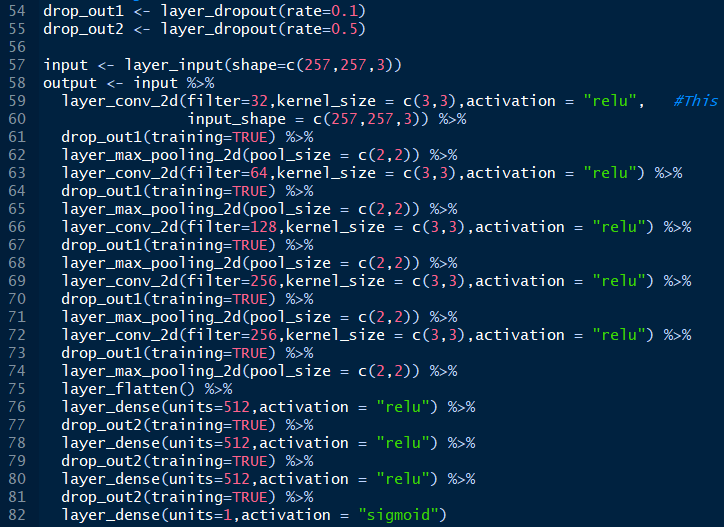
As you can see, I am applying dropout with the ARGUMENT "training=TRUE".
I am doing the data augmentation and creating the train data with train generator function.I have 230 observations in my training data

I fit the model with dropout being active.I use fit generator function to fit the model

Finally, I want to predict the probability of y. I have 30 observations in test data and I want 100 probability value for each observation.I apply Monte Carlo dropout with predict generator function.

But I am not sure about the prediction part.I am not sure whether data is being passed 200 times through test data.Your suggestions will help a lot.
EhtashamBillah
on 5 May 2018
for regression
@EhtashamBillah In order to get all distribution of y for lets say X_test[23] , just use
for i=1 to 500
y_pred <- model.predict(X_test[23])
y_pred_samples[i]<-y_pred
Now y_pred_samples [array] is the samples of the posterior distribution for X_test[23]. Use mean(y_pred_samples) for evaluation and get uncertainty of the model's prediction with std(y_pred_samples). If you want something quick, evaluate all X_test set with the mean. Otherwise, figure out how to use the uncertainty in the evaluation process.
sorry for the pseudo code in the for the loop
 aplamhden22
on 14 Jan 2019
aplamhden22
on 14 Jan 2019
Related issues
 saanasum
·
4Comments
saanasum
·
4Comments
 faltinl
·
6Comments
faltinl
·
6Comments
 gsimchoni
·
3Comments
gsimchoni
·
3Comments
 vincenhe
·
7Comments
vincenhe
·
7Comments
 gundalav
·
3Comments
gundalav
·
3Comments
Most helpful comment
Yes, you can do this. Layers are essentially functions so if we use the Keras functional API we can call them with arbitrary parameters (like the
training=TRUEone you need here). For example: