Keras-yolo3: why i run train.py is ok,but run train_bottleneck is wrong:loss:nan,val_loss:nan
run the train_bottleneck :
start like this:
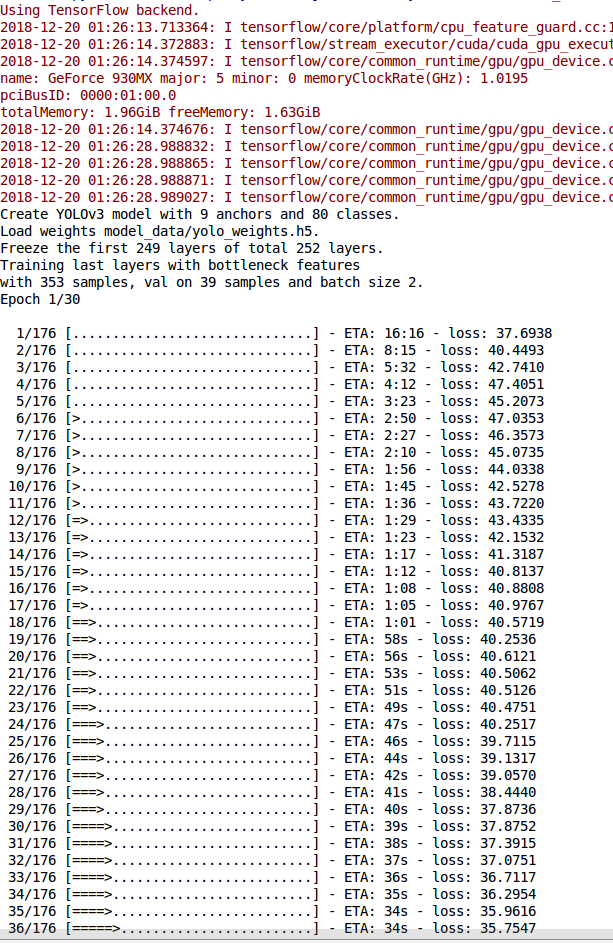
later change to this:
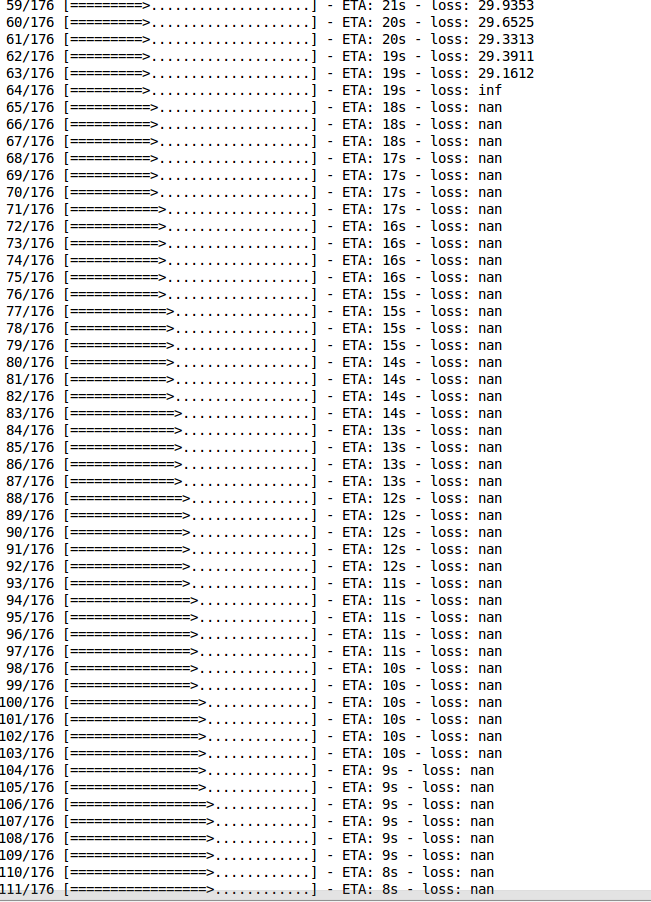
can someone tell me why?
 AryaCao
All 7 comments
It seems to be that the parameters:steps of " bottleneck_model.predict_generator" is wrong?
AryaCao
on 20 Dec 2018
hello,can you tell me the different between the train.py and the train_bottleneck.py?Which one should I use?
 Fingerl
on 21 Dec 2018
Fingerl
on 21 Dec 2018
hello , I think that the two file has same function.
The 'train_bottlenck.py' can speed up the training process in cpu or gpu, because it will compute the bottleneck features of the frozen model first(saved in the .npy files) and then load the features to train the last layers.
I think that you can just use the train.py, if you have a gpu (good compute capability ).
AryaCao
on 22 Dec 2018
thank you
Fingerl
on 23 Dec 2018
I was able to fix this by adding the following lines around 383 of yolo3/model.py:
_(right below the existing K.switch... statement)_
# filter out inf/nan values encountered here:
raw_true_wh = K.switch(tf.is_inf(raw_true_wh), raw_true_wh, K.zeros_like(raw_true_wh))
raw_true_wh = K.switch(tf.is_nan(raw_true_wh), raw_true_wh, K.zeros_like(raw_true_wh))
This is a bit of a hack; there may be some data-related causes for those inf/nan values to occur, but I wasn't able to find them in my data set; then again, it can't hurt to be less sensitive to bogus data, right?
 matt-deboer
on 13 Feb 2019
matt-deboer
on 13 Feb 2019
@AryaCao 请问如何使用gpu运行train.py文件呢?需要额外的指令代码吗?
 CherishineNi
on 16 Mar 2019
CherishineNi
on 16 Mar 2019
I have the same problem. How did you solve it?
 monicatao
on 10 Aug 2020
monicatao
on 10 Aug 2020
Related issues
 nguyeho7
·
4Comments
nguyeho7
·
4Comments
 ISSstone
·
4Comments
ISSstone
·
4Comments
 warsi22
·
3Comments
warsi22
·
3Comments
 hejie
·
6Comments
hejie
·
6Comments
 jinbooooom
·
4Comments
jinbooooom
·
4Comments
Most helpful comment
I was able to fix this by adding the following lines around
383ofyolo3/model.py:_(right below the existing
K.switch...statement)_This is a bit of a hack; there may be some data-related causes for those inf/nan values to occur, but I wasn't able to find them in my data set; then again, it can't hurt to be less sensitive to bogus data, right?