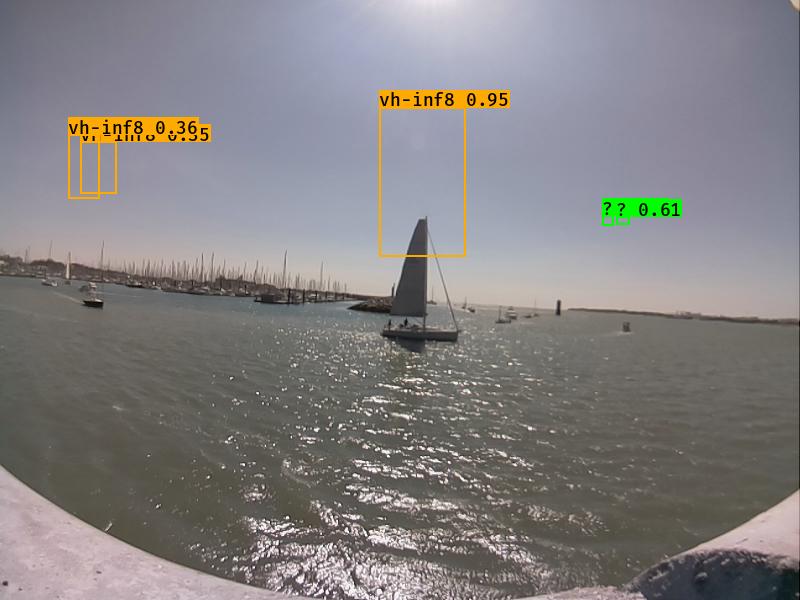
@qqwweee I don't know why the loss become nan when i trained on total parameter and i got this result when i trained in 3 last parameters!
Can you help me fix this problem, pls!
 maiminh1996
All 5 comments
@maiminh1996 Have you solved the same problem? Expected reply
 xm1112
on 19 Jul 2018
xm1112
on 19 Jul 2018
I also have the same problem
 mbalty
on 17 Feb 2019
mbalty
on 17 Feb 2019
I also have the same problem, val_loss=Nan. Expected reply
 wtx8887
on 5 Mar 2019
wtx8887
on 5 Mar 2019
Any solution to this?
 AGrosserHH
on 22 May 2019
AGrosserHH
on 22 May 2019
I have a solution here that works for me. Basically if the box's width or height is too small, after resizing to size or 416x416, either or both box's width and height become 0. If this is the case, the loss function will fail at this step:
def yolo_loss(args, anchors, num_classes, ignore_thresh=.2, print_loss=False):
...
raw_true_wh = K.log(y_true[l][..., 2:4] / anchors[anchor_mask[l]] * input_shape[::-1])
raw_true_wh = K.switch(object_mask, raw_true_wh, K.zeros_like(raw_true_wh)) # avoid log(0)=-inf
due to the fact that the switch was intended to avoid where there is no box, not where the box was accidentally removed.
To fix this, simply adding a tiny term to the K.log function:
def yolo_loss(args, anchors, num_classes, ignore_thresh=.2, print_loss=False):
...
raw_true_wh = K.log(y_true[l][..., 2:4] / anchors[anchor_mask[l]] * input_shape[::-1] + 1e-10)
raw_true_wh = K.switch(object_mask, raw_true_wh, K.zeros_like(raw_true_wh)) # avoid log(0)=-inf
which won't result in any performance changes.
 datduonguva
on 18 Aug 2019
datduonguva
on 18 Aug 2019
Related issues
 Exorcismus
·
3Comments
Exorcismus
·
3Comments
 laihaotao
·
5Comments
laihaotao
·
5Comments
 dmadhitama
·
5Comments
dmadhitama
·
5Comments
 nseidl
·
3Comments
nseidl
·
3Comments
 dongdyang
·
6Comments
dongdyang
·
6Comments
Most helpful comment
I have a solution here that works for me. Basically if the box's width or height is too small, after resizing to size or 416x416, either or both box's width and height become 0. If this is the case, the loss function will fail at this step:
due to the fact that the switch was intended to avoid where there is no box, not where the box was accidentally removed.
To fix this, simply adding a tiny term to the K.log function:
which won't result in any performance changes.