Keepassxc: Partial password may be leaked if it contains "{" and "}"
Expected Behavior
No password is exposed unless explicit user actions (copy, auto type, export, ...) or pre-authentication (keepasshttp, ...)
Current Behavior
If a password contains {foobar} and it can't be resolved, an error message with partial password is printed to the terminal. For example:
Can't resolve placeholder {foobar} for entry with uuid 12345678
Possible Solution
- Allow disabling placeholder resolution. Making
ResolveMaximumDepthconfigurable should work. - Disable error messages that may contain sensitive information (unconditionally or only in RELEASE builds)
- Don't print error messages related to placeholders
- Don't run keepassxc from terminal
Steps to Reproduce (for bugs)
- Run keepassxc from the terminal
- Create a new entry
- Set its password to
foobar{foobar} - Check terminal messages
Context
I noticed quite a few "Can't resolve placeholder" messages in my terminal after bumping to the latest git-master. They are annoying and might have security issues. And seems such invalid placeholders are common in long generated passwords.
Debug Info
KeePassXC - Version 2.2.2
Revision: 5718f3d
Libraries:
- Qt 5.9.2
- libgcrypt 1.8.1
Operating system: Arch Linux
CPU architecture: x86_64
Kernel: linux 4.13.9-1-ARCH
Enabled extensions:
- Auto-Type
 yan12125
All 20 comments
Nice catch
 TheZ3ro
on 27 Oct 2017
TheZ3ro
on 27 Oct 2017
Setting milestone to v2.3.0 because the regression is in #1078 that will be available in 2.3.0
TheZ3ro
on 28 Oct 2017
@frostasm what do you think about this? I know that the warning is there for let the user know that a placeholder is not supported (for example).
Most users won't run KeePassXC from terminal so they won't even read the warning, should we remove it entirely or should we remove the {placeholder} print from it?
ex qWarning("Can't resolve placeholder for entry with uuid %s", qPrintable(uuid().toHex()));
TheZ3ro
on 28 Oct 2017
@TheZ3ro tomorrow I'll try to offer some sort of solution
 frostasm
on 28 Oct 2017
frostasm
on 28 Oct 2017
@frostasm You don't have to solve it youself if you don't want :smile: I can do it myself, just want to know your opinion since you added that chunk of code
TheZ3ro
on 28 Oct 2017
@TheZ3ro I need some time to think about this problem ;)
frostasm
on 28 Oct 2017
@TheZ3ro I think we need remove qWarning for Unknown placeholders. And maybe in the future, we should add some validation for input fields, for example when we save the entry.
frostasm
on 29 Oct 2017
Maybe it's better to exclude password field from any kind of parsing (for placeholders, etc)? Since data in the password field can be quite unpredicted, this could help avoid bugs due to poor sanitizing or parsing errors altogether.
 rkiyanchuk
on 30 Oct 2017
rkiyanchuk
on 30 Oct 2017
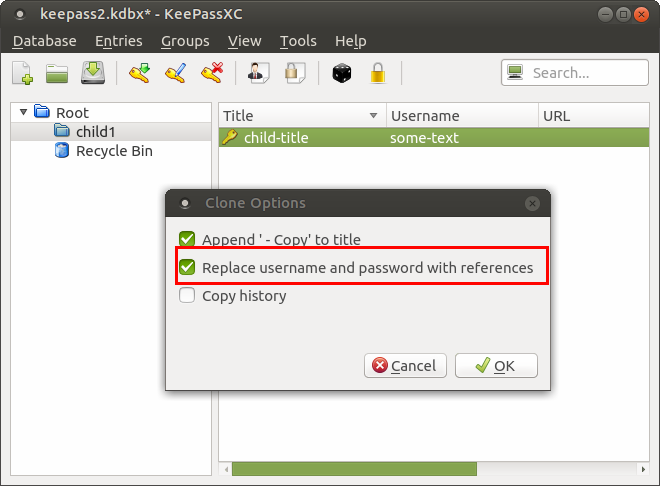
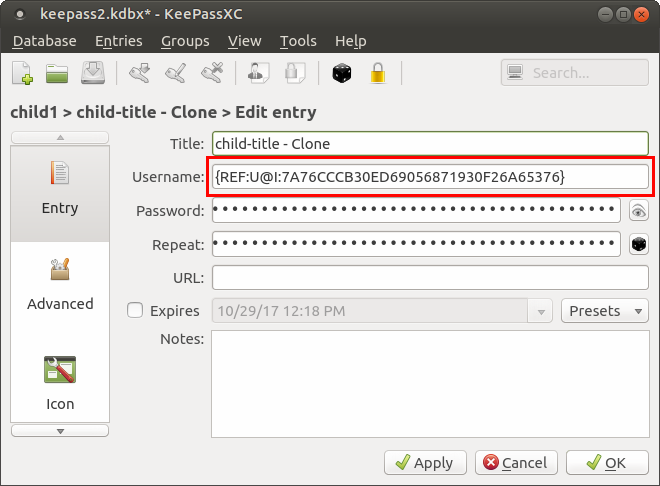
@zoresvit this isn't a viable option since the password field can contain placeholders (that need to be parsed)
for exaple try cloning an entry.
TheZ3ro
on 30 Oct 2017
@TheZ3ro Sounds scary :) But thanks for the explanation.
rkiyanchuk
on 30 Oct 2017
@zoresvit
@TheZ3ro was talking about cloning entries with references
frostasm
on 31 Oct 2017
Maybe we can set the password field as "special" and parse for placeholder only if it starts for { and ends for }
TheZ3ro
on 31 Oct 2017
Unfortunately, a random password can begin with {and end with } :(
frostasm
on 2 Nov 2017
Yup, even better since you will leak the full password 😝 (ironic btw)
TheZ3ro
on 2 Nov 2017
Checking for .begin("{REF:") && .end("}") would rule out 99.99999% of randomized passwords.
 droidmonkey
on 2 Nov 2017
droidmonkey
on 2 Nov 2017
But this way you assume that a password must start with a reference placeholder otherwise no placeholder will be parsed.
If we want we can limit passwords to 1 reference only placeholder but I don't think this is a good approach.
I'm thinking of passwords like {REF:}some_more_data
First thing is stop reporting errors in release mode (#ifndef QT_DEBUG)
TheZ3ro
on 2 Nov 2017
@TheZ3ro While I don't see any use case for references and especially placeholders in the password field, if it is required by some, the only way to avoid ambiguity here is to store the reference information elsewhere. Like having separate variable for indicating the field contains placeholder/reference and specifying what placeholder exactly to look for. Otherwise it's just changing the possibility of conflict between random password and intentional placeholder.
rkiyanchuk
on 2 Nov 2017
My main goal was to report problems with incorrect placeholders in the records and this can be done in other ways. For example, we can add a tool to check the correctness of placeholders in the database. So I agree with @TheZ3ro and think it will be enough do not print passwords in release mode for closing this issue.
frostasm
on 11 Nov 2017
@frostasm @TheZ3ro Building on @zoresvit's suggestion: what about using an entry's additional attribute for specifying such behaviour? We could agree on using the special name of resolve-password as a flag for "the password field contains a placeholder that needs to be resolved". If no such "flag" exists for a given entry, no placeholder resolving is done for its password field's content.
 adolfogc
on 18 Nov 2017
adolfogc
on 18 Nov 2017
If the db comes from KeePass (that doesn't implement this special attribute flag) the password will still leaks.
I think it's fine to suppress errors in Release builds
TheZ3ro
on 18 Nov 2017
Related issues
 MisterY
·
3Comments
MisterY
·
3Comments
 Throne3d
·
3Comments
Throne3d
·
3Comments
 n1trux
·
3Comments
n1trux
·
3Comments
 shyim
·
3Comments
shyim
·
3Comments
 813gan
·
3Comments
813gan
·
3Comments
Most helpful comment
@TheZ3ro While I don't see any use case for references and especially placeholders in the password field, if it is required by some, the only way to avoid ambiguity here is to store the reference information elsewhere. Like having separate variable for indicating the field contains placeholder/reference and specifying what placeholder exactly to look for. Otherwise it's just changing the possibility of conflict between random password and intentional placeholder.