Suggested as a precursor to full equation numbering support in #350, it has AFAICT the following behavior:
- add a
\tagcommand will force the math to typeset in display mode but respects the current style - only one
\tagcommand is allowed per math block - the content of the
\tagis typeset intextmode (not sure if entering math mode is allowed or not, my assumption would be not) - the content of the
\tagis right aligned and typset within parens, e.g.\tag{3.1c}yields(3.1c)
 kevinbarabash
All 9 comments
- I've been unable to get
\tagto work in inline math mode (both$...$and\(...\)). I get! Package amsmath Error: \tag not allowed here.So I think it makes sense to raise a similar error in KaTeX. (Can't imagine how the styling would make sense in inline mode.) - I also found that
\tagdoesn't work in$$...$$(same error), only\[...\]. Weird. I kind of understand why, but I don't think we can/need to inherit the same limitation. - Repeated
\tagindeed produces! Package amsmath Error: Multiple \tag. - You can definitely enter math mode within the
\tagargument. Indeed,\tag{$\star$}is common form. But we support that already, if we parse\taglike\text. \tag*omits the the parens, so we should probably support that too.
One challenge here is getting the CSS layout right. To implement \hfill <displaymath> \hfill <tag>, I think we need flexbox, right?
Another challenge is carrying the \tag, which can appear anywhere in the equation, to the end. Variable carrying is somewhat related to \setlength (#687), though at least with \tag the setting is global.
 edemaine
on 20 Sep 2017
edemaine
on 20 Sep 2017
\Huge
\[a + b\] \\
\[a + b \tag{c}\]
produces
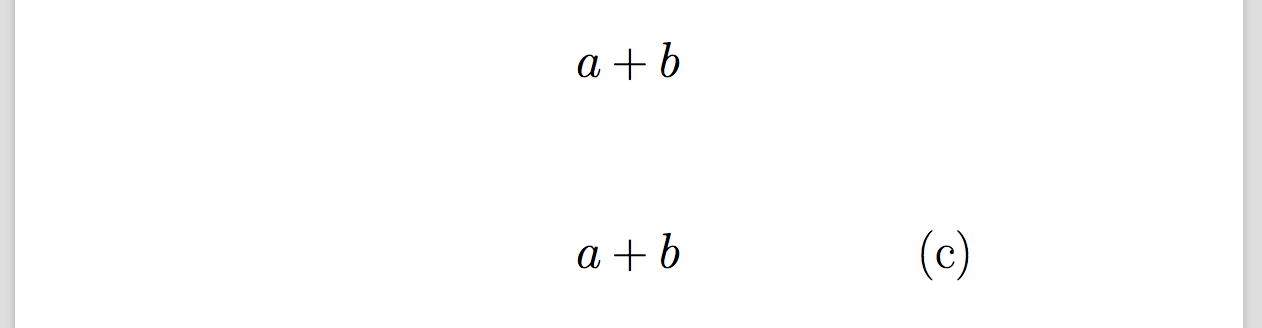
which leads me to believe that we can absolutely position the tag to the right. \hfill <displaymath> \hfill <tag> I think would have a + b position slightly off center iiuc.
kevinbarabash
on 20 Sep 2017
For what it's worth, I would argue that the equation number is not part of the math typesetting at all, and could simply produce an additional HTML element within katex-display. That way, the tag can easily be styled and positioned without the risk of throwing the math off.
Besides, it would be nice if the tags could function as anchors in some automatic way.
 ntessore
on 20 Sep 2017
ntessore
on 20 Sep 2017
@kevinbarabash Oh, right -- that's convenient! Maybe a float would be better (with a clear afterward), so that we can push it to the next line on overfill?
\[\tag{x+y+$x+y$+x+y+x} x+y+x+y+x+y+x+y+x+y+x+y+x+y+x+y+x+y+x+y+x+y \]

@ntessore Yes, of course we can use a class like katex-tag that enables the user to restyle as they desire. But I'd like to have a good default formatting, like we do for katex-display.
edemaine
on 20 Sep 2017
@edemaine finally a legit use of float ^_^
kevinbarabash
on 20 Sep 2017
I did some experiments with this. Unfortunately, there seems to be no perfect answer...
float: rightleads to bad vertical alignment: floats are always pushed as high as possible, so we can't align them to the baseline.position: absoluteandposition: relativecan cause tag to overlap with a wide formula (no go-to-second-line behavior), and I don't see how to get it to vertically align to the baseline while also doing some horizontal centering.- Flexbox seems like the best bet, though it won't do LaTeX's horizontal centering as @kevinbarabash found -- the best we can do is the equivalent of
\hfill <equation> \hfill <tag>. (I tried putting an invisible copy of the tag on the left side, but there are circumstances where that doesn't do the right horizontal spacing.)
Option 3 seems the best compromise, though -- for short tags, it's only slightly off in horizontal spacing.
edemaine
on 10 Oct 2017
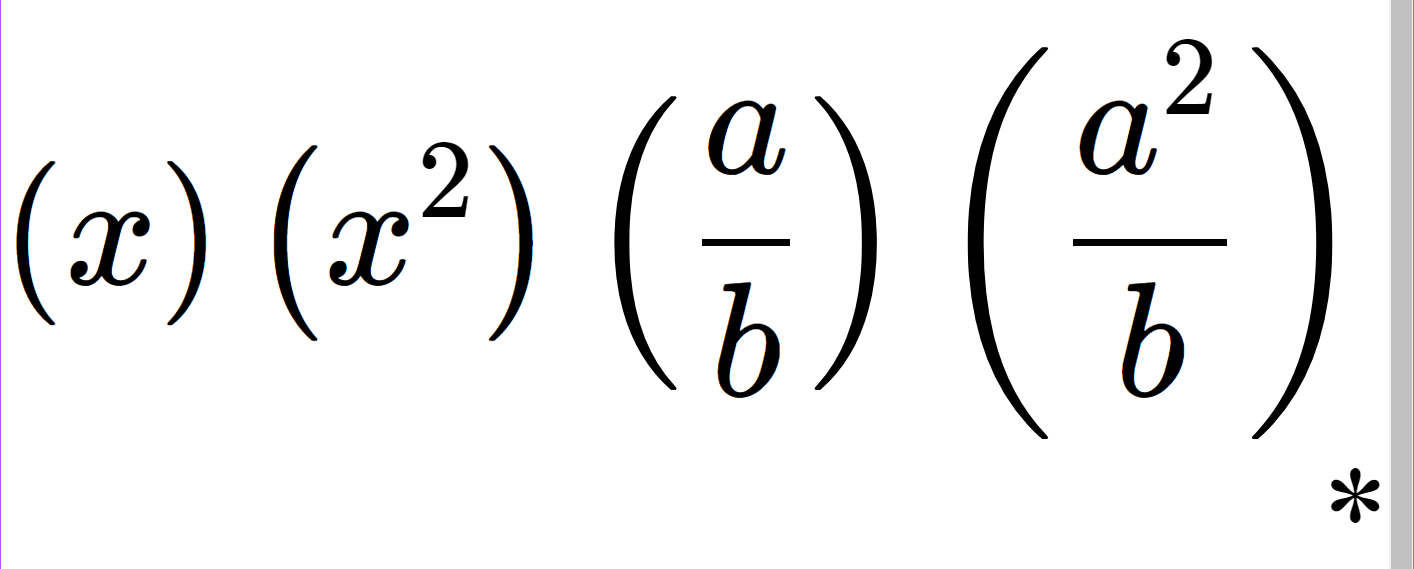
Here are two screenshots of Option 3 at different screen widths, showing the move-tag-to-next-line behavior possible with flexbox:

edemaine
on 11 Oct 2017
which leads me to believe that we can absolutely position the tag to the right.
In some document class, we can specify leqno option to place tags (and equation numberings) on the left.
For example,
\documentclass[leqno]{article}
\usepackage{amsmath,amssymb}
\pagestyle{empty}
\begin{document}
\[
 \int_{-\infty}^{\infty} e^{-x^{2}} \mathrm{d}x = \sqrt{\pi} \tag{\ensuremath{\star}}
\]
\end{document}
results in:

So, it might be appropriate to provide the option to specify tag/numbering position.
 konn
on 19 Oct 2017
konn
on 19 Oct 2017
\tag and \tag* are now on master branch, and 0.10.0-alpha.
edemaine
on 20 May 2018
Related issues
 shaunc
·
4Comments
shaunc
·
4Comments
 mbourne
·
3Comments
mbourne
·
3Comments
 OisinMoran
·
4Comments
OisinMoran
·
4Comments
 pvnr0082t
·
4Comments
pvnr0082t
·
4Comments
 asmeurer
·
3Comments
asmeurer
·
3Comments