Kakoune: Change the default face for Python docstring from string to comment.
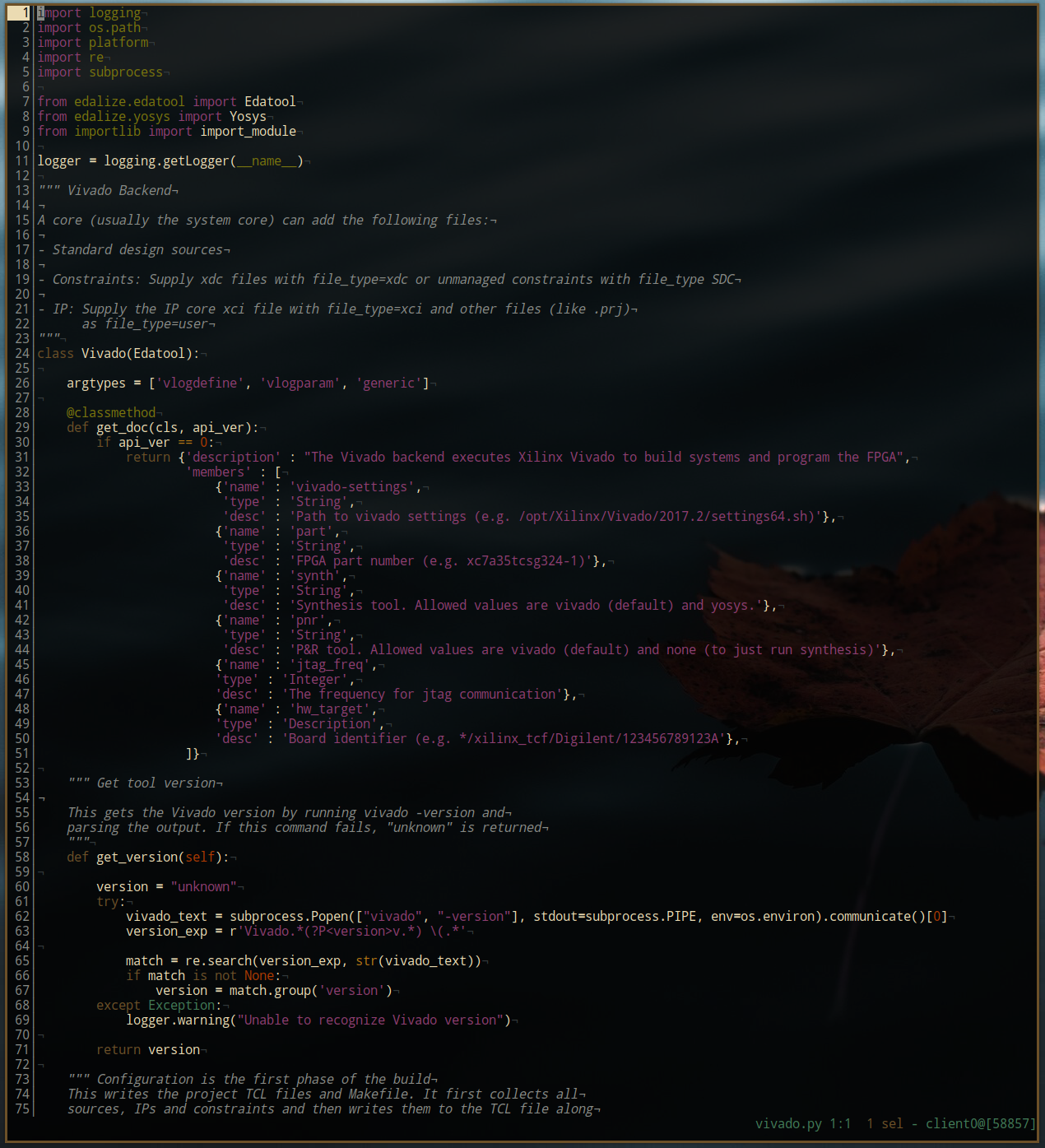
Docstring in Python files uses string face as the default one. I think it is bad idea. When you have both strings and docstrings on the display they blends together.
Example:

After potential change to comment.
 m-kru
m-kru
All 4 comments
As you might know the other main use case of triple quotes is to define strings than can contain newlines:
my_long_string = """This is a multi-line string,
where this is the second line
    then you can even have indented lines like this one.
"""
print(my_long_string)
print("""Another one with a newline at the end.
""")
Is there a reliable and robust way to detect whether a triple-quoted string is a docstring or a regular string? Vim also seems to not make this distinction. This change would be good for docstrings as long as we can reliably detect which one it is.
 caksoylar
on 29 Oct 2020
caksoylar
on 29 Oct 2020
I advised that change in the PR that introduces the documentation face.
Triple strings could be highlighted as documentation if they are not assigned to a variable, e.g. ^\h*"{3}\b.
 lenormf
on 30 Oct 2020
lenormf
on 30 Oct 2020
I was trying to fix this. However, I do not understand what is the meaning of (?<!\\)(?:\\\\)* within
add-highlighter shared/python/docstring region -match-capture ("""|''') (?<!\\)(?:\\\\)*("""|''') regions
This bit makes sure that the closing quote is not escaped.
lenormf
on 20 Nov 2020
Related issues
 abitofalchemy
·
3Comments
abitofalchemy
·
3Comments
 a12l
·
3Comments
a12l
·
3Comments
 1g0rb0hm
·
3Comments
lenormf
·
3Comments
1g0rb0hm
·
3Comments
lenormf
·
3Comments
 alexherbo2
·
4Comments
alexherbo2
·
4Comments
Most helpful comment
I advised that change in the PR that introduces the
documentationface.Triple strings could be highlighted as
documentationif they are not assigned to a variable, e.g.^\h*"{3}\b.