Jupyterhub: Authorization form must be sent from authorization page
Hi! after upgrading to master branch (around 40 days of new commits) admins are no longer able to impersonate users, we get this error right after clicking "Authorize" on the new page:
403 : Forbidden
Authorization form must be sent from authorization page
We are still using GitHubOAuthenticator and Postgres as backend.
Also other strange thing is happening, the admin page is not properly listing all users, but this is probably related to some of our custom page.html templates:

 elgalu
All 47 comments
Update I disabled all custom templates and the listing users issue persists.
Also, when clicking "Add Users" the new user doesn't appear. It will only appear if the user himself logs into the Hub independently of the admin.
Is this an intended changed behavior?
elgalu
on 3 Nov 2018
Found the problem, is related to being using http and https in different parts of the config settings
elgalu
on 3 Nov 2018
It seems I should switch to c.JupyterHub.internal_ssl = True in order to keep http_method consistency with my external TLS termination.
elgalu
on 3 Nov 2018
Interesting. We should add it to https://github.com/jupyterhub/jupyterhub/blob/master/docs/source/getting-started/security-basics.rst#if-ssl-termination-happens-outside-of-the-hub, no?
 hnykda
on 7 May 2019
hnykda
on 7 May 2019
I think this means something is wrong in the detection of what URL is being used to make the request. How is SSL termination being implemented? Since all of these requests are made by the client with HTTPS, it shouldn't be relevant whether internal SSL is used. That would only come up if the proxy-protocol is not properly forwarding that the request is made via HTTPS.
Is this perhaps on Amazon? I believe folks have seen incorrect proxy headers coming from Amazon load-balancers. I think we need to provide the ability to override public URLs in cases where the proxy-protocol doesn't properly preserve the request protocol.
 minrk
on 8 May 2019
minrk
on 8 May 2019
We have seen this on GCP with roughly this
hnykda
on 8 May 2019
thanks for the pointer. It would be helpful if someone had a reproducible test case where this occurs (I think it's somewhere in the proxy protocol reporting http when the client request is actually https). Dumping all of the headers for the rejected request would be useful, I think.
minrk
on 9 May 2019
So when I try to impersonate user:
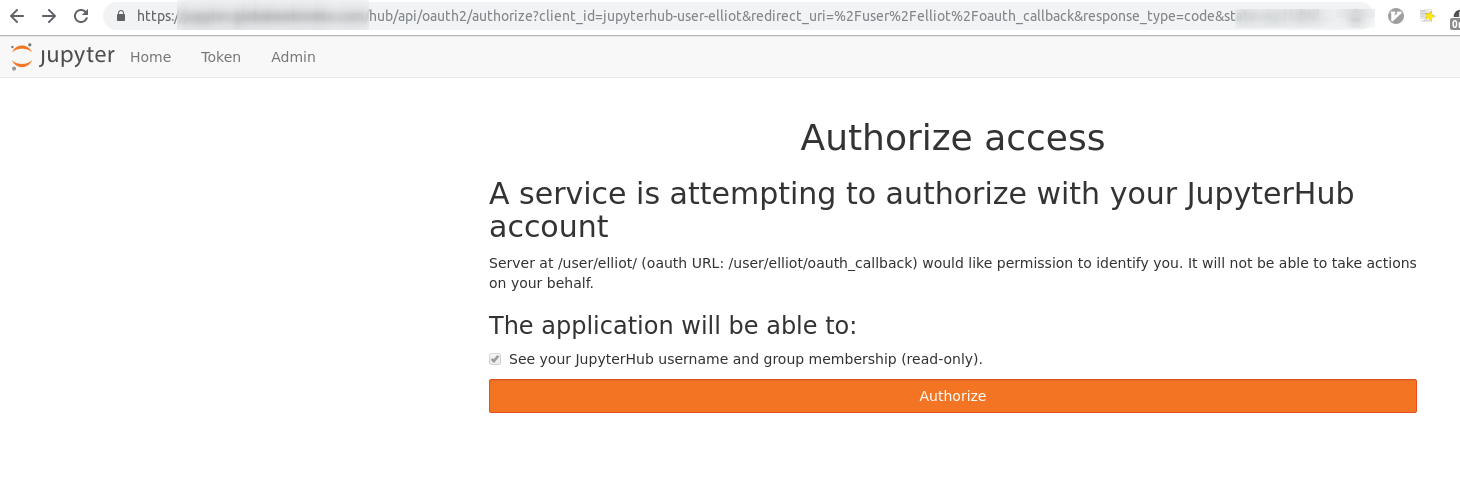
I click on authorize and the following HAR (annonymized) request/response 403 is returned:
https://gist.github.com/hnykda/1e7bad208c53971b04077a88bf01f313
hnykda
on 9 May 2019
any solution for this ?
 ahkui
on 29 May 2019
ahkui
on 29 May 2019
Is there some progress or solution? We use jupyterhub on GCP behind proxy which provides SSL connection so jupyterhub does not use internal SSL and it is quite complicated to use internal SSL in a such case.
 alpine-digger
on 5 Jun 2019
alpine-digger
on 5 Jun 2019
This issue seems related to https://github.com/jupyterhub/jupyterhub/issues/2604
 vnijs
on 21 Jun 2019
vnijs
on 21 Jun 2019
We faced the same issue today and did the following in our JupyterHub container: we have an nginx proxy (openresty version with lua support) started and there we added following lines as a workaround for now to the location / directive:
set $ref "";
access_by_lua_block {
if (ngx.var.http_referer ~= nil and ngx.var.http_referer ~= "") then
ngx.var.ref = string.gsub(ngx.var.http_referer, "https", "http")
end
}
proxy_set_header Referer $ref;
You can see the full nginx.conf here: https://github.com/ml-tooling/ml-hub/blob/develop/docker-res/nginx.conf#L71
The solution comes from as the Hub compares the Referer with an internally-saved url here.
To pass this test, we modify the Referer header by replacing "https" with "http".
 raethlein
on 12 Jul 2019
raethlein
on 12 Jul 2019
Is there any solution to this? We recently upgraded jupyterhub from 0.7.2 -> 1.0.0 and admins can no longer access user servers. When navigating to a user server, the Authorize Access page appears, followed by:
```403 : Forbidden
Authorization form must be sent from authorization page
We are running the hub behind a proxy/single user servers in docker containers. Having read around, I tried:
c.JupyterHub.internal_ssl = True
c.JupyterHub.allow_named_servers = True
```
Neither of which worked. Are there any other fixes/suggestions?
 cw6515
on 23 Jul 2019
cw6515
on 23 Jul 2019
We faced the same issue today and did the following in our JupyterHub container: we have an nginx proxy (openresty version with lua support) started and there we added following lines as a workaround for now to the
location /directive:set $ref ""; access_by_lua_block { if (ngx.var.http_referer ~= nil and ngx.var.http_referer ~= "") then ngx.var.ref = string.gsub(ngx.var.http_referer, "https", "http") end } proxy_set_header Referer $ref;You can see the full nginx.conf here: https://github.com/ml-tooling/ml-hub/blob/develop/docker-res/nginx.conf#L71
The solution comes from as the Hub compares the Referer with an internally-saved url here.
To pass this test, we modify the Referer header by replacing "https" with "http".
I also found that the cause of this problem is http referer, but I'm using apache2 instead of nginx.
There's no lua_block in apache2, This is how I solve this problem in apache2:
Note: better solutions see comments by @Carreau, @bitnik and @ianalis
also see https://jupyterhub.readthedocs.io/en/stable/reference/config-proxy.html
RewriteEngine on
<Location /jupyter>
ProxyPass http://localhost:8000/jupyter
ProxyPassReverse http://localhost:8000/jupyter
# important config
RewriteCond %{HTTP_REFERER} /jupyter/hub/api/oauth2/ [NC]
RewriteRule /jupyter/(.*) - [E=REFERER:%{SERVER_NAME}/jupyter/$1]
# thanks to @Carreau, fix a mistake here
RequestHeader set Referer http://%{REFERER}e env=REFERER
# important config end
RewriteCond %{HTTP:UPGRADE} WebSocket$ [NC]
RewriteCond %{HTTP:CONNECTION} Upgrade$ [NC]
RewriteRule /jupyter/(.*) ws://localhost:8000/jupyter/$1 [P,L]
</Location>
Rewrite engine can set environment virable by [E=REFERER:%{SERVER_NAME}/jupyter/$1]
RequestHeader is similar to "proxy_set_header" in niginx
 limimiking
on 13 Aug 2019
limimiking
on 13 Aug 2019
@limimiking solution worked for me.
 Carreau
on 28 Aug 2019
Carreau
on 28 Aug 2019
Well I spoke too soon, that broke other stuff.
[W 2019-08-28 11:16:29.068 JupyterHub base:60] Blocking Cross Origin API request. Referer:
http://(null), Host: <mydomain>/jupyter/hub/
I fixed it with
RequestHeader set Referer http://%{REFERER}e env=REFERER
So the RequestHeader is set only if REFERER has been defined by the previous rule.
Carreau
on 28 Aug 2019
From tornado source code (https://github.com/tornadoweb/tornado/blob/v6.0.3/tornado/httputil.py#L314-L318):
The protocol used, either "http" or "https". If
HTTPServer.xheaders
is set, will pass along the protocol used by a load balancer if
reported via anX-Schemeheader.
So I set the X-Scheme header in my nginx config and this fixed the problem:
    # Managing literal requests to the JupyterHub front end
    location / {
        ...
        proxy_set_header X-Scheme $scheme;
    }
 bitnik
on 2 Sep 2019
bitnik
on 2 Sep 2019
@limimiking's solution with @Carreau's correction worked for me as well but @bitnik's solution is easier. For apache, I added this single line to the config:
RequestHeader set "X-Scheme" expr=%{REQUEST_SCHEME}
 ianalis
on 10 Sep 2019
ianalis
on 10 Sep 2019
I fixed it with
RequestHeader set Referer http://%{REFERER}e env=REFERERSo the RequestHeader is set only if REFERER has been defined by the previous rule.
My fault, I also encountered this problem later.
Thank you for your correction, worked for me pretty well.
limimiking
on 2 Dec 2019
@bitnik solution is work for me on my caddy proxy
proxy / jupyterhub {
    header_upstream X-Scheme {scheme}
    transparent
    websocket
    timeout 0
}
@yuvipanda this issue was automatically closed by https://github.com/berkeley-dsep-infra/datahub/commit/ae18ef85490dde261981b08d1e8a6b25a4d22dd5
Was that unintentional?
 manics
on 16 Jan 2020
manics
on 16 Jan 2020
This issue has been mentioned on Jupyter Community Forum. There might be relevant details there:
https://discourse.jupyter.org/t/authorization-form-must-be-sent-from-authorization-page/3081/1
 meeseeksmachine
on 19 Jan 2020
meeseeksmachine
on 19 Jan 2020
@manics I think it was a mistake, but the same code is now available as part of z2jh 0.9.0-beta.3 though, but that is only related to a z2jh deployment rather than JupyterHub in general. I'm reopening this for now.
 consideRatio
on 20 Jan 2020
consideRatio
on 20 Jan 2020
With latest JupyterHub I also had issues in accessing other users' servers while being an admin.
I use JupyterHub with SwarmSpawner and OAuth authentication.
I have an HAproxy in front of JupyterHub handling TLS termination.
I added this to HAproxy config to fix the scheme mismatch:
http-request add-header X-Scheme https if { ssl_fc }
To note that I already had the following, but it was not enough:
http-request add-header X-Forwarded-Proto https if { ssl_fc }
Now with both headers added, things do work without breaking other pieces.
Thank you all for the tips!
 matteoipri
on 24 Jan 2020
matteoipri
on 24 Jan 2020
If you're running istio like we do, just add something like
headers:
  request:
    set:
      "x-scheme": "https"
 duongnt
on 3 Mar 2020
duongnt
on 3 Mar 2020
Anyone solved that issue using the jupyterhub helm chart jupyterhub/zero-to-jupyterhub-k8s?
 zifeo
on 12 Apr 2020
zifeo
on 12 Apr 2020
We're also running into this issue with the "Zero to JupyterHub" Helm chart (Kubernetes). SSL is terminated at the AWS load balancer (proxy.https.type: offload).
I don't think any of the above workarounds apply in that scenario?
 itssimon
on 17 Apr 2020
itssimon
on 17 Apr 2020
@itssimon what version of the helm chart is used?
consideRatio
on 17 Apr 2020
Chart version: jupyterhub-0.9.0
App version: 1.1.0
itssimon
on 17 Apr 2020
Same issue here with:
Chart version: jupyterhub-0.9.0
App version: 1.1.0
Using LDAP auth. Worked with chart 0.8.2
Using NGINX reverse proxy for https
 stefanvangastel
on 4 May 2020
stefanvangastel
on 4 May 2020
This issue has been mentioned on Jupyter Community Forum. There might be relevant details there:
meeseeksmachine
on 19 May 2020
This issue has been mentioned on Jupyter Community Forum. There might be relevant details there:
meeseeksmachine
on 19 May 2020
@yuvipanda your commit autoclosed this again!
manics
on 19 May 2020
Same problem. Using Traefik as a reverse proxy. Posting just to keep thread open.
 covrig
on 16 Jun 2020
covrig
on 16 Jun 2020
Same here with GCP Loadbalancer
 gadiener
on 16 Jun 2020
gadiener
on 16 Jun 2020
Managed to get this working by adding this config to my Gloo (Envoy wrapper) config:
<snip>
    routes:
      - matchers:
          - methods: []
            prefix: /
        options:
          headerManipulation:
            requestHeadersToAdd:
              - header:
                  key: X-Scheme
                  value: https
                append: false
              - header:
                  key: X-Forwarded-Proto
                  value: https
                append: false
<snip>
 leosunmo
on 19 Jun 2020
leosunmo
on 19 Jun 2020
@zifeo The issue with jupyterhub/zero-to-jupyterhub-k8s for me is related to the proxy. The proxy adds its own x-forward headers to the ones created by the service offloading SSL. I offload SSL at the load balancer.
x-forwarded-port=443,80
x-forwarded-proto=https,http
Editing the proxy deployment adding --no-x-forward passes the headers to the hub unaltered by the proxy.
 0nebody
on 28 Jun 2020
0nebody
on 28 Jun 2020
@zifeo The issue with jupyterhub/zero-to-jupyterhub-k8s for me is related to the proxy. The proxy adds its own x-forward headers to the ones created by the service offloading SSL. I offload SSL at the load balancer.
x-forwarded-port=443,80
x-forwarded-proto=https,http
Editing the proxy deployment adding
--no-x-forwardpasses the headers to the hub unaltered by the proxy.
@0nebody and this fixed it for you? (we are also offloading ssl at the NGINX reverse proxy)
stefanvangastel
on 30 Jun 2020
@stefanvangastel Yes, it works for me as the AWS ALB adds the correct headers. Assuming your Nginx configuration sets the x-forwarded headers than it should be the same.
If the proxy doesn't have --no-x-forward set it appends its own x-forwarded-proto to the one added by the ALB for http. I assume this is why people are having success setting x-scheme.
0nebody
on 30 Jun 2020
Hmm. Nginx sets the correct forwarded scheme and proto (https), deployment of proxy modified to use the --no-x-forward flag. Still getting the "Authorization form must be sent from authorization page".
stefanvangastel
on 30 Jun 2020
This issue has been mentioned on Jupyter Community Forum. There might be relevant details there:
https://discourse.jupyter.org/t/gateway-error-with-haproxy-in-front-of-kubernetes/5821/5
meeseeksmachine
on 9 Sep 2020
@bitnik's tip worked for me when using nginx for ssl termination.
 ryanlovett
on 5 Oct 2020
ryanlovett
on 5 Oct 2020
@0nebody adding --no-x-forward doesn't work for OKD 4.5 (haproxy underneath), throwing too many redirects with this in unfortunately.
@elgalu did this commit fix it for you? https://github.com/elgalu/jupyterhub/commit/5e687c095542be6799d282ed23a1fa130e0c6f23 If yes, could you submit a PR with it?
 aneagoe
on 21 Oct 2020
aneagoe
on 21 Oct 2020
yes, my commit fixed the problem for us but it's a desperate workaround, isn't it?
elgalu
on 21 Oct 2020
@elgalu I think we're all desperate here... seems to be an issue plaguing us since 2018. In OKD 3.11 I've fixed it by patching the openshift router template as per https://github.com/jupyterhub/jupyterhub/issues/2284#issuecomment-578118761 but that's an even worse approach. I see quite some folks implementing workarounds for this left and right when hopefully it can be fixed here.
aneagoe
on 21 Oct 2020
@aneagoe #3219 fixes the problem in my setup, feel free to test it in yours if you have time.
elgalu
on 23 Oct 2020
Related issues
 dramaley
·
22Comments
dramaley
·
22Comments
 ponomarevsy
·
42Comments
ponomarevsy
·
42Comments
 ckbhatt
·
28Comments
ckbhatt
·
28Comments
 statueofmike
·
27Comments
statueofmike
·
27Comments
 nayan1247
·
27Comments
nayan1247
·
27Comments
Most helpful comment
From tornado source code (https://github.com/tornadoweb/tornado/blob/v6.0.3/tornado/httputil.py#L314-L318):
So I set the
X-Schemeheader in my nginx config and this fixed the problem: