Joss-reviews: [REVIEW]: ALVA: An adaptive MATLAB package for layered viscoelastic elastic analysis
Submitting author: @asmusskar (Asmus Skar)
Repository: https://github.com/asmusskar/ALVA
Version: v1.0.0
Editor: @Kevin-Mattheus-Moerman
Reviewer: @AnaWaldila, @CBenghi
Archive: Pending
:warning: JOSS reduced service mode :warning:
Due to the challenges of the COVID-19 pandemic, JOSS is currently operating in a "reduced service mode". You can read more about what that means in our blog post.
Status

Status badge code:
HTML: <a href="https://joss.theoj.org/papers/d1a4081402f444afcf68231832a14fc1"><img src="https://joss.theoj.org/papers/d1a4081402f444afcf68231832a14fc1/status.svg"></a>
Markdown: [](https://joss.theoj.org/papers/d1a4081402f444afcf68231832a14fc1)
Reviewers and authors:
Please avoid lengthy details of difficulties in the review thread. Instead, please create a new issue in the target repository and link to those issues (especially acceptance-blockers) by leaving comments in the review thread below. (For completists: if the target issue tracker is also on GitHub, linking the review thread in the issue or vice versa will create corresponding breadcrumb trails in the link target.)
Reviewer instructions & questions
@AnaWaldila & @CBenghi, please carry out your review in this issue by updating the checklist below. If you cannot edit the checklist please:
- Make sure you're logged in to your GitHub account
- Be sure to accept the invite at this URL: https://github.com/openjournals/joss-reviews/invitations
The reviewer guidelines are available here: https://joss.readthedocs.io/en/latest/reviewer_guidelines.html. Any questions/concerns please let @Kevin-Mattheus-Moerman know.
✨ Please start on your review when you are able, and be sure to complete your review in the next six weeks, at the very latest ✨
Review checklist for @AnaWaldila
Conflict of interest
- [x] I confirm that I have read the JOSS conflict of interest (COI) policy and that: I have no COIs with reviewing this work or that any perceived COIs have been waived by JOSS for the purpose of this review.
Code of Conduct
- [x] I confirm that I read and will adhere to the JOSS code of conduct.
General checks
- [x] Repository: Is the source code for this software available at the repository url?
- [x] License: Does the repository contain a plain-text LICENSE file with the contents of an OSI approved software license?
- [x] Contribution and authorship: Has the submitting author (@asmusskar) made major contributions to the software? Does the full list of paper authors seem appropriate and complete?
- [x] Substantial scholarly effort: Does this submission meet the scope eligibility described in the JOSS guidelines
Functionality
- [x] Installation: Does installation proceed as outlined in the documentation?
- [x] Functionality: Have the functional claims of the software been confirmed?
- [x] Performance: If there are any performance claims of the software, have they been confirmed? (If there are no claims, please check off this item.)
Documentation
- [x] A statement of need: Do the authors clearly state what problems the software is designed to solve and who the target audience is?
- [x] Installation instructions: Is there a clearly-stated list of dependencies? Ideally these should be handled with an automated package management solution.
- [x] Example usage: Do the authors include examples of how to use the software (ideally to solve real-world analysis problems).
- [x] Functionality documentation: Is the core functionality of the software documented to a satisfactory level (e.g., API method documentation)?
- [x] Automated tests: Are there automated tests or manual steps described so that the functionality of the software can be verified?
- [x] Community guidelines: Are there clear guidelines for third parties wishing to 1) Contribute to the software 2) Report issues or problems with the software 3) Seek support
Software paper
- [x] Summary: Has a clear description of the high-level functionality and purpose of the software for a diverse, non-specialist audience been provided?
- [x] A statement of need: Do the authors clearly state what problems the software is designed to solve and who the target audience is?
- [x] State of the field: Do the authors describe how this software compares to other commonly-used packages?
- [x] Quality of writing: Is the paper well written (i.e., it does not require editing for structure, language, or writing quality)?
- [x] References: Is the list of references complete, and is everything cited appropriately that should be cited (e.g., papers, datasets, software)? Do references in the text use the proper citation syntax?
Review checklist for @CBenghi
Conflict of interest
- [x] I confirm that I have read the JOSS conflict of interest (COI) policy and that: I have no COIs with reviewing this work or that any perceived COIs have been waived by JOSS for the purpose of this review.
Code of Conduct
- [x] I confirm that I read and will adhere to the JOSS code of conduct.
General checks
- [x] Repository: Is the source code for this software available at the repository url?
- [x] License: Does the repository contain a plain-text LICENSE file with the contents of an OSI approved software license?
- [x] Contribution and authorship: Has the submitting author (@asmusskar) made major contributions to the software? Does the full list of paper authors seem appropriate and complete?
- [x] Substantial scholarly effort: Does this submission meet the scope eligibility described in the JOSS guidelines
Functionality
- [x] Installation: Does installation proceed as outlined in the documentation?
- [x] Functionality: Have the functional claims of the software been confirmed?
- [x] Performance: If there are any performance claims of the software, have they been confirmed? (If there are no claims, please check off this item.)
Documentation
- [x] A statement of need: Do the authors clearly state what problems the software is designed to solve and who the target audience is?
- [x] Installation instructions: Is there a clearly-stated list of dependencies? Ideally these should be handled with an automated package management solution.
- [x] Example usage: Do the authors include examples of how to use the software (ideally to solve real-world analysis problems).
- [x] Functionality documentation: Is the core functionality of the software documented to a satisfactory level (e.g., API method documentation)?
- [x] Automated tests: Are there automated tests or manual steps described so that the functionality of the software can be verified?
- [x] Community guidelines: Are there clear guidelines for third parties wishing to 1) Contribute to the software 2) Report issues or problems with the software 3) Seek support
Software paper
- [x] Summary: Has a clear description of the high-level functionality and purpose of the software for a diverse, non-specialist audience been provided?
- [x] A statement of need: Do the authors clearly state what problems the software is designed to solve and who the target audience is?
- [x] State of the field: Do the authors describe how this software compares to other commonly-used packages?
- [x] Quality of writing: Is the paper well written (i.e., it does not require editing for structure, language, or writing quality)?
- [x] References: Is the list of references complete, and is everything cited appropriately that should be cited (e.g., papers, datasets, software)? Do references in the text use the proper citation syntax?
 whedon
All 79 comments
Hello human, I'm @whedon, a robot that can help you with some common editorial tasks. @AnaWaldila, @CBenghi it looks like you're currently assigned to review this paper :tada:.
:warning: JOSS reduced service mode :warning:
Due to the challenges of the COVID-19 pandemic, JOSS is currently operating in a "reduced service mode". You can read more about what that means in our blog post.
:star: Important :star:
If you haven't already, you should seriously consider unsubscribing from GitHub notifications for this (https://github.com/openjournals/joss-reviews) repository. As a reviewer, you're probably currently watching this repository which means for GitHub's default behaviour you will receive notifications (emails) for all reviews 😿
To fix this do the following two things:
- Set yourself as 'Not watching' https://github.com/openjournals/joss-reviews:

- You may also like to change your default settings for this watching repositories in your GitHub profile here: https://github.com/settings/notifications

For a list of things I can do to help you, just type:
@whedon commands
For example, to regenerate the paper pdf after making changes in the paper's md or bib files, type:
@whedon generate pdf
Reference check summary:

OK DOIs

- 10.1080/10298436.2018.1483502 is OK
- 10.1080/14680629.2010.9690274 is OK
- 10.1080/14680629.2012.757558 is OK
- 10.3141/2037-06 is OK
- 10.3850/978-981-11-0449-7-132-cd is OK
- 10.1080/14680629.2020.1741429 is OK

MISSING DOIs

- https://doi.org/10.1080/10298436.2020.1790559 may be missing for title: Analytic pavement modeling with a fragmented layer

INVALID DOIs

- None
@AnaWaldila, @CBenghi this is where the review takes place. Please can you let me know when you expect to be able to complete your review? Thanks again for your help! Let me know if you have any questions.
 Kevin-Mattheus-Moerman
on 20 Aug 2020
Kevin-Mattheus-Moerman
on 20 Aug 2020
Hi,
I need more 2 weeks, please. My father had an ischemic stroke and I am in hospital with him.
Kind regards,
Ana Reis
Obter o Outlook para Androidhttps://aka.ms/ghei36
De: Kevin Mattheus Moerman notifications@github.com
Enviado: quinta-feira, 20 de agosto de 2020 09:55
Para: openjournals/joss-reviews
Cc: Ana Waldila; Mention
Assunto: Re: [openjournals/joss-reviews] [REVIEW]: ALVA: An adaptive MATLAB package for layered viscoelastic elastic analysis (#2548)
@AnaWaldilahttps://github.com/AnaWaldila, @CBenghihttps://github.com/CBenghi this is where the review takes place. Please can you let me know when you expect to be able to complete your review? Thanks again for your help! Let me know if you have any questions.
—
You are receiving this because you were mentioned.
Reply to this email directly, view it on GitHubhttps://github.com/openjournals/joss-reviews/issues/2548#issuecomment-677647152, or unsubscribehttps://github.com/notifications/unsubscribe-auth/AO7SK34AZQVLB3QOMOQ2KSTSBUMLFANCNFSM4PVKTOHQ.
 AnaWaldila
on 20 Aug 2020
AnaWaldila
on 20 Aug 2020
@AnaWaldila thanks for letting us know. Sorry to hear that. We can be flexible. Let us know when you are able to pick this up again.
Kevin-Mattheus-Moerman
on 31 Aug 2020
@CBenghi how are you getting on with this review? Let me know if you have any questions.
Kevin-Mattheus-Moerman
on 31 Aug 2020
Sorry to hear that, @AnaWaldila.
I need a little more time to adjust to recent workplace changes, will be able to pick up next week.
Sorry for the delay.
Claudio
 CBenghi
on 1 Sep 2020
CBenghi
on 1 Sep 2020
Hi Kelvin,
So.... my father deaed in 26th August.
Well, sorry about the long time to reviewer the paper.
I am finishing now. The last part is completing the list of revision that I received from @whedon.
I have a question:
- Functionality: Have the functional claims of the software been confirmed?
- Performance: If there are any performance claims of the software, have they been confirmed? (If there are no claims, please check off this item.)
In Performance, did I put my considerations about the software? Because I have some suggestions for the author of the software. I dind't unsderstand this case.
Well, thank you for understanding and I am sorry for the long time to revision.
Kind Regards,
Ana Reis
Ana Waldila de Queiroz Ramiro Reis
Doutoranda em Engenharia Civil - Estrutura (UERJ)
Engenheira Civil
Tel: (21) 9 7945 - 6510
E-mail: [email protected]
De: Claudio Benghi notifications@github.com
Enviado: terça-feira, 1 de setembro de 2020 06:34
Para: openjournals/joss-reviews joss-reviews@noreply.github.com
Cc: Ana Waldila anawaldila@hotmail.com; Mention mention@noreply.github.com
Assunto: Re: [openjournals/joss-reviews] [REVIEW]: ALVA: An adaptive MATLAB package for layered viscoelastic elastic analysis (#2548)
Sorry to hear that, @AnaWaldilahttps://github.com/AnaWaldila.
I need a little more time to adjust to recent workplace changes, will be able to pick up next week.
Sorry for the delay.
Claudio
—
You are receiving this because you were mentioned.
Reply to this email directly, view it on GitHubhttps://github.com/openjournals/joss-reviews/issues/2548#issuecomment-684575560, or unsubscribehttps://github.com/notifications/unsubscribe-auth/AO7SK3ZZV5EWMZQDDONCZJTSDSW25ANCNFSM4PVKTOHQ.
AnaWaldila
on 2 Sep 2020
@AnaWaldila our condolences on your loss. Thank you for your continued help here. Again we can be flexible with time so please take as much time as you need, all your help is greatly appreciated.
In Performance, did I put my considerations about the software? Because I have some suggestions for the author of the software. I dind't unsderstand this case.
Yes please comment here if you have minor comments/issues or open dedicated issues on the software repository for longer comments/issues. Let me know if you are still unsure what to do or if you have more questions.
Kevin-Mattheus-Moerman
on 2 Sep 2020
Hi Kevin,
I finished the revision. Thank you soo much for the compreension and thank you for the condolences. The last days was hard for me.
How can I send to you my considerations about the paper?
One more time, thank you for compreension and I are allways avaiable for a new revision to you.
Kind Regards,
Ana Reis
Ana Waldila de Queiroz Ramiro Reis
Doutoranda em Engenharia Civil - Estrutura (UERJ)
Engenheira Civil
Tel: (21) 9 7945 - 6510
E-mail: [email protected]
De: Kevin Mattheus Moerman notifications@github.com
Enviado: quarta-feira, 2 de setembro de 2020 07:56
Para: openjournals/joss-reviews joss-reviews@noreply.github.com
Cc: Ana Waldila anawaldila@hotmail.com; Mention mention@noreply.github.com
Assunto: Re: [openjournals/joss-reviews] [REVIEW]: ALVA: An adaptive MATLAB package for layered viscoelastic elastic analysis (#2548)
@AnaWaldilahttps://github.com/AnaWaldila our condolences on your loss. Thank you for your continued help here. Again we can be flexible with time so please take as much time as you need, all your help is greatly appreciated.
In Performance, did I put my considerations about the software? Because I have some suggestions for the author of the software. I dind't unsderstand this case.
Yes please comment here if you have minor comments/issues or open dedicated issues on the software repository for longer comments/issues. Let me know if you are still unsure what to do or if you have more questions.
—
You are receiving this because you were mentioned.
Reply to this email directly, view it on GitHubhttps://github.com/openjournals/joss-reviews/issues/2548#issuecomment-685531498, or unsubscribehttps://github.com/notifications/unsubscribe-auth/AO7SK36C4YMHCPCZA2CEPCDSDYJEXANCNFSM4PVKTOHQ.
AnaWaldila
on 4 Sep 2020
@AnaWaldila thanks for your help here. Would you be able to log in to GitHub and to comment in this issue with your findings? Also you should be able to tick the boxes related to the review items at the top of this issue (let me know if you are not able to tick them). Let me know if you have any questions.
Kevin-Mattheus-Moerman
on 8 Sep 2020
Hi, Kelvin
I opened this e-mail in GitHub and I see all boxes. Thank you for help me. I cheked some boxes and next, here, I will put my considerations, because the author needs to rectify some cases in paper.
All parts in bold are my answers.
Functionality
• Functionality: Have the functional claims of the software been confirmed? All of results presents in repository confirmed the functional of the software. One result input by the reviewer presents problems in result (layer frictionless).
• Performance: If there are any performance claims of the software, have they been confirmed? (If there are no claims, please check off this item.)
- The implementation of ALVA presents 3 types of interface: Bonded, Slip and Frictionless. When the user change the type to Frictionless (line 65 of the first validation example), the results between ALVA and Analytical Case are different. Please, justify.
- Presentating a graphic with 3 types of interface (Bonded, Slip and Frictionless), comparing the solution of ALVA and analytical process for the each case.
- Its interesting the author compare in all graphics the results between ALVA and ELLEA1 about all interfaces between layers.
- Presentating in all scripts references that used.
- In repository, its interesting the author explain the input data used in each example (https://github.com/asmusskar/ALVA)
- In repository (https://github.com/asmusskar/ALVA) that’s describe ALVA, the author can put an explanation in paragraph of main.m (where describes the archive main.m) about the validation examples, i. e, the validation examples are the main.m archive.
- Suggestion to future work: Create an interface using AppDesigner or an interaction with user in Command Window. Validation examples are good to understand the process of input data, but the user need this type of script to input own data to create an analysis.
Software paper
• Summary: Has a clear description of the high-level functionality and purpose of the software for a diverse, non-specialist audience been provided? About general explanations, YES.
• State of the field: Do the authors describe how this software compares to other commonly-used packages? NO. It needs a clear explanation about this. The author needs to explain how compareted ALVA with ELLA1, ELLVA and analytical analysis. Also that, explain more about ELLEA1, ELLVA and the analytical methods.
All procession of the user can change parameters (like layers, geometry structure, materials and for exemple) are need presented in context, i.e, a short description to user the software.
• Quality of writing: Is the paper well written (i.e., it does not require editing for structure, language, or writing quality)? It’s interesting to use an impersonal expressions (expressions like “we” are not common in publishing papers).
• References: Is the list of references complete, and is everything cited appropriately that should be cited (e.g., papers, datasets, software)? Do references in the text use the proper citation syntax?
NO. Next, references presented in software and not presented in list of references
Burmister, D. M. (1945). The general theory of stresses and displacements in layered systems. i. Journal of applied physics, 16(2), 89–94.
Huang, Y.H., 2003. Pavement Analysis Design, 2nd Edition, Prentice-Hall, New Jersey.
Ioannides, A. M., & Khazanovich, L. (1998). General formulation for multilayered pavement systems. Journal of transportation engineering, 124(1), 82–90.
Levenberg, E. (2018). ELLVA_VD: Isotropic Layered Viscoelasticity in Excel: Analysis tool for interpretation of deflections measured with a moving load
Next, references presented in paper and not presented in software
Chabot, A., Chupin, O., Deloffre, L., & Duhamel, D. (2010). ViscoRoute 2.0 a: Tool for the simulation of moving load effects on asphalt pavement. Road Materials and Pavement Design, 11(2), 227–250. doi:10.1080/14680629.2010.9690274
Erlingsson, S., & Ahmed, A. W. (2013). Fast layered elastic response program for the analysis of flexible pavement structures. Road Materials and Pavement Design, 14(1), 196–210. doi:10.1080/14680629.2012.757558
Khazanovich, L., & Wang, Q. (2007). MnLayer: High-performance layered elastic analysis program. Transportation Research Record, 2037(2037), 63–75. doi:10.3141/2037-06
Levenberg, E., & Skar, A. (2020). Analytic pavement modeling with a fragmented layer. International Journal of Pavement Engineering. Taylor; Francis Ltd.
Maina, J. W., De Beer, M., & Matsui, K. (2007). Effects of layer interface slip on the response and performance of elastic multi-layered flexible airport pavement systems. Maintenance and Rehabilitation of Pavements and Technological Control - Proceedings of the 5th International Conference, Mairepav 2007, 145–150.
Skar, A., Levenberg, E., Andersen, S., & Andersen, M. B. (2020). Analysis of a moving measurement platform based on line profile sensors for project-level pavement evaluation. Road Materials and Pavement Design, 1–17. doi:10.1080/14680629.2020.1741429
Next, the list of references that’s appears in both cases (software and list of references), but the citation are differens:
Levenberg, E. (2016a). ELLEA1: Isotropic layered elasticity in excel: Pavement analysis tool for students and engineers.
Levenberg, E. (2016b). ELLVA1: Isotropic layered viscoelasticity in excel (moving load): Advanced pavement analysis tool for students and engineers.
Levenberg, E. (2016c). Viscoelastic pavement modeling with a spreadsheet. Proceedings of the Eighth International Conference on Maintenance and Rehabilitation of Pavements (mairepav8), 746–755. doi:10.3850/978-981-11-0449-7-132-cd
Please, for all cases, put the same type of references in software and in paper. Also that, it's important to references all scripts (some scripts does not have references).
AnaWaldila
on 10 Sep 2020
@asmusskar have a look at the above comments :point_up:. Can you deal with these/formulate a response?
Kevin-Mattheus-Moerman
on 14 Sep 2020
@CBenghi I hope that you are now also able to continue with this review. Let me know if you have any questions. Thanks
Kevin-Mattheus-Moerman
on 14 Sep 2020
@Kevin-Mattheus-Moerman,
Unfortuntely all University staff IT is completely absorbed in the solution of a major incident that has crippled all fundamental services at a critical time of the new academic year, which would be hard in normal times, but unbearable in Covid times.
At the moment I cannot tell when I'll have access to online services to install Matlab; sadly, this has been going on for weeks.
@asmusskar, I would be able to test the software using Octave instead of Matlab, do you think this might be worth an attempt?
Apologies for the delay, this incident is truly unprecented in terms of scale and scope for our university.
Thanks,
Claudio
CBenghi
on 14 Sep 2020
Yes @CBenghi should be compatible with Octave 👍
Den 14. sep. 2020 kl. 17.30 skrev Claudio Benghi notifications@github.com:
@Kevin-Mattheus-Moerman,Unfortuntely all University staff IT is completely absorbed in the solution of a major incident that has crippled all fundamental services at a critical time of the new academic year, which would be hard in normal times, but unbearable in Covid times.
At the moment I cannot tell when I'll have access to online services to install Matlab; sadly, this has been going on for weeks.
@asmusskar, I would be able to test the software using Octave instead of Matlab, do you think this might be worth an attempt?
Apologies for the delay, this incident is truly unprecented in terms of scale and scope for our university.
Thanks,
Claudio—
You are receiving this because you were mentioned.
Reply to this email directly, view it on GitHub, or unsubscribe.
 asmusskar
on 14 Sep 2020
asmusskar
on 14 Sep 2020
Will do my best @Kevin-Mattheus-Moerman
https://github.com/Kevin-Mattheus-Moerman, any fixed deadline?
On Mon, Sep 14, 2020 at 3:02 PM Kevin Mattheus Moerman <
[email protected]> wrote:
@asmusskar https://github.com/asmusskar have a look at the above
comments ☝️. Can you deal with these/formulate a response?—
You are receiving this because you were mentioned.
Reply to this email directly, view it on GitHub
https://github.com/openjournals/joss-reviews/issues/2548#issuecomment-692036812,
or unsubscribe
https://github.com/notifications/unsubscribe-auth/ALEUAW74DFOZGFBBWHMGW2LSFYH6XANCNFSM4PVKTOHQ
.
asmusskar
on 15 Sep 2020
@asmusskar great. No fixed deadline. We just recommend not delaying things to much to avoid losing track of the reviewers.
Kevin-Mattheus-Moerman
on 15 Sep 2020
@asmusskar can you report any updates on progress? Thanks
Kevin-Mattheus-Moerman
on 30 Sep 2020
@asmusskar we do not have strict deadlines, but to avoid loosing track of the reviewers I do recommend responding in a timely manor.
Kevin-Mattheus-Moerman
on 4 Oct 2020
Hi Kevin,
sure, I can respond within a few days. However I'm not sure in what
format.. I respond to the reviewers comments here, and then implement the
changes in the code/paper/readme accordingly?
Asmus
On Sun, Oct 4, 2020 at 12:51 PM Kevin Mattheus Moerman <
[email protected]> wrote:
@asmusskar https://github.com/asmusskar we do not have strict
deadlines, but to avoid loosing track of the reviewers I do recommend
responding in a timely manor.—
You are receiving this because you were mentioned.
Reply to this email directly, view it on GitHub
https://github.com/openjournals/joss-reviews/issues/2548#issuecomment-703237289,
or unsubscribe
https://github.com/notifications/unsubscribe-auth/ALEUAW2WPID7IC2CRMENVPDSJBHTRANCNFSM4PVKTOHQ
.
asmusskar
on 4 Oct 2020
Hi @Kevin-Mattheus-Moerman https://github.com/Kevin-Mattheus-Moerman,
@AnaWaldila https://github.com/AnaWaldila, @CBenghi
https://github.com/CBenghi
thank you for your helpful comments on the ALVA computer package.
We have revised the software/paper accordingly and feel your comments
helped clarify and improve ALVA.
Please find the response (in yellow) to the reviewers comments below:
Functionality
· Functionality: Have the functional claims of the software been
confirmed? All of results presents in repository confirmed the functional
of the software. One result input by the reviewer presents problems in
result (layer frictionless).
· Performance: If there are any performance claims of the software,
have they been confirmed? (If there are no claims, please check off this
item.)
o The implementation of ALVA presents 3 types of interface: Bonded,
Slip and Frictionless. When the user change the type to Frictionless (line
65 of the first validation example), the results between ALVA and
Analytical Case are different. Please, justify. The current version of
ALVA requires minimum two layers. Thus, in order to resemble a one-layer
system (i.e., half-space) the two layers should have identical material
properties and their interface be bonded. Based on the Reviewers comment
the following text was added in the README: “..minimum two layers is
required for analysis of pavement systems in ALVA. For analysis of
one-layer / half-space system, select identical parameters for each layer,
as well as ”bonded” interface conditions..”
o *Presentating a graphic with 3 types of interface (Bonded, Slip and
Frictionless), comparing the solution of ALVA and analytical process for
the each case. *There is no closed form solution available for
this problem. Thus, based on the Reviewers comments a new validation
example “ALVA_bonding_validation1.m” was included and compared to benchmark
results published by the European Commission. In addition, we show that a
high interface spring value yields the same solution as the “bonded” case
(self-validation).
o *Its interesting the author compare in all graphics the results
between ALVA and ELLEA1 about all interfaces between layers. *It is not
clear to the Author if this point needs to be addressed
o Presentating in all scripts references that used.
o In repository, its interesting the author explain the input data used
in each example (https://github.com/asmusskar/ALVA
https://github.com/asmusskar/ALVA*). *Definition of pavement system in
each example script has been removed
o In repository (https://github.com/asmusskar/ALVA
https://github.com/asmusskar/ALVA) *that’s describe ALVA, the author
can put an explanation in paragraph of main.m (where describes the archive
main.m) about the validation examples, i. e, the validation examples are
the main.m archive. *Accepted and amended accordingly
o Suggestion to future work: Create an interface using AppDesigner or
an interaction *with user in Command Window. Validation examples are good
to understand the process of input data, but the user need this type of
script to input own data to create an analysis. *Thanks for the
suggestion; this is definitely something that we will consider in a future
release of the software.
Software paper
• Summary: Has a clear description of the high-level functionality and
purpose of the software for a diverse, non-specialist audience been
provided? About general explanations, YES.
• State of the field: Do the authors describe how this software compares to
other commonly-used packages? *NO. It needs a clear explanation about this.
The author needs to explain how compareted ALVA with ELLA1, ELLVA and
analytical analysis. Also that, explain more about ELLEA1, ELLVA and the
analytical methods. *Based on the Reviewers comment, the following text was
added: “… The code have been validated by comparing ALVA responses at
several positions within pavement system to analytical solutions and other
commonly used software packages, i.e.: (i) for a one-layer model with the
analytical solution for an elastic half-space, (ii) for elastic
multilayered systems with the software package ELLEA [@Levenberg:2016a],
and (ii) for viscoelastic multilayered systems with the software package
ELLVA [@Levenberg:2016b]. Moreover, the code have been validated against
benchmark results, covering a range of commonly used software packages,
published by the European Commission [@amadeus:2000a]..”. The information
added is limited due to two reasons: (i) The layered elastic theory (LET)
and mathematical formulations for implementation is widely covered in the
referenced literature, and (ii) no existing software provide their source
code or explain in detail how equations are solved computationally. This is
basically one of the main arguments for publishing ALVA open-source.
- All procession of the user can change parameters (like layers, geometry
structure, materials and for exemple) are need presented in context, i.e, a
short description to user the software. *To comply with the reviewers
suggestion a paragraph and two figures describing the user inputs have been
included in the paper.
• Quality of writing: Is the paper well written (i.e., it does not require
editing for structure, language, or writing quality)? *It’s interesting to
use an impersonal expressions (expressions like “we” are not common in
publishing papers). *To comply with the reviewer suggestion non-scientific
wording as “we” was rephrased.
• References: Is the list of references complete, and is everything cited
appropriately that should be cited (e.g., papers, datasets, software)? Do
references in the text use the proper citation syntax?
NO. Next, references presented in software and not presented in list of
references
Burmister, D. M. (1945). The general theory of stresses and displacements
in layered systems. i. Journal of applied physics, 16(2), 89–94.
Huang, Y.H., 2003. Pavement Analysis Design, 2nd Edition, Prentice-Hall,
New Jersey.
Ioannides, A. M., & Khazanovich, L. (1998). General formulation for
multilayered pavement systems. Journal of transportation engineering,
124(1), 82–90.
Levenberg, E. (2018). ELLVA_VD: Isotropic Layered Viscoelasticity in
Excel: Analysis tool for interpretation of deflections measured with a
moving load
Next, references presented in paper and not presented in software
Chabot, A., Chupin, O., Deloffre, L., & Duhamel, D. (2010). ViscoRoute 2.0
a: Tool for the simulation of moving load effects on asphalt pavement. Road
Materials and Pavement Design, 11(2), 227–250.
doi:10.1080/14680629.2010.9690274
Erlingsson, S., & Ahmed, A. W. (2013). Fast layered elastic response
program for the analysis of flexible pavement structures. Road Materials
and Pavement Design, 14(1), 196–210. doi:10.1080/14680629.2012.757558
Khazanovich, L., & Wang, Q. (2007). MnLayer: High-performance layered
elastic analysis program. Transportation Research Record, 2037(2037),
63–75. doi:10.3141/2037-06
Levenberg, E., & Skar, A. (2020). Analytic pavement modeling with a
fragmented layer. International Journal of Pavement Engineering. Taylor;
Francis Ltd.
Maina, J. W., De Beer, M., & Matsui, K. (2007). Effects of layer interface
slip on the response and performance of elastic multi-layered flexible
airport pavement systems. Maintenance and Rehabilitation of Pavements and
Technological Control - Proceedings of the 5th International Conference,
Mairepav 2007, 145–150.
Skar, A., Levenberg, E., Andersen, S., & Andersen, M. B. (2020). Analysis
of a moving measurement platform based on line profile sensors for
project-level pavement evaluation. Road Materials and Pavement Design,
1–17. doi:10.1080/14680629.2020.1741429
Next, the list of references that’s appears in both cases (software and
list of references), but the citation are differens:
Levenberg, E. (2016a). ELLEA1: Isotropic layered elasticity in excel:
Pavement analysis tool for students and engineers.
Levenberg, E. (2016b). ELLVA1: Isotropic layered viscoelasticity in excel
(moving load): Advanced pavement analysis tool for students and engineers.
Levenberg, E. (2016c). Viscoelastic pavement modeling with a spreadsheet.
Proceedings of the Eighth International Conference on Maintenance and
Rehabilitation of Pavements (mairepav8), 746–755.
doi:10.3850/978-981-11-0449-7-132-cd
Please, for all cases, put the same type of references in software and in
paper. Also that, it's important to references all scripts (some scripts
does not have references).
To comply with the reviewers comments, all references in the script also
appear in the paper (with the same citation format).
Best Regards,
Asmus
>
asmusskar
on 9 Oct 2020
@AnaWaldila, @CBenghi it looks like the author has made several changes and replied to issues raised. Can you resume review at this point please? Thanks again for your help!
Kevin-Mattheus-Moerman
on 10 Oct 2020
Hey @Kevin-Mattheus-Moerman, sorry for late to answer. Dont't worry, I will see what @asmusskar answered about the revision in few days.
AnaWaldila
on 23 Oct 2020
@asmusskar, thank you to modify all topics of revision. Only 3 other topics I need that you modify, but in this case, are details.
- In repository https://github.com/asmusskar/ALVA and in paper https://github.com/asmusskar/ALVA/blob/master/paper.md, the topic "Main input parameters" presents the Figure 2 and their description. This descritption presents "Poisson’s ratio Νn" and Figure 2 shows "ν". I understand "N" is the \nu greek letter, but I think in this case is better to use "ν" in description.
- In topic "Code Validation", there are two "Table 2" (Table 2: Load cases used for basic validation of the code.; Table 2: Description of key-point responses used for basic validation of the code.). Please, modify.
- Finally, topic "User examples" has Table 7. The "Youngs moduli (MPa)" column shows "?". I saw your code ALVA_let_backcalculation.m and the initial parameter of Youngs Moduli is 200 in three layers. Is the Table 7 (column Youngs Moduli (MPa) correct in this case? Is not, in this case, to put this value (200) in column?
@Kevin-Mattheus-Moerman , after these modifications, my revision is finished. The author modifyed all recomendations and the paper, to me, is clear, well written, good examples and validations.
AnaWaldila
on 26 Oct 2020
Thanks @AnaWaldila, the modifications proposed have now been implemented.
asmusskar
on 26 Oct 2020
@AnaWaldila thanks for your reviewing efforts. The authors have made some changes :point_up:, are you able to resume this review? Thanks!
Kevin-Mattheus-Moerman
on 2 Nov 2020
@Kevin-Mattheus-Moerman Yes, I saw. It is already correct.
AnaWaldila
on 2 Nov 2020
@AnaWaldila great. Are you able to tick more boxes at the top of this issue or clarify any remaining issues? Thanks
Kevin-Mattheus-Moerman
on 2 Nov 2020
@Kevin-Mattheus-Moerman ok! I already checked all boxes! Anything else I need to complete? Thanks!
AnaWaldila
on 3 Nov 2020
@Kevin-Mattheus-Moerman I have a question, sorry for that. About the pdf paper. @asmusskar modified in repository the introduction and The presentation that has been in paper.md. Is The final pdf file made by the author or by the journal? Thanks!
AnaWaldila
on 3 Nov 2020
@whedon generate pdf
Kevin-Mattheus-Moerman
on 4 Nov 2020
@AnaWaldila we can update the paper draft here by calling @whedon generate pdf
Kevin-Mattheus-Moerman
on 4 Nov 2020
:point_right::page_facing_up: Download article proof :page_facing_up: View article proof on GitHub :page_facing_up: :point_left:
whedon
on 4 Nov 2020
@whedon check references
Kevin-Mattheus-Moerman
on 4 Nov 2020
Reference check summary (note 'MISSING' DOIs are suggestions that need verification):

OK DOIs

- 10.1080/10298436.2018.1483502 is OK
- 10.1080/14680629.2010.9690274 is OK
- 10.1080/14680629.2012.757558 is OK
- 10.3141/2037-06 is OK
- 10.3850/978-981-11-0449-7-132-cd is OK
- 10.1080/10298436.2020.1790559 is OK
- 10.3141/1896-11 is OK
- 10.1080/14680629.2020.1741429 is OK

MISSING DOIs

- None

INVALID DOIs

- None
@Kevin-Mattheus-Moerman. I saw the final paper to check if it is allrigth. Sorry about that, but I did not understand why figures are not in pdf paper. I saw in this exact moment, the figures are in paper.md, like @asmusskar put.
AnaWaldila
on 5 Nov 2020
Thanks @AnaWaldila for pointing that out. I'll check with our tech support on why this is happening.
Kevin-Mattheus-Moerman
on 7 Nov 2020
@openjournals/dev can you check why this paper does not contain the images it shows in the paper.md. Is it because the images are in a different (/images) folder (so they are found on the repo but not by whedon?). They are using the following HTML format to render the images (which I assume is fine?):
<p>
     <img src="images/N_layer.png" width="50%">
</p>
<p>
     <b>Figure 1</b>: N-Layered half-space model
</p>
@openjournals/dev :point_up:
Kevin-Mattheus-Moerman
on 9 Nov 2020
Figures should be included using markdown format with something similar to:

 xuanxu
on 9 Nov 2020
xuanxu
on 9 Nov 2020
@asmusskar can you update your paper to use this markdown format for the images :point_up: ? You can run @whedon generate pdf when done.
Kevin-Mattheus-Moerman
on 10 Nov 2020
Thanks, the paper is now updated.
@Kevin-Mattheus-Moerman is this my last chance to make changes (proof read the article)?
asmusskar
on 10 Nov 2020
@whedon generate pdf
asmusskar
on 10 Nov 2020
:point_right::page_facing_up: Download article proof :page_facing_up: View article proof on GitHub :page_facing_up: :point_left:
whedon
on 10 Nov 2020
@Kevin-Mattheus-Moerman, @AnaWaldila and @CBenghi my co-author corrected a few typos otherwise the paper and figures are updated according to your comments. Please see the article proof below :point_down:
@whedon generate pdf
asmusskar
on 10 Nov 2020
@whedon generate pdf
asmusskar
on 10 Nov 2020
:point_right::page_facing_up: Download article proof :page_facing_up: View article proof on GitHub :page_facing_up: :point_left:
whedon
on 10 Nov 2020
@CBenghi thanks for your help here. Please can you finalize this review at your earliest convenience?
Kevin-Mattheus-Moerman
on 11 Nov 2020
@AnaWaldila thanks again for your help here. All boxes seem ticked. Are you happy to recommend an accept based on the updated paper :point_up: ?
Kevin-Mattheus-Moerman
on 11 Nov 2020
@CBenghi can you please finalize your review, thanks!
Kevin-Mattheus-Moerman
on 16 Nov 2020
@AnaWaldila :point_up:
Kevin-Mattheus-Moerman
on 16 Nov 2020
@asmusskar . Please, 2 cases to change:
"This model is engaged to calculate the response (i.e, stress and deformations)." Please, change "deformations" to "strain".
"The point of response evaluation Aj is indicated in the Figure;". Aj is present in both Figures. Please, specify (Figure 1 or Figure 2).
@Kevin-Mattheus-Moerman , thanks! After this two cases, I am going to read the paper and I will accept. Do I need to check any box or complete any documentation? Do I only to informate to you my acception?
Thanks!
AnaWaldila
on 16 Nov 2020
@whedon generate pdf
asmusskar
on 16 Nov 2020
:point_right::page_facing_up: Download article proof :page_facing_up: View article proof on GitHub :page_facing_up: :point_left:
whedon
on 16 Nov 2020
@AnaWaldila, thank you very much for your efforts. Please find the revised manuscript (with proposed changes included) above ☝️
asmusskar
on 16 Nov 2020
@Kevin-Mattheus-Moerman I saw the paper. It is Ok for me.
AnaWaldila
on 16 Nov 2020
Hi All,
apologies for the sluggish responses on this review.
Everything seems to require my full attention lately.
I'll go ahead provide my review tonight.
Best,
Claudio
CBenghi
on 17 Nov 2020
@Kevin-Mattheus-Moerman,
I thought I could tick the check-list above but it appears disabled, even if I'm logged in; is there something I need to do before that?
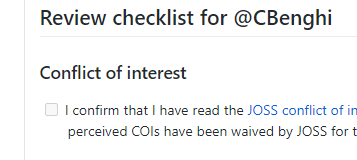
Thanks.
CBenghi
on 17 Nov 2020
@whedon re-invite @CBenghi as reviewer
Kevin-Mattheus-Moerman
on 17 Nov 2020
The reviewer already has a pending invite.
@cbenghi please accept the invite by clicking this link: https://github.com/openjournals/joss-reviews/invitations
whedon
on 17 Nov 2020
@CBenghi the invitation must have expired. :point_up: here it is once more. Can you accept it and try again? Thanks!
Kevin-Mattheus-Moerman
on 17 Nov 2020
I get the following message:
"Sorry, we couldn't find that repository invitation. It is possible that the invitation was revoked or that you are not logged into the invited account."
I'm on the right account. But something was different when I first opened the page. I got an expiration message from github.
maybe inviting/re-inviting would work this time, could you try again?
CBenghi
on 17 Nov 2020
@whedon re-invite @CBenghi as reviewer
Kevin-Mattheus-Moerman
on 17 Nov 2020
OK, the reviewer has been re-invited.
@cbenghi please accept the invite by clicking this link: https://github.com/openjournals/joss-reviews/invitations
whedon
on 17 Nov 2020
@Kevin-Mattheus-Moerman Do I need to check anything else?
AnaWaldila
on 17 Nov 2020
@asmusskar,
The paper ticks the large majority of the requirements except a few minor glitches.
1) Automated tests: I've posted an issue on the repository to notify about an error thrown in Octave by the label API that prevents me from running the validation script(s); and you have a claim it should work on Octave (I'm running 5.2.0, which is the latest).
2) Community guidelines: I can't find clear guidelines for third parties wishing to 1) Contribute to the software 2) Report issues or problems with the software 3) Seek support
3) Quality of writing: the language is clear, but I think the paper would improve substantially if you identified sub-sections in its content (and perhaps rearranged the order of some statements). I don't have a strong opinion on this, I would accept as is if you insisted; this is just a suggestion for easier readability.
Finally, I'm not sure of a method to evaluate your performance claim around "near real time" as the term itself is vague and context dependent. Again, not a deal breaker, though.
Thanks,
Claudio
CBenghi
on 18 Nov 2020
@AnaWaldila if you are happy to recommend that we accept this work then you are all done. Thanks a lot for your help!!!!!
Kevin-Mattheus-Moerman
on 18 Nov 2020
Thanks for raising those points @CBenghi
@asmusskar can you work on those :point_up: ?
Kevin-Mattheus-Moerman
on 18 Nov 2020
@Kevin-Mattheus-Moerman, yes
@CBenghi,
- I have resolved the latest issue. I hope you can accept the "quick-fix" until I come up with a more beatified solution.
- I have included a short "How to contribute" section in the Readme.. I'm relatively new in this forum, so any additional inputs are very welcome
- I'm not sure what is meant by " sub-sections in its content".. you want me to add sub-sections in the paper, e.g. ##Introduction, ##Input parameters ##Summary?... The text "near-real time" was deleted as suggested
asmusskar
on 18 Nov 2020
@whedon generate pdf
CBenghi
on 19 Nov 2020
:point_right::page_facing_up: Download article proof :page_facing_up: View article proof on GitHub :page_facing_up: :point_left:
whedon
on 19 Nov 2020
Hello @asmusskar,
Ok on 1 and 2.
I've also added a PR to the paper with minor grammar changes.
On number 3: yes that's what I meant. I think readability would benefit from that, but I would accept as is if you think differently. Just let me know.
CBenghi
on 19 Nov 2020
@CBenghi, thanks for those changes. I have updated the paper, dividing into sections as proposed 👇
asmusskar
on 20 Nov 2020
@whedon generate pdf
asmusskar
on 20 Nov 2020
:point_right::page_facing_up: Download article proof :page_facing_up: View article proof on GitHub :page_facing_up: :point_left:
whedon
on 20 Nov 2020
Thanks @asmusskar, all checks passed for me.
@Kevin-Mattheus-Moerman, I think both @AnaWaldila and I are happy with the paper, would you like to take the helm?
CBenghi
on 20 Nov 2020
@Kevin-Mattheus-Moerman and @CBenghi . For me, the paper is OK.
AnaWaldila
on 20 Nov 2020
Related issues
whedon
·
6Comments
whedon
·
8Comments
whedon
·
12Comments
whedon
·
8Comments
whedon
·
10Comments