Joss-reviews: [REVIEW]: AxoPy: A Python Library for Implementing Human-Computer Interface Experiments
Submitting author: @ixjlyons (Kenneth Lyons)
Repository: https://github.com/axopy/axopy
Version: 0.2.3
Editor: @trallard
Reviewer: @lucask07, @peircej
Archive: 10.5281/zenodo.2562630
Status

Status badge code:
HTML: <a href="http://joss.theoj.org/papers/55b11ae10f53dfef20ac3ffce87db41c"><img src="http://joss.theoj.org/papers/55b11ae10f53dfef20ac3ffce87db41c/status.svg"></a>
Markdown: [](http://joss.theoj.org/papers/55b11ae10f53dfef20ac3ffce87db41c)
Reviewers and authors:
Please avoid lengthy details of difficulties in the review thread. Instead, please create a new issue in the target repository and link to those issues (especially acceptance-blockers) in the review thread below. (For completists: if the target issue tracker is also on GitHub, linking the review thread in the issue or vice versa will create corresponding breadcrumb trails in the link target.)
Reviewer instructions & questions
@lucask07 & @peircej, please carry out your review in this issue by updating the checklist below. If you cannot edit the checklist please:
- Make sure you're logged in to your GitHub account
- Be sure to accept the invite at this URL: https://github.com/openjournals/joss-reviews/invitations
The reviewer guidelines are available here: https://joss.theoj.org/about#reviewer_guidelines. Any questions/concerns please let @trallard know.
✨ Please try and complete your review in the next two weeks ✨
Review checklist for @lucask07
Conflict of interest
- [x] As the reviewer I confirm that I have read the JOSS conflict of interest policy and that there are no conflicts of interest for me to review this work.
Code of Conduct
- [x] I confirm that I read and will adhere to the JOSS code of conduct.
General checks
- [x] Repository: Is the source code for this software available at the repository url?
- [x] License: Does the repository contain a plain-text LICENSE file with the contents of an OSI approved software license?
- [x] Version: 0.2.3
- [x] Authorship: Has the submitting author (@ixjlyons) made major contributions to the software? Does the full list of paper authors seem appropriate and complete?
Functionality
- [x] Installation: Does installation proceed as outlined in the documentation?
- [x] Functionality: Have the functional claims of the software been confirmed?
- [x] Performance: If there are any performance claims of the software, have they been confirmed? (If there are no claims, please check off this item.)
Documentation
- [x] A statement of need: Do the authors clearly state what problems the software is designed to solve and who the target audience is?
- [x] Installation instructions: Is there a clearly-stated list of dependencies? Ideally these should be handled with an automated package management solution.
- [x] Example usage: Do the authors include examples of how to use the software (ideally to solve real-world analysis problems).
- [x] Functionality documentation: Is the core functionality of the software documented to a satisfactory level (e.g., API method documentation)?
- [x] Automated tests: Are there automated tests or manual steps described so that the function of the software can be verified?
- [x] Community guidelines: Are there clear guidelines for third parties wishing to 1) Contribute to the software 2) Report issues or problems with the software 3) Seek support
Software paper
- [x] Authors: Does the
paper.mdfile include a list of authors with their affiliations? - [x] A statement of need: Do the authors clearly state what problems the software is designed to solve and who the target audience is?
- [x] References: Do all archival references that should have a DOI list one (e.g., papers, datasets, software)?
Review checklist for @peircej
Conflict of interest
- [x] As the reviewer I confirm that I have read the JOSS conflict of interest policy and that there are no conflicts of interest for me to review this work.
Code of Conduct
- [x] I confirm that I read and will adhere to the JOSS code of conduct.
General checks
- [x] Repository: Is the source code for this software available at the repository url?
- [x] License: Does the repository contain a plain-text LICENSE file with the contents of an OSI approved software license?
- [ ] Version: 0.2.3
- [x] Authorship: Has the submitting author (@ixjlyons) made major contributions to the software? Does the full list of paper authors seem appropriate and complete?
Functionality
- [x] Installation: Does installation proceed as outlined in the documentation?
- [x] Functionality: Have the functional claims of the software been confirmed?
- [x] Performance: If there are any performance claims of the software, have they been confirmed? (If there are no claims, please check off this item.)
Documentation
- [x] A statement of need: Do the authors clearly state what problems the software is designed to solve and who the target audience is?
- [x] Installation instructions: Is there a clearly-stated list of dependencies? Ideally these should be handled with an automated package management solution.
- [x] Example usage: Do the authors include examples of how to use the software (ideally to solve real-world analysis problems).
- [x] Functionality documentation: Is the core functionality of the software documented to a satisfactory level (e.g., API method documentation)?
- [x] Automated tests: Are there automated tests or manual steps described so that the function of the software can be verified?
- [x] Community guidelines: Are there clear guidelines for third parties wishing to 1) Contribute to the software 2) Report issues or problems with the software 3) Seek support
Software paper
- [x] Authors: Does the
paper.mdfile include a list of authors with their affiliations? - [x] A statement of need: Do the authors clearly state what problems the software is designed to solve and who the target audience is?
- [x] References: Do all archival references that should have a DOI list one (e.g., papers, datasets, software)?
 whedon
All 37 comments
Hello human, I'm @whedon, a robot that can help you with some common editorial tasks. @lucask07, it looks like you're currently assigned as the reviewer for this paper :tada:.
:star: Important :star:
If you haven't already, you should seriously consider unsubscribing from GitHub notifications for this (https://github.com/openjournals/joss-reviews) repository. As a reviewer, you're probably currently watching this repository which means for GitHub's default behaviour you will receive notifications (emails) for all reviews 😿
To fix this do the following two things:
- Set yourself as 'Not watching' https://github.com/openjournals/joss-reviews:

- You may also like to change your default settings for this watching repositories in your GitHub profile here: https://github.com/settings/notifications

For a list of things I can do to help you, just type:
@whedon commands
Attempting PDF compilation. Reticulating splines etc...
Some important notes about the revision:
- We ideally want the review to be conducted within a couple of weeks, but if any of you are struggling for time, please let me know
- As you go over the checklist: if you encounter any issues or suggest any changes to the package feel free to use this issue as a discussion platform as well as opening issues on the submission repo as needed.
- If there is anything that is not clear in the reviewers manual or you have any questions about the review process, please feel free to ping me here
 trallard
on 21 Jan 2019
trallard
on 21 Jan 2019
Hi @ixjlyons, this package is looking good, very nice work.
Installation via pip (OSX Python 3.7) proceeded without issues:
python -m pip install axopy
However, when importing axopy I hit a snag.
import axopy
ImportError: cannot import name 'Transmitter' from 'axopy.messaging'
Note that this works:
from axopy.messaging import transmitter
so I'm suspecting just a capatalization issue?
 lucask07
on 26 Jan 2019
lucask07
on 26 Jan 2019
@lucask07 my apologies. It turns out there were some stale build files lying around on my system so two versions of the messaging submodule ended up in the packages uploaded to PyPI (the old version and the refactored one). I just did a clean build and uploaded version 0.2.2 to PyPI, so you can try again or just upgrade:
python -m pip install --upgrade axopy
@trallard is there a way to bump the version under review to 0.2.2 since the 0.2.1 package is broken? Or is the version number of much consequence for JOSS? This is the only change just to upload a fixed package to PyPI so it shouldn't affect the other review if it's under way.
 ixjlyons
on 26 Jan 2019
ixjlyons
on 26 Jan 2019
Thanks @ixjlyons
The import of axopy is working now.
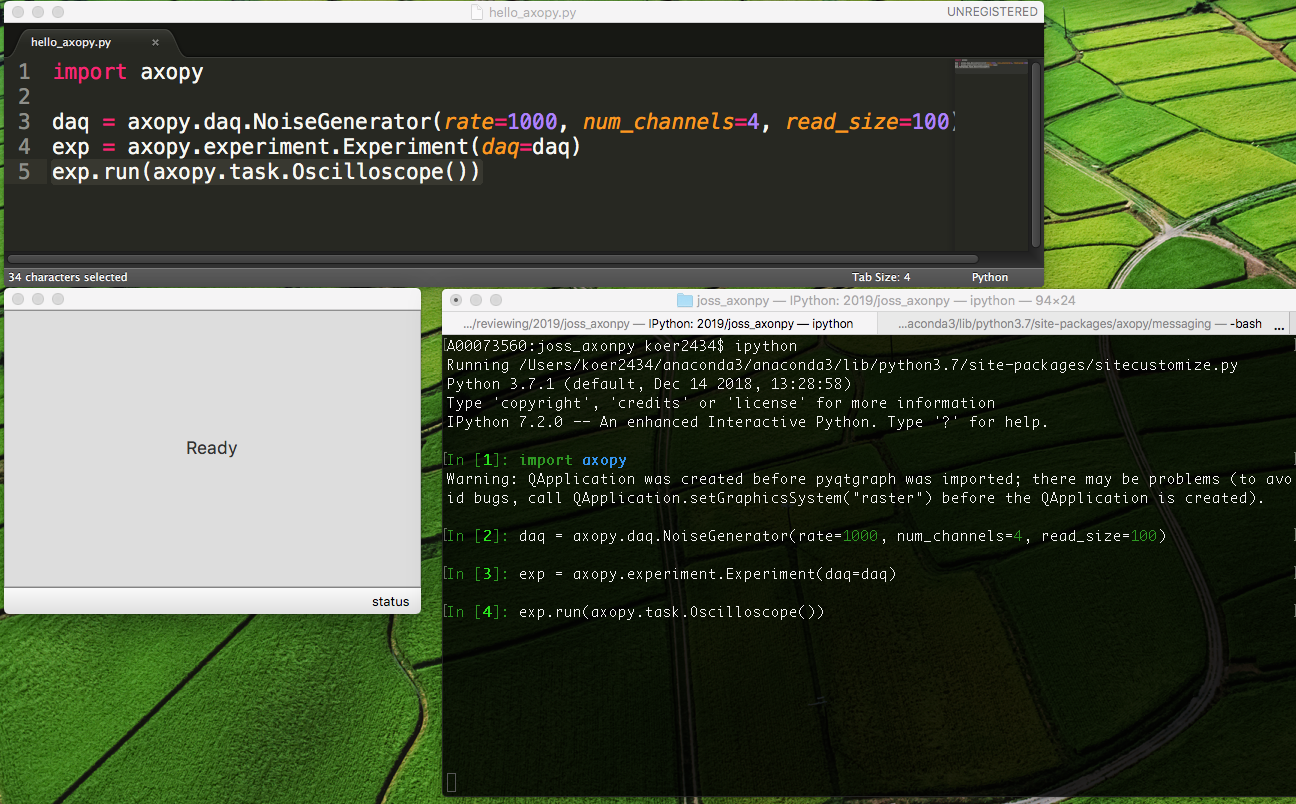
I'm attempting to run the example within the README file. The QT window seems stuck and only reports "Ready". I tried this in an iPython window and without iPython. It would be helpful to know the expected output of this example. I'm running MacOSX.
A screenshot is below:
lucask07
on 26 Jan 2019
Hey @ixjlyons we can definitely bump the version in JOSS. I'll wait until the review is completed in case the reviewers request any more substantial changes or you make another release in the meantime
trallard
on 26 Jan 2019
@lucask07 yes, that looks like it's working as expected. You should be able to press Enter (with the Qt window focused) and then the screen should show an "oscilloscope" with some random signals updating periodically. Pressing Enter again should then finish the experiment and close the window. One thing to note is running an experiment in an interactive shell isn't something I've intended to support, so it looks like there are a few buggy behaviors when doing so. I foresee this as potentially being an issue for people using an IDE that runs things in an interactive shell like Spyder, so I'll work on finding a solution and track things here.
edit: Oh and the takeaway here at least for now is I need to add a note in the README explaining how the GUI works regarding progression through the tasks.
ixjlyons
on 26 Jan 2019
@ixjlyons
Great, I didn't know to press Enter
Now I see real time updates as an oscilloscope. And it works in the IPython console.
One side note. Python aborted when I requested the power spectrum:
line 683, in _fourierTransform
    y = abs(f[1:len(f)/2])
TypeError: slice indices must be integers or None or have an __index__ method
Abort trap: 6
Ah, that appears to be an upstream issue. There is a way to selectively disable that operation, but I'm currently leaning toward disabling the context menu altogether. It adds a few nice features, but it's probably best if AxoPy users implement their own processing in the form of the pipeline keyword arg in creating the Oscilloscope task.
ixjlyons
on 26 Jan 2019
Hi @ixjlyons,
Thank you for this software it looks great. The documentation is very nicely done. 😀
My only suggestion would be to emphasize examples that involve connecting a real-world DAQ.
The pymcc is a useful example, but explicitly knowing things like the needed format of the return data from the read method. I'm thinking about using the Oscilloscope connected to a USB3.0 DAQ system that transfers ~20 MB/s.
So two questions:
- What format must the data returned by
readbe? - What is the maximum data rate that the
oscilloscopewaveform display can keep up with?
lucask07
on 27 Jan 2019
@trallard Hi Tania,
I accept this submission and am finished with my review.
lucask07
on 27 Jan 2019
I agree. The paper looks all fine. The software looks sensible, useful and following best practices.
Minor suggestions around docs:
- I also hit the snag of not realising that I should hit
to start simulating the data collection. (I opened the script file and found it mentioned inside the script, but I did this after trying to run). Rather than adding this in the documentation, I would add it to the actual screen "Ready/nHit to start". Lots of people will jump into a demo before reading anything. - I'd also include the demos in the package itself (the first place I looked for demos was site-packages and then went online and had to download them separately)
- Lastly, for projects where the documentation isn't directly at the home page (e.g. hope page is github) it's best to include a link to the readthedocs documentation very clearly at the top of the readme file. When someone arrives at https://github.com/axopy/axopy what steps will they be taking to find the (formatted) docs?
But these are minor things. Useful package, put together nicely (and I love the logo!)
I also accept this submission.
 peircej
on 27 Jan 2019
peircej
on 27 Jan 2019
Thank you both @peircej and @lucask07 for your reviews. In a nutshell, I agree with all proposed changes and have made them. Here they are as I've understood:
- There was a packaging error that caused v0.2.1 to be broken.
- A context menu provided by an upstream library caused a crash. I disabled the menu, at least until the upstream issue is fixed.
- It was totally unclear what to do upon running the example in the README. I added instructions to the "ready" screen telling the user what to do to proceed. Thanks @peircej for the much more elegant method of conveying that info :)
- The DAQ API didn't say anything about the expected format of the data. I added some info about this in the documentation.
- Links to documentation were fairly hidden in the README. I added a link at the top.
- The examples were not very easy to find/obtain, given that they weren't packaged and weren't mentioned in the documentation. I can see some benefits to including the examples in the package itself (so it can be run like
python -m axopy.examples.example), but for now I've opted to use sphinx-gallery to render the examples in the documentation.
The changes can be seen here: https://github.com/axopy/axopy/compare/181eab2d2a9f203c61b0a82b259538cdf838d890...master
@lucask07 to answer your questions:
I'm thinking about using the Oscilloscope connected to a USB3.0 DAQ system that transfers ~20 MB/s.
So two questions:
What format must the data returned by read be?
What is the maximum data rate that the oscilloscope waveform display can keep up with?
I added a small note about this in the docs, but basically it's up to you. So far in AxoPy, there's an "encouraged" return type: ndarray with shape (n_channels, n_samples). I say encouraged because you could always just implement some transformations as a pipeline block to get it into the format needed by Oscilloscope :). This may become a problem, however, if that can't be done fast enough with the addition of plotting time... AxoPy uses pyqtgraph in the Oscilloscope -- you'd likely have to downsample, but it can plot quite fast (there are some pyqtgraph examples that demonstrate). The process of creating the ndarray may be the problem at that rate. If you try it, let me know.
ixjlyons
on 29 Jan 2019
Hi all thanks for the time spent in this review, it seems that all the issues have already been dealt with and there are just a few steps between acceptance and now.
@peircej can you please make sure to complete the following tasks before completing this?
- [x] make a new release of the package (unless the latest release is up to date with the recent modifications) and add let us know what is the most up to date version
- [x] upload the revised software to your DOI-granting data/software repository, and post the DOI here
- [x] double check the submission paper to ensure it is up-to-date (citations are correct, DOIs are added, etc)
trallard
on 11 Feb 2019
@whedon generate pdf
trallard
on 11 Feb 2019
Attempting PDF compilation. Reticulating splines etc...
Minor: I think the request above was meant for the author @ixjlyons rather than me (to update the version etc).
peircej
on 11 Feb 2019
Ok, here's the DOI for axopy-0.2.3: 10.5281/zenodo.2562630
Thanks once again @trallard, @peircej, and @lucask07 for your time and feedback.
ixjlyons
on 12 Feb 2019
@whedon set 10.5281/zenodo.2562630 as archive
trallard
on 16 Feb 2019
@whedon set 0.2.3 as version
trallard
on 16 Feb 2019
OK. 0.2.3 is the version.
whedon
on 16 Feb 2019
@ixjlyons all looks good to me so I am going to proceed for acceptance
@lucask07 and @peircej thanks a lot for your time and valuable contribution to JOSS as reviewers for this submission 🙌🏻
@arfon: this submission is accepted and ready to be published 🎉👾
trallard
on 16 Feb 2019
@whedon set 10.5281/zenodo.2562630 as archive
trallard
on 16 Feb 2019
OK. 10.5281/zenodo.2562630 is the archive.
whedon
on 16 Feb 2019
@whedon accept
 arfon
on 16 Feb 2019
arfon
on 16 Feb 2019
Attempting dry run of processing paper acceptance...
```Reference check summary:
OK DOIs
MISSING DOIs
- None
INVALID DOIs
- None
```
whedon
on 16 Feb 2019
Check final proof :point_right: https://github.com/openjournals/joss-papers/pull/496
If the paper PDF and Crossref deposit XML look good in https://github.com/openjournals/joss-papers/pull/496, then you can now move forward with accepting the submission by compiling again with the flag deposit=true e.g.
@whedon accept deposit=true
whedon
on 16 Feb 2019
@whedon accept deposit=true
arfon
on 16 Feb 2019
Doing it live! Attempting automated processing of paper acceptance...
🚨🚨🚨 THIS IS NOT A DRILL, YOU HAVE JUST ACCEPTED A PAPER INTO JOSS! 🚨🚨🚨
Here's what you must now do:
- Check final PDF and Crossref metadata that was deposited :point_right: https://github.com/openjournals/joss-papers/pull/497
- Wait a couple of minutes to verify that the paper DOI resolves https://doi.org/10.21105/joss.01191
- If everything looks good, then close this review issue.
Party like you just published a paper! 🎉🌈🦄💃👻🤘
Any issues? notify your editorial technical team...
whedon
on 16 Feb 2019
@lucask07, @peircej - many thanks for your reviews and to @trallard for editing this submission ✨
@ixjlyons - your paper is now accepted into JOSS :zap::rocket::boom:
arfon
on 16 Feb 2019
@arfon: this submission is accepted and ready to be published 🎉👾
@trallard - in the future could you please ping @openjournals/joss-eics when a review is complete? That way, the managing editor on duty can process the submission.
arfon
on 16 Feb 2019
:tada::tada::tada: Congratulations on your paper acceptance! :tada::tada::tada:
If you would like to include a link to your paper from your README use the following code snippets:
Markdown:
[](https://doi.org/10.21105/joss.01191)
HTML:
<a style="border-width:0" href="https://doi.org/10.21105/joss.01191">
<img src="http://joss.theoj.org/papers/10.21105/joss.01191/status.svg" alt="DOI badge" >
</a>
reStructuredText:
.. image:: http://joss.theoj.org/papers/10.21105/joss.01191/status.svg
:target: https://doi.org/10.21105/joss.01191
This is how it will look in your documentation:

We need your help!
Journal of Open Source Software is a community-run journal and relies upon volunteer effort. If you'd like to support us please consider doing either one (or both) of the the following:
- Volunteering to review for us sometime in the future. You can add your name to the reviewer list here: http://joss.theoj.org/reviewer-signup.html
- Making a small donation to support our running costs here: https://www.flipcause.com/secure/cause_pdetails/Mjk3Nzk=
whedon
on 16 Feb 2019
Related issues
whedon
·
11Comments
whedon
·
8Comments
whedon
·
12Comments
whedon
·
6Comments
whedon
·
12Comments
Most helpful comment
@lucask07, @peircej - many thanks for your reviews and to @trallard for editing this submission ✨
@ixjlyons - your paper is now accepted into JOSS :zap::rocket::boom: