If Joplin had support for maths input in LaTeX style, it would be perfect as a journal / lab book for scientists.
Ideally this would be compatible with Pandoc's implementation, MathOverflow / Math StackExchange, or Jupyter notebooks, as it is a syntax already familiar to many scientists.
 jeanm
jeanm
All 15 comments
I'm using markdown-it for rendering and there are two plugins for Math support:
https://github.com/runarberg/markdown-it-math
https://github.com/waylonflinn/markdown-it-katex
Do you know about the syntax they use? Is one better than the other?
 laurent22
on 7 Dec 2017
laurent22
on 7 Dec 2017
Thanks for looking into this!
@cofinley's suggestion would work, but I would also look into markdown-it-katex. KaTeX is a new typesetting library built by the Khan Academy people, because MathJax was too slow for them. Look at the comparison at the bottom of their homepage: https://khan.github.io/KaTeX/ . For Joplin's use case I would expect the speed gains from using KaTeX vs MathJax to be non-trivial. Not to mention the lack of reflowing, which is something really annoying in long pages that use MathJax.
jeanm
on 7 Dec 2017
@jeanm: Oh cool! I didn't know that about its background.
I agree, long document load times are very noticeable with MathJax. It looks like there was some debate on Latex features support in Katex a few years ago, but I'd imagine it's better now.
 cofinley
on 7 Dec 2017
cofinley
on 7 Dec 2017
The mathjax package seems to be abandoned, so it would probably be better to use a different one. Maybe the katex one then.
laurent22
on 7 Dec 2017
For information, I got it working in this branch but there's some issue with the CSS which makes the fraction bar appears slightly too high. Other than that it seems to be fine.
Since it's the second most popular request, I might look at it again later, or if someone can figure out the CSS that would be great.
laurent22
on 19 Jan 2018
Support for Katex is now available. I've tried with various expressions and as far as I can tell it works, but if there's any mathematician here please give it a try and let me know if something's off.
In the end I've simply used the actual Katex lib instead of the plugin as this is well supported, and it means we can get the latest fixes and improvements easily.
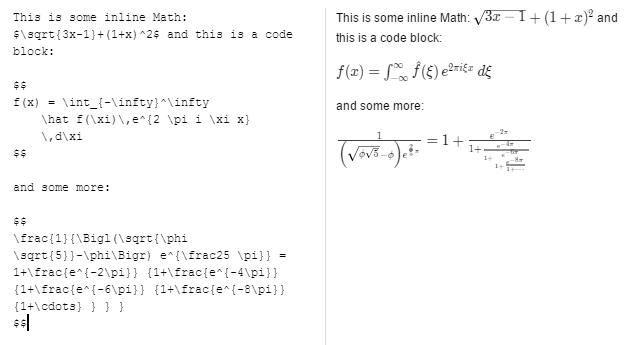
To add an inline equation, wrap the expression in `{.katex}EXPRESSION`, eg. `{.katex}\sqrt{3x-1}+(1+x)^2`. To create an expression block, wrap it as follow:
```katex
EXPRESSION
```
For example:
```katex
f(x) = \int_{-\infty}^\infty
    \hat f(\xi)\,e^{2 \pi i \xi x}
    \,d\xi
```
Here is an example with the Markdown and rendered result side by side:
laurent22
on 6 Feb 2018
That looks brilliant!
Any chance it could use a syntax already used by other markdown engines/app, instead of a new one? Such as the pandoc one, with $$ for display and $ for inline? There is a summary table here of all the places that already support this syntax.
jeanm
on 6 Feb 2018
Done, the next release will support both $ and backtick syntaxes.
laurent22
on 7 Feb 2018
This is now part of the desktop version and will be in Android and iOS soon too
laurent22
on 11 Feb 2018
Hey sorry to reopen this but is there any chance that $ and $$ could be added to the autocomplete so that typing one inserts the other half of the pair as already happens with square brackets etc.?
 hughwilliams94
on 6 Mar 2018
hughwilliams94
on 6 Mar 2018
I may be missing something, but this issue says math support was added, and while I've created a note with $$ in markdown on the android app, it does not seem to render. Here's an image of what I'm seeing: 
 dzackgarza
on 3 Dec 2018
dzackgarza
on 3 Dec 2018
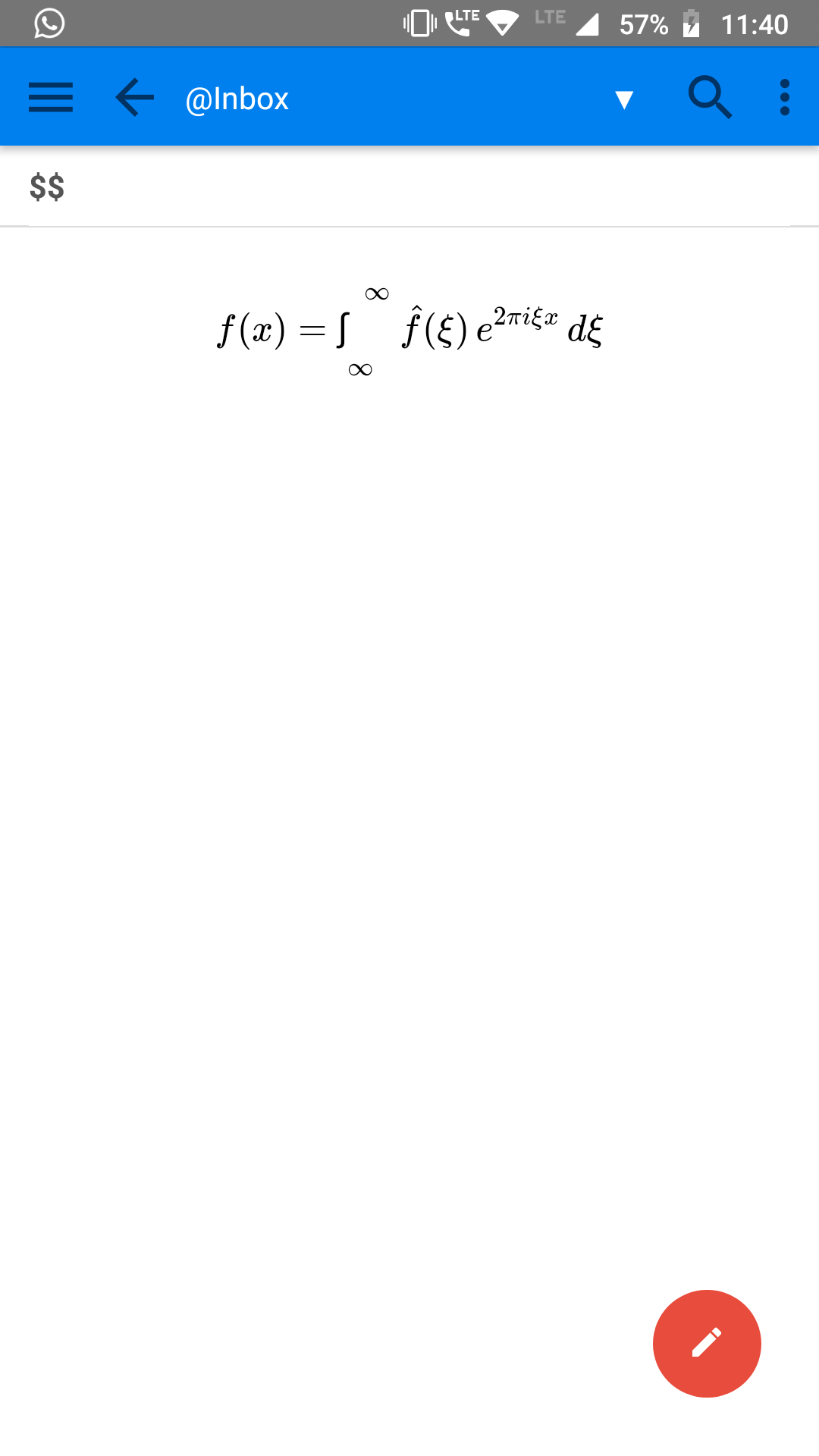
@dzackgarza you've to edit the note, the note will render it. That red circle with pencil on it.
You've currently copied the content into the title field. After rendering:
 subi54
on 3 Dec 2018
subi54
on 3 Dec 2018
Ahhh I see! I thought these were just plain markdown files, had no idea there was a title field or anything like that. Confirmed that this works, thanks.
dzackgarza
on 4 Dec 2018
@dzackgarza, your data is stored in markdown format. The Title field is there for the convenience of users. You don't actually have to use it, app takes the first line as Title as well.
subi54
on 5 Dec 2018
Related issues
 hakim89
·
3Comments
hakim89
·
3Comments
 Cybernemo
·
3Comments
Cybernemo
·
3Comments
 jacobgonzales20
·
3Comments
jacobgonzales20
·
3Comments
 yschutz
·
3Comments
yschutz
·
3Comments
 deftdawg
·
3Comments
deftdawg
·
3Comments
Most helpful comment
Done, the next release will support both $ and backtick syntaxes.