Jest: Immutable.Map comparison with not the same key order
Do you want to request a feature or report a bug?
bug
What is the current behavior?
Comparison between to identical Immutable.Map() but declared without the same key order fails.
If the current behavior is a bug, please provide the steps to reproduce and either a repl.it demo through https://repl.it/languages/jest or a minimal repository on GitHub that we can yarn install and yarn test.
What is the expected behavior?
All the specs on this example should pass.
describe('comparison with Immitable.Map', () => {
  const map1 = Immutable.Map({ a: 1, b: 2 });
  const map2 = Immutable.Map({ b: 2, a: 1 });

  it('should ignore key order with Immutable.is', () => {
    expect(Immutable.is(map1, map2)).toBe(true);
  });

  it('should ignore key order with Jest', () => {
    expect(map1).toEqual(map2);
  });
});
 davidfou
All 17 comments
The behavior is consistent with normal JS Map.
describe('comparison with Map', () => {
  const map1 = new Map();
  const map2 = new Map();

  map1.set('a', 1);
  map1.set('b', 2);
  map2.set('b', 2);
  map2.set('a', 1);

  it('should ignore key order with Jest', () => {
    expect(map1).toEqual(map2);
  });
});
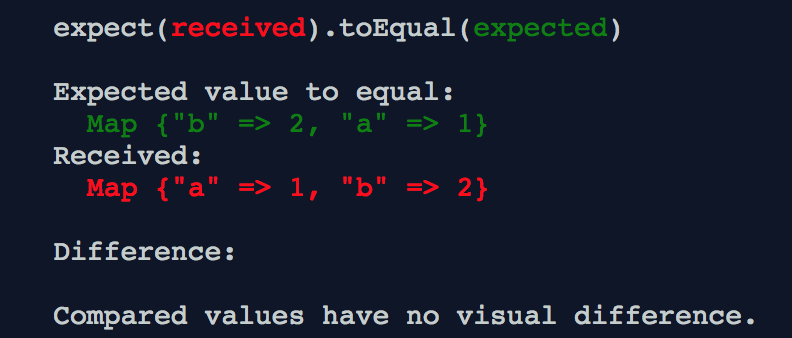
(We could probably start rendering "visual differences" here)
It's the same for plain arrays.
// Fails
expect(['foo', 'bar']).toEqual(['bar', 'foo']);
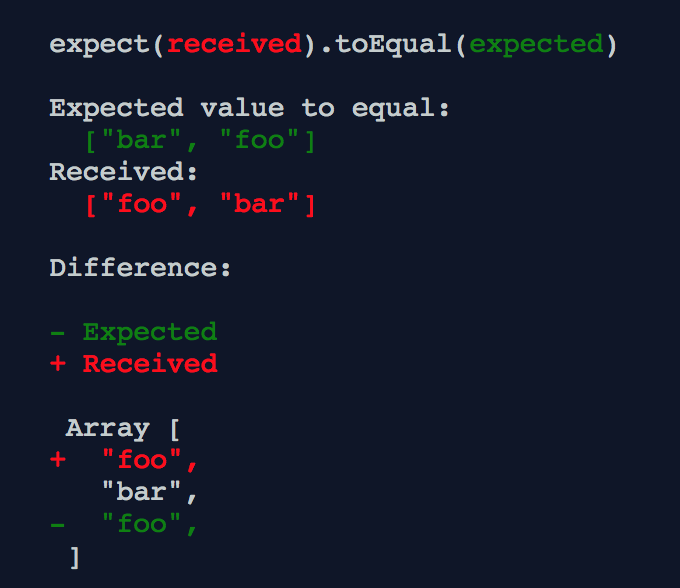
But objects don't care about insertion order (which is not really specced, so makes sense)
// Passes
expect({ a: 1, b: 2 }).toEqual({ b: 2, a: 1 });
I'm not sure what the correct solution is, but it feels like we should be more consistent between Maps and Objects?
This feels weird:
it('should treat objects, and arrays of their keys, consistently', () => {
const obj1 = { a: 1, b: 2 };
const obj2 = { b: 2, a: 1 };
// Passes
expect(obj1).toEqual(obj2);
// Fails
expect(Object.keys(obj1)).toEqual(Object.keys(obj2));
});
Put the parts about arrays in detail blocks, not really related to the issue at hand
 SimenB
on 7 Oct 2017
SimenB
on 7 Oct 2017
Map is not ordered
On Sat, Oct 7, 2017 at 7:45 AM Simen Bekkhus notifications@github.com
wrote:
The behavior is consistent with normal JS Map.
describe('comparison with Map', () => {
const map1 = new Map();
const map2 = new Map();map1.set('a', 1);
map1.set('b', 2);
map2.set('b', 2);
map2.set('a', 1);it('should ignore key order with Jest', () => {
expect(map1).toEqual(map2);
});
});[image: image]
https://user-images.githubusercontent.com/1404810/31307491-5a10f014-ab65-11e7-8885-48c3031b011b.pngIt's the same for plain arrays.
// Failsexpect(['foo', 'bar']).toEqual(['bar', 'foo']);
[image: image]
https://user-images.githubusercontent.com/1404810/31307425-9dec3614-ab64-11e7-838b-255f446031ce.pngBut objects don't care about insertion order
// Passesexpect({ a: 1, b: 2 }).toEqual({ b: 2, a: 1 });
I'm not sure what the correct solution is, but it feels like we should be
more consistent?—
You are receiving this because you were mentioned.
Reply to this email directly, view it on GitHub
https://github.com/facebook/jest/issues/4618#issuecomment-334929424, or mute
the thread
https://github.com/notifications/unsubscribe-auth/AADD0kT6Mqjyx7zsQU1aFHGyNgrm5m4bks5sp2RigaJpZM4Pw2vL
.
 leebyron
on 7 Oct 2017
leebyron
on 7 Oct 2017
Indeed, which makes me think that both Maps from Immutable and standard JS Maps should behave like Object when checking equality. That's up to @cpojer though.
(we can safely ignore what I said about arrays, it's not relevant here. I'll put it in details)
SimenB
on 7 Oct 2017
This is tricky because Jest doesn't have knowledge on how to sort two iterables to make them comparable. I think I'd be in favor of making toEqual work though if it isn't too big of a deal in the equality matcher.
 cpojer
on 7 Oct 2017
cpojer
on 7 Oct 2017
Here my 2 cents: why not first use Immutable.is then fallback to current behaviour only if it's false?
davidfou
on 9 Oct 2017
Feels icky to have a dependency on immutable js in a generic assertion library. You can create your own assertion for that (and plug it in with expect.extend)
SimenB
on 9 Oct 2017
That's right. So toEqual only use the output from pretty-format? Maybe this package should reorder on all unordered types recursively?
const initialMap = Immutable.Map({b: 1, a: 2});
const orderedMap = initialMap.toSeq().sortBy((v, k) => k).toMap();
Immutable.Map({b: 1, a: 2}).toSeq().sortBy((v, k) => k).toMap()
we do a deep equality (which doesn't know about immutable js), pretty-format is used to try to show a pretty diff afterwards
Again, I'd suggest to do create a custom matcher. See e.g. https://github.com/jest-community/jest-extended for lots of examples on how to create them
SimenB
on 1 Dec 2017
The JS Map test given by @SimenB passes on the new Jest.
describe('comparison with Map', () => {
  const map1 = new Map();
  const map2 = new Map();

  map1.set('a', 1);
  map1.set('b', 2);
  map2.set('b', 2);
  map2.set('a', 1);

  it('should ignore key order with Jest', () => {
    expect(map1).toEqual(map2);
  });
});
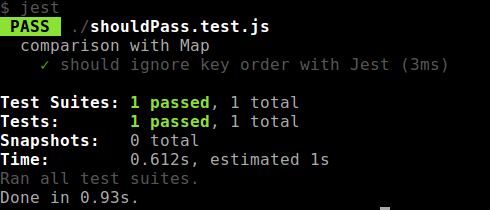
Jest: 21.2.1
Node: 8.9.1
Yarn: 1.3.2
Should we make it consistent for Immutable Map?
 seanli3
on 3 Dec 2017
seanli3
on 3 Dec 2017
Yeah, we should make it consistent if possible.
cpojer
on 16 Dec 2017
Hi!
I encountered this issue today and wanted to upvote this so it has a bit more priority. So, thanks!
 enrique-ramirez
on 23 Jan 2018
enrique-ramirez
on 23 Jan 2018
PR welcome 🙂
SimenB
on 23 Jan 2018
I want to implement this.
What is the correct (or sufficient) way to say a structure is ImmutableJS?
- It has a sentinel - as we do in pretty-format.
- It has
equalsandhashCodefunctions (cf. isValueObject). - Both conditions above.
 robinpokorny
on 25 Jan 2018
robinpokorny
on 25 Jan 2018
I'd say that whatever pretty-format does is good enough
SimenB
on 26 Jan 2018
Current status: I tried to use method equals which every Immutable structure has. However, it does not perform deep equality :(
robinpokorny
on 28 Jan 2018
@robinpokorny Hi Robin!
I believe that the best way to compare two immutable objects is to use is()
It basically compares a hash based on the contents of the object (so if any value is different, the hash will also be different), rather than the actual object, so it's faster than an actual deep comparison.
enrique-ramirez
on 28 Jan 2018
@enrique-ramirez, hi!
Internally, .equals and Immutable.is are the same. The problem is that isEqual should perform a deep equality.
robinpokorny
on 29 Jan 2018
Related issues
 nsand
·
3Comments
nsand
·
3Comments
 GrigoryPtashko
·
3Comments
GrigoryPtashko
·
3Comments
 gustavjf
·
3Comments
gustavjf
·
3Comments
 emmby
·
3Comments
emmby
·
3Comments
 kentor
·
3Comments
kentor
·
3Comments
Most helpful comment
The JS
Maptest given by @SimenB passes on the new Jest.Jest: 21.2.1
Node: 8.9.1
Yarn: 1.3.2
Should we make it consistent for Immutable Map?