In the Deep Implicit Layers tutorial from NeurIPS 2020, a very nice grad_graph function was used to make things clearer, around minute 23.
Is that function available elsewhere? If not, could it be added to the library?
I think it would be generally useful as a way to explore how things work in Jax.
 IlyaOrson
All 6 comments
Thanks for this suggestion! It certainly seems worth considering.
Here's the version I used in the demo. It'll probably bit-rot unless we merge it into JAX.
I agree it seems like a useful tool for user exploration as well as for presentations, and it is pretty lightweight. I'm interested to hear other opinions though!
 mattjj
on 11 Dec 2020
mattjj
on 11 Dec 2020
Longer twitter thread here: https://twitter.com/lukasheinrich_/status/1340042422223572993 and was asked to add in a (not-so-naive apparently) suggestion: https://twitter.com/SingularMattrix/status/1340306739191672832
It would be nice to have a way to label in jax (both input arrays as well as computational calls) so I can annotate such a graph. I guess an expected API might be like
x = jnp.array(..., label="observations")
y = jnp.sum(x, axis=0, label='calculate sum(logpdf)')
or similar.
 kratsg
on 19 Dec 2020
kratsg
on 19 Dec 2020
Good to see the issue already opened :+1:
Here's also the variation from said twitter thread, reusing @mattjj's gist to graph any jaxpr: jaxpr_graph.py
 niklasschmitz
on 19 Dec 2020
niklasschmitz
on 19 Dec 2020
Just found that jaxlib.xla_extension.XlaComputation.as_hlo_dot_graph exists and can be used for similar results:
import jax
import graphviz

def hlo_graph(f, *args, **kwargs):
    comp = jax.xla_computation(f)(*args, **kwargs)
    graph = graphviz.Source(comp.as_hlo_dot_graph())
    return graph
which gives
import jax.numpy as jnp
f = lambda x: jnp.sum(x**2)
x = jnp.ones(5)
hlo_graph(jax.grad(f), x)
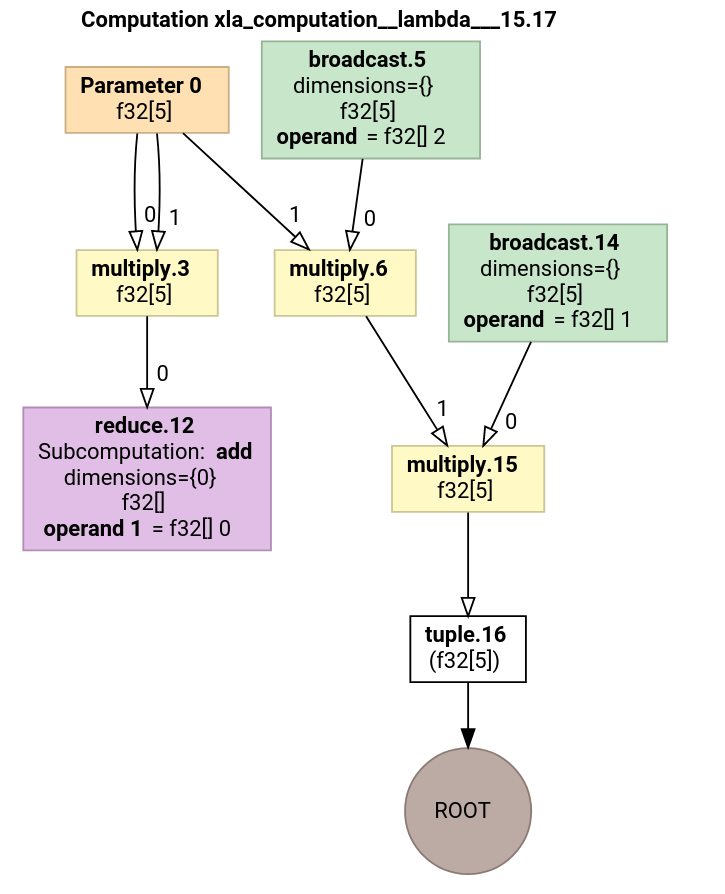
niklasschmitz
on 19 Dec 2020
Indeed! Some brainstorming on the differences:
grad_graphcan handle data-dependent Python control flow, unlikexla_computation(actually, this was the main desideratum for that demo in the implicit layers tutorial, since the fwd iteration implementation had a Python while loop in it!)- the jaxpr IR has some differences with the XLA HLO IR, e.g. it shows custom derivative rules and some primitives like scan, so it's a slightly higher-level representation in some respects (while the HLO representation has the advantage of being more explicit about actually gets executed, especially the optimized HLO)
- the colors, labels, etc are more hackable in the pure-Python version
- the XLA HLO tools are much more developed than the quick hack in the gist
mattjj
on 20 Dec 2020
Cool! Also, I see now that my jaxpr_graph example, where using jax.make_jaxpr, fails on data-dependent Python control flow, while grad_graph works fine with extracting the jaxpr directly from the vjp. Is there a better/similar-to-vjp way to get a traced jaxpr for this purpose?
Regarding labelled subcomputations, would this call for a dedicated Tracer already?
I certainly appreciate the hackability aspect! Learning a lot about jaxprs here.
niklasschmitz
on 21 Dec 2020
Related issues
 sursu
·
3Comments
sursu
·
3Comments
 yfji
·
3Comments
yfji
·
3Comments
 harshit-2115
·
3Comments
harshit-2115
·
3Comments
 madvn
·
3Comments
madvn
·
3Comments
 lonelykid
·
3Comments
lonelykid
·
3Comments
Most helpful comment
Thanks for this suggestion! It certainly seems worth considering.
Here's the version I used in the demo. It'll probably bit-rot unless we merge it into JAX.
I agree it seems like a useful tool for user exploration as well as for presentations, and it is pretty lightweight. I'm interested to hear other opinions though!