Imgui: ImDrawList coding party - deadline Nov 30, 2020!
ImDrawList coding party!
- create small visual effects
- 1024 bytes of source code
- 320x180 output
- only use dear imgui's crappy low-level shape drawing api
Two days ago I thought:
_"It'd be fun to organize a contest for writing special effects using the ImDrawList api, with a constraint on source code size. May be fun to see what people can come up with using shape/vector-based api (quite different from a pixel-shading function). Would you participate?"_
It's by no mean a great api but it has served many well, to draw custom widgets etc, let's get it some extra love..
Here's a testbed imdrawlist_party.cpp which you can paste in your application or any dear imgui example:
https://gist.github.com/ocornut/51367cc7dfd2c41d607bb0acfa6caf66
Rules:
- Your source file
fx.inlmust be <= 1024 bytes. - Effect should be reasonably portable (not relying on specific render backend callback)
- OK to use preprocessor define or other tricks as long as they are reasonably portable.
- Included are: math.h, imgui.h, imgui_internal.h with ImVec2 maths operators
- The effect should not use ImGui:: functions, only use ImDrawList facilities.
- Canvas ratio is expected to be 16/9, canvas size expected to be 320 by 180.
- For simplicity we assume you can encode a color as 0xAAGGBBRR instead of using the IM_COL32() macro, therefore IMGUI_USE_BGRA_PACKED_COLOR config option is not supported!
Prizes:
- This is mostly for fun so please feel free to make multiple submissions or tweak them as you feel. No pressure. Mostly, I'm supposed to work and ship tables this or next week so hey why I am doing this?!
- We could possibly include some of them in imgui_demo if they strike a good balance of cool and educational. If we end up doing that we'll rework code to be neat and proper for a demo (aka not densely packed into 1024 characters).
Function signature:
void FX(ImDrawList* d, ImVec2 a, ImVec2 b, ImVec2 sz, ImVec4 mouse, float t);
     d : draw list
     a : upper-left corner
     b : lower-right corner
    sz : size (== b - a)
 mouse : x,y = mouse position (normalized so 0,0 over 'a'; 1,1 is over 'b', not clamped)
         z,w = left/right button held. <-1.0f not pressed, 0.0f just pressed, >0.0f time held.
    t  : time
If not using a given parameter, you can omit its name in your function to save a few characters.
To record gif files you can use ShareX https://getsharex.com or ScreenToGif https://www.screentogif.com/
Let's get started! You can post on this thread, on discord or on twitter!
Known issues
- ImDrawList polygon stroking with thick lines looks broken on acute angle, good luck!!
 ocornut
All 77 comments
Here are some examples I made to get you started:
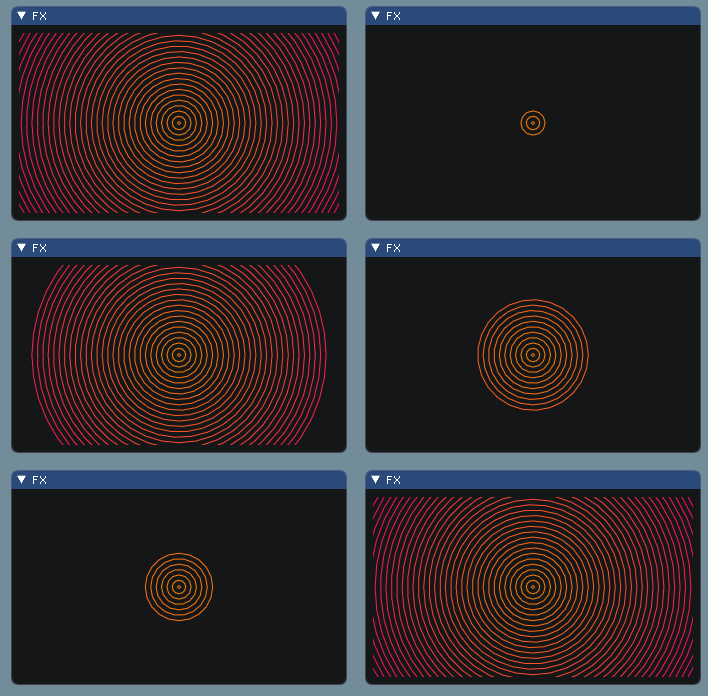
Circles
#define V2 ImVec2
void FX(ImDrawList* d, V2 a, V2 b, V2 sz, ImVec4 mouse, float t)
{
for (int n = 0; n < (1.0f + sinf(t * 5.7f)) * 40.0f; n++)
d->AddCircle(V2(a.x + sz.x * 0.5f, a.y + sz.y * 0.5f), sz.y * (0.01f + n * 0.03f),
IM_COL32(255, 140 - n * 4, n * 3, 255));
}
Squares
#define V2 ImVec2
void FX(ImDrawList* d, V2 a, V2 b, V2 sz, ImVec4, float t)
{
float sx = 1.f / 16.f;
float sy = 1.f / 9.f;
for (float ty = 0.0f; ty < 1.0f; ty += sy)
for (float tx = 0.0f; tx < 1.0f; tx += sx)
{
V2 c((tx + 0.5f * sx), (ty + 0.5f * sy));
float k = 0.45f;
d->AddRectFilled(
V2(a.x + (c.x - k * sx) * sz.x, a.y + (c.y - k * sy) * sz.y),
V2(a.x + (c.x + k * sx) * sz.x, a.y + (c.y + k * sy) * sz.y),
IM_COL32(ty * 200, tx * 255, 100, 255));
}
}

Curves
#define V2 ImVec2
void FX(ImDrawList* d, V2 a, V2 b, V2 sz, ImVec4, float t0)
{
for (float t = t0; t < t0 + 1.0f; t += 1.0f / 100.0f)
{
V2 cp0(a.x, b.y);
V2 cp1(b);
float ts = t - t0;
cp0.x += (0.4f + sin(t) * 0.3f) * sz.x;
cp0.y -= (0.5f + cos(ts * ts) * 0.4f) * sz.y;
cp1.x -= (0.4f + cos(t) * 0.4f) * sz.x;
cp1.y -= (0.5f + sin(ts * t) * 0.3f) * sz.y;
d->AddBezierCurve(V2(a.x, b.y), cp0, cp1, b, IM_COL32(100 + ts*150, 255 - ts*150, 60, ts * 200), 5.0f);
}
}

Waves
#define V2 ImVec2
#define ARFM d->AddRectFilledMultiColor
#define ACF d->AddCircleFilled
#define CH s.SetCurrentChannel
void FX(ImDrawList* d, V2 a, V2 b, V2 sz, ImVec4, float t)
{
ARFM(a, b, 0xFF1E1E1E, 0xFF1E281E, 0xFF1E1E5A, 0xFF321E78);
ARFM(a, V2(b.x, a.y + sz.y*0.4f), 0x1EFFDCFF, 0x14FFFFDC, 0x001E1E5A, 0x00321E78);
auto s = d->_Splitter;
s.Split(d, 2);
for (int n = 0; n < 256; n++)
{
V2 c(a.x + n / 256.f * sz.x, b.y + 20 - cos(t - 0.1f * n / 2) * 10 + cos(t) * 5);
float r(40 + sin(t + n / 2) * 40);
CH(d, 0);
ACF(c, r + 1, 0x80FFFFFF);
CH(d, 1);
ACF(c, r, IM_COL32(255, n / 2, n / 8, 255));
}
s.Merge(d);
d->AddRect(a, b, IM_COL32(128, 128, 128, 100));
}

ocornut
on 19 Nov 2020
Thunder Storm
#define min(x,y) ((x)<(y)?x:y)
#define wh(a) ImColor(1.f,1.f,1.f,a)
void FX(ImDrawList* d, ImVec2 a, ImVec2 b, ImVec2 sz, ImVec2, float t)
{
static float fl;
if ((rand() % 500) == 0) fl = t;
if ((t-fl) > 0)
{
auto ft = 0.25f;
d->AddRectFilled(a, b, wh((ft - (t - fl)) / ft));
}
for (int i = 0; i < 2000; ++i) {
unsigned h = ImGui::GetID(d+i + int(t/4));
auto f = fmodf(t + fmodf(h / 777.f, 99), 99);
auto tx = h % (int)sz.x;
auto ty = h % (int)sz.y;
if (f < 1) {
auto py = ty - 1000 * (1 - f);
d->AddLine({ a.x + tx, a.y + py }, { a.x + tx, a.y + min(py + 10,ty) }, (ImU32)-1);
}
else if (f < 1.2f)
d->AddCircle({ a.x + tx, a.y + ty }, (f - 1) * 10 + h % 5, wh(1-(f-1)*5.f));
}
}

 kudaba
on 19 Nov 2020
kudaba
on 19 Nov 2020
The Matrix effect, slowly been shaving off spaces and making the code uglier and uglier
//v1.1
#define V2 ImVec2
void FX(ImDrawList*d,V2 a,V2,V2 sz,ImVec4,float t)
{
static struct{int y,h,c; float t,s;} m[40]={0};
static int S=0x1234;
static float t0=t;
float ZI=t*.07f,Z=ZI+1.f;
for(int x=0;x<40;x++)
{
auto& M=m[x];
int i=x>=15&&x<25;
if(M.s==0.f||M.y>16)
{
M.h = (t<7.f||i)*((int)(2+t*.5f) + S%(int)(6+(t*0.3f)));
M.y = (M.s==0.f)*-(S%15)-M.h;
M.c += S;
M.s = (5+(S%14))*(.01f-t*.001f);
if(t>5.f&&i)
{
M.c = (340003872375972UL>>(x*5-75))&31;
M.h = i?(x!=19):0;
}
}
if((M.t-=t-t0)<0.f)
{
if(t<6.f||!i||M.y!=6)
M.y++;
M.t += M.s;
}
char c=64|M.c%42;
for(int j=0; j<M.h; j++,c=64|(c^M.c+M.h^j)%42)
for(int f=(j+1==M.h)?13:4+(M.c&1);f--;)
d->AddText(0, 13*(i?Z:-Z), V2(a.x-(sz.x*.5f*ZI)+x*8*Z+sin(j+t*f), a.y-(sz.y*.5f*ZI)+(M.y+j)*13*Z+cos(x*f-t)), 0x3c68bb5b, &c, &c+1);
S|=((S&1)^((S&8)>>2))<<16;
S>>=1;
}
t0 = t;
}

ocornut
on 19 Nov 2020
Tiny Loading Screen!
Had a bunch of fun trying to get this as small I could, managed to get it just under 600 bytes for now.

#define V ImVec2
#define R d->AddRectFilled
#define C(x) IM_COL32((sin(x) + 1) * 255 / 2, (cos(x) + 1) * 255 / 2, 99, 255)
#include <set>
void FX(ImDrawList* d, V a, V b, V s, ImVec4, float t) {
static auto z = 0.f;
if (t > z + 2) z += 2;
auto c = C(z + 2);
R(a, b, C(z));
for (auto B = b.x, i = 0.f, o = s.y / 8; i < 8; ++i, B = b.x) {
if (auto w = (i / 7) * .2f, x = std::max(t - z - w, 0.f); t - z < w + 1)
B = a.x + (x < .5 ? 8 * x * x * x * x : std::min(1 - pow(-2 * x + 2, 4.f) / 2, 1.f)) * s.x;
R(V(a.x, a.y + o * i), V(B, a.y + o * i + o), c);
}
}
 Fuzznip
on 19 Nov 2020
Fuzznip
on 19 Nov 2020
Quicksort visualization.
#define V2 ImVec2
#include <vector>
#include <array>
using namespace std;
int N = 64, S, J;
#define V vector<int>
V v = [] {
    V r;
    for (; J < N; J++) r.push_back(rand() % 180);
    return r;
}();
vector<array<int,4>> st { { 0, N-1, 0, 0} };
#define A st.back()[0]
#define B st.back()[1]
#define I st.back()[2]
void FX(ImDrawList* d,V2 a,V2 b,V2 s,ImVec4,float t)
{
    float bs = s.x / N, y, c;
    for (int i = 0; i < N; i++) {
        y=a.y+v[i];
        c=70+v[i];
        d->AddRectFilled(V2(a.x+bs*i,y),V2(a.x+bs*(i+1),b.y),IM_COL32(c,255-c,255,255));
    }
    d->AddText(a, -1u, "Quicksort");
    if (st.empty()) return;
    d->AddRect(V2(a.x+bs*A,a.y),V2(a.x+bs*(B+1),b.y),0xFF00FF00,8,ImDrawCornerFlags_Top,2);
    switch (S) {
    case 0:case 5: if(A>=B)st.pop_back(),S+=3;else I=J=A,S++;break;
    case 1:case 6:
        if(v[J]>v[B])swap(v[I],v[J]),I++;
        if(++J>B)swap(v[I],v[B]),S++;
        break;
    case 2:case 7:st.push_back({A,I-1,A,3});S=0;break;
    case 3:st.push_back({I+1,B,A,8});S=5;break;
    case 8:S = st.back()[3]; st.pop_back();
    }
}

Blobs.
#define V2 ImVec2
void FX (ImDrawList* d, V2 a, V2 b, V2 s, ImVec4 m, float t)
{
    int N = 25;
    float sp = s.y / N, y, st = sin(t) * 0.5 + 0.5,
          r[3] = { 1500, 1087 + 200 * st, 1650 },
          ctr[3][2] = { { 150, 140 }, { s.x * m.x, s.y * m.y },
              { 40 + 200 * st, 73 + 20*sin(st * 5) } };
    for (int i = 0; i < N; i++) {
        y = a.y + sp*(i+.5);
        for (int x = a.x; x <= b.x; x += 2) {
            float D = 0, o = 255;
            for (int k = 0; k < 3; k++)
                D += r[k]/(pow(x-a.x-ctr[k][0], 2) + pow(y-a.y-ctr[k][1], 2));
            if (D < 1) continue;
            if (D>2.5) D = 2.5;
            if (D < 1.15) o /= 2;
            d->AddLine(V2(x, y), V2(x+2, y), IM_COL32(239, 129, 19, o), D + sin(2.3 * t + 0.3 * i));
        }
    }
}

3D cube.
#define V2 ImVec2
void FX (ImDrawList* d, V2 a, V2 b, V2 s, ImVec4 m, float t)
{
    a.x += s.x/2, a.y += s.y / 2;
    float S = sin(m.x), C = cos(m.x), x = 50, y, z = (m.y * 2 - 1) * x;
    float v[8][3] { { x, x, z+x }, { x, -x, z+x }, { -x, -x, z+x }, { -x, x, z+x },
            { x, x, z-x }, { x, -x, z-x }, { -x, -x, z-x }, { -x, x, z-x } };
    for (int i = 0; i < 8; i++) {
        x = v[i][0] * C - v[i][1] * S;
        y = v[i][0] * S + v[i][1] * C + 120;
        z = v[i][2];
        v[i][0] = x / y * 50;
        v[i][1] = z / y * 50;
        v[i][2] = y;
    }
#define L(A,B) z = 500 / (v[A][2] + v[B][2]); \
    d->AddLine(V2(a.x+v[A][0],a.y+v[A][1]),V2(a.x+v[B][0],a.y+v[B][1]),-1u,z);
    L(0, 1) L(1, 2) L(2, 3) L(0, 3)
    L(4, 5) L(5, 6) L(6, 7) L(4, 7)
    L(0, 4) L(1, 5) L(2, 6) L(3, 7)
}

Real-time visualization of the interweb blogosphere.
#define V2 ImVec2
#include <vector>
int N = 300;
auto v = [] {
    std::vector<std::pair<V2,V2>>r(N);
    for (auto&p:r)
        p.second = p.first = V2(rand() % 320, rand() % 180);
    return r;
}();
float l2 (V2 x) { return x.x*x.x + x.y*x.y; }
void FX(ImDrawList* d,V2 a,V2 b,V2 s,ImVec4,float t)
{
    float D, T;
    for (auto&p:v) {
        D = sqrt(l2(p.first - p.second));
        if (D > 0) p.first += (p.second - p.first) / D;
        if (D < 4) p.second = V2(rand() % 320, rand() % 180);
    }
    for (int i = 0; i < N; i++) {
        for (int j = i+1; j < N; j++) {
            D = l2(v[i].first - v[j].first);
            T = l2((v[i].first + v[j].first) - s) / 200;
            if (T > 255) T = 255;
            if (D < 400) d->AddLine(a+v[i].first, a+v[j].first, IM_COL32(T, 255-T, 255, 70), 2);
        }
    }
}

 Crowbarous
on 20 Nov 2020
Crowbarous
on 20 Nov 2020
Here's my attempt at some abstract fireworks... with about four bytes to spare. The code has ended up pretty unreadable as a result, sadly.
````C++
define V ImVec2
define R rand()
define I int
define F float
define S ((F)R/32767)
define T(d,b,e)p[j].d=(b(j&1^j>>1?1:-1))+(e((j>1)?1:-1))+c.d+a.d;
define X(a)I a=128+(R&127);
struct P {F x,y,vx,vy,a;I l,s,f,d;};P p[8192]={0};
void A(V o, I f){P t;t.x=o.x;t.y=o.y;t.vx=S3-1.5;t.vy=S2.5-(f?4:1);t.l=R%(f?50:99);t.s=R;t.f=f;for(I j=0;j<9;j++){t.d=j;t.a=1-(F)j/9;for(I i=0;i<8192;i++)if(!p[i].l){p[i]=t;break;}}}
void FX(ImDrawList*d,V a,V b,V sz,V mn,F t0){I g=R;for(I i=200;i;--i)d->AddLine(V(a.x,a.y+i),V(b.x,a.y+i),IM_COL32(0,0,i,255));I e=0;for(I i=0;i<8192;i++){P&c=p[i];if(c.l){if(c.d)c.d--;else{srand(c.s);c.x+=c.vx;c.y+=c.vy;c.vy+=.04;c.l-=(c.vy>0)?1:0;F s=(S3+.1)(c.f+1);F n=(t0(c.l<0?0:1))+(i*S*2.5-1.5);F sa=sin(n)*s;F ca=cos(n)*s;V p[4];for(I j=0;j<4;j++){T(x,sa,ca);T(y,ca,-sa);}X(r)X(g)X(b)d->AddConvexPolyFilled(p,c.f?4:3,IM_COL32(r,g,b,(c.f?255:c.l)c.a));if(!c.l&&c.f&&c.a==1){I l=R%40+15;for(I j=0;j
````

 ShironekoBen
on 20 Nov 2020
ShironekoBen
on 20 Nov 2020
Old school plasma.

#define V2 ImVec2
#define S sinf
#define C cosf
#define I int
#define F float
#define CL(x,l,h) (((x)>(h))?(h):(((x)<(l))?(l):(x)))
#define PI 3.1415926535
#define CO(c,b) (int(c*255)<<b)
void FX(ImDrawList* d, V2 a, V2 b, V2 s, ImVec4 m, float t)
{
    t*=3;
    F ix=s.x/320;
    F iy=s.y/180;
    F sz=s.x / 15;
    for (F x=a.x;x<b.x;x+=ix)
        for (F y=a.y;y<b.y;y+=iy){
            F v=0;
            v+=S((x/sz+t));
            v+=S((y/sz+t)/2.0f);
            v+=S((x/sz+y/sz+t)/2.0f);
            F cx=x/sz/10+0.3*S(t/3.0);
            F cy=y/sz/10+0.3f*C(t/2.0);
            v+=S(sqrt(100*(cx*cx+cy*cy+1))+t);
            v=CL(v/2, 0, 1);
            F r=S(v*PI)*.5f+.5f;
            F g=S(v*PI+PI/3)*.5f+.5f;
            F b=S(v*PI+PI)*.5f+.5f;
            d->AddQuadFilled({x,y},{x+ix,y},{x+ix,y+iy},{x,y+iy},0xff000000|CO(b,16)|CO(g,8)|CO(r,0));
        }
}
 heretique
on 20 Nov 2020
heretique
on 20 Nov 2020
Guitar for strumming. Unfortunately, requires that Using ImGuiWindowFlags_NoMove be set for the window in the testbed to work correctly.InvisibleButton instead of Dummy also works.
#define V2 ImVec2
#define C1 0xA7A830FF
#define C2 0x775839FF
float amp[6], ml;
int pk;
void FX(ImDrawList* d, V2 a, V2 b, V2 s, ImVec4 m, float t)
{
    if (m.z > -1)
        pk |= 2;
    m.y *= s.y; m.x *= s.x;
    m.y += a.y; m.x += a.x;
    float st = sin(10*t), th, y, w;
    d->AddRectFilledMultiColor(V2(a.x, a.y+40), V2(b.x, b.y-40), C1, C1, C2, C2);
    for (float i = a.x + 10, j = 20; i < b.x; i += (j += 10))
        d->AddRectFilled(V2(i, a.y+38), V2(i + 8, b.y-38), 0xFF888888, 8);
    for (int i = 0; i < 6; i++) {
        y = a.y + 48 + i * 16.6; th = 4-i*.5f; w = 1;
        int N = 10;
        for (int j = 0; j < N; j++) {
            float x = a.x + j * s.x / N, k = (w *= -1) * amp[i] * st;
            d->AddBezierCurve(V2(x,y+k),V2(x+10,y+k),V2(x+s.x/N-10,y-k),V2(x+s.x/N,y-k),-1u,th);
        }
        amp[i] *= 0.9;
        if (pk == 3) {
            float A=ml, B=m.y;
            if((A<=y&&B>y)||(A>=y&&B<y))amp[i]+=A-B;
        }
    }
    ml = m.y;
    if (pk >>= 1) d->AddTriangleFilled(V2(m.x, m.y), V2(m.x-15, m.y-15), V2(m.x+10, m.y-25), 0xFF0000FF);
}

Crowbarous
on 20 Nov 2020
Complementary colors I guess? I have to optimize the hell out of it to get it under 1K, the code looks so ugly now :'( But it's quite fun!
#define min(a,b) (a<b?a:b)
#define max(a,b) (a>b?a:b)
#define fract(x) (abs(x-floor(x)))
#define rand(x,se) (fract(sin(x)*se))
#define eps 1e-3
#define V2 ImVec2
#define C 10000.0f
float mix(float a,float b,float v) {return a+(b-a)*v;}float ss(float a,float b,float v) {return mix(a,b,3.0f*v*v-2.0f*v*v*v);}float perlin(float v,float se) {v=v*0.7f+eps;float f=floor(v);float s=fract(v);float a=rand(f,se);float b=rand(f+1.0f,se);return ss(a,b,s);}float perlin_d(float v,float se) {v *= 2.0f;float f=floor(v);float s=fract(v);float a=rand(f,se);float b=rand(f+1.0f,se);return ss(a,b,s);}void FX(ImDrawList* d,ImVec2 a,ImVec2 b,ImVec2 sz,ImVec4 mouse,float t) {t *= 0.3f;float sa[]={255.0f,0.0f};float sb[]={125.0f,130.0f};float sc[]={0.0f,255.0f};for(int i=0;i<2;i++) {for(int x=0;x<sz.x;x++) {float p=0.5f+rand(1.0f,(C-sa[i]));float bt=perlin(x/sz.x+t*p,C-sa[i])*sz.y;float tp=perlin(x/sz.x+t*p,C-sb[i])*sz.y;float h=tp-bt;d->AddRectFilled(V2(a.x+x,a.y+bt),V2(a.x+x+1,a.y+bt+h),IM_COL32(sa[i],sb[i],sc[i],200));}}}

 42yeah
on 20 Nov 2020
42yeah
on 20 Nov 2020
Unfortunately, requires that ImGuiWindowFlags_NoMove be set for the window in the testbed to work correctly.
I updated the test bed today (to 0.22) to use InvisibleButton() instead of Dummy() for the canvas, so it catches inputs.
Beautiful submissions everyone!
ocornut
on 20 Nov 2020
Snake Game (781 bytes)
#define v2 ImVec2
#define px(v,c) d->AddRectFilled(a+v*2,a+v*2+v2(2,2),c);
#define fr(v,x) for(int v=0;v<x;++v)
#define eq(l,r) l.x==r.x&l.y==r.y
#define kd(k) ImGui::IsKeyDown(ImGui::GetKeyIndex(k))
v2 sn[160*90]={{20,20}};
int ln=0,tg=4;
float lf;
v2 dr(1,0);
v2 fd(99,45);
void FX(ImDrawList* d, v2 a, v2 b, v2 sz, v2, float t)
{
    if (t-lf>0.033f){
        lf=t;
        if (ln<tg){ln++;sn[ln]=sn[ln-1];}
        else fr(x,ln)sn[x]=sn[x+1];
        sn[ln]+=dr;
        bool e=sn[ln].x<0|sn[ln].x>159|sn[ln].y<0|sn[ln].y>89;
        fr(x,ln-1)e|=eq(sn[x],sn[ln]);
        if(e)ln=0,tg=4,sn[0]={20,20};
        if(eq(sn[ln],fd))tg+=4,fd={rand()%150+5.f,rand()%80+5.f};
        if(kd(1))dr={-1,0};
        if(kd(2))dr={1,0};
        if(kd(3))dr={0,-1};
        if(kd(4))dr={0,1};
    }

    fr(x,ln+1)px(sn[x],-1);
    px(fd,-256);
}

kudaba
on 20 Nov 2020
Mosaic. It wasn't what I was trying to do, but ended up in a neat place.
#define v2 ImVec2
#define wh(a) ImColor(1.f,1.f,1.f,a)
#define px(v,c) d->AddRectFilled(a+v*2,a+v*2+v2(2,2),c);
#define fr(v,x) for(int v=0;v<x;++v)
#define frc(x) ((x)-int(x))
#define hash(x) (srand(x),ImLerp(rand()/32767.f,rand()/32767.f,0.5f))
#define noise(x) ImLerp(hash(x),hash(x+1),frc(x))
void FX(ImDrawList* d, v2 a, v2 b, v2 sz, v2 mm, float t)
{
    fr(x,160)fr(y,90){
        auto rx=x-80;
        auto ry=y-45;
        auto an=ImAtan2(rx,ry);an=an<0?M_PI*2+an:an;
        auto len=(rx*rx+ry*ry+0.1f)+t*4;
        auto n0 = noise(an);
        auto n1 = noise(len);
        auto al= n0+n1;
        px(v2(x,y),wh(al));
    }
}

kudaba
on 20 Nov 2020
Hershey vectorial font! 3.8 KiB. I have not stripped the ASCII chars in the font to make the code fit under 1KiB, bc I wanted to make something useful as well. Sorry for breaking the rules! :D
void Hershey(ImDrawList* d, ImVec2 pos, ImVec2 sca, ImVec2 old, char *s) {
 static const char *fnt[] = {
 "AQ","IKFVFH@@FCEBFAGBFC","FQEVEO@@MVMO","LVLZE:@@RZK:@@EMSM@@DGRG","[UIZI=@@MZ"
 "M=@@RSPUMVIVFUDSDQEOFNHMNKPJQIRGRDPBMAIAFBDD","`YVVDA@@IVKTKRJPHOFODQDSEUGVIVK"
 "UNTQTTUVV@@RHPGOEOCQASAUBVDVFTHRH","c[XMXNWOVOUNTLRGPDNBLAHAFBECDEDGEIFJMNNOOQ"
 "OSNULVJUISIQJNLKQDSBUAWAXBXC","HKFTEUFVGUGSFQEP","KOLZJXHUFQELEHFCH?J<L:","KOD"
 "ZFXHUJQKLKHJCH?F<D:","IQIVIJ@@DSNM@@NSDM","F[NSNA@@EJWJ","IKGBFAEBFCGBG@F>E=",\
 "C[EJWJ","FKFCEBFAGBFC","CWUZC:","RUJVGUERDMDJEEGBJALAOBQERJRMQROULVJV","EUGRIS"
 "LVLA","OUEQERFTGUIVMVOUPTQRQPPNNKDARA","PUFVQVKNNNPMQLRIRGQDOBLAIAFBECDE","GUN"
 "VDHSH@@NVNA","RUPVFVEMFNIOLOONQLRIRGQDOBLAIAFBECDE","XUQSPUMVKVHUFREMEHFDHBKAL"
 "AOBQDRGRHQKOMLNKNHMFKEH","FURVHA@@DVRV","^UIVFUESEQFOHNLMOLQJRHREQCPBMAIAFBECD"
 "EDHEJGLJMNNPOQQQSPUMVIV","XUQOPLNJKIJIGJELDODPESGUJVKVNUPSQOQJPENBKAIAFBED","L"
 "KFOENFMGNFO@@FCEBFAGBFC","OKFOENFMGNFO@@GBFAEBFCGBG@F>E=","DYUSEJUA","F[EMWM@@"
 "EGWG","DYESUJEA","USDQDRETFUHVLVNUOTPRPPONNMJKJH@@JCIBJAKBJC","x\\SNRPPQMQKPJO"
 "ILIIJGLFOFQGRI@@MQKOJLJIKGLF@@SQRIRGTFVFXHYKYMXPWRUTSUPVMVJUHTFREPDMDJEGFEHCJB"
 "MAPASBUCVD@@TQSISGTF","ISJVBA@@JVRA@@EHOH","XVEVEA@@EVNVQURTSRSPRNQMNL@@ELNLQK"
 "RJSHSERCQBNAEA","SVSQRSPUNVJVHUFSEQDNDIEFFDHBJANAPBRDSF","PVEVEA@@EVLVOUQSRQSN"
 "SIRFQDOBLAEA","LTEVEA@@EVRV@@ELML@@EARA","ISEVEA@@EVRV@@ELML","WVSQRSPUNVJVHUF"
 "SEQDNDIEFFDHBJANAPBRDSFSI@@NISI","IWEVEA@@SVSA@@ELSL","CIEVEA","KQMVMFLCKBIAGA"
 "EBDCCFCH","IVEVEA@@SVEH@@JMSA","FREVEA@@EAQA","LYEVEA@@EVMA@@UVMA@@UVUA","IWEV"
 "EA@@EVSA@@SVSA","VWJVHUFSEQDNDIEFFDHBJANAPBRDSFTITNSQRSPUNVJV","NVEVEA@@EVNVQU"
 "RTSRSORMQLNKEK","YWJVHUFSEQDNDIEFFDHBJANAPBRDSFTITNSQRSPUNVJV@@MES?","QVEVEA@@"
 "EVNVQURTSRSPRNQMNLEL@@LLSA","UURSPUMVIVFUDSDQEOFNHMNKPJQIRGRDPBMAIAFBDD","FQIV"
 "IA@@BVPV","KWEVEGFDHBKAMAPBRDSGSV","FSBVJA@@RVJA","LYCVHA@@MVHA@@MVRA@@WVRA",""
 "FUDVRA@@RVDA","GSBVJLJA@@RVJL","IURVDA@@DVRV@@DARA","LOEZE:@@FZF:@@EZLZ@@E:L:",
 "COAVO>","LOJZJ:@@KZK:@@DZKZ@@D:K:","KQGPISKP@@DMIRNM@@IRIA","CQA?Q?","HKGVFUES"
 "EQFPGQFR","RTPOPA@@PLNNLOIOGNELDIDGEDGBIALANBPD","RTEVEA@@ELGNIOLONNPLQIQGPDNB"
 "LAIAGBED","OSPLNNLOIOGNELDIDGEDGBIALANBPD","RTPVPA@@PLNNLOIOGNELDIDGEDGBIALANB"
 "PD","RSDIPIPKOMNNLOIOGNELDIDGEDGBIALANBPD","IMKVIVGUFRFA@@COJO","WTPOP?O<N;L:I"
 ":G;@@PLNNLOIOGNELDIDGEDGBIALANBPD","KTEVEA@@EKHNJOMOONPKPA","IIDVEUFVEWDV@@EOE"
 "A","LKFVGUHVGWFV@@GOG>F;D:B:","IREVEA@@OOEE@@IIPA","CIEVEA","S_EOEA@@EKHNJOMOO"
 "NPKPA@@PKSNUOXOZN[K[A","KTEOEA@@EKHNJOMOONPKPA","RTIOGNELDIDGEDGBIALANBPDQGQIP"
 "LNNLOIO","RTEOE:@@ELGNIOLONNPLQIQGPDNBLAIAGBED","RTPOP:@@PLNNLOIOGNELDIDGEDGBI"
 "ALANBPD","INEOEA@@EIFLHNJOMO","RROLNNKOHOENDLEJGILHNGOEODNBKAHAEBDD","IMFVFEGB"
 "IAKA@@COJO","KTEOEEFBHAKAMBPE@@POPA","FQCOIA@@OOIA","LWDOHA@@LOHA@@LOPA@@TOPA",
 "FRDOOA@@OODA","JQCOIA@@OOIAG=E;C:B:","IROODA@@DOOO@@DAOA","hOJZHYGXFVFTGRHQIOI"
 "MGK@@HYGWGUHSIRJPJNILEJIHJFJDIBHAG?G=H;@@GIIGIEHCGBF@F>G<H;J:","CIEZE:","hOFZH"
 "YIXJVJTIRHQGOGMIK@@HYIWIUHSGRFPFNGLKJGHFFFDGBHAI?I=H;@@IIGGGEHCIBJ@J>I<H;F:",""
 "XYDGDIELGMIMKLOIQHSHUIVK@@DIEKGLILKKOHQGSGUHVKVM" };
 for( char c, *glyph; (c = *s++, glyph = (char*)fnt[c - 32], c > 0 && c < 127); ) {
  if( c != '\n' && c != '\r' ) {
   if( c > 32 ) for( int pen = 0, i = 0; i < (glyph[0] - 65); i++ ) {
    int x = glyph[2 + i*2 + 0] - 65, y = glyph[2 + i*2 + 1] - 65;
    if( x == -1 && y == -1 ) pen = 0; else {
     ImVec2 next = ImVec2(pos.x+sca.x*x, pos.y-sca.y*y);
     if( !pen ) pen = 1; else d->AddLine(old, next, 0.9*(ImU32)-1);
     old = next;
    }
   }
   pos.x += sca.x * (glyph[1] - 65);
  }
 }
}
void FX(ImDrawList* d, ImVec2 a, ImVec2 b, ImVec2 sz, ImVec4 mouse, float t) {
 ImVec2 pos(a.x,((a+b)/2).y), sca(1,sin(t*5)+1+0.5f);
 char str[128]; sprintf(str, "Hello imgui! %5.2fs", t);
 Hershey(d, pos, sca, ImVec2(), str);
}

 r-lyeh
on 20 Nov 2020
r-lyeh
on 20 Nov 2020
Ugly Doom Fire

#define V2 ImVec2
#define W 64
#define H 48
#define S 0x07
#define T 0x1F
#define U 0x0F
#define I int
#define F float
I w=0,P[]={S,S,S,T,S,S,0x2F,U,S,0x47,U,S,0x57,0x17,S,0x67,T,S,0x77,T,S,0x8F,0x27,S,0x9F,0x2F,S,0xAF,0x3F,S,0xBF,0x47,S,0xC7,0x47,S,0xDF,0x4F,S,0xDF,0x57,S,0xDF,0x57,S,0xD7,0x5F,S,0xD7,0x5F,S,0xD7,0x67,U,0xCF,0x6F,U,0xCF,0x77,U,0xCF,0x7F,U,0xCF,0x87,0x17,0xC7,0x87,0x17,0xC7,0x8F,0x17,0xC7,0x97,T,0xBF,0x9F,T,0xBF,0x9F,T,0xFF,0xFF,0xFF};
char i[W*H];
void FX(ImDrawList *d,V2 a,V2 b,V2 sz,ImVec4,F t){if(!w){memset(i,0,W*H);memset(i+(H-1)*W,27,W);w=1;}for(I x=0;x<W;x++){for(I y=1;y<H;y++){I j=y*W+x,p=i[j];if(!p)i[j-W]=0;else{I r=I(3.f*rand()/RAND_MAX),d=j-r+1;i[d-W]=p-(r&1);}}};I j=0;F sx=1.f/W,sy=1.f/H,k=0.45f,ty=0;for(I y=0;y<H;y++,ty+=sy){F tx=0;for(I x=0;x<W;x++,tx+=sx){V2 c((tx+.5f*sx),(ty+.5f*sy));I *z=P+i[j++]*3;d->AddRectFilled(V2(a.x+(c.x-k*sx)*sz.x,a.y+(c.y-k*sy)*sz.y),V2(a.x+(c.x+k*sx)*sz.x,a.y+(c.y+k*sy)*sz.y),IM_COL32(z[0],z[1],z[2],255));}}}
 scemino
on 20 Nov 2020
scemino
on 20 Nov 2020
This one (The Business Card Raytracer from Paul Heckbert) is too big 1 510 bytes 😢 but still fun

#define V2 ImVec2
#define op operator
#define rt return
typedef int i;typedef float f;struct v{f x,y,z;v op+(v r){rt v(x+r.x,y+r.y,z+r.z);}v op*(f r){rt v(x*r,y*r,z*r);}f op%(v r){rt x*r.x+y*r.y+z*r.z;}v(){}v op^(v r){rt v(y*r.z-z*r.y,z*r.x-x*r.z,x*r.y-y*r.x);}v(f a,f b,f c){x=a;y=b;z=c;}v op!(){rt*this*(1/sqrt(*this%*this));}};i G[]={247570,280596,280600,249748,18578,18577,231184,16,16};f R(){rt(f)rand()/RAND_MAX;}i T(v o,v d,f&t,v&n){t=1e9;i m=0;f p=-o.z/d.z;if(.01<p)t=p,n=v(0,0,1),m=1;for(i k=19;k--;)for(i j=9;j--;)if(G[j]&1<<k){v p=o+v(-k,0,-j-4);f b=p%d,c=p%p-1,q=b*b-c;if(q>0){f s=-b-sqrt(q);if(s<t&&s>.01)t=s,n=!(p+d*t),m=2;}}rt m;}v S(v o,v d){f t;v n;i m=T(o,d,t,n);if(!m)rt v(.7,.6,1)*pow(1-d.z,4);v h=o+d*t,l=!(v(9+R(),9+R(),16)+h*-1),r=d+n*(n%d*-2);f b=l%n;if(b<0||T(h,l,t,n))b=0;f p=pow(l%r*(b>0),99);if(m&1){h=h*.2;rt((i)(ceil(h.x)+ceil(h.y))&1?v(3,1,1):v(3,3,3))*(b*.2+.1);}rt v(p,p,p)+S(h,r)*.5;}
v img[512*512];i y=512;void FX(ImDrawList*d,V2 z,V2,V2 sz,ImVec4,f){v g=!v(-6,-16,0),a=!(v(0,0,1)^g)*.002,b=!(g^a)*.002,c=(a+b)*-256+g;f sx=1.f/512.f;f sy=1.f/512.f;if(y){y--;for(i x=512;x--;){v p(13,13,13);for(i r=64;r--;){v t=a*(R()-.5)*99+b*(R()-.5)*99;p=S(v(17,16,8)+t,!(t*-1+(a*(R()+x)+b*(y+R())+c)*16))*3.5+p;}img[y*512+x]=p;}}v*img2=img;f k=0.45f;for(f ty=1.0f;ty;ty-=sy)for(f tx=1.0f;tx;tx-=sx){V2 u((tx+0.5f*sx),(ty+0.5f*sy));v q=*img2++;d->AddRectFilled(V2(z.x+(u.x-k*sx)*sz.x,z.y+(u.y-k*sy)*sz.y),V2(z.x+(u.x+k*sx)*sz.x,z.y+(u.y+k*sy)*sz.y),IM_COL32((i)q.x,(i)q.y,(i)q.z,255));}}
tribute to https://tixy.land/ 473 bytes

#define V2 ImVec2
void FX(ImDrawList* d, V2 a, V2 b, V2 sz, ImVec4, float t)
{
   int i =0;
   for (int y = 0;y <= sz.y *0.2;y++)
   {
      for (int x = 0;x<=sz.x * 0.2;x++, i++)
      {
         //float v = cos(t * cos(i * 2)) * cos(i * cos(x * 2));
         float v = tan(t * cos(i * 2))* sin(i * cos(x * 2));
         v = ImClamp(v, -1.f, 1.f);
         d->AddCircleFilled(V2(x * 10 + a.x,y * 10 + a.x), 5 * fabsf(v), (v>0.f)?0xFFFFFFFF:0xFF0000FF, 12);
      }
   }
}
 CedricGuillemet
on 21 Nov 2020
CedricGuillemet
on 21 Nov 2020
Yet another entry because it's a lot of fun!
I tried to emulate DOF with alpha and bigger disks.

800 bytes
#define V2 ImVec2
#define F float
F k;
int i{};
F r() { return F(rand() / 32768.f) * 2.f - 1.f; };
struct P {F x,y,z,a,b,c;void A(){x+=a*k;y+=b*k;z+=c*k;
F ng{0.008f};z-=5.f;F xp=x*cosf(ng)-z*sinf(ng);F zp=x*sinf(ng)+z*cosf(ng);
x=xp;z=zp+5.f;a-=x*k+r()*k;b-=y*k+r()*k;c-=(z-5.0f)*k+r()*k;}};
P p[64];
void FX(ImDrawList* d, V2 o, V2 b, V2 sz, ImVec4, F t)
{int j{};
if (!i) {i=1;for (P&a:p){a={r(),r(),r()+5.f,r(),r(),r() };}}
for (P&a:p){
if (a.z<0.001) continue;
V2 s((a.x/a.z)*sz.x*2.f+sz.x*0.5f+o.x,(a.y/a.z)*sz.y*2.f+sz.y*0.5f+o.y);
int x=(j++)%16;
k=cosf((j/64.f)*3.14592f)*0.002f+0.002f;
F dist=fabsf(a.z-5.f)/2.5f,sc=(10.f+dist*100.f)/a.z;
int tr=int(ImMin(dist*128.f,128.f)+127)<<24;
ImColor col=ImColor::HSV(k*9.f+0.06f,0.8f,1.f,1.f-sqrtf(dist));
d->AddCircleFilled(s,sc,col,12);a.A();
}}
A Breakout/Arkanoid type of game implementation in 1014 bytes. (Control paddle with mouse, use right-click to reset)

#define V2 ImVec2
#define I int
#define F float
#define B bool
#define T static
#define W 320
#define H 180
#define FR(i,m) for(I i=0;i<m;++i)
#define C 0xffffffff
struct B2{V2 l,h;B a=1;B in(V2 p){return(p.x>l.x&&p.x<h.x)&&(p.y>l.y&&p.y<h.y);}};
void FX(ImDrawList* d,V2 a,V2 b,V2 s,ImVec4 m,float t)
{T B re=1;T F cx,cy,r,vx,vy;T F lt=t;T F dt=0;T F bw=W/10;T F bh=H/12;T B2 br[60];T B2 p{{0,b.y-5},{0,b.y}};if(re){cx=a.x+W/2;cy=a.y+H-8;r=3;vx=-1;vy=-3;FR(i,6)FR(j,10){B2& b=br[j+i*10];b.a=1;b.l={a.x+j*bw,a.y+i*bh};b.h={a.x+(j+1)*bw,a.y+(i+1)*bh};}re=0;}FR(i,60){B2& b=br[i];if(!b.a)continue;if(!b.in({cx,cy}))continue;b.a=0;F ol=cx-b.l.x;F or=b.h.x-cx;F ot=cy-b.l.y;F ob=b.h.y-cy;F ox=min(ol,or);F oy=min(ot,ob);B lo=ol<ob;B to=ot<ob;ox<oy?vx=-vx:vy=-vy;}dt=t-lt;lt=t;p.l.x=a.x+m.x*s.x-20;p.h.x=p.l.x+40;if(p.in({cx,cy}))vy=-vy;FR(i,60){if(br[i].a)d->AddRect(br[i].l,br[i].h,C);}d->AddRect(p.l,p.h,C);d->AddCircle({cx,cy},r,C);cx+=vx*dt*30;cy+=vy*dt*30;if(cx<a.x||cx>b.x)vx=-vx;if(cy<a.y)vy=-vy;if (!m.w)re=1;}
Update:
@ocornut 's suggestion on Twitter made we want to push it a little further and here it is in 1024 bytes with colors

using V=ImVec2;using I=int;using F=float;using B=bool;
#define T static
#define W 320
#define H 180
#define FR(i,m) for(I i=0;i<m;++i)
#define A d->AddRectFilled
struct B2{V l,h;B a=1;I c=~0;B in(V p){return(p.x>l.x&&p.x<h.x)&&(p.y>l.y&&p.y<h.y);}};
void FX(ImDrawList* d,V a,V b,V s,ImVec4 m,float t){T B re=1;T F cx,cy,r,vx,vy;T F lt=t;T F dt=0;T F bw=W/10;T F bh=H/12;T B2 br[60];T B2 p{{0,b.y-5},{0,b.y}};if(re){cx=a.x+W/2;cy=a.y+H-8;r=3;vx=-1;vy=-3;FR(i,6)FR(j,10){B2& b=br[j+i*10];b.a=1;b.l={a.x+j*bw,a.y+i*bh};b.h={a.x+(j+1)*bw,a.y+(i+1)*bh};b.c=255<<24|rand();}re=0;}FR(i,60){B2& b=br[i];if(!b.a)continue;if(!b.in({cx,cy}))continue;b.a=0;F ol=cx-b.l.x;F or=b.h.x-cx;F ot=cy-b.l.y;F ob=b.h.y-cy;F ox=min(ol,or);F oy=min(ot,ob);B lo=ol<ob;B to=ot<ob;ox<oy?vx=-vx:vy=-vy;}dt=t-lt;lt=t;p.l.x=a.x+m.x*s.x-20;p.h.x=p.l.x+40;if(p.in({cx,cy}))vy=-vy;FR(i,60){B2& b=br[i];if(b.a)A(b.l,b.h,b.c);}A(p.l,p.h,~0);d->AddCircleFilled({cx,cy},r,~0);cx+=vx*dt*30;cy+=vy*dt*30;if(cx<a.x||cx>b.x)vx=-vx;if(cy<a.y)vy=-vy;if (!m.w)re=1;}
Came across this by accident. I think it looks quite cool.

521 bytes
#define V ImVec2
#define CF d->AddCircleFilled
#define RAND(a) (float)rand()/(float)(RAND_MAX/a)
void FX(ImDrawList*d,V a,V b,V s,ImVec4 m,float t) {
 static bool o = true;
 static V bs[1000];
 if(o){
  o=false;
  for(int i=0;i<1000;++i){
   float g=RAND(IM_PI/2)+(IM_PI/4);
   float r=RAND(50)+5;
   bs[i]=V(g,r);
  }
 }
 for(int i=0;i<1000;++i){
  float
   g=bs[i].x,
   r=bs[i].y;
  r+=sin(t+i)*100;
  CF(V(r*cos(g),r*sin(g))+(s/2+a)+V(r*cos(t),0),i%2+1,IM_COL32(r+100,50,fabs(r)+100,200));
 }
}
 PossiblyAShrub
on 21 Nov 2020
PossiblyAShrub
on 21 Nov 2020
I did a poor man’s tetris
I’d like top put some more features (like, detection for when the game is lost, for example [mostly done]), but I’m at 1021 994 1024 bytes, so I can’t really add more
By the way, I also took the liberty to change from mouse_data.y = (io.MousePos.y - p1.y) / size.y; to mouse_data.y = (io.MousePos.y - p0.y) / size.y; in the gist, so that it corresponds to the specs on the OP
In case anyone wonders about the controls : the piece follows the mouse’s _y_ coordinate, mouse left click rotates it, and right click accelerates it.

disclaimer: colors were modified to squeeze some space for end-game detection
#define F(a,b)for(I a=b;a--;)
#define S(a,b)s(c[a],c[b]);
#define I int
#define V ImVec2
#define L(w,z) d->AddLine(a+V(p,y)*8,a+V(p+w,y+z)*8,g-1^~0);
#define P(x,y) a+V(x,y)*8,a+V(x+1,y+1)*8
#define R(x,y,c) d->AddRectFilled(P(x,y),c);
I g=1;I pc[][9]={{1,1,1},{1,1,0,1,1},{1,1,1,0,1},{1,1,1,1},{1,1,1,0,0,1},{1,1,0,0,1,1},{0,1,1,1,1}};I*c=0;I p=0;I f=0;I T[41][21];void s(I&a,I&b){I d=a;a=b;b=d;}void FX(ImDrawList * d,V a,V,V,ImVec4 m,float t){F(i,21)T[40][i]=1;if(!p)F(i,40){c=pc[(I)t%7];I s=-21;F(j,21)s+=T[i][j];if(!s){F(j,i)F(k,21)T[j+1][k]=T[j][k];++i;}}if(!m.z){S(0,6)S(1,5)S(2,8)S(3,7)S(3,5)S(0,8)}I y=m.y*23-1.;if(y<0){if(!(c[0]|c[1]|c[2]))F(i,3){c[i]=c[i+3];c[i+3]=c[i+6];c[i+6]=0;}y=0;}if(y>18){if(!(c[6]|c[7]|c[8]))F(i,3){c[i+6]=c[i+3];c[i+3]=c[i];c[i]=0;}y=18;}p+=m.w>0|!(++f%8);F(i,3)F(j,3)if(c[j*3+i]&T[p+i+1][y+j]){F(k,3)F(l,3)T[p+k][y+l]|=g&c[l*3+k];p=0;}F(i,21)g&=!T[0][i];F(i,40)F(j,21)if(T[i][j])R(i,j,g?~0xFDA:~0)if(g)F(i,3)F(j,3)if(c[j*3+i])R(i+p,j+y,~0xFF14)L(3,0)L(0,3)p+=3;y+=3;L(0,-3)L(-3,0)p-=3;}
#include <algorithm>
#include <numeric>

static int board[41][21];
static int pieces_list[][9] = {
        {1, 1, 1,
         0, 0, 0,
         0, 0, 0},
        {0, 1, 1,
         0, 1, 1,
         0, 0, 0},
        {1, 1, 1,
         0, 1, 0,
         0, 0, 0},
        {1, 1, 1,
         1, 0, 0,
         0, 0, 0},
        {1, 1, 1,
         0, 0, 1,
         0, 0, 0},
        {1, 1, 0,
         0, 1, 1,
         0, 0, 0},
        {0, 1, 1,
         1, 1, 0,
         0, 0, 0}};

static int * current_piece = nullptr;
static int piece_pos = 0;
static int frame_count = 0;
static int game_ongoing = 1;

void FX(ImDrawList * d, ImVec2 a, ImVec2, ImVec2, ImVec4 mouse, float t) {
    ++frame_count;

    std::fill_n(board[40], 21, 1);// could be done only once

    if (piece_pos == 0) {
        for (int i = 39; i >= 0; --i) {
            current_piece = pieces_list[static_cast<int>(t) % 7];// selecting new piece (such randomness)

            if (std::accumulate(board[i], board[i] + 21, 0) == 21) {// checking for full line
                for (int j = i; j > 0; --j) {
                    for (int k = 0; k < 21; ++k) {
                        board[j + 1][k] = board[j][k];
                    }
                }
                ++i;// rollback
            }
        }
    }

    if (mouse.z == 0.f) {// rotating piece
        int copy[9]{};
        std::copy(current_piece, current_piece + 9, copy);
        current_piece[0] = copy[2];
        current_piece[1] = copy[5];
        current_piece[2] = copy[8];
        current_piece[3] = copy[1];
        current_piece[5] = copy[7];
        current_piece[6] = copy[0];
        current_piece[7] = copy[3];
        current_piece[8] = copy[6];
    }

    int y = mouse.y * 23 - 1.;// piece y coord
    if (y < 0) {
        if (!current_piece[0] && !current_piece[1] && !current_piece[2]) {
            for (int i = 0; i < 3; ++i) {
                current_piece[i] = current_piece[i + 3];
                current_piece[i + 3] = current_piece[i + 6];
                current_piece[i + 6] = 0;
            }
        }
        y = 0;

    } else if (y > 18) {
        if (!current_piece[6] && !current_piece[7] && !current_piece[8]) {
            for (int i = 0; i < 3; ++i) {
                current_piece[i + 6] = current_piece[i + 3];
                current_piece[i + 3] = current_piece[i];
                current_piece[i] = 0;
            }
        }
        y = 18;
    }

    if (mouse.w > 0 || frame_count % 8 == 0) {
        ++piece_pos;
    }

    bool collided = false;
    for (int i = 0; i < 3; ++i) {
        for (int j = 0; j < 3; ++j) {

            if (current_piece[j * 3 + i] && board[piece_pos + i + 1][y + j]) {
                collided = true;
            }
        }
    }

    if (collided) {
        for (int i = 0; i < 3; ++i) {
            for (int j = 0; j < 3; ++j) {
                if (game_ongoing && current_piece[j * 3 + i]) {
                    board[piece_pos + i][y + j] = 1;
                }
            }
        }
        piece_pos = 0;
    }

    if (std::accumulate(board[0], board[0] + 21, 0) != 0) {
        // game lost
        game_ongoing = 0;
    }


    for (int i = 0; i < 40; ++i) {
        for (int j = 0; j < 21; ++j) {
            if (board[i][j]) {
                d->AddRectFilled(a + ImVec2(i, j) * 8, a + ImVec2(i + 1, j + 1) * 8, game_ongoing ? IM_COL32(37,240,255,255) : IM_COL32_WHITE);
            }
        }
    }

    if (game_ongoing) {
        for (int i = 0; i < 3; ++i) {
            for (int j = 0; j < 3; ++j) {
                if (current_piece[j * 3 + i]) {
                    d->AddRectFilled(a + ImVec2(i + piece_pos, j + y) * 8, a + ImVec2(i + piece_pos + 1, j + y + 1) * 8, IM_COL32(235,0,255,255));
                }
            }
        }

        d->AddLine(a + ImVec2(piece_pos, y) * 8, a + ImVec2(piece_pos + 3, y) * 8, IM_COL32_WHITE);
        d->AddLine(a + ImVec2(piece_pos, y) * 8, a + ImVec2(piece_pos, y + 3) * 8, IM_COL32_WHITE);
        d->AddLine(a + ImVec2(piece_pos + 3, y + 3) * 8, a + ImVec2(piece_pos + 3, y) * 8, IM_COL32_WHITE);
        d->AddLine(a + ImVec2(piece_pos + 3, y + 3) * 8, a + ImVec2(piece_pos, y + 3) * 8, IM_COL32_WHITE);
    }
}
 Organic-Code
on 21 Nov 2020
Organic-Code
on 21 Nov 2020
I made a Mandelbrot set visualization with mouse-centered zoom/de-zoom:

I also took the liberty to change from mouse_data.y = (io.MousePos.y - p1.y) / size.y; to mouse_data.y = (io.MousePos.y - p0.y) / size.y; in the gist, so that it corresponds to the specs on the OP
Source code (1024 bytes)
#include <complex>

ImVec2 shift(-2.12,-0.9);
float scale = 0.01;
float zoom_factor = 0.9;
size_t max_iter = 32;

void FX(ImDrawList* d, ImVec2 a, ImVec2, ImVec2 sz, ImVec4 m, float)
{
    if((m.x >= 0 && m.x <= 1 && m.y >= 0 && m.y <= 1) && (m.z > 0 || m.w > 0))
    {
        float zf = m.z > 0 ? zoom_factor : 1 / zoom_factor;
        shift.x -= (m.x * sz.x * scale * (zf - 1));
        shift.y -= (m.y * sz.y * scale * (zf - 1));
        scale *= zf;
    }

    for(size_t x = 0; x < sz.x; ++x)
    {
        for (size_t y = 0; y < sz.y; ++y)
        {
            std::complex<double> c(shift.x + x /(sz.x-1.0)*(sz.x * scale), shift.y + y /(sz.y-1.0)*(sz.y * scale)), z;

            size_t iter;
            for (iter = 0; iter < max_iter && std::abs(z) < 2.0; ++iter)
                z = z * z + c;

            double v = std::log(iter) / std::log(max_iter - 1);
            if(iter < max_iter)
                d->AddRectFilled(ImVec2(a.x+ x,a.y+ y), ImVec2(a.x+ x +1,a.y+ y +1), IM_COL32((v*255), 255-(v*255), 255, 255));
            else
                d->AddRectFilled(ImVec2(a.x+ x,a.y+ y), ImVec2(a.x+ x +1,a.y+ y +1), IM_COL32(0, 0,0, 255));
        }
    }
}
 pinam45
on 21 Nov 2020
pinam45
on 21 Nov 2020
Mandatory tunnel 971 bytes
#define V2 ImVec2
#define F float
V2 conv(V2 v, F z, V2 sz, V2 o){return V2((v.x/z)*sz.x*5.f+sz.x*0.5f,(v.y/z)*sz.y*5.f+sz.y*0.5f)+o;}
V2 R(V2 v, F ng){ng*=0.1f;return V2(v.x*cosf(ng)-v.y*sinf(ng),v.x*sinf(ng)+v.y*cosf(ng));}
void FX(ImDrawList* d, V2 o, V2 b, V2 sz, ImVec4, F t){d->AddRectFilled(o,b,0xFF000000,0);t*=4;
for (int i = 0; i < 20; i++){
F z=21.-i-(t-floorf(t))*2.,ng=-t*2.1+z,ot0=-t+z*0.2,ot1=-t+(z+1.)*0.2,os=0.3;
V2 s[]={V2(cosf((t+z)*0.1)*0.2+1.,sinf((t+z)*0.1)*0.2+1.),V2(cosf((t+z+1.)*0.1)*0.2+1.,sinf((t+z+1.)*0.1)*0.2+1.)};
V2 of[]={V2(cosf(ot0)*os,sinf(ot0)*os),V2(cosf(ot1)*os,sinf(ot1)*os)};
V2 p[]={V2(-1,-1),V2(1,-1),V2(1,1),V2(-1,1)};
ImVec2 pts[8];int j;
for (j=0;j<8;j++){int n = (j/4);pts[j]=conv(R(p[j%4]*s[n]+of[n],ng+n),(z+n)*2.,sz,o);}
for (j=0;j<4;j++){V2 q[4]={pts[j],pts[(j+1)%4],pts[((j+1)%4)+4],pts[j+4]};
F it=(((i&1)?0.5:0.6)+j*0.05)*((21.-z)/21.);
d->AddConvexPolyFilled(q,4,ImColor::HSV(0.6+sinf(t*0.03)*0.5,1,sqrtf(it)));
}}}

CedricGuillemet
on 22 Nov 2020
Awesome stuff so far.
I started by looking at some of the first entries, and decided to play with circles. So I went on googling for something to find some inspiration, and I though it would be cool to replicate this: Black and White Minimal Circles
by Colin Saunders.
Anyway, while playing with the drawing algorithm something went wrong and I ended up with an out of control Death Star laser-shooting randomly onto the galaxy!
Death Star - 926 bytes
#define V2 ImVec2
#define CR(o,r,c) d->AddCircle(o,r,c)
#define LN(a,b,c) d->AddLine(a,b,c)
#define FORI(n) for(int i=0;i<n;++i)
void FX(ImDrawList*d,V2 a,V2 b,V2 sz,ImVec4,float t){
    static float pr{t}, tm{};
    static auto st=[](){ImVector<V2> v; v.resize(512); FORI(512) v[i]=V2(rand()%480,rand()%270); return v;}();
    V2 hsz{sz/2}, o{a+hsz}, dir{sinf(tm),cosf(tm)}, c, sf;
    float dt{}, rad{hsz.y*0.7}, r;
    int cnt{rad/2}, sh{!(int(t)%2)}, inc;
    FORI(512) CR(st[i],1,0xFF333333);
    if(!sh) dt=t-pr,tm+=dt;
    pr=t;
    ImU32 BL{0xFF000000}, WH{0xFFFFFFFF}, G{0xFF00FF00};
    FORI(cnt){r=rad-i,inc=i; c={o.x+inc*dir.x,o.y+inc*dir.y}; CR(c,r,WH);}
    V2 la{o.x-rad,o.y}, lb{o.x+rad,o.y};
    LN(la,lb,BL);
    FORI(cnt){r=rad-(cnt+i), inc=(cnt-i); c={o.x+inc*dir.x,o.y+inc*dir.y}; CR(c,r,WH);}
    if(sh){la=o+dir*rad/8; lb=o+dir*hsz.x*2; sf={3*sinf(t*1024),3*cosf(t*1024)}; LN(la,lb,G); LN(la+sf,lb+sf,G); LN(la-sf,lb-sf,G);}
}

 Fahien
on 22 Nov 2020
Fahien
on 22 Nov 2020
Following the Mandelbrot set visualization, this time I made a Julia sets visualization:

Inspired by this Wikipedia gif, the Julia sets represented are generated by
z^{2} + 0.7885 e^{ia}
where a ranges from 0 to 2π.
Source code (1024 bytes)
#include <complex>
#define C(r,g,b) IM_COL32(255*(r), 255*(g), 255*(b), 255)
size_t max_iter = 256;
float color_f = 48.0;
float speed_f = 2.0;

ImU32 to_color(float v)
{
    v = 1.f - std::log(v * color_f+1) / std::log(color_f+1);
    size_t p = v * 5.0;
    double g = (v * 5.0 - p);
    ImU32 colors[] = {C(1, 0, 1-g),C(1, g, 0),C(1-g, 1, 0),C(0, 1, g),C(0, 1-g, 1),C(0, 0, 1),};
    return colors[p];
}
void FX(ImDrawList* d, ImVec2 a, ImVec2, ImVec2 sz, ImVec4, float t)
{
    for (size_t x = 0; x < sz.x; ++x)
        for (size_t y = 0; y < sz.y; ++y)
        {
            std::complex<double> z(-2.1+x/(sz.x-1.0)*(sz.x*0.013), -1.15+y/(sz.y-1.0)*(sz.y*0.013));
            std::complex<double> c(0.7885*std::cos(t/speed_f),0.7885*std::sin(t/speed_f));

            size_t iter;
            for (iter = 0; iter < max_iter && std::abs(z) < 2.0; ++iter)
                z=z*z+c;

            if(iter < max_iter)
                d->AddRectFilled(ImVec2(a.x+x,a.y+y), ImVec2(a.x+x+1,a.y+y+1), to_color((float)iter / max_iter));
            else
                d->AddRectFilled(ImVec2(a.x+x,a.y+y), ImVec2(a.x+x+1,a.y+y+1), 0XFF000000);
        }
}
A little driving game. Use the mouse buttons to move left and right.

#define V2 ImVec2
#define R d->AddRectFilled
#define RED 0xff0000ff

void FX(ImDrawList* d, V2 a, V2 b, V2 sz, ImVec4 m, float t)
{
    static float mx = a.x + 160;
    float dy = 36, dt = 8;
    int i = fmodf(dt * t, 2) < 1 ? 1 : 0;
    auto v = fmodf(dt * t, 1), y = a.y - dy + v * dy;
    for (int s = 1 + sz.y / dy; s > 0; --s, y += dy) {
        float c = sinf(t + v / dy - s / dy) * 40;
        V2 tl = { c + a.x + sz.x / 2 - 64, y };
        V2 br = { c + a.x + sz.x / 2 + 64, y + dy };
        R(tl, br, (++i & 1) ? 0xffffffff : RED);
        tl.x += 8;
        br.x -= 8;
        R(tl, br, 0xff3f3f3f);
    }
    if (m.z >= 0) mx--; if (m.w >= 0) mx++;
    R({ mx - 8, b.y - sz.y / 4 - 15 }, { mx + 8, b.y - sz.y / 4 + 15 }, 0xff00ff00, 4);
    R({ mx - 7, b.y - sz.y / 4 - 8 }, { mx + 7, b.y - sz.y / 4 + 12 }, 0xff007f00, 4);
    R({ mx - 6, b.y - sz.y / 4 + 12 }, { mx - 2, b.y - sz.y / 4 + 14 }, RED);
    R({ mx + 2, b.y - sz.y / 4 + 12 }, { mx + 6, b.y - sz.y / 4 + 14 }, RED);
}
 badlydrawnrod
on 22 Nov 2020
badlydrawnrod
on 22 Nov 2020
Inspired by this party, my entry is a Game of Life pulsar oscillator (see Wikipedia)

Uses left mouse button clicks to process next generation.
My algorithm is probably not efficient, and I need quite a big data input, so had to make the code ugly to get to 994 bytes:
#define V2 ImVec2
#define S 17
#define L 16
#define I int
#define F float

I h[S][S],g[S][S]={{0},{0},{0,0,0,0,1,1,1,0,0,0,1,1,1},{0},{0,0,1,0,0,0,0,1,0,1,0,0,0,0,1},{0,0,1,0,0,0,0,1,0,1,0,0,0,0,1},{0,0,1,0,0,0,0,1,0,1,0,0,0,0,1},{0,0,0,0,1,1,1,0,0,0,1,1,1},{0},{0,0,0,0,1,1,1,0,0,0,1,1,1},{0,0,1,0,0,0,0,1,0,1,0,0,0,0,1},{0,0,1,0,0,0,0,1,0,1,0,0,0,0,1},{0,0,1,0,0,0,0,1,0,1,0,0,0,0,1},{0},{0,0,0,0,1,1,1,0,0,0,1,1,1}};

void FX(ImDrawList* d,V2 a,V2 b,V2 sz,ImVec4 m,F t)
{
if (!m.z)
{
for(I i=1;i<L;i++)
for(I j=1;j<L;j++)
{
I c=g[i-1][j-1]+g[i-1][j]+g[i-1][j+1]+g[i][j-1]+g[i][j+1]+g[i+1][j-1]+g[i+1][j]+g[i+1][j+1];
h[i][j]=(g[i][j]&&c==2)||c==3;
}
for(I i=1;i<L;i++)
for(I j=1;j<L;j++)
g[i][j]=h[i][j];
}
F s=1.f/S; I i=0,j=0;
for(F y=0.f;y<1.f;y+=s,j++,i=0)
for(F x=0.f;x<1.f;x+=s,i++)
{
V2 c((x+.5f*s),(y+.5f*s));
F k = .45f;
d->AddRectFilled(
V2(a.x+(c.x-k*s)*sz.x,a.y+(c.y-k*s)*sz.y),
V2(a.x+(c.x+k*s)*sz.x,a.y+(c.y+k*s)*sz.y),
g[i][j]*0xFFFF0000);
}
}
 jv42
on 22 Nov 2020
jv42
on 22 Nov 2020
Non competing (I mean it’s not really my idea ; and truthfully it’s not really an effect), inspired by the previous comment, Conway’s Game of Life


Use left click to place/remove a cell, and right click to start/stop.
Source code (1024 bytes)
#define V ImVec2
#define R(c)d->AddRectFilled(a+V(1,1)+V(i-1,j-1)*8, a-V(1,1)+V(i,j)*8,c)
int board[42][24]{};
int r = 0;
int f = 0;
void FX(ImDrawList * d,V a,V,V,ImVec4 m, float t) {
    if (r && ++f%10==1) {
        int n[42][22] = {};
        for (int i = 41; --i;) {
            for (int j = 23; --j;) {
                int s = -board[i][j];
                for (int k = 3; k--;) {
                    for (int l = 3; l--;) {
                        s += board[i + k - 1][j + l - 1];
                    }
                }
                if (s == 3)
                    n[i][j] = board[i][j]?1:2;
                if (s == 2)
                    n[i][j] = board[i][j];
            }
        }
        for (int i = 41; --i;)
            for (int j = 23; --j;)
                board[i][j] = n[i][j];
    }
    int x = int(m.x * 40);
    int y = int(m.y * 22.5f);
    if (m.z == 0.f && !r)
        if (x >= 0 && x < 41 && y >= 0 && y < 23)
            board[x+1][y+1] = !board[x+1][y+1];

    if (m.w == 0.f)
        r = !r;

    for (int i = 41; --i;)
        for (int j = 23; --j;) {
            if (board[i][j] == 2) {
                board[i][j] = 1+!!(f%10);
                R(0xFF55AAAA);
            }
            if (board[i][j] == 1)
                R(0xFFFF8855);
        }

    d->AddRect(a + V(x,y) * 8, a + V(x+1,y+1) * 8, ~0);
}
A kind of 2D version of the old electropaint effect using translucent circles. Works well against either a light or dark background.


Source Code (1021 bytes)
typedef float F;
struct G { F v0, v1; int mc, w; F ms, ma; int c; F v, d, a; };

F x(G& g){
g.c++;
if (g.c > g.mc){
g.a = (drand48() - 0.5) * 2 * g.ma;
g.c = 0;
}
g.d += g.a;
g.d = fmin(g.ms, fmax(-g.ms, g.d));
g.v += g.d;
if (g.w)
g.v = g.v0 + fmodf(g.v - g.v0, g.v1 - g.v0);
else
g.v = fmin(g.v1, fmax(g.v0, g.v));
return g.v;
}

int mx=999;
G rc={-15, 15, 150, 0, 0.05, 0.005, mx};
G ac={0, 360, 120, 1, 1, 0.025, mx};
G da={0, 360, 80, 1, 0.1, 0.01, mx};
G rm={0, 255, 95, 0, 5, 1.275, mx};
G gm={0, 255, 40, 0, 5, 1.275, mx};

struct Elt{F r;F a;F da;F cr;F cg;};
Elt ne() {return {x(rc),x(ac),x(da),x(rm),x(gm)};}
#include <deque>
std::deque<Elt> es(80);

void FX(ImDrawList* d, V2 a, V2 b, V2 sz, ImVec4, F){
es.pop_back();
es.push_front(ne());
V2 o = a + sz * 0.5;
for (Elt& e : es){
F ar=e.a*M_PI/180;
V2 p(sinf(ar), cosf(ar));
p *= sz.y*e.r/37.5;
F cr = sz.y/10 * (0.25 + fabs(e.r/20));
d->AddCircleFilled(o+p, cr, IM_COL32(e.cr, e.cg, (255-e.cr*e.cg/255), 48));
d->AddCircle(o+p, cr, 64<<24);
e.a += e.da;
}
}
 andrewwillmott
on 23 Nov 2020
andrewwillmott
on 23 Nov 2020
Simple DFS Maze Generation, I had a rough time getting it under 1024 bytes

Source Code (989 bytes)
#include <random>
#include <functional>
#define arf q->AddRectFilled
#define al q->AddLine
#define V ImVec2
#define I(p,o) V(a.x+j*5+p,a.y+i*5+o)
#define J I(0,0)
#define K I(5,5)
#define wh 0xFFFFFFFF
#define bl 0xFF000000
#define fr(x,y) for(int x=0;x<y;++x)
#define P int p,int&c,int m,int&f
int u=1,d=2,r=4,l=8;auto S=std::random_device()();float W=0,I=.002;void FX(ImDrawList*q,V a,V,V s,ImVec4,float t){if(t>W+I)W=t;int w=64,h=36,C=0,F=-1;std::vector<int>G(w*h,15);std::mt19937 N(S);std::function<void(P)>fn=[&](P){if(c==m){f=p;return;}int n[]={-w,w,1,-1};int T[]={0,1,2,3};std::shuffle(T,T+4,N);fr(i,4){if(c==m)return;int L=p+n[T[i]];if(L<0||L>w*h-1||(L<p&&!(p%w))||(L>p&&!((p+1)%w)))continue;if(G[L]==15){auto v=1<<T[i];G[p]^=v;G[L]^=(v==u||v==r)?v*2:v/2;fn(L,++c,m,f);}}};fn(0,C,W/I,F);fr(i,h)fr(j,w){int e=G[i*w+j];if(i*w+j==F)arf(J,K,0xFF00FF00);else if(e!=15)arf(J,K,wh);if(e&u)al(J,I(5,0),bl);if(e&d)al(I(0,5),K,bl);if(e&l)al(I(0,5),J,bl);if(e&r)al(K,I(5,0),bl);}}
Fuzznip
on 23 Nov 2020
Non competing (I mean it’s not really my idea ; and truthfully it’s not really an effect), inspired by the previous comment, Conway’s Game of Life
Use left click to place/remove a cell, and right click to start/stop.
Source code (1024 bytes)
That's a nice improvement over my attempt! And it can double as a paint program :-D
jv42
on 23 Nov 2020
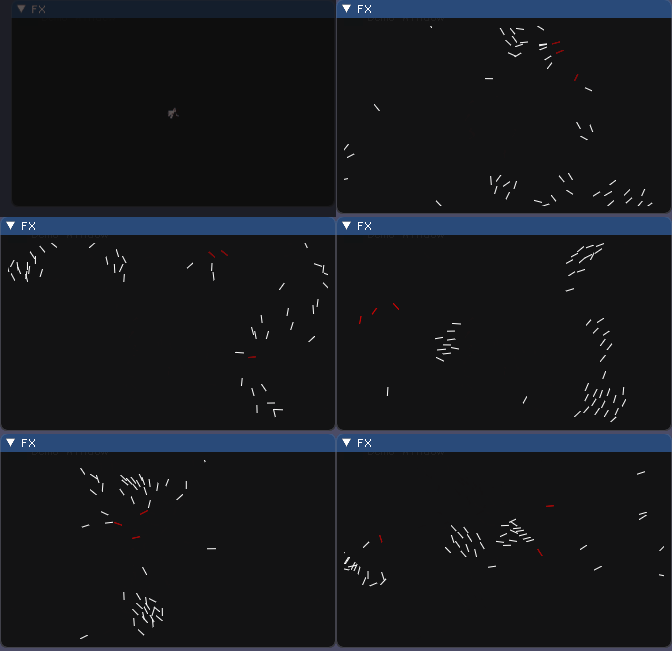
Boids implementation, 1020 bytes. It was a nightmare to get from 1090 to 1020. It had triangles for boids initially that looked better but I had to cut from somewhere 😅. This is so much fun, I feel like a teen again 🎉

using V=ImVec2;using F=float;using I=int;
#define O operator
#define R return
#define C cos(u)
#define S sin(u)
#define P(s)(V l,V r){R{l.x s r.x,l.y s r.y};};
#define Ps(s)(V l,F r){R{l.x s r,l.y s r};};
#define Y(s)V O s P(s)
#define Z(s)V O s Ps(s)
#define W(i,m)for(I i=0;i<m;++i)
Y(+)
Y(-)
Z(+)
Z(*)
Z(/)
F L(V v){R sqrt(v.x*v.x+v.y*v.y);}V M(V v,F m){F d=L(v);if(d>m)R v/d*m;R v;}V N(V v){R v/L(v);}V U(V v,F u){R{v.x*C-v.y*S,v.x*S+v.y*C};}struct B{V p,v,a;};B z[50];I t=1;void FX(ImDrawList* d,V a,V b,V,ImVec4,F){if(t){W(i,50){B&o=z[i];o.p={(b.x+a.x)/2,(b.y+a.y)/2};F u=rand()%99;o.v={C,S};}t=0;}W(i,50){auto&[p,v,f]=z[i];V pa,pc,ps;I c=0,cs=0;W(j,50){B&n=z[j];F d=L(n.p-p);if(d>0&&d<20){pa=pa+n.v;pc=pc+n.p;c++;}if(d>0&&d<10){ps=ps+(p-n.p)/d/d;cs++;}}if(c){pa=N(pa/c)*2-v;pc=N(pc/c-p)*2-v;}if(cs){ps=N(ps/cs)*2-v;}f=M(ps*2+pa+pc,.03);v=v+f;v=M(v,2);p=p+v;if(p.x<a.x-2)p.x=b.x+2;if(p.y<a.y-2)p.y=b.y+2;if(p.x>b.x+2)p.x=a.x-2;if(p.y>b.y+2)p.y=a.y-2;F u=atan2(v.x,-v.y);d->AddLine(p+U({0,-4},u),p+U({2,4},u),~0);}}
Update:
With the help of good folks around here, see bellow, I managed to reduce the size and add predator behavior as well. (986 bytes) now
#define R return
#define C cos(u)
#define S sin(u)
#define W(i,m)for(I i=m;i--;)
using V=ImVec2;using F=float;using I=int;F L(V v){R sqrt(v.x*v.x+v.y*v.y);}V M(V v,F m){F d=L(v);if(d>m)R v/d*m;R v;}V N(V v){R v/L(v);}V U(V v,F u){R{v.x*C-v.y*S,v.x*S+v.y*C};}struct B{V p,v,a;I h;};B z[50];I t=1;void FX(ImDrawList* d,V a,V b,V,ImVec4,F){if(t){W(i,50){B&o=z[i];o.p=(b+a)/2;F u=rand()%99;o.v={C,S};o.h=i%20==0;}t=0;}W(i,50){auto&[p,v,f,h]=z[i];V pa,pc,ps,ph;I c=0,cc=0,cs=0,ch=0;I hs=h?3:1;W(j,50){B&n=z[j];F d=L(n.p-p);if(d>0&&d<20){pa=pa+n.v;c++;}if(d>0&&d<20*hs){pc=pc+n.p;cc++;}if(d>0&&d<10){ps=ps+(p-n.p)/d/d;cs++;}if(!h&&n.h){if(d>0&&L(p+v-n.p)<40){ph=ph+(p-n.p)/d*3;ch++;}}}if(c){pa=N(pa/c)*2-v;}if(cc){pc=N(pc/cc-p)*2-v;}if(cs){ps=N(ps/cs)*2-v;}if(ch){ph=N(ph/ch)-v;}f=M(ps*2+pa+pc,.03)+ph;v=v+f;v=M(v,2);p=p+v;if(p.x<a.x-2)p.x=b.x+2;if(p.y<a.y-2)p.y=b.y+2;if(p.x>b.x+2)p.x=a.x-2;if(p.y>b.y+2)p.y=a.y-2;F u=atan2(v.x,-v.y);d->AddLine(p+U({0,-4},u),p+U({2,4},u),h?0xff0000ff:~0);}}
Catalin: are you on testbed 0.10? because since 0.20 we enabled the math operators so you should be able to shave some of that code defining them :)
ocornut
on 23 Nov 2020
@heretique If you still need a few extra bytes after removing math ops, you can also use reverse for loops to gain a few (for(I i=m;i--;) instead of for(I i=0;i<m;++i)), and replace o.p={(b.x+a.x)/2,(b.y+a.y)/2} with o.p={(b+a)/2};
Organic-Code
on 23 Nov 2020
Haven't checked since the beginning, so yeah I'm using the first version. Thanks for the tip 😉
heretique
on 23 Nov 2020
@heretique If you still need a few extra bytes after removing math ops, you can also use reverse for loops to gain a few (
for(I i=m;i--;)instead offor(I i=0;i<m;++i)), and replaceo.p={(b.x+a.x)/2,(b.y+a.y)/2}witho.p={(b+a)/2};
Thanks Lucas for the hints, keen eyes you have there 😉.
heretique
on 23 Nov 2020
@ocornut and @Organic-Code with your suggestions I'm down to 834 bytes, I might be able to add predator behavior as well.
heretique
on 23 Nov 2020
@heretique Hm that’s strange, I shove your code down to 815 bytes, but I don’t remember changing anything apart from what was mentioned 🤔
Well that’s not entirely true, because I forgot to say that you could reorder the code and put the using directives in the same line as the rest, but I mean that’s only 1 byte. Maybe you have some extra spaces here and there?
for comparison, here is what I have
#define C cos(u)
#define S sin(u)
#define W(i,m)for(I i=m;i--;)
#define R return
using V=ImVec2;using F=float;using I=int;F L(V v){R sqrt(v.x*v.x+v.y*v.y);}V M(V v,F m){F d=L(v);if(d>m)R v/d*m;R v;}V N(V v){R v/L(v);}V U(V v,F u){R{v.x*C-v.y*S,v.x*S+v.y*C};}struct B{V p,v,a;};B z[50];I t=1;void FX(ImDrawList*d,V a,V b,V,ImVec4,F){if(t){W(i,50){B&o=z[i];o.p={(b+a)/2};F u=rand()%99;o.v={C,S};}t=0;}W(i,50){auto&[p,v,f]=z[i];V pa,pc,ps;I c=0,cs=0;W(j,50){B&n=z[j];F d=L(n.p-p);if(d>0&&d<20){pa=pa+n.v;pc=pc+n.p;c++;}if(d>0&&d<10){ps=ps+(p-n.p)/d/d;cs++;}}if(c){pa=N(pa/c)*2-v;pc=N(pc/c-p)*2-v;}if(cs){ps=N(ps/cs)*2-v;}f=M(ps*2+pa+pc,.03);v=v+f;v=M(v,2);p=p+v;if(p.x<a.x-2)p.x=b.x+2;if(p.y<a.y-2)p.y=b.y+2;if(p.x>b.x+2)p.x=a.x-2;if(p.y>b.y+2)p.y=a.y-2;F u=atan2(v.x,-v.y);d->AddLine(p+U({0,-4},u),p+U({2,4},u),~0);}}
@Organic-Code my bad, I forgot to remove #define O operator line 😁
heretique
on 23 Nov 2020
These demos are pretty cool! Thought I'd give it a shot.
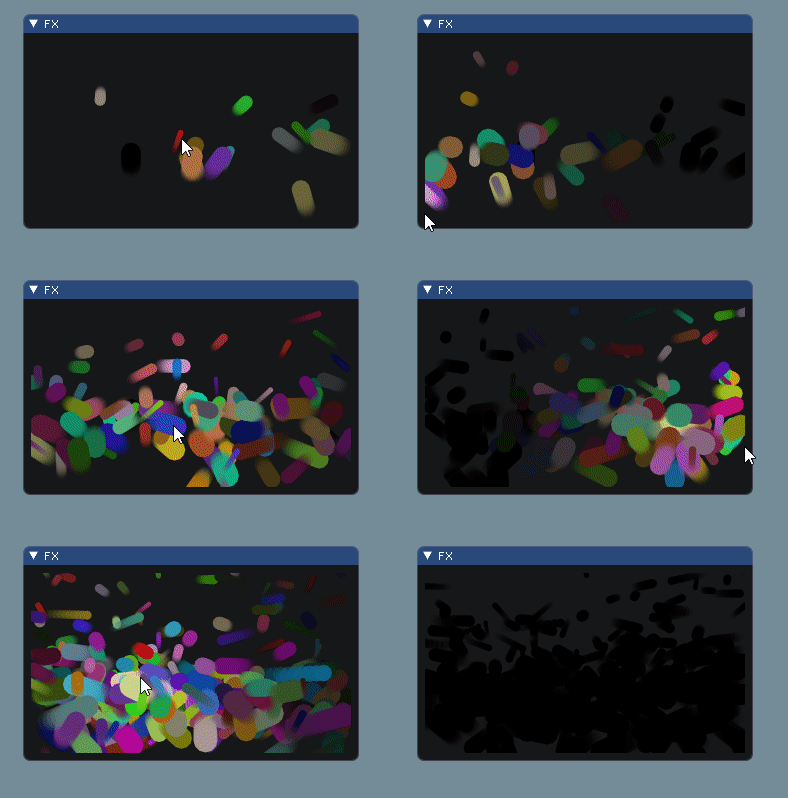
Bouncing balls, new ones spawning on bounce, motion blur, light by distance from mouse, pause on mouse down (that's what the pauses are) - 760 bytes. There is still heaps of room to reduce it further, but this will do.
```C
define V2 ImVec2
define N 400
define R(x) rand()/(F)RAND_MAX*x
define F float
V2 P[N]={{100,80}},v[N];F r[N]={10},a=.02,t=10;ImVec4 c[N];int cu=1;
void FX(ImDrawList* d,V2 p,V2,V2 s,ImVec4 m,F)
{int n=-1;for(int i=0;i
{F sc=j/t;d->AddCircleFilled(V2(P[i].x+p.x+v[i].xsc4,P[i].y+p.y+v[i].ysc4),r[i],IM_COL32(c[i].xii,c[i].yii,c[i].zii,sc255));}}
if(n>-1&&(cu
 TonyAlbrecht
on 23 Nov 2020
TonyAlbrecht
on 23 Nov 2020
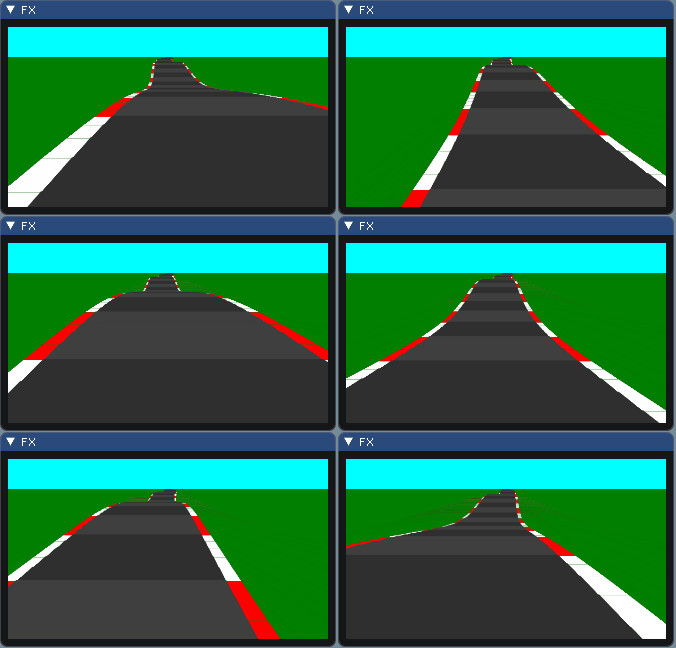
A racetrack. 948 bytes (thanks to tabs!)
#define V2 ImVec2
#define Q d->AddQuadFilled

void FX(ImDrawList* d, V2 a, V2 b, V2, ImVec4, float)
{
    static float cz = 0;
    V2 bl = {160, 90}, br = bl, bri = bl, bli = bl;
    cz += 0.5f;
    Q(a, {b.x, a.y}, {b.x, a.y + 30}, {a.x, a.y + 30}, 0xffffff00);
    Q({a.x, a.y + 30}, {b.x, a.y + 30}, b, {a.x, b.y}, 0xff007f00);
    for (int s = 300; s > 0; s--) {
        float c = sinf((cz + s) * 0.1f) * 500;
        float f = cosf((cz + s) * 0.02f) * 1000;
        V2 tl = bl, tr = br, tli = bli, tri = bri;
        tli.y--;
        tri.y--;
        float ss = 0.003f / s;
        float w = 2000 * ss * 160;
        float px = a.x + 160 + (f * ss * 160);
        float py = a.y + 30 - (ss * (c * 2 - 2500) * 90);
        bl = {px - w, py};
        br = {px + w, py};
        w = 1750 * ss * 160;
        bli = {px - w, py};
        bri = {px + w, py};
        if (s != 300) {
            bool j = fmodf(cz + s, 10) < 5;
            Q(tl, tr, br, bl, j ? 0xffffffff : 0xff0000ff);
            Q(tli, tri, bri, bli, j ? 0xff2f2f2f : 0xff3f3f3f);
        }
    }
}
<
badlydrawnrod
on 23 Nov 2020
Doom fire in 666 bytes.
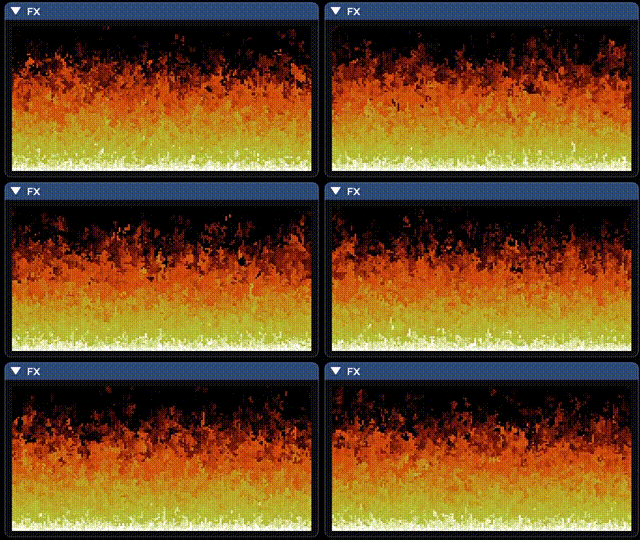
I first started to add interactive features, but I thought it would be more fun to get it down to 666 bytes instead (including carriage returns). There is room to get it a bit smaller still, but I didn't want to sacrifice readability any more than that. I'm happy I could keep the #define directives for W and H.
#define U unsigned
#define V ImVec2
#define P(o) V(a.x+(o+x)*s.x/W,b.y-(o+y)*s.y/H)
#define W 160
#define H 90
U n,C[666]={0xFFFFFF,0xC7EFEF,0x9FDFDF,0x6FCFCF,0x37B7B7,0x2FB7B7,0x2FAFB7,0x2FAFBF,0x27A7BF,0x27A7BF,0x1F9FBF,0x1F9FBF,0x1F97C7,0x178FC7,0x1787C7,0x1787CF,0xF7FCF,0xF77CF,0xF6FCF,0xF67D7,0x75FD7,0x75FD7,0x757DF,0x757DF,0x74FDF,0x747C7,0x747BF,0x73FAF,0x72F9F,0x7278F,0x71F77,0x71F67,0x71757,0x70F47,0x70F2F,0x7071F,0x70707};
U char T[H+2][W];
void FX(ImDrawList*d,V a,V b,V s,ImVec4,float t){20*t>n?n++:t=0;for(U x=0;x<W;x++)for(U y=0;y<H;y++){d->AddRectFilled(P(),P(1),C[T[y+1][x]]|255U<<24);U r=3&rand();if(t)T[y+1][x]=T[y][x+r-(r>1)]+(r&1);}}
 0x1100
on 24 Nov 2020
0x1100
on 24 Nov 2020
I've ported a number of these funs into my java binding, the code can be retrieved here. Here's the collection view I've created for them: https://youtu.be/ojgWnelaRfw
I also have an executable jar for download, renamed to a .zip as GitHub required so: fun-v0.11-full.jar.zip
 ice1000
on 24 Nov 2020
ice1000
on 24 Nov 2020
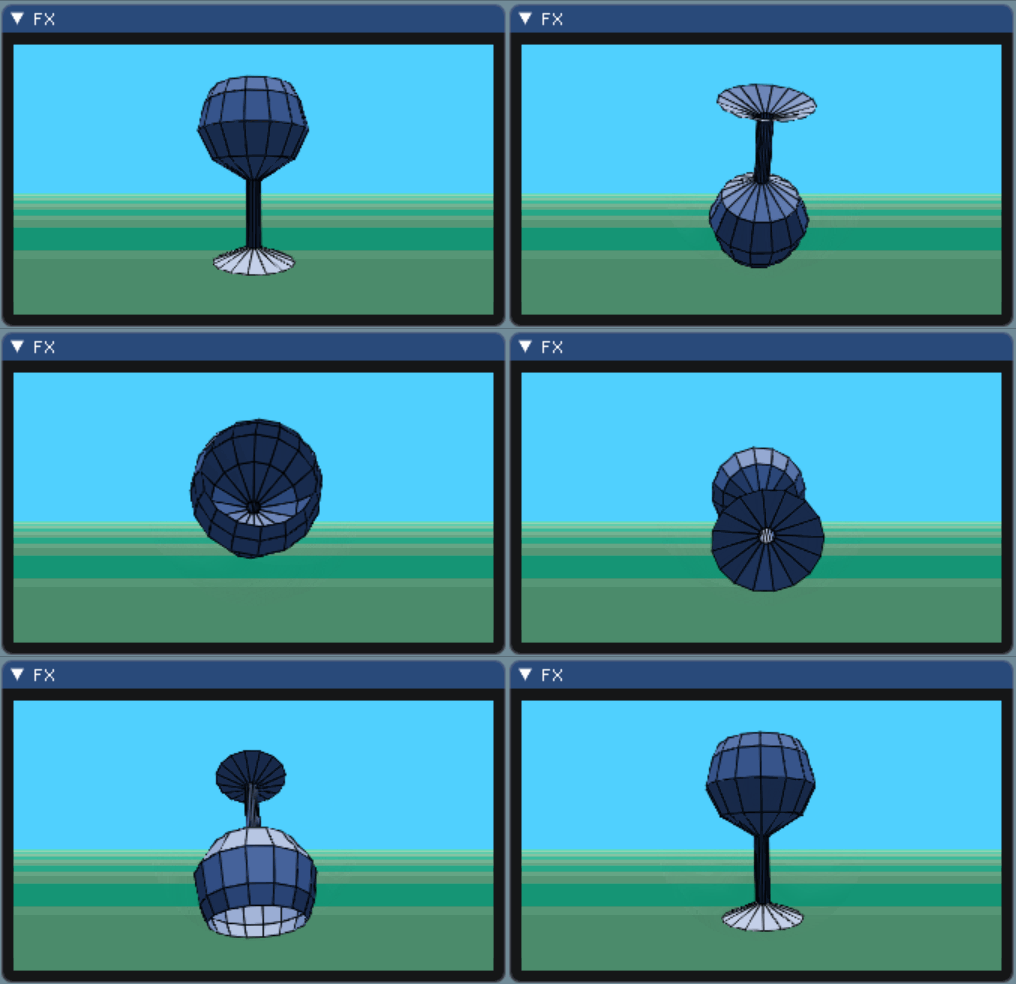
Flat Shaded Cup - 1019 bytes
#include<algorithm>
#define V ImVec2
#define F float
F L(F d,F s){d*=d>0;return sqrt(1-exp(-s*(d+.1)-d*d*d));}
void R(F&x,F&y,F r){F s=sin(r),c=cos(r),t=c*x-s*y;y=s*x+c*y;x=t;}
F x,y,z,e,f,g,l;
void T(F u,F t){R(x,z,t/3+u);R(x,y,t);R(y,z,t/5);}
void FX(ImDrawList*d,V a,V b,V S,ImVec4,F t){
int n=0,i,j,k,u,v,K=7,J=16;
char P[]="GZHXITGPBMBCGA",*X=P;
V m=(a+b)/2;
struct Q{F d,l;V o[4];bool operator<(Q&b){return d<b.d;}}q[99];
for(k=K;--k;){X+=2;for(j=J;j--;){
Q&o=q[n++];
o.d=0;
for(i=4;i--;){
u=j+(i%3>0);v=-(i/2)*2;
x=X[v]-65;y=77-X[v+1];z=0;
T(IM_PI*2*u/J,t);
e=x;f=y;
o.d+=z=S.y/(g=z+40);
o.o[i]=m+V(x,y)*z;
}
x=X[1]-X[-1];y=*X-X[-2];z=0;
l=sqrt(x*x+y*y);
T(IM_PI*2*(j+.5)/J,t);
o.l=((x*e+y*f+z*g)>0?1:-1)*y/l;
}}
std::sort(q,q+n);
for(i=99;i--;){b.y=a.y;a.y=m.y+9e2/(i+1);d->AddRectFilled(a,b,i>97?0xffffd050:0xff608000+(i/9&1)*64+i*65793);}
for(i=0;i<n;i++){Q&o=q[i];l=o.l;
d->AddConvexPolyFilled(o.o,4,ImColor(L(l,.1),L(l,.3),L(l,1),1.));
d->AddPolyline(o.o,4,~0<<24,1,1);
}}
 pmalin
on 24 Nov 2020
pmalin
on 24 Nov 2020
Working on porting some of the demos on my RISCV core for FPGAs (https://github.com/BrunoLevy/learn-fpga).
For now I do not have a FPU so it is damned slow. The goal in the end is to have a fully working ImGui API for it.
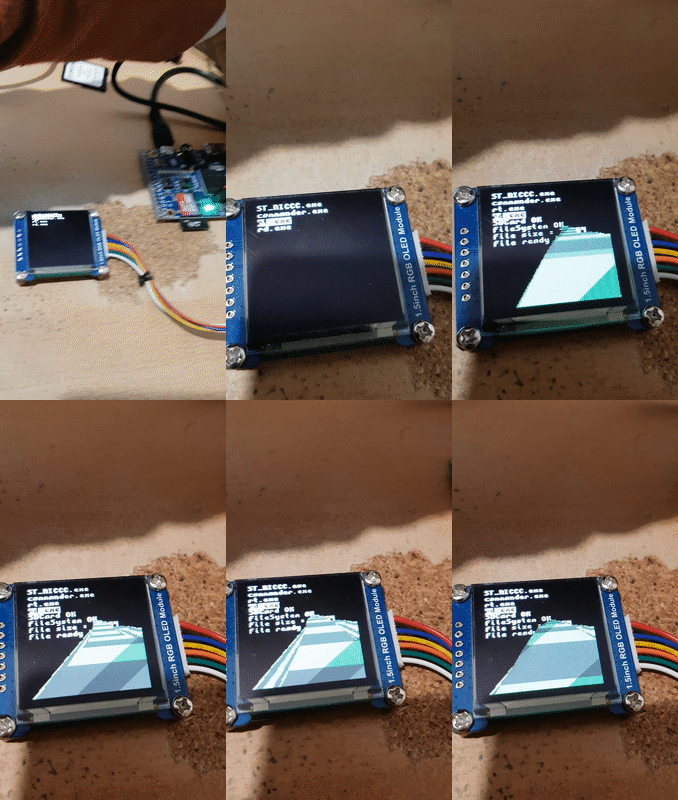
Making progress ! Tweaked a bit the code, to have a smoother animation (removed some tiny polygons near the horizon, which saves many floating point ops).
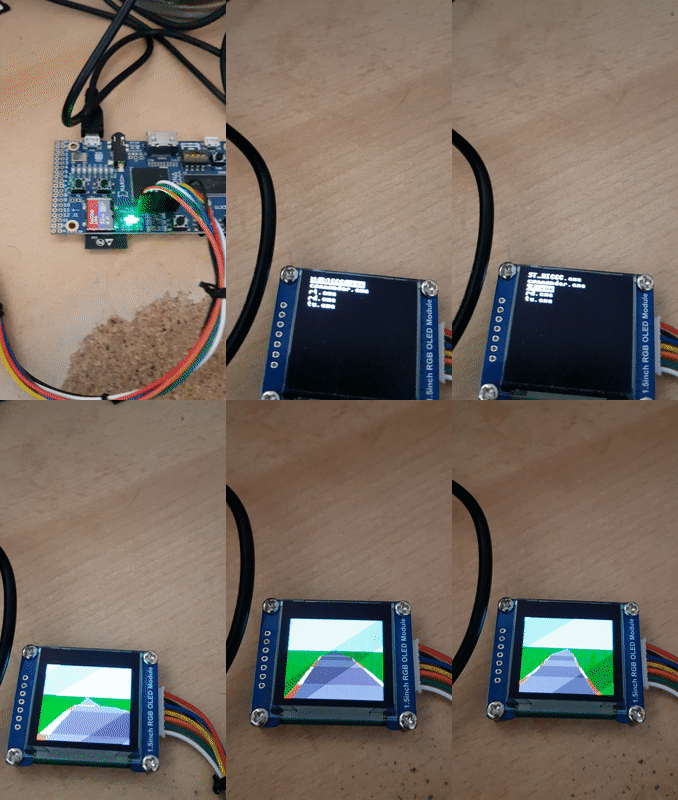
The Doom fire one is awesome ! Since it does not use FPU, it runs smoothly on the FemtoRV32 core. So realistic that I do not dare touching the screen !
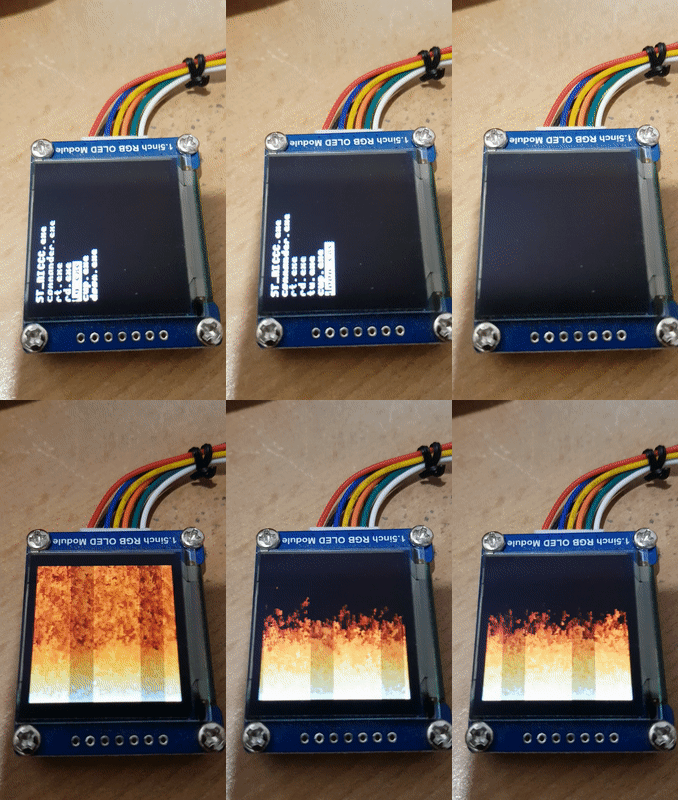
 BrunoLevy
on 24 Nov 2020
BrunoLevy
on 24 Nov 2020
An old school screensaver, remember these?
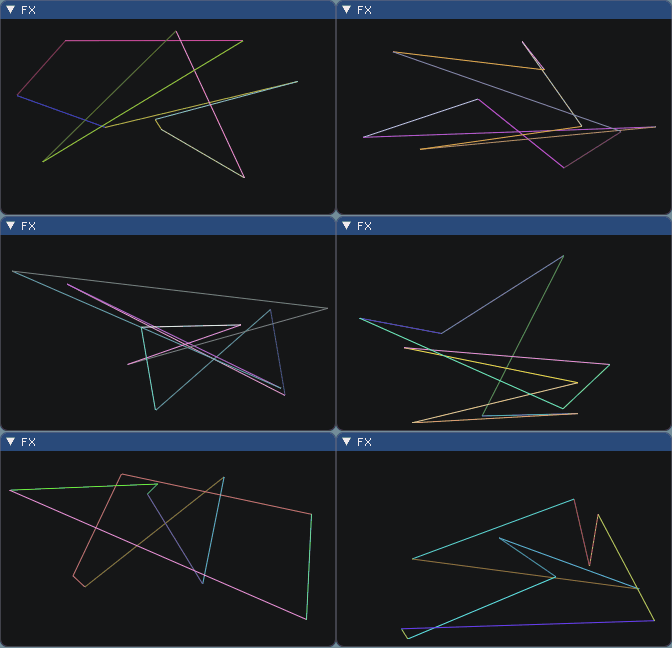
Add points with left click.
It was already < 1024 before making it ugly, but hey, it's part of the fun. I've stopped at 716 bytes.
#define V2 ImVec2
#define Co ImColor
#define SZ 32
#define SP 40
#define I int
#define F float

V2 p[SZ],s[SZ];
Co c[SZ];
I n=-1;

Co RandColor(){return Co(55+rand()%200,55+rand()%200,55+rand()%200);}

void FX(ImDrawList* d,V2 a,V2,V2 sz,ImVec4 m,F)
{
    if(m.z==0)
    {
        if(++n>=SZ){n=0;}
        else{p[n]=V2((F)(rand()%(I)sz.x),(F)(rand()%(I)sz.y));s[n]=V2((rand()%SP)/10.0f,(rand()%SP)/10.0f);c[n]=RandColor();}
    }

    for (I i=0;i<n;i++)
    {
        if(p[i].x<0.f||p[i].x>sz.x){s[i].x*=-1.0f;c[i]=RandColor();}
        if(p[i].y<0.f||p[i].y>sz.y){s[i].y*=-1.0f;c[i]=RandColor();}
        p[i]+=s[i];
    }

    for (I i=1;i<n;i++)
        d->AddLine(a+p[i-1],a+p[i],c[i]);

    if(n>1)
        d->AddLine(a+p[n-1],a+p[0],c[0]);
}
Sorry for the spam but I just had to post an updated version - all I changed was the alpha from 1. to .8 but it's loads better!
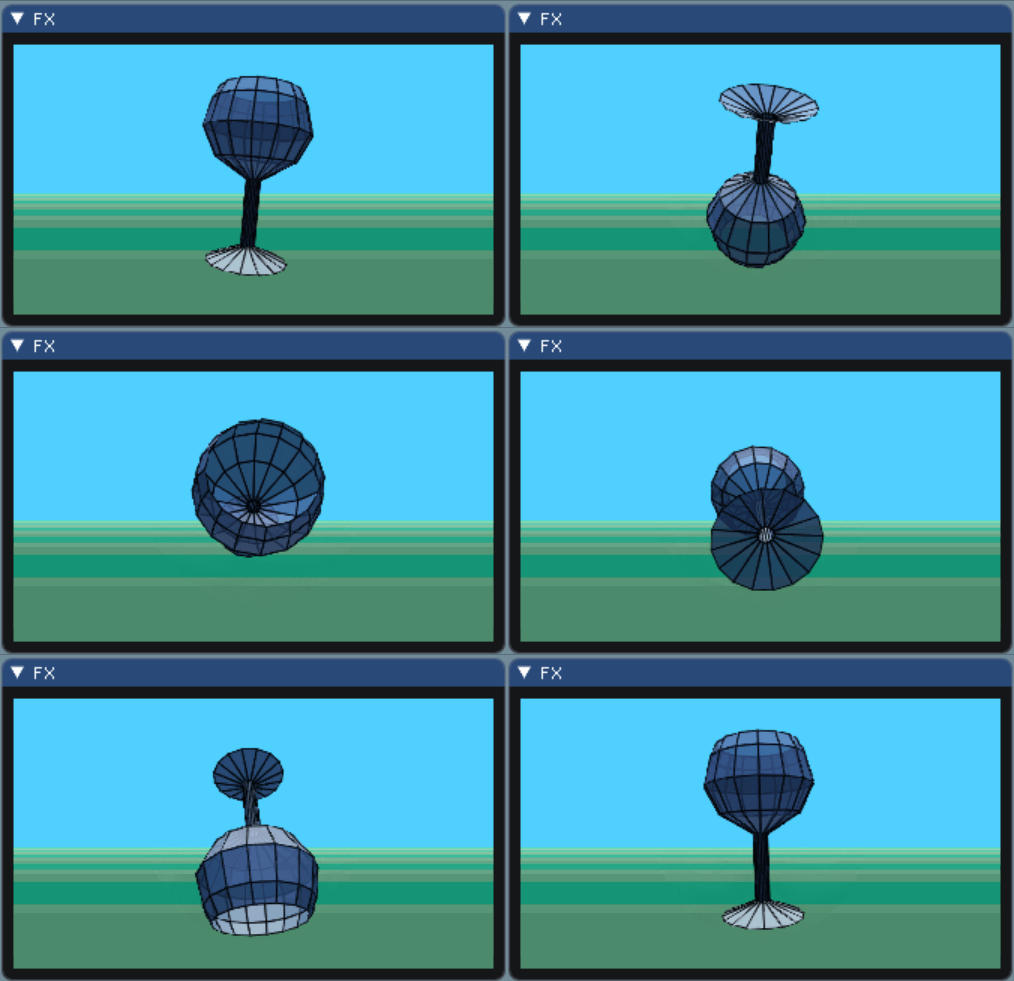
https://gist.github.com/pmalin/550058583492478beedd7b31ab468174
pmalin
on 24 Nov 2020
Here is mine, which is an upgraded version of an effect from our VX2 demo from Revision2020
I managed to keep some indentation in the compression process, but still hard to read ;)
@ocornut : thanks to the PushClipRect so the creature can blink 👀
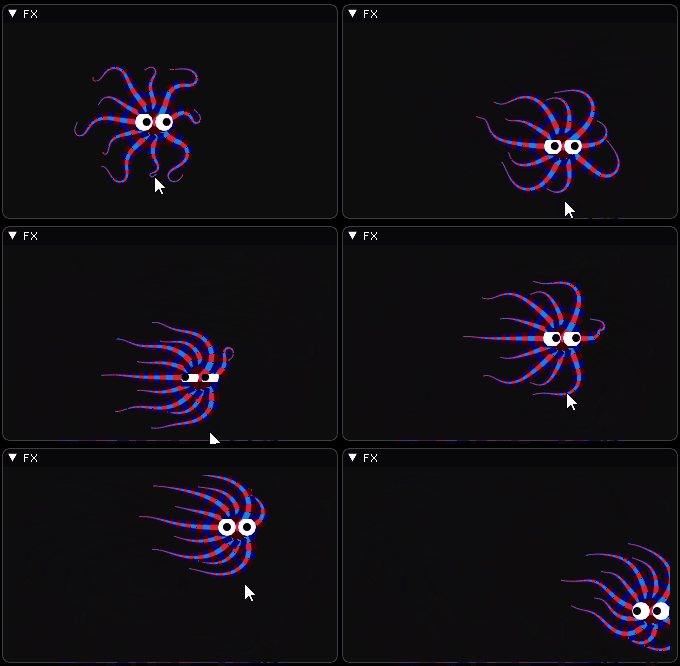
using V=ImVec2;
using I=int;
using F=float;
const I t=10,s=50;
F p1=IM_PI,p2=2*p1,lb=10;
V T[t][s];
V e(10,0);
I bk=0xFF000000;
F NA(F f){return f-p2*floor((f+p1)/p2);}
void FX(ImDrawList* d,V a,V z,V sz,ImVec4 m,F u)
{
    V vP=a+V(m.x,m.y-.3f)*sz;
    for (I i=0;i<t;++i)
    {
        F aT=i*p2/t,apv=aT,l=lb;
        V vDT(cos(aT),sin(aT)),vpv=vP;
        for (I j=0;j<s;++j)
        {
            V& vC=T[i][j];
            V vab=vC-vpv;
            V vAB=vab*ImInvLength(vab,1);
            F aS=atan2(vAB.y,vAB.x);
            F cl=ImClamp(NA(aS-apv),-p1,p1);
            aS=apv+ImClamp(cl-cl*.6f,-p1,p1);
            V vD(cos(aS),sin(aS));
            vC=vpv+vD*l;
            d->AddLine(vpv,vC,j&1?0xFF800000:0xFF000040,2*l);
            d->AddLine(vpv,vC,j&1?0xFFE08020:0xFF4020E0,2*l/3);
            apv=aS;
            vpv=vC;
            l*=i&1?.9f:.85f;
        }
    }
    F cs=pow(abs(sin(u)),.3);
    d->PushClipRect(vP-V(99,10)*cs,vP+V(99,10)*cs,1);
    d->AddCircleFilled(vP+e,9,-1);
    d->AddCircleFilled(vP-e,9,-1);
    V o=e*.5*sin(u*.8);
    d->AddCircleFilled(vP+e+o,4,bk);
    d->AddCircleFilled(vP-e+o,4,bk);
    d->PopClipRect();
}
 speedoog
on 26 Nov 2020
speedoog
on 26 Nov 2020
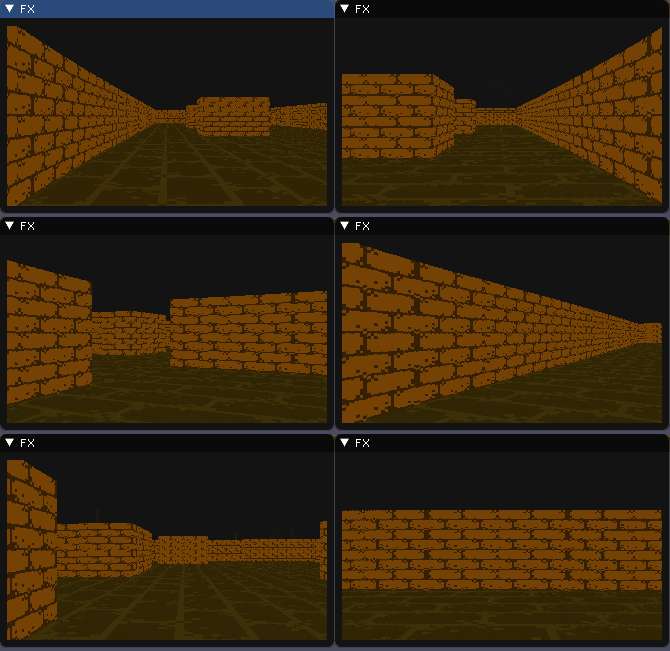
Little raycaster (1020 bytes).
Hold right mouse button to look around and left mouse to move forward.
There's no collision testing for the walls but there's a limitation on position inside map (16x16 squares).
Code is unreadable but pretty simple actually, for a good basic explanation of the principles have a look here, for an in depth dive I recommend The Black Book series
#define C(u)cos(u)
#define S(u)sin(u)
#define W(i,m,c)for(F i=0;i<m;i+=c)
using V=ImVec2;using F=float;using I=int;I mp[8]={0xffff8001,0x82418001,0xa0018cf9,0x8009a289,0x80098289,0xa0018ef1,0x80058001,0x8001ffff},t1[8]={0x4003a001,0x10001,0x30003,0x8045ffff,0x3a00140,0x1000500,0x21000704,0xb80ffff},K=16;F px=1.5,py=1.5,pa=0,fv=1,mx=0;
#define M(m,x,y)m[I(y/2)]&(1<<I(32-(x+(I(y)%2?K:0))))
#define R(k,l,m,n,r,p)d->AddRectFilled({a.x+i,(b.y+a.y)/2+(k)},{a.x+i+1,(b.y+a.y)/2+(k)+1},M((l),(m),(n))?(r):(p))
void FX(ImDrawList* d,V a,V b,V s,ImVec4 m,F t){W(i,s.x,1){F ag=pa-fv/2+fv*i/s.x;W(j,K,.01){F x=px+j*C(ag),y=py+j*S(ag),di=j*cos(ag-pa),ch=min(300,I(s.y/di));R(ch/2,t1,I(32*x)%K,I(32*y)%K,0xff082f3d,0xff042530);if(M(mp,x,y)){F wx=x-I(x+.5),wy=y-I(y+.5);I tx = I(64*(abs(wy)>abs(wx)?wy:wx))%K;if(tx<0)tx+=K;W(c,ch,1){I ty=I(64*c/ch)%K;R(-ch/2+c,t1,tx,ty,0xff062036,0xff044275);}break;}}}if(m.w==0)mx=m.x;if(m.w>0){pa+=m.x-mx;mx=m.x;}if(m.z>0){px=max(1.3,min(14.5,px+.05*C(pa)));py=max(1.3,min(14.5,py+.05*S(pa)));}}
Update:
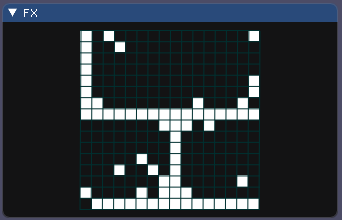
I added a small map/texture editor for who wants to play with the map or texture for the demo.
Use left mouse left click to toggle cells and right click to print the values to console. Copy paste the values from the console inside the mp[8]= or t1[8]= arrays and recompile.
using V = ImVec2;
using I = int;
using F = float;
const I kTiles = 16;
// the map is 16x16 encoded in 8 integers
// one value in the array encodes two rows
// The same idea is used for the ground/wall texture as well
I map[8] = { 0, 0, 0, 0, 0, 0, 0, 0 };
ImU32 gridColor = 0xff303000;
void FX(ImDrawList* d, V a, V b, V s, ImVec4 m, F)
{
    // I chose to draw the map centered and with 1 aspect ratio
    // as it looks better
    F sz = (s.y - 1) / kTiles; // define size of tile in pixels


    // tile drawing
    for (I i = 0; i < kTiles; ++i)
    {
        for (I j = 0; j < kTiles; ++j)
        {
            // we pack 2 rows into an integer
            // so we have to adjust index in map and bit position in value
            I mapIndex = j / 2;
            I shift = 32 - (i + (j % 2 ? 16 : 0));
            if (map[mapIndex] & (1 << shift))
            {
                d->AddRectFilled({ (a.x + b.x - s.y - 1) / 2 + i * sz + 1, a.y + j * sz }, { (a.x + b.x - s.y - 1) / 2 + (i + 1) * sz + 1, a.y + (j + 1) * sz }, ~0);
            }
        }
    }

    if (!m.z && (m.x >= 0 && m.x <= 1.0) && (m.y >= 0 && m.y <= 1.0))
    {
        // remap mouse pos to [0,1] inside grid
        F mx = (m.x - (s.x - s.y) / 2 / s.x) * s.x / s.y;
        F my = m.y;
        if ((mx >= 0 && mx <= 1.0) && (my >= 0 && my <= 1.0))
        {
            I mapIndex = my * kTiles / 2;
            I mod = I(my * kTiles) % 2;
            I shift = 32 - (I(mx * kTiles) + (mod ? kTiles : 0));
            map[mapIndex] ^= 1 << shift;
        }
    }
    // vertical grid
    for (I i = 0; i < kTiles + 1; ++i)
    {
        d->AddLine({ (a.x + b.x - s.y - 1) / 2 + i * sz + 1, a.y }, { (a.x + b.x - s.y - 1) / 2 + i * sz, b.y }, gridColor);
    }
    // horizontal grid
    for (I j = 0; j < kTiles + 1; ++j)
    {
        d->AddLine({ (a.x + b.x - s.y - 1) / 2, a.y + j * sz }, { (a.x + b.x + s.y - 1) / 2, a.y + j * sz }, gridColor);
    }
    if (!m.w)
    {
        for (I i = 0; i < 8; ++i)
        {
            printf("0x%x", map[i]);
            if (i != 7)
                printf(",");
        }
        printf("\n");
    }
}
@heretique OK, that's seriously impressive - you even managed to fit a texture in there!
ShironekoBen
on 26 Nov 2020
Googly Eyes
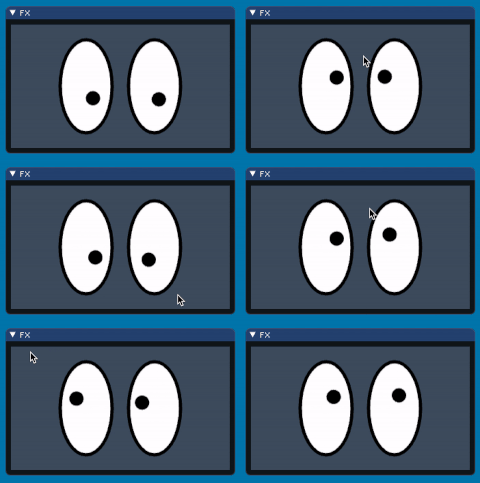
WASM demo: https://floooh.github.io/oryol-sticky-tests/xeyes/imgui-sapp.html
void FX(ImDrawList* d, ImVec2 a, ImVec2 b, ImVec2 sz, ImVec4 m, float) {
    #define el(p,rx,ry,c){for(int s=0;s<36;s++){d->PathLineTo(ImVec2(p.x+sinf((IM_PI/18)*s)*rx,p.y+cosf((IM_PI/18)*s)*ry));}d->PathFillConvex(c);}
    #define v2 ImVec2
    v2 c((a+b)*0.5f);
    v2 mp(a.x+m.x*sz.x,a.y+m.y*sz.y);
    d->AddRectFilled(a,b,0xFF665544);
    v2 eye[2]={{c.x-50,c.y},{c.x+50,c.y}};
    for (int i=0;i<2;i++){
        el(eye[i],40,70,0xFF000000);
        el(eye[i],35,65,0xFFFFFFFF);
        v2 v(mp-eye[i]);
        float l=sqrtf(v.x*v.x+v.y*v.y);
        v2 n(v/l);
        if (l>20)l=20;
        v2 p(eye[i]+n*l);
        el(p,10,10,0xFF000000);
    }
}
 floooh
on 26 Nov 2020
floooh
on 26 Nov 2020
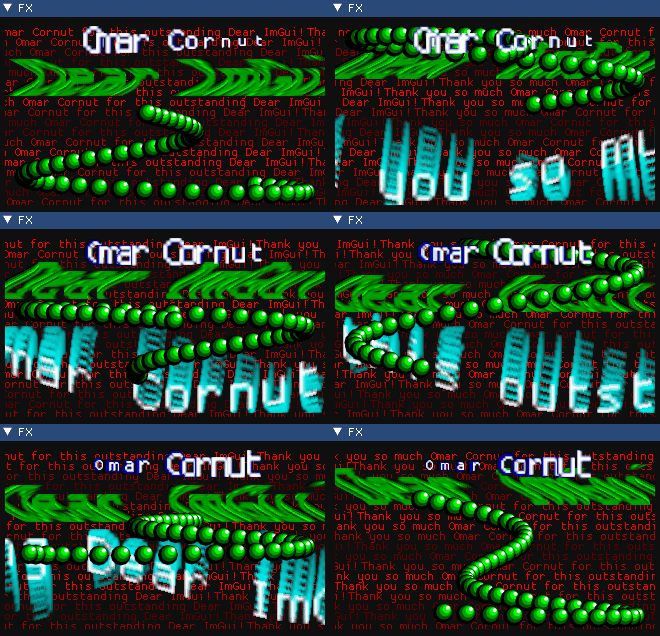
My contribution (1020b). Thx you so much for ur great lib omar.
It's a tribute to the spreadpoint demo also ported on atari by TCB.
Demoscene for ever!
Stef/Spectrals
using V=ImVec2;using F=float;
#define R(w,x,y,z) d->PushClipRect(V(w,x),V(y,z),1);
#define Rf d->PopClipRect();
#define L(i,x,y,z) for(F i=x;i<y;i+=z)
#define X(i,x,y,z,w) d->AddText(ImGui::GetFont(),i,x,0xff000000+y,z,w);
void FX(ImDrawList* d,V a,V b,V sz,ImVec4 m,F t){char*s="Thank you so much Omar Cornut for this outstanding Dear ImGui!";V c=a+sz/2;F o=410;
L(y,0,sz.y,10)L(x,fmod(t*-100+30*sin(t+y),o)-o,sz.x,o) X(0,a+V(x,y),0xaa+0x55*cos(y*.1),s,0)
L(x,a.x,b.x,1){R(x,a.y,x+1,b.y)L(j,8,16,1) X(60,V(b.x-fmod(t,12)*200-j,10+c.y+cos(x*.01+t*5+j*.3)*30),0x111111*j,s,0);Rf}
F z=fabs(cos(t)*30);L(y,a.y+z,a.y+z+60,1){R(a.x,y,b.x,y+1.01)L(i,0,6,1) X(60,V(c.x-150+20*sin(t*3-i*.2+(y-z)*.1),a.y+z),i*0x5500,s+51,0)Rf}
L(i,0,50,1){F tt=t+i*.02;V p=V(sin(tt*10)-cos(tt*5),sin(tt*-3)+cos(tt*1.5))*sz/4+c;L(j,0,5,1) d->AddCircleFilled(p+V(1,-1)*10*j/8,10*(1-j/5),j<4?0xff000000+j*0x5500:-1);}
for(int k=18;k<29;k++) L(j,0,6,1){F w=sin(j*-.2+t*5+k*.3)*15+30; X(w,a+V(-190+k*16-w/2,16-w/2),j*0x550000,s+k,s+k+1)}}
 StephaneMenardais
on 26 Nov 2020
StephaneMenardais
on 26 Nov 2020
Here is mine, which is an upgraded version of an effect from our VX2 demo from Revision2020
I managed to keep some indentation in the compression process, but still hard to read ;)
@ocornut : thanks to the PushClipRect so the creature can blink 👀
My son (9y) goes crazy with this one... It could be a good candidate for a Dear Imgui mascot...
 phicore
on 26 Nov 2020
phicore
on 26 Nov 2020
Wow, oh dear this is all incredibly amazing <3 I'm not even sure how to comment on those yet!
@StephaneMenardais yours as well as being touching was very ingenuous, how you simulated raster/scanline effect with cliprect.
@speedoog incredibly charming, would make a good screen saver as well (or easter egg)
@heretique i'm not even sure what to say at this point :)
It's quite fun to investigate them, still have lots to catch up with! keep them coming!
I believe we could end up packaging all of them in bundled sources + ship on emscripten with code on the side :)
ocornut
on 26 Nov 2020
Particle Text

Code is in orb form (1024 bytes):
#include <algorithm>
#define V ImVec2
#define R(u,v,r){float U=u;u=cos(r)*u-sin(r)*v;v=sin(r)*U+cos(r)*v;}
#define S(T)1.f/(1+exp(-(T)))*IM_PI*2
#define B(T)sin((T)*3)*exp(-(T))
                       int  W =
             11;unsigned c [] ={0xD9000080,
      0x750A2B18,0xDC2A2A17,0x0200025D,0x5AB1E800,
   0x26EAB555,0x01800100};struct T{float x,y,z; int i
 ;bool operator < (T &o) {return z > o.z; }}; void FX (
ImDrawList *d,V a,V b,V s,ImVec4 m,float t){float L=fmod
(t,6)*10;T v[221];for(int n=3;n<224;n++){int i=n-3;float
x =i%17*W-8.5*W,y=i/17*W-6.5*W,z=0,D=sqrt(x*x+y*y)/32,X=
S(L-4-D)+cos(t/3)/4,Y=S(L-12-D)+cos(t/7)/4,Z=S(L-20-D) +
cos(t/2)/4;R(x,y,Z)R(y,z,X)R(x,z,Y)z-=L-D>28?B((L-28-D)/
2)*50:0;z=c[n/32]&1<<n%32?z/100+1:0; v[i] = {a.x+s.x*.5f
 +x/z,a.y+s.y*.5f+y/z,z,i};}std::sort(v,&v[221]); for (
   int i = 0; i < 221; i++) { if ( v[i].z != 0 ) {d->
      AddCircleFilled(V(v[i].x,v[i].y),W*.8/v[i].z
            ,ImColor(v[i].i>102?0.f:1.f,v[i]
                   .i<102?0.f:1.f,3.f
-v[i].z*2.5f,1.f));}}}
A slightly less obfuscated version (1015 bytes):
#include <algorithm>
#define V ImVec2
#define R(u,v,r) {float U=u;u=cos(r)*u-sin(r)*v;v=sin(r)*U+cos(r)*v;}
#define S(T) 1.f/(1+exp(-(T)))*IM_PI*2
#define B(T) sin((T)*3)*exp(-(T))
int W = 11;
unsigned c[] = {0xD9000080,0x750A2B18,0xDC2A2A17,0x0200025D,0x5AB1E800,0x26EAB555,0x01800100};
struct T{float x,y,z;int i;bool operator<(T&o){return z>o.z;}};
void FX(ImDrawList *d,V a,V b,V s,ImVec4 m,float t) {
    float L=fmod(t,6)*10;T v[221];
    for (int n=3;n<224;n++) {
        int i=n-3;
        float x=i%17*W-8.5*W,y=i/17*W-6.5*W,z=0,D=sqrt(x*x+y*y)/32,
            X=S(L-4-D)+cos(t/3)/4,Y=S(L-12-D)+cos(t/7)/4,Z=S(L-20-D)+cos(t/2)/4;
        R(x,y,Z)R(y,z,X)R(x,z,Y)
        z-=L-D>28?B((L-28-D)/2)*50:0;
        z=c[n/32]&1<<n%32?z/100+1:0;
        v[i] = {a.x+s.x*.5f+x/z,a.y+s.y*.5f+y/z,z,i};
    }
    std::sort(v,&v[221]);
    for (int i=0;i<221;i++)
        if (v[i].z!=0)
            d->AddCircleFilled(V(v[i].x,v[i].y),W*.8/v[i].z,ImColor(v[i].i>102?0.f:1.f,v[i].i<102?0.f:1.f,3.f-v[i].z*2.5f,1.f));
}
 bdero
on 27 Nov 2020
bdero
on 27 Nov 2020
Another one (806 bytes)
Update: fixed UB.
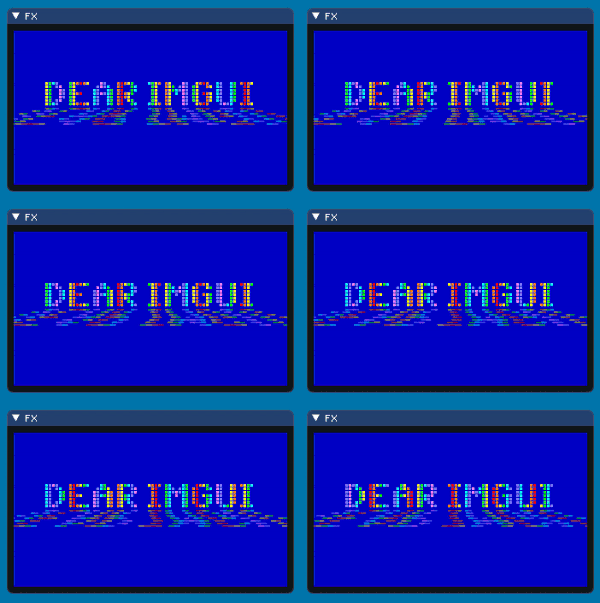
WASM demo: https://floooh.github.io/oryol-sticky-tests/imguidl2/imgui-sapp.html
void FX(ImDrawList* d, ImVec2 a, ImVec2 b, ImVec2 sz, ImVec4 m, float t) {
#define v2 ImVec2
#define u32 uint32_t
#define R(p0,p1,c) d->AddRectFilled(p0,p1,c)
u32 s[]={0xF1F8C7C3,0xD8CF3378,0xD981E661,0x9DD9B330,0xCD833661,0x9FD83330,0xCDE3F7C1,0x9ADBB330,0xCD833781,0x98D9B330,0xD98336C1,0x98D9B330,0xF1FB3663,0xD8CF1E78};
u32 p[]={0xFF0000FF,0xFF0088FF,0xFF00FFFF,0xFF00FF00,0xFFFFFF00,0xFFFF8888,0xFFFF88FF,0xFFFF8888,0xFFFFFF00,0xFF00FF00,0xFF00FFFF,0xFF0088FF};
v2 p0(a+v2(165,60));R(a,b,0xFFCC0000);for(int y=0;y<7;y++){for (int x=0,ix=-32;x<2;x++){u32 c=s[y*2+x];for (int i=31; i>=0;i--,ix++){
if (c&(1<<i)){v2 p1(p0.x+ix*4,p0.y+y*4);u32 pi=u32((t*30+32)-ix)%12;R(p1,p1+v2(3,3),p[pi]);float w=4+(6-y)*0.5;v2 p2(p0.x+ix*w+sinf(t*2+p1.y*.3)*(6-y),p0.y+48-y*3);
R(p2,p2+v2(w,2),p[pi]&0x7FFFFFFF);}}}}}
Formatted:
void FX(ImDrawList* d, ImVec2 a, ImVec2 b, ImVec2 sz, ImVec4 m, float t) {
    #define v2 ImVec2
    #define u32 uint32_t
    #define R(p0,p1,c) d->AddRectFilled(p0,p1,c)
    u32 s[]={0xF1F8C7C3,0xD8CF3378,0xD981E661,0x9DD9B330,0xCD833661,0x9FD83330,0xCDE3F7C1,0x9ADBB330,0xCD833781,0x98D9B330,0xD98336C1,0x98D9B330,0xF1FB3663,0xD8CF1E78};
    u32 p[]={0xFF0000FF,0xFF0088FF,0xFF00FFFF,0xFF00FF00,0xFFFFFF00,0xFFFF8888,0xFFFF88FF,0xFFFF8888,0xFFFFFF00,0xFF00FF00,0xFF00FFFF,0xFF0088FF};
    v2 p0(a+v2(165,60));
    R(a,b,0xFFCC0000);
    for(int y=0;y<7;y++){
        for (int x=0,ix=-32;x<2;x++){
            u32 c=s[y*2+x];
            for (int i=31; i>=0;i--,ix++){
                if (c&(1<<i)){
                    v2 p1(p0.x+ix*4,p0.y+y*4);
                    u32 pi=u32((t*30+32)-ix)%12;
                    R(p1,p1+v2(3,3),p[pi]);
                    float w=4+(6-y)*0.5;
                    v2 p2(p0.x+ix*w+sinf(t*2+p1.y*.3)*(6-y),p0.y+48-y*3);
                    R(p2,p2+v2(w,2),p[pi]&0x7FFFFFFF);
                }
            }
        }
    }
}

2nd effect, 1022b
Thx @bdero for sort idea.
#include <algorithm>
using V=ImVec2;using F=float;int h;struct E{V p;F z,w;bool operator<(E&o){return z<o.z;}};E G[999];
#define L(i,x,y,z)for(F i=x;i<y;i+=z)
#define Q(y)sin((y+t)*.03)*(1-sin(t*3)*cos(y/99+t))*9
#define H(p,w)L(k,0,5,1)d->AddCircleFilled(p+V(1,-1)*w*k/8,w*(1-k/5),k<4?0xff000000+k*0x554400:-1);
#define J(b)L(i,0,h,1){E&o=G[int(i)];if(b*o.z>0)H(o.p,(o.z*.3+4)*o.w)}
#define O(b)i=t+1.6+j/99;if(b*sin(i)>0)H(c+v*j+u*(cos(i)*40+Q(j)),30)
void FX(ImDrawList*d,V a,V b,V,ImVec4,F t){F i=sin(t)-.7;V u(cos(i),sin(i)),v(-sin(i),cos(i)),c=(a+b)/2;F l=300;
F w=0;L(z,4,20,1){w+=z;L(yy,-l,l,z*2){F y=yy+fmod(t*z*10,z*2);L(i,-1,2,2)d->AddCircle(c+v*y+u*i*(w+sin((y+t)/25)*w/30),z,0xff000000+0x110e00*int(z*z*z/384),12,z/2);}}
h=0;L(y,-l,l,15)L(b,0,16,1){i=t+b*.2+y/99;G[h++]={c+v*y+u*(cos(i)*60+Q(y)),sinf(i),(b<1||b>14)?2.f:1.5f};}std::sort(G,G+h);
F j=(-2+fmod(t*3,5))*99;J(-1)O(-1)a=c+v*-l;L(y,-l,l,15){b=c+v*y+u*(15-rand()&31)*.1;L(k,0,9,1)d->AddLine(a-v,b,k<8?0x11222200*k:-1,(9-k)*4);a=b;}O(1)J(1)}
Stateless particle effect with mouse controlling the acceleration (1022b)

using V=ImVec2;
using I=int;
using U=unsigned int;
using F=float;
I sc=50,pa=0;
F lt=800.0f;
I noise(U p, U s){const U a=0xB5297A4D,b=0x68E31DA4,c=0x1B56C4E9;U m=p;m*=a;m+=s;m^=(m>>8);m+=b;m^=(m <<8);m*=c;m^=(m>>8);return m;}
F rbt(U s,U *p,F a,F b){U v = noise(*p, s); *p += 1;return (F)((((F)(v%10000))/10000.0f)*(b-a)+a);}
V dv(U s,U *p,F a,F b,F c,F d){F z=rbt(s,p,a,b);return V(cos(z),sin(z))*rbt(s, p, c, d);}
void FX(ImDrawList* d,V a,V z,V sz,ImVec4 m,F dt){F t=dt*1000.0f,tbe=100.0f/5.0f;I g=(I)(t/tbe);F cst=(F)g*tbe;I mga=ceil(lt/tbe),pc=min(g+1,mga)*sc;I icg=max(0,g+1-mga),cg=icg;for(I pi=0;piAddCircleFilled(p,si,pt/lt<0.1?0x44FFFFFF:pt/lt<0.3?0xAA00AAFF:ImColor(1.0f,.0f,.0f,1.0f-pt/lt));}}}
 vzaramel
on 28 Nov 2020
vzaramel
on 28 Nov 2020
Colored random walks, very simple code, cool looking result.
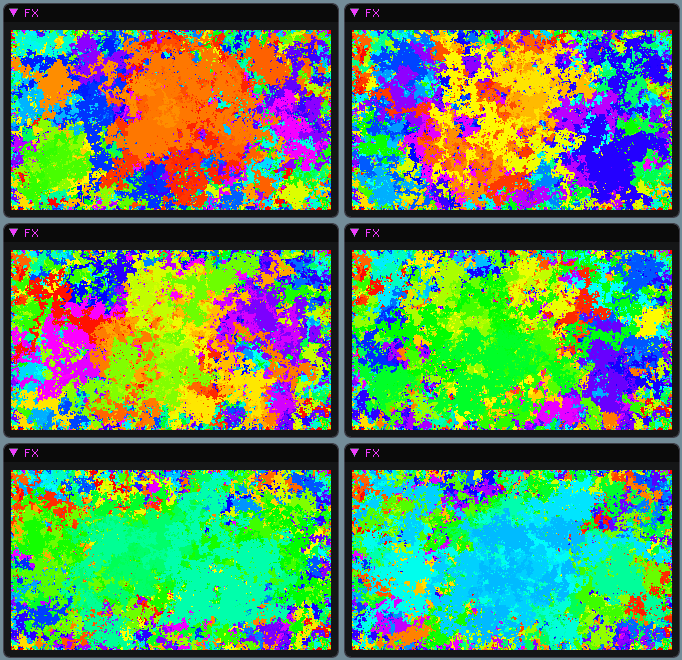
Source code (741 bytes)
#define C(r,g,b) IM_COL32(255*(r), 255*(g), 255*(b), 255)

ImU32 to_color(float v)
{
    size_t p = v * 5.0;
    double g = (v * 5.0 - p);
    ImU32 colors[] = {
      C(1, g, 0),
      C(1-g, 1, 0),
      C(0, 1, g),
      C(0, 1-g, 1),
      C(g, 0, 1),
      C(1, 0, 1-g),
    };
    return colors[p];
}

float pixel[320][180];
#define R ((float)std::rand()/RAND_MAX > 0.5)

void FX(ImDrawList* d, ImVec2 a, ImVec2, ImVec2, ImVec4, float t)
{
    size_t x(320.f/2), y(180.f/2);
    do
    {
        pixel[x][y] = t - (int) t;
        if(R)
            x += R ? -1 : 1;
        else
            y += R ? -1 : 1;
    } while(x >= 0 && x < 320 && y >= 0 && y < 180);

    for (x = 0; x < 320; ++x)
        for (y = 0; y < 180; ++y)
        {
            d->AddRectFilled(ImVec2(a.x+x,a.y+y), ImVec2(a.x+x+1,a.y+y+1), to_color(pixel[x][y]));
        }
}
I made this landscape for another entry.
Shame the deadline is so soon, these are fun and I have a list of ideas.
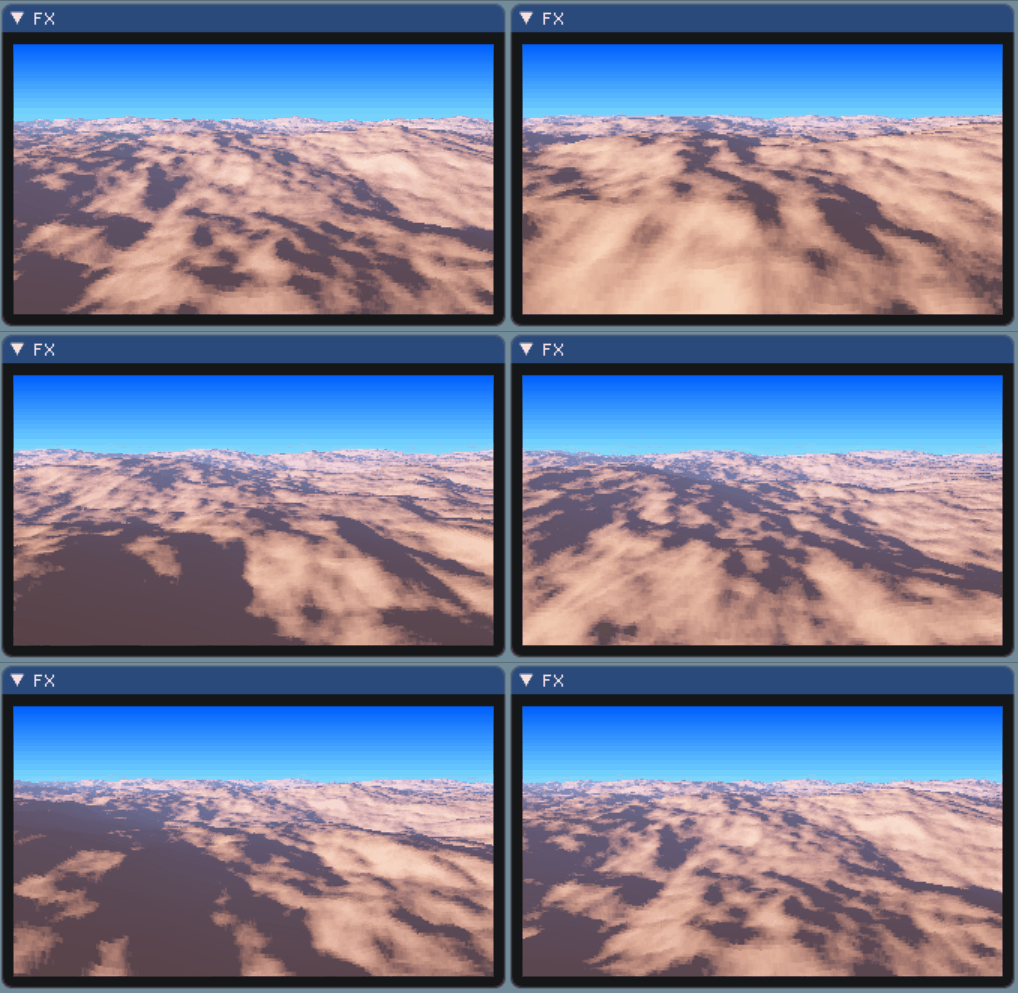
1017 bytes
#define V ImVec2
#define F float
#define D 2048
F m[D*D],I,O,w,x,y,z,h,u,v,l;
int q,i,j,T,M;
F&A(int x,int y){return m[(x&(D-1))+(y&(D-1))*D];}
F S(F x,F y){return A(x*D,y*D);}
void L(F& x,F a,F c){x=sqrt(1.-exp(-a*I*(1.-O)-c*O));}
#define R ((rand()%98)/49.-1)*l
void FX(ImDrawList*d,V a,V b,V B,ImVec4 o,F t){
if(!q){q=1;m[0]=0;l=.5;
for(T=D;T>1;l=l/2,T=T/2){M=T/2;for(j=0;j<D;j+=T){for(i=0;i<D;i+=T){w=A(i,j);x=A(i+T,j);y=A(i,j+T);z=A(i+T,j+T);
A(i+M,j)=(w+x)/2+R;A(i+M,j+T)=(y+z)/2+R;A(i,j+M)=(w+y)/2+R;A(i+T,j+M)=(x+z)/2+R;A(i+M,j+M)=(w+x+y+z)/4+R;}}}}
V s=a,e=b;o.w=1;for(i=64;i--;){s.y=e.y;e.y=a.y+B.y*i/150;d->AddRectFilled(s,e,0xffff6000+i*771);}
for(i=0;i<B.x;i++){s.x=e.x=a.x+i;e.y=s.y=b.y;w=(i/B.x)*2-1;h=S(.5,t*.2)-.5;
for(j=0;j<400;j++){z=j/400.;z=z*z*500;x=w*z;u=x/300+.5;v=z/300+t*.2;l=S(u,v);y=(l-h)*32;s.y=a.y+B.y*(y/(z+.1)+.25);
if(s.y<e.y){I=l-S(u+.01,v+.005)+.01;I=I*(I>0)*99+.2;O=1.0-exp(-z*3e-4);
L(o.x,.6,2);L(o.y,.25,4);L(o.z,.15,10);d->AddLine(s,e,ImColor(o));e.y=s.y;}}}}
Once again I find a hack just after I posted that improves things. Sorry for the double post.

https://gist.github.com/pmalin/5e2906acc4983bdcbf9a7349997fe824
(1021 bytes)
pmalin
on 29 Nov 2020
@pmalin I love that that the compression of the gif paints in an extra mountain range on the right side. Extra scenic!
bdero
on 29 Nov 2020
Second entry: Sail boat!

Based on a small game jam entry I made a few years back.
Source is 1019 bytes -- thanks to @andwn for brainstorming additional ideas to shed off characters:
#define C cos
#define W(I){F R=H(I)*62,X=a.x+s.x/8*((I%11)-1)+C(R+t)*10,Y=a.y+s.y/8*(I/11)+40+sin(R+t)*10,E=1-exp(-(I/11)/3.);\
d->AddTriangleFilled(V(X,Y),V(X+300,Y+90),V(X-300,Y+90),ImColor(.94f-.17f*E,.61-.25*E,.36+.38*E));}
using F=float;using V=ImVec2;
ImU32 c[7]={0xff00a4fb,0xff00a4fb,(ImU32)-1,(ImU32)-1,0xff262aa2,0xff01007d,0xff64c9fd};
F M=FLT_MAX;V N=V(M,M);F H(F x){F y=C(x)*42;return y-floor(y);}
void FX(auto *d,V a,V b,V s,auto m,F t){d->AddRectFilled(a,b,c[6]);int i=0,j=0,k=0;
for(;i<33;i++)W(i)
F x=C(t*1.3)*2+a.x+s.x*.5,y=15+C(t*1.4)*2.5+C(t*2)*3+a.y+s.y*.5,r=C(t)/10+C(t*1.33)/12,
f[98]={-11,-3.5,4,-24,1.5,-3.5,M,M,5.5,-2,3,-24,11,-2,M,M,2.8,-24,4,-24,4,-2,2.8,-2,M,M,-11,-4.4,4,-4.4,4,-3.5,-11,-3.5,M,M,-12,-2,12,-2,12,0,-12,0,M};
V *v=(V*)f;v[48]=N;
for(i=25;i--;){F d=.1308*i;v[i+23]=V(C(d)*11,sin(d)*8);};
for(;i<49;i++)
if(v[i].x==M){d->AddConvexPolyFilled(&v[j],i-j,c[k]);j=i+1;k++;}
else{v[i]=V(x+(C(r)*v[i].x-sin(r)*v[i].y)*3.5,y+(sin(r)*v[i].x+C(r)*v[i].y)*3.5);}
for(i=33;i<88;i++)W(i)}
Got an hour to remove the STL dependency from my entry (particularly as I see there are some cool ports above) and polish it a bit.

Calling it "spirals" -- source is now down to 1010 bytes, with _some_ formatting retained :)
typedef float F;
struct G{F v0,v1; int mc,w; F ms,ma; int c; F v,d,a;};

F x(G& g){
g.c++;
if (g.c > g.mc){
g.a = (drand48()-0.5)*2*g.ma;
g.c = 0;
}
g.d += g.a;
g.d = fmin(g.ms, fmax(-g.ms, g.d));
g.v += g.d;
if (g.w)
g.v = g.v0 + fmod(g.v-g.v0, g.v1-g.v0);
else
g.v = fmin(g.v1, fmax(g.v0, g.v));
return g.v;
}

int mx=999;
G rc={-15,15, 150,0,0.05,0.005,mx};
G ac={0,360,120,1,1,0.03,mx};
G da={0,360,80,1,0.1,0.01,mx};
G rm={64,255,95,0,10,1.3,mx};
G gm={64,255,40,0,10,1.3,mx};

struct E{F r;F a;F da;F cr;F cg;};
E ne(){return{x(rc),x(ac),x(da),x(rm),x(gm)};}

int ei=0,en=400;
E es[400];

void FX(ImDrawList* d,V2 a,V2 b,V2 sz,ImVec4,F){
ei++;ei%=en;
es[ei]=ne();

V2 o=a+sz*0.5;
d->AddRectFilled(a,b,~0);

for (int i=en;i;){
E& e = es[(i-- + ei)% en];
F ar = e.a*M_PI/180;
V2 p(sin(ar),cos(ar));
p.x += sin(e.da*e.a/3600)*.5;
p *= sz.y*e.r/42;
F cr = sz.y/20 * (1+fabs(e.r/15));
d->AddCircleFilled(o+p, cr, IM_COL32(e.cr, e.cg, (255-e.cr*e.cg/255), 60));
d->AddCircle(o+p, cr, 30<<24);
e.a += e.da/4;
}}

A little shot'em up. Lots of features bypassed to make it fit in 1Ko (missile, gui, sort, planet background, level of difficulty etc.)
Did not anticipate how game logic increase complexity. If some1 is able to compress 10+bytes i could increase sphere display quality :)
edit: updated sphere visual (1022b).
nb: u must have mouse on windows before start (2sec delay)
#define Q 999
#define L(i,x)for(I i=0;i<x;i++)
#define D(a,b)sqrt(pow(a.p.x-b.p.x,2)+pow(a.p.y-b.p.y,2))
#define S(...)L(i,Q)if(!E[i].h){E[i]={__VA_ARGS__};i=Q;}
#define J (rand()&511)*.002
#define H(a)a.h--;z=!a.h&&a.i==8;L(i,6)S(a.p,V(cos(J*9),sin(J*9))*99,z?4:2,z?1:120,z*2)
using V=ImVec2;using I=int;struct T{V p,v;I i=9,h=0,s=2;};I z;T E[Q],C,&M=E[Q-1],&N=E[Q-2];void FX(ImDrawList*d,V a,V b,V sz,ImVec4 m,float t){C.p=a+sz/2;M.p=a+V(m.x,m.y)*sz;N.p=a+sz*V(.75,.5)+V(sin(t),cos(t*2))*40;if(t<2){M.h=N.h=99;M.s=1;}else{S(V(b.x,a.y+sz.y*J),V(-1-J,0)*50,1,40,0)L(i,Q)if(E[i].h){T&e=E[i];e.p+=e.v/50;t=e.i>8?e.s*10+J*(99-e.h)*.1:e.i;I j=64+7*e.i;L(k,(e.i>8?4:1))d->AddCircleFilled(e.p+(M.p-e.p)*k/50,t-k*t/4,((k&1)+2)*ImColor(e.s&2?j:e.h,e.s&1?j:e.h,e.s?0:e.h),32);if(e.i==2)e.h-=5;if(D(C,e)>200+e.i)e.h=0;L(j,Q){T&f=E[j];if(e.h*f.h&&e.s*f.s==2&&D(e,f)<f.i+e.i){H(e)H(f)}}}if(M.h*N.h){if(J<.1)S(N.p,M.p-N.p,4,2)if(J<.02)S(N.p,V(-50,0),8,2)if(m.z==0)L(j,4)S(M.p+V(0,(j&1)*(j-2)*4),V(500,j<3?(j-1)*250:0),4,1,1)}}}
Inspired by 'Symmetry in Chaos' from Michael Field and Martin Golubitsky. 997 bytes.

#define V ImVec2
#define f float
#define i int
i color(f h){h=fmod(h,3);i n=192,o=n*h;i c=0xFF404040;if(h<1){c+=n-o;c+=o<<8;}else if(h<2){o-=n;c+=(n-o)<<8;c+=o<<16;}else{o-=2*n;h-=2;c+=(n-o)<<16;c+=o;}return c;}
#define mul(a,b)V((a).x*(b).x-(a).y*(b).y,(a).x*(b).y+(a).y*(b).x)
void FX(ImDrawList* d,V a,V b,V s,ImVec4 m,f t){
i c = color(t);
f ps[5][7]={{-1.860,2,0,1,.1,4,90},{-2.08,1,-.1,0.167,0,7,60},{-1.816,1.791,0,1,0,5,90},{1.52,-1.21,-.091,-0.8005,0,3,60},{2.404,-2.505,0,.9,0,13,90}};
static f*qs=ps[0];i k=(i)(m.y*5);k=k<0?-1:k>=5?-1:k;
for(i j=0;j<5;j++)d->AddRectFilled(a+V(0,s.y*j/5+3),a+V(s.x*.2,s.y*(j+1)/5-3),k==j&&0<m.x&&m.x<0.2?c:c&0xEFFFFFF,2);
k=k==-1?0:k;
if(m.x<0.2&&m.z==0)qs=ps[k];
f l1=qs[0]+m.x*.01;
f l2=qs[1]+m.y*.01;
V z=V(.1,.1);
for(i j=0;j<1<<16;j++){
V p=z,q(1,0),e= V(z.x,-z.y);
for(i j=1;j<qs[5];j++){p = mul(p,z); q=mul(q,e);}
z=z*(l1+l2*(z.x*z.x+z.y*z.y)+qs[2]*p.x)+q*qs[3]+V(-z.y*qs[4],z.x*qs[4]);
d->AddCircleFilled(z*qs[6]+(a+b)/2,1.0,c&0x08FFFFFF,4);
}}
 Horrowind
on 29 Nov 2020
Horrowind
on 29 Nov 2020
@StephaneMenardais
There you go, 15 bytes removed
#define Q 999
#define L(i,x)for(I i=0;i<x;i++)
#define D(a,b)pow(pow(a.p.x-b.p.x,2)+pow(a.p.y-b.p.y,2),.5)
#define S(...)L(i,Q)if(!E[i].i){E[i]={__VA_ARGS__};i=Q;}
#define J (rand()&511)*.002
#define H(a)a.h--;L(i,8)S(a.p,V(cos(J*9),sin(J*9))*99,2,120,0)
using V=ImVec2;using I=int;struct T{V p,v;I i=0,h=99,s=2;};T E[Q],C,&M=E[Q-1],&N=E[Q-2];void FX(ImDrawList*d,V a,V b,V sz,ImVec4 m,float t){C.p=a+sz/2;M.p=a+V(m.x,m.y)*sz;N.p=a+sz*V(.75,.5)+V(sin(t),cos(t*2))*40;if(t<2){M.i=N.i=9;M.s=1;}else{S(V(b.x,a.y+sz.y*J),V(-50-J*50,0),1,40,0)L(i,Q)if(E[i].i){T&e=E[i];e.p+=e.v/50;I j=50+16*e.i;d->AddCircleFilled(e.p,e.i>8?e.s*10+J*(99-e.h)*.1:e.i,ImColor(e.s&2?j:e.h,e.s&1?j:e.h,e.s?0:e.h)*2,32);if(D(C,e)>200+e.i)e.h=0;L(j,Q){T&f=E[j];if(e.h*f.h&&e.s*f.s==2&&D(e,f)<(f.i+e.i)){H(e);H(f);}}if(!e.h){if(e.i==8)L(i,16)S(e.p,V(cos(J*7),sin(J*7))*99,4,1)e.i=0;}if(e.i==2)e.h-=5;}if(M.h*N.h){if(J<.1)S(N.p,M.p-N.p,4,4)if(J<.01)S(N.p,V(-50,0),8,4)if(!m.z)L(j,4)S(M.p+V(0,(j&1)*(j-2)*4),V(500,j<3?(j-1)*250:0),4,1,1)}}}
changes :
- replaced
if(m.z==0)byif(!m.z) - removed an extraneous
;(S(e.p,V(cos(J*7),sin(J*7))*99,4,1);) - moved
MandNdeclarations (fromT E[Q],C;//...//T&M=E[Q-1];T&N=E[Q-2];toT E[Q],C,&M=E[Q-1],&N=E[Q-2];//...//
edit: nvm I can’t count, that’s not 15 at all, that’s only 5 my bad
Organic-Code
on 29 Nov 2020
!m.z do not work on my visual since it is the mouse (a float)
thx for the others. your eyes are definitely better than mine ^^
edit: finally i saved 16bytes (thx @Organic-Code) :), i'll try tonight to improve the gfx quality of the spheres
edit2: omg i reduced to 980bytes with a factorisation between explosion particles and bomb explosion (/me dancing!)
StephaneMenardais
on 29 Nov 2020
That’s peculiar, I am building it using MVSC (not visual studio itself though)
Organic-Code
on 29 Nov 2020

#define V2 ImVec2
#define fl float
#define in int
#define S 1000
V2 p(S/2,S/2);
fl r=0;
#define c cos
#define s sin
#define re return
in m[S][S];
in g=1;
V2 ro(V2 v){re V2(v.x*s(r)-v.y*c(r),v.x*c(r)+v.y*s(r));}
V2 ro(V2 v,fl b){re V2(v.x*s(b)-v.y*c(b),v.x*c(b)+v.y*s(b));}
fl dot(V2 v1,V2 v2){re v1.x*v2.x+v1.y*v2.y;}
void gm()
{
    if(!g)re;
    for(in j=0;j<S;j++)for(in i=0;i<S;i++)m[j][i]=rand()>20000;
    m[(in)p.y][(in)p.x]=0;g=0;
}
void FX(ImDrawList*dl,V2 a,V2 b,V2 sz,ImVec4 ms,fl)
{
    gm();
    fl d=sz.x/2/tan(IM_PI/4);
    fl adv=ms.z>=0?ms.z:0;adv=ms.w>=0?-ms.w:adv;
    r=(ms.x-.5)*IM_PI*2;
    V2 f=ro(V2(adv,0));p+=f;
    for(fl x=-sz.x/2;x<sz.x/2;x++){
        V2 ray=V2(x,d)/sqrt(x*x+d*d);ray=ro(ray,r+IM_PI/2);
        V2 q=p;fl s;
        for(s=0;s<S;s+=.01){
            if(m[(in)(q.y)][(in)(q.x)])break;
            q=ray*s+p;
        }
        fl z=dot(q-p,ro(V2(1,0)));
        fl h2=d/z/2;fl l=.15+1/s;in v=((in)q.x+(in)q.y)&1;
        dl->AddLine(V2(x+a.x+sz.x/2,sz.y/2-h2+a.y),V2(x+a.x+sz.x/2,sz.y/2+h2+a.y),ImColor(v*l,l/4,(1-v)*l));
    }
}
This is my entry, Wolf3D style sw rendering in imgui, called imguiWolf.
Mouse.x = yaw
Mouse.LButton = move forward
Mouse.RButton = move backward
 Seyedof
on 29 Nov 2020
Seyedof
on 29 Nov 2020
Fluid paint

1024 bytes
#define U using
#define L for(I
#define M L y=Y;y--;)L x=X;x--;){
#define R return
#define Z [x][y]
enum{X=160,Y=90};U I=int;U F=float;U A=ImVec2;U B=ImVec4;U C=ImColor;U D=A[X][Y];U E=B[X][Y];A operator+(A a,A b){R{a.x+b.x, a.y+b.y};}A operator*(A v,F f){R{f*v.x,f*v.y};}A G(A v){R{v.x-I(v.x),v.y-I(v.y)};}A J(A p){R A(p.x*-.5+p.y*.87,-p.x*.87-p.y*.5);}F K(F a,F b){R a<b?a:b;}E c,d;D e,f,g,h,i;F j,k;void FX(ImDrawList*_,A a,A b,A,B m,F t){F s,z;M g Z=g Z*.9;d Z=c Z;f Z=e Z;}M A u((x+.5)/X,(y+.5)/Y),a=u*2,t(cos(a.x),sin(a.x)),v;s=.01;L l=4;l--;s*=3.7)L m=3;m--;t=J(t)){A q=t*s,r=u+q,p(cos(a.y),sin(a.y)),b,o,w;z=0;L i=3;i--;p=J(p)){b=p*s,w=G(r+b);I x=w.x*X,y=w.y*Y;o=f Z;z+=(o.x*b.y-o.y*b.x)/(b.x*b.x+b.y*b.y);}v=v+A(-q.y*.02,q.x*.03)*z*.33;}u=G(u+v);I i=u.x*X,m=u.y*Y;c Z=d[i][m];e Z=(f[i][m]+g Z*.08)*.99;}s=m.x,z=m.y;M F a=s*X-x,b=z*Y-y,d=1-K(sqrt(a*a+b*b)/12,1);d*=m.z>0;if(d)c Z=C::HSV(t-I(t),sin(t)*.3+.7,1);e Z=e Z+A((j-s)*16,(k-z)*9)*d*.5;}j=s,k=z;M s=a.x+x*2,z=a.y+y*2;_->AddLine({s,z},{s+1,z+2},C(c Z));}}
Mouse left-click + drag to paint.
Sorry for the heavily compressed code :-s!
Inspired by flockaroo's fluid dynamics (https://www.shadertoy.com/view/MdKXRy).
 tcantenot
on 29 Nov 2020
tcantenot
on 29 Nov 2020
Ok, here is another one. I thought the ImDrawList coding party needed a disco ball.

#define V ImVec2
#define F float
void R(F&x,F&y,F r){F s=sin(r),c=cos(r),t=c*x-s*y;y=s*x+c*y;x=t;}
F c,e,f,g,l,r,x,y,z;
int i,j,k,u,v,K=24,J=48;
F L(F a){l*=l>0;return sqrt(1-exp(-a*(l+.1)-l*l*l));}
void T(F u){R(x,z,c+6.28*u);}
V P(F t){t*=3.14/K;return V(sin(t),cos(t));}
void FX(ImDrawList*d,V a,V b,V S,ImVec4 I,F t){
V o[4],m=(a+b)/2;c=t/2;
k=sin(t*13)*24+24;j=-0xafefb0+k*0x101;d->AddRectFilledMultiColor(a,b,j,j+0x503010,j+0x4050,j+0x7040);
for(k=K;--k;){for(j=J;j--;){for(i=4;i--;){
u=j+(i%3>0);v=-(i/2);
V p=P(k+v);x=p.x;y=p.y;z=0;
T((F)u/J);e=x;f=y;z=S.y/(g=z+2.5);
o[i]=m+V(x,y)*z;}
V v1=P(k),v2=P(k-1);
x=v1.y-v2.y;y=v2.x-v1.x;z=0;
l=sqrt(x*x+y*y);x=x/l;y=y/l;T((j+.5)/J);
r=2*(x*e+y*f+z*g);
e-=r*x;f-=r*y;g-=r*z;
l=sqrt(e*e+f*f+g*g);
x=atan2(e,g);y=atan2(sqrt(e*e+g*g),f);
l=sin(x*5+sin(y*3+t))+sin(x*9+sin(y*5+t))+cos(y*4+sin(x*5+t));
l=l/4+.5;
I.x=l;I.y=l*.9*(.8+e/4);I.z=(.5-f/2)*l/2;I.w=1;
if(r>0)d->AddConvexPolyFilled(o,4,ImColor(I)),d->AddPolyline(o,4,0xff<<24,true,1);
}}}
(1022 bytes)
pmalin
on 30 Nov 2020
Amazing work all! As per the undefined behavior of what constitute a deadline of "Nov 30", let's make it maximum-optimistic Pacific Time, aka about 19 extra hours from the time of this post.
What shall we do with this to provide some kind of climax?
Would an "everyone wins" statement constitute enough climax? :)
How about:
- We assemble everything into a single thing that's somehow shippable (potentially the stub could also play it as a megademo)
- Publish on the web via emscripten
- Bonus: with a source / text editor display on the side using ImGuiColorTextEdit ?
ocornut
on 30 Nov 2020

#include <vector>
#define Z std::vector
#define V ImVec2
#define W ImVec4
#define F float
#define R return
ImDrawList*gd;V bl;W ey;W la;W z;W x;W y;
W operator*(W&l,F r){R W(l.x*r,l.y*r,l.z*r,l.w*r);}
F d(W v,W w){R v.x*w.x+v.y*w.y+v.z*w.z+v.w*w.w;}
W n(W&v){R v*(1./sqrt(d(v,v)));}
V j(W&v){v.w=1;W r(d(x,v),d(y,v),d(z,v),v.w);V p(r.x*277/r.z+160,-r.y*277/r.z+90);R p+bl;}
#define A(a,b,c) W p##c=(v[a]+v[b])*.5;
#define Q(a,b,c,e,f) P({p##a,p##b,p##c,p##e,p##f},r+1);
#define C(a) W p##a=v[a-10];
#define I ImColor
#define D(a,b,c,f,g,h) gd->AddTriangleFilled(j(v[a]),j(v[b]),j(v[c]),I((F)l*f/10,l*g/10,l*h/10,1.));
void P(Z<W>v,int r){if(r<5) A(0,1,1)A(0,2,2)A(0,3,3)A(0,4,4)A(1,2,5)A(1,3,6)A(2,4,7)A(3,4,8)A(1,4,9)C(10)C(11)C(12)C(13)C(14)Q(1,11,5,6,9)Q(2,5,12,4,7)Q(10,1,2,3,4)Q(3,6,9,13,8)Q(4,9,7,8,14)R;}   F l=2./(v[0].z+5);D(0,2,2,5,5,0)D(0,2,4,0,5,0)D(0,1,3,0,0,10)D(0,3,4,10,0,0)}
void FX(ImDrawList*dl,V a,V,V,W,F t)
{bl=a;gd=dl;ey=W(sin(t/2.)*7,3.,-9,0);la=W(0,1,0,1);z=n(la-ey);x=n(W(z.z,0,-z.x,0));y=W(z.y*x.z-z.z*x.y,z.z*x.x-z.x*x.z,z.x*x.y-z.y*x.x,0);x.w=-d(x,ey);y.w=-d(y,ey);z.w=-d(z,ey);Z<W>v={{0,5,0,1},{-5,0,5,1},{5,0,5,1},{-5,0,-5,1},{5,0,-5,1}};P(v,0);}
3D Sierpinksi Triangle
I tried to reduce to 1024 but did not succeed, if we had ImVec4 math operators in imgui, it could end up being under 1024, maybe worth to share anyway :)
Seyedof
on 30 Nov 2020
Hello, here's my entry, mixing random terrain generation and some kind of simulation (pseudo random movement, boundary checking). Randomness strives to eat all vegetation; once that happens, everything starts all over.

````
define g using
g C=int;C f=10;g A=ImVec2;g B=float;bool E=1;B G;B U=IM_PI2;B H=0;B R(A S){C X=S.x+S.y57;X=(X<<13)^X;return .5+.5*(1.-((X*((X*X*15731)+789221)+1376312589)&0x7fffffff)/1073741824.);}B V(B Y,B Z,B X){B W=ImClamp((X-Y)/(Z-Y),0,1);return WW(3-2W);}C I(A S){return C(ImMin
1022Kb, my backend is limited to 60 FPS, I hope the simulation runs well on other configs.
Thanks for ImGui, thanks for all entries, this was a marvellous week !
 Daandelange
on 30 Nov 2020
Daandelange
on 30 Nov 2020
Thought I'd do something with hexagons! 1024 bytes exactly.

#define V2 ImVec2
#define PI 3.1415926535
#define HP(p,s,c,o) V2(cosf(p * PI / 3 + o) * s + c.x, sinf(p * PI / 3 + o) * s + c.y)
#define SQ(t) sinf(t) + sinf(3*t)/3 + sinf(5*t)/5 + sinf(7*t)/7
#define max(x,y) ((x)>(y)?x:y)
#define min(x,y) ((x)<(y)?x:y)
#define CI(i) ((int)(sinf(i) * 128 + 128)) % 256
#define Z 35.0
// Hexagons! Better make it 1024.
void FX(ImDrawList* d, V2 a, float t) {
    for (int x=-2;x<=5;x++) {
        for (float y = 0; y <= 4; y++) {
            V2 o = V2(a.x + sqrt(3) * Z * (x + y/2), a.y + y * 3 * Z / 2 + max(50*((4+((int)y+x)%5)-(15-15/t)),0));
            for (int s = 0; s <= Z; s += 5) {
                float h = max(0, t < 2.5 ? 0 : SQ(t - 1.5 + x * min(t-2.5,1) + s * 10));
                int l = 0;
                for (int p = 1; p <= 6; p++) {
                    d->AddLine(HP(p % 6, s, o, h + PI / 6), HP(l % 6, s, o, h + PI / 6), IM_COL32(CI(h), CI(h + 2), CI(h + 3), 255));
                    l = p;
                }
            }
        }
    }
}
 redream
on 1 Dec 2020
redream
on 1 Dec 2020
I'm late to the party but here goes. seven segment timer (resizable).
I really had to cram everything together to fit it into 1015 bytes:

#define W 15
#define H 7.5
#define v ImVec2
#define fl float
#define dr(n,i)d->AddConvexPolyFilled(pp,6,(kd[n]>>(6-i))&1 ? 0xffffffff : 0xff222222)
char kd[]={0x7E,0x30,0x6D,0x79,0x33,0x5B,0x5F,0x70,0x7F,0x7B};void digit(ImDrawList*d,int n,v e,v p){fl r[7][4]={{-1,-1,H,H},{1,-1,-H,H},{1,0,-H,-H},{-1,1,H,-W*1.5},{-1,0,H,-H},{-1,-1,H,H},{-1,0,H,-H},};for(int i=0;i<7;i++){v a,b;if(i%3==0){a=v(p.x+r[i][0]*e.x+r[i][2],p.y+r[i][1]*e.y+r[i][3]-H);b=v(a.x+e.x*2-W,a.y+W);}else{a=v(p.x+r[i][0]*e.x+r[i][2]-H,p.y+r[i][1]*e.y+r[i][3]);b=v(a.x+W,a.y+e.y-W);}v q=b-a;fl s=W*0.6,u=s-H;if(q.x>q.y){v pp[]={{a.x+u,a.y+q.y*.5f},{a.x+s,a.y},{b.x-s,a.y},{b.x-u,a.y+q.y*.5f},{b.x-s,b.y},{a.x+s,b.y}};dr(n,i);}else{v pp[]={{a.x+q.x*.5f,a.y+u},{b.x,a.y+s},{b.x,b.y-s},{b.x-q.x*.5f,b.y-u},{a.x,b.y-s},{a.x,a.y+s}};dr(n,i);}}}void FX(ImDrawList*d,v a,v b,v sz,ImVec4,fl t){int _t=int(t/60)*100+fmod(t,60);fl p=0.02*sz.x,s=sz.x/4-p,x=s*.5,y=sz.y*.5;for(int i=0;i<4;i++){int _d=_t%10;_t/=10;digit(d,_d,v(s*.5,y),v(b.x-x,a.y+y));x+=s+p;}}
 septag
on 1 Dec 2020
septag
on 1 Dec 2020
https://github.com/ocornut/imgui/issues/3606#issuecomment-735764957
I’m up with that
Might be a headache to put into place though, not all code snippets assumes the same compiler parameters (I had to modify about half of those I tested)
Not that that I’m familiar with emscripten, but if you need some tasking hands let me know
Organic-Code
on 2 Dec 2020
Related issues
 dowit
·
3Comments
dowit
·
3Comments
 BlackWatersInc
·
3Comments
BlackWatersInc
·
3Comments
 mkanakis
·
3Comments
mkanakis
·
3Comments
 inflex
·
3Comments
inflex
·
3Comments
 bogdaNNNN1
·
3Comments
bogdaNNNN1
·
3Comments
Most helpful comment
Quicksort visualization.
Blobs.
3D cube.
Real-time visualization of the interweb blogosphere.