Hub: Universal Sentence Encoder not using GPU
I've been trying to figure out why is it that the https://tfhub.dev/google/universal-sentence-encoder/1 module is choking the GPU ram and not using it.
On one of a local machine with CUDA 9.0 Ubuntu 16.04, it's just not using any GPU compute when I did:
import tensorflow as tf
import tensorflow_hub as hub

model_name_dan = 'https://tfhub.dev/google/universal-sentence-encoder/1'
embed = hub.Module(model_name_dan)

with tf.Session() as session:
    session.run([tf.global_variables_initializer(), tf.tables_initializer()])
On nvidia-smi:
+-----------------------------------------------------------------------------+
| NVIDIA-SMI 387.26                 Driver Version: 387.26                    |
|-------------------------------+----------------------+----------------------+
| GPU  Name        Persistence-M| Bus-Id        Disp.A | Volatile Uncorr. ECC |
| Fan  Temp  Perf  Pwr:Usage/Cap|         Memory-Usage | GPU-Util  Compute M. |
|===============================+======================+======================|
|   0  GeForce GTX 1080    On   | 00000000:02:00.0 Off |                  N/A |
| 27%   37C    P2    37W / 180W |   7754MiB /  8114MiB |      0%      Default |
+-------------------------------+----------------------+----------------------+
|   1  GeForce GTX 1080    On   | 00000000:03:00.0 Off |                  N/A |
| 27%   34C    P2    37W / 180W |   7722MiB /  8114MiB |      0%      Default |
+-------------------------------+----------------------+----------------------+
|   2  GeForce GTX 1080    On   | 00000000:81:00.0 Off |                  N/A |
| 27%   34C    P2    40W / 180W |   7722MiB /  8114MiB |      0%      Default |
+-------------------------------+----------------------+----------------------+
|   3  GeForce GTX 1080    On   | 00000000:82:00.0 Off |                  N/A |
| 27%   33C    P2    36W / 180W |   7722MiB /  8114MiB |      0%      Default |
+-------------------------------+----------------------+----------------------+
When tracking the htop, it looks like it's using the CPU instead of the GPU but somehow the RAM on the GPU is choked to the max when starting the session.
Is this the expected behavior? Anyone else have the same experience?
 alvations
All 24 comments
Would it possible to print out device placement (logging device placement
https://www.tensorflow.org/programmers_guide/using_gpu)? A tentative
theory is that the module is CPU bound because text pre-processing
(tokenization and ngramming) has to happen on CPU. The memory is taken up
by the embedding lookup. But to make sure that this conjunction is correct
it would be great to see the placement info.
On Fri, Jun 8, 2018 at 3:05 AM alvations notifications@github.com wrote:
I've been trying to figure out why is it that the
https://tfhub.dev/google/universal-sentence-encoder/1 module is choking
the GPU ram and not using it.On one of a local machine with CUDA 9.0 Ubuntu 16.04, it's just not using
any GPU compute when I did:import tensorflow as tfimport tensorflow_hub as hub
embed = hub.Module(model_name_dan)
with tf.Session() as session:
session.run([tf.global_variables_initializer(), tf.tables_initializer()])On nvidia-smi:
+-----------------------------------------------------------------------------+
| NVIDIA-SMI 387.26 Driver Version: 387.26 |
|-------------------------------+----------------------+----------------------+
| GPU Name Persistence-M| Bus-Id Disp.A | Volatile Uncorr. ECC |
| Fan Temp Perf Pwr:Usage/Cap| Memory-Usage | GPU-Util Compute M. |
|===============================+======================+======================|
| 0 GeForce GTX 1080 On | 00000000:02:00.0 Off | N/A |
| 27% 37C P2 37W / 180W | 7754MiB / 8114MiB | 0% Default |
+-------------------------------+----------------------+----------------------+
| 1 GeForce GTX 1080 On | 00000000:03:00.0 Off | N/A |
| 27% 34C P2 37W / 180W | 7722MiB / 8114MiB | 0% Default |
+-------------------------------+----------------------+----------------------+
| 2 GeForce GTX 1080 On | 00000000:81:00.0 Off | N/A |
| 27% 34C P2 40W / 180W | 7722MiB / 8114MiB | 0% Default |
+-------------------------------+----------------------+----------------------+
| 3 GeForce GTX 1080 On | 00000000:82:00.0 Off | N/A |
| 27% 33C P2 36W / 180W | 7722MiB / 8114MiB | 0% Default |
+-------------------------------+----------------------+----------------------+When tracking the htop, it looks like it's using the CPU instead of the
GPU but somehow the RAM on the GPU is choked to the max when starting the
session.Is this the expected behavior? Anyone else have the same experience?
—
You are receiving this because you are subscribed to this thread.
Reply to this email directly, view it on GitHub
https://github.com/tensorflow/hub/issues/70, or mute the thread
https://github.com/notifications/unsubscribe-auth/AbunTHnAhKD9EC34XKy2qSPDrkshpubQks5t6c3UgaJpZM4UfVzt
.
 akhorlin
on 11 Jun 2018
akhorlin
on 11 Jun 2018
We're also having issues with this (but with model version 2): when model placement is forced with with tf.device('/gpu:0'):, we get error that OpKernel Size for type DT_STRING is not defined for GPU.
Do you support or plan for supporting these models on GPU? Perhaps it would make sense to force placement of string ops in this model on the CPU, and let the rest be allocated on GPU if it is present.
 pzelasko
on 23 Jul 2018
pzelasko
on 23 Jul 2018
I'm having the same problem, I can't get USE (Transformer) to run on a GPU. I'd really like to get some attention paid to this if possible. Also, I can't find source anywhere to submit a PR even if I were able to find where I needed to make a fix, so source would be nice as well.
 ELind77
on 2 Aug 2018
ELind77
on 2 Aug 2018
This was working (on my GTX 1080) till I tried to install tensorflow-serving-api via pip. Then, it must've modified something in my environment because I started getting an error similar to this one. I knew, just _knew_ that I should've backed up my environment before installing that package. Serves me right.
 neil-119
on 3 Aug 2018
neil-119
on 3 Aug 2018
Was this working with an older tensorflow version? My guess is this is a regression in tf-1.9 and was working with 1.8?
 andresusanopinto
on 6 Aug 2018
andresusanopinto
on 6 Aug 2018
I'm getting the same error messages as #94 (just like @neil-119), but only when I try to load a SavedModel that includes USE (v2). Loading the model from the checkpoint (from regular model.ckpt files) is working fine for me though (on GPU). Don't understand why it works one way and not the other. Should we reopen #94?
 micahprice
on 8 Aug 2018
micahprice
on 8 Aug 2018
@andresusanopinto The errors in #94 disappear upon reverting to version 1.8. It's still to-be-determined if the GPU is fully being utilized though.
 tinder-arozinov
on 10 Aug 2018
tinder-arozinov
on 10 Aug 2018
To clarify, the issue I am having is not the errors as in https://github.com/tensorflow/hub/issues/94. I am seeing what @alvations indicated in the opening post, RAM is allocated for a job on my GPU but no compute usage, all compute appears to be on CPU. I'm running TF 1.8 and USE large/3.
ELind77
on 15 Aug 2018
One thing to try to see how GPU utilization depends on the size of the text
fed to USE embedding. It could be that computation is bottle-necked on text
parsing/pre-processing that happens inside USE and which happens on the
CPU. It might be interesting to run the model under tf.profiler and post
the resulting timelines.
On Wed, Aug 15, 2018 at 9:59 PM Eric Lind notifications@github.com wrote:
To clarify, the issue I am having is not the errors as in #94
https://github.com/tensorflow/hub/issues/94. I am seeing what @alvations
https://github.com/alvations indicated in the opening post, RAM is
allocated for a job on my GPU but no compute usage, all compute appears to
be on CPU. I'm running TF 1.8 and USE large/3.—
You are receiving this because you commented.Reply to this email directly, view it on GitHub
https://github.com/tensorflow/hub/issues/70#issuecomment-413316969, or mute
the thread
https://github.com/notifications/unsubscribe-auth/AbunTG2TUk-Jd0ejE3n4pK6MjVRF_gZQks5uRH2SgaJpZM4UfVzt
.
akhorlin
on 17 Aug 2018
I have the same peoblem as pzelasko have with v2. I can use this encoder only on CPU.
 DzianisH
on 25 Sep 2018
DzianisH
on 25 Sep 2018
As a workaround, I was able to run the "lite" model version on the GPU https://alpha.tfhub.dev/google/universal-sentence-encoder-lite/2
However, it would still be useful to be able to run the more powerful models on the GPU as well.
pzelasko
on 25 Sep 2018
Any update on this by any chance?
 daniellevy
on 3 Oct 2018
daniellevy
on 3 Oct 2018
@daniellevy I have a simple working example on JANN
with tf.device('/gpu:0'):
          chunk_line_embeddings = session.run(module(chunk_unencoded_lines))
 korymath
on 4 Oct 2018
korymath
on 4 Oct 2018
I have the same problem, the only way I can make it run is to prefix the invocation of the model with:
with tf.device('CPU'):
 santiontanon
on 18 Oct 2018
santiontanon
on 18 Oct 2018
Allow soft placement can also help handle code which might be run under both GPU and CPU. From: Tensorflow: Using GPUs
sess = tf.Session(config=tf.ConfigProto(
      allow_soft_placement=True, log_device_placement=True))
Maybe if it's inside an estimator it'll run on both GPU and CPU?
 OmarMAmin
on 27 Nov 2018
OmarMAmin
on 27 Nov 2018
@alvations ,
Can you please confirm if this issue is resolved, so that we can close this issue.
 rmothukuru
on 30 Apr 2019
rmothukuru
on 30 Apr 2019
Looks like it's resolved in the latest version of the tf-hub. Anyone else have the old experience of GPU not movings when embedding/encoding sentences?
alvations
on 30 Apr 2019
Closing this issue as it has been resolved.
rmothukuru
on 10 May 2019
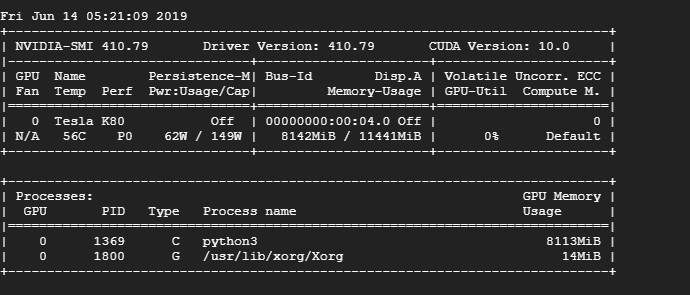
@alvations I attempted to run a DNN estimator on a GPU, but it crashes out and produces: CUDA_ERROR_OUT_OF_MEMORY. I tried allow_soft_placement=True, log_device_placement=True along with gpu_options.per_process_gpu_memory_fraction = 0.70.
 MajesticKhan
on 14 Jun 2019
MajesticKhan
on 14 Jun 2019
Still not able to use GPU for USE model 'https://tfhub.dev/google/universal-sentence-encoder/4'
Specs:
tensorflow=2.1.0
tensorflow-hub=0.7.0
Ubuntu 16.04
GPUs available
Using import tensorflow.compat.v1 as tf for USE model compatability
Code:
import tensorflow.compat.v1 as tf
tf.disable_eager_execution()
import tensorflow_hub as hub

module_url = "https://tfhub.dev/google/universal-sentence-encoder/4"
embed = hub.load(module_url)

with tf.Session() as session:
    session.run([tf.global_variables_initializer(), tf.tables_initializer()])
    with tf.device('/gpu:1'):
        embeds = session.run(embed(list_of_events))
Stack trace:
Op: Const
Node attrs: value=Tensor<type: string shape: [4] values: sad untrustworthy unlucky...>, dtype=DT_STRING
Registered kernels:
  device='XLA_CPU_JIT'; dtype in [DT_FLOAT, DT_DOUBLE, DT_INT32, DT_UINT8, DT_INT16, ..., DT_COMPLEX128, DT_HALF, DT_UINT32, DT_UINT64, DT_STRING]
  device='XLA_GPU_JIT'; dtype in [DT_FLOAT, DT_DOUBLE, DT_INT32, DT_UINT8, DT_INT16, ..., DT_COMPLEX128, DT_HALF, DT_UINT32, DT_UINT64, DT_STRING]
  device='GPU'; dtype in [DT_VARIANT]
  device='GPU'; dtype in [DT_BOOL]
  device='GPU'; dtype in [DT_COMPLEX128]
  device='GPU'; dtype in [DT_COMPLEX64]
  device='GPU'; dtype in [DT_UINT64]
  device='GPU'; dtype in [DT_INT64]
  device='GPU'; dtype in [DT_QINT32]
  device='GPU'; dtype in [DT_UINT32]
  device='GPU'; dtype in [DT_QUINT16]
  device='GPU'; dtype in [DT_QINT16]
  device='GPU'; dtype in [DT_INT16]
  device='GPU'; dtype in [DT_UINT16]
  device='GPU'; dtype in [DT_QINT8]
  device='GPU'; dtype in [DT_INT8]
  device='GPU'; dtype in [DT_UINT8]
  device='GPU'; dtype in [DT_DOUBLE]
  device='GPU'; dtype in [DT_FLOAT]
  device='GPU'; dtype in [DT_BFLOAT16]
  device='GPU'; dtype in [DT_HALF]
  device='GPU'; dtype in [DT_INT32]
  device='XLA_GPU'; dtype in [DT_UINT8, DT_QUINT8, DT_UINT16, DT_INT8, DT_QINT8, ..., DT_DOUBLE, DT_COMPLEX64, DT_COMPLEX128, DT_BOOL, DT_BFLOAT16]
  device='XLA_CPU'; dtype in [DT_UINT8, DT_QUINT8, DT_UINT16, DT_INT8, DT_QINT8, ..., DT_DOUBLE, DT_COMPLEX64, DT_COMPLEX128, DT_BOOL, DT_BFLOAT16]
  device='CPU'

     [[{{node Const_1}}]]

tensorflow.python.framework.errors_impl.InvalidArgumentError: Cannot assign a device for operation Const_1: Could not satisfy explicit device specification '/device:GPU:1' because no supported kernel for GPU devices is available.
Will the model be supported on GPU?
 sarahwie
on 12 Feb 2020
sarahwie
on 12 Feb 2020
Why are you using compat.v1 with TF2.1? This should be totally unnecessary unless there is some massive backward compatibility requirement (like legacy code at a company).
If you are using the model as a standalone, you can just access the signature by name can use the embed as a callable object. Models with multiple input signatures will need those signatures accessed by dict lookup.
If you are using it as part of another model, the preferred way is to load the module as a hub.KerasLayer layer and use that in a custom model.
...That being said, I also don't see usemqa/3 using GPU cores. Wtf!
 paulegradie
on 27 Feb 2020
paulegradie
on 27 Feb 2020
Second that, using use QA model/3 / K80 GPU. Not utilizing GPU cores
    def __init__(self, **kwargs):
        super().__init__(**kwargs)
        self.module = hub.load('https://tfhub.dev/google/universal-sentence-encoder-qa/3')


    def rank(self, query: str, choices: List[str],
             filter_results: type(defaults.filter_results) = defaults.filter_results
             ) -> Tuple[List[int], List[float]]:
        questions = [query]

        question_embeddings = self.module.signatures['question_encoder'](
            tf.constant(questions))
        response_embeddings = self.module.signatures['response_encoder'](
            input=tf.constant(choices),
            context=tf.constant(choices))

        scores = np.inner(question_embeddings['outputs'], response_embeddings['outputs'])
        scores = np.reshape(scores, (-1,))
        sorted_indices = list(np.argsort(scores)[::-1])
        return sorted_indices, scores[sorted_indices]
nvidia-smi shows
+-----------------------------------------------------------------------------+
| NVIDIA-SMI 410.104      Driver Version: 410.104      CUDA Version: 10.0     |
|-------------------------------+----------------------+----------------------+
| GPU  Name        Persistence-M| Bus-Id        Disp.A | Volatile Uncorr. ECC |
| Fan  Temp  Perf  Pwr:Usage/Cap|         Memory-Usage | GPU-Util  Compute M. |
|===============================+======================+======================|
|   0  Tesla K80           Off  | 00000000:00:04.0 Off |                    0 |
| N/A   73C    P0    73W / 149W |     70MiB / 11441MiB |      0%      Default |
+-------------------------------+----------------------+----------------------+
+-----------------------------------------------------------------------------+
| Processes:                                                       GPU Memory |
|  GPU       PID   Type   Process name                             Usage      |
|=============================================================================|
|    0     15272      C   /usr/bin/python3                              59MiB |
+-----------------------------------------------------------------------------+
 pertschuk
on 5 Mar 2020
pertschuk
on 5 Mar 2020
Looks like there's several issues here. I'll try to go step by step.
@sarahwie, I suspect the error you get is from using a Python value list_of_events that gets converted to a tf.constant under the device scope. Making a tf.constant outside that scope makes your code run for me. (It's beyond tensorflow/hub to argue about that TF pitfall.)
EDIT: Point being, this is a tf.constant of dtype string.
 arnoegw
on 10 Mar 2020
arnoegw
on 10 Mar 2020
Related issues
 bhack
·
3Comments
arnoegw
·
5Comments
bhack
·
3Comments
arnoegw
·
5Comments
 iliaschalkidis
·
5Comments
iliaschalkidis
·
5Comments
 bzburr
·
4Comments
bzburr
·
4Comments
 marcoaleixo
·
4Comments
marcoaleixo
·
4Comments
Most helpful comment
We're also having issues with this (but with model version 2): when model placement is forced with
with tf.device('/gpu:0'):, we get error that OpKernelSizefor typeDT_STRINGis not defined for GPU.Do you support or plan for supporting these models on GPU? Perhaps it would make sense to force placement of string ops in this model on the CPU, and let the rest be allocated on GPU if it is present.