Handson-ml: Chapter 3: ValueError: The number of classes has to be greater than one; got 1 class
Hello,
When I run the following:
from sklearn.linear_model import SGDClassifier
sgd_clf = SGDClassifier(tol=None, max_iter=5, random_state=42)
sgd_clf.fit(X_train, y_train_5)
I get the error ValueError: The number of classes has to be greater than one; got 1 class
I'm sure both classes y_train_5 and y_test_5 are set up correctly as I have run in the course notebook and my own.
Can anyone point me in the right direction for a solution?
 pin0S
pin0S
All 10 comments
Hi @pin0S ,
The error message says that there's just one class in y_train_5. Could you please print the output of:
np.unique(y_train_5)
There should be more than one value in the resulting array.
If not, then perhaps what happened is that you used fetch_openml() to download MNIST, and it returns labels as strings so when you defined y_train_5 = (y_train == 5), it results an array full of False. A solution is to cast y_train to int8: y_train = y_train.astype(np.int8) (which is what I do in the notebook, just after loading the data).
Hope this helps,
Aurélien
 ageron
on 22 Feb 2019
ageron
on 22 Feb 2019
Hi @ageron
Thanks for coming back so quick and apologies I have only got around to it now.
You were correct I had missed the to int8. I was looking at the old notebook and not the newer one.
Cheers,
Pete
pin0S
on 17 Mar 2019
Hi @ageron
I did the same mistake, thought that "We prefer numbers" was something optional, skipped and then forgot that I did it. Maybe different wording will help people like us in the next edition.
P.S. The book is amazing btw, thanks!

 eapotapov
on 25 Jul 2019
eapotapov
on 25 Jul 2019
Hi @eapotapov ,
Thanks for your feedback and your kind words. Indeed "We prefer numbers" was not a great way to phrase this, I'll fix it.
Edit: I changed it to "Most ML algorithms expect numbers".
Cheers!
ageron
on 3 Aug 2019
I also started working with machine learning of recent(real programming in general) and I missed the conversion to integer part:).
i am working with the book, I must say it is wonderful, I don't regret a cent of my money. Thanks a lot, @ageron. God bless
 FritzPeleke
on 6 Aug 2019
FritzPeleke
on 6 Aug 2019
Thanks for your kind words Fritz! :)
ageron
on 6 Aug 2019
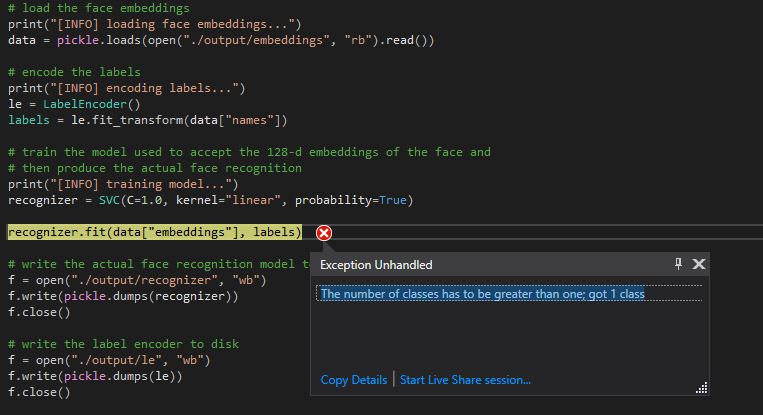
The number of classes has to be greater than one; got 1 class
Please help me sir
 umeshhello12
on 8 Aug 2019
umeshhello12
on 8 Aug 2019
@umeshhello12 @ageron
Hi guys, The targets of 'MNIST' dataset downloaded are string digit. So you just need to change to
y_train_5 = (y_train == '5')
y_test_5 = (y_test == '5')
 corvettettt
on 10 Mar 2020
corvettettt
on 10 Mar 2020
Hi @pin0S ,
The error message says that there's just one class in
y_train_5. Could you please print the output of:np.unique(y_train_5)There should be more than one value in the resulting array.
If not, then perhaps what happened is that you usedfetch_openml()to download MNIST, and it returns labels as strings so when you definedy_train_5 = (y_train == 5), it results an array full ofFalse. A solution is to casty_trainto int8:y_train = y_train.astype(np.int8)(which is what I do in the notebook, just after loading the data).Hope this helps,
Aurélien
yeah it worked!!
 renil0210
on 23 Sep 2020
renil0210
on 23 Sep 2020
@umeshhello12 @ageron
Hi guys, The targets of 'MNIST' dataset downloaded are string digit. So you just need to change to
y_train_5 = (y_train == '5')
y_test_5 = (y_test == '5')
love you babe
 triumphMe
on 21 Nov 2020
triumphMe
on 21 Nov 2020
Related issues
 WillKoehrsen
·
4Comments
WillKoehrsen
·
4Comments
 tetsuyasu
·
3Comments
tetsuyasu
·
3Comments
 nitml
·
6Comments
nitml
·
3Comments
nitml
·
6Comments
nitml
·
3Comments
 qinhanmin2014
·
5Comments
qinhanmin2014
·
5Comments
Most helpful comment
Hi @pin0S ,
The error message says that there's just one class in
y_train_5. Could you please print the output of:There should be more than one value in the resulting array.
If not, then perhaps what happened is that you used
fetch_openml()to download MNIST, and it returns labels as strings so when you definedy_train_5 = (y_train == 5), it results an array full ofFalse. A solution is to casty_trainto int8:y_train = y_train.astype(np.int8)(which is what I do in the notebook, just after loading the data).Hope this helps,
Aurélien