Handson-ml: chapture 8 ploting projection
i'm having trouble understanding following code of chapter 8 ploting projection and plane of jupyter notebook cell 23 and 24 code :
R = C.T.dot(C)
z = (R[0, 2] * x1 + R[1, 2] * x2) / (1 - R[2, 2])
can u please explain it to me.
 nitml
nitml
All 5 comments
Aha, yes, it took me a while to figure that one out. I don't have the time right now (off to Singapore tomorrow), but I'll try to remember how I found this. I suppose it's not urgent? :)
 ageron
on 9 Jul 2018
ageron
on 9 Jul 2018
Was there any solution to this? I'm running into the same question.. I thought the plane equation would be found with the first two eigenvectors cross product - or the third eigenvector. But I still don't understand where the "1-" came from
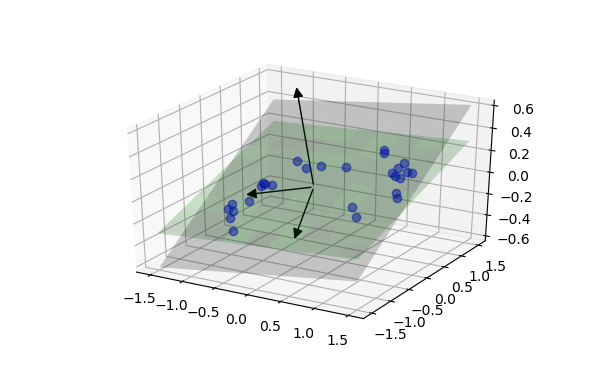
The figure below shows two planes - the grey is plotted with the books method, and the green is plotted with the third principle component/orthogonal vector.
So I realized that using z2 = (Vt.T[0,2] *_x1 + Vt.T[1,2] *_x2)/(-Vt.T[2,2]) is the same as using the books method - the difference being the "1-".. I still don't understand why the books method works. Ill update if I find the answer
 johnvorsten
on 7 May 2019
johnvorsten
on 7 May 2019
Hi @johnvorsten ,
Thanks for your question.
SVD gives us U, Σ and V such that U @ Σ @ V.T = X (centered), where @ is matrix multiplication, and V.T is the transpose of V.
Let us define C = V.T[:2].
To project X from 3D down to 2D, we must multiply it by C.T.
To project the dataset back from 2D up to 3D, we must multiply it by C.
If we project the dataset from 3D down to 2D and then back to 3D, we get the 3D coordinates of the projections of all the original points onto the 2D plane in 3D space.
If we define R = C.T @ C then multiplying the original 3D dataset by R will just chain both operations and give use the coordinates of the projection onto the plane in 3D space.
Okay, now the points on that plane are the only ones that do not change when projected down to 2D and back to 3D. So if we have a matrix P=[[x1, x2, z]] containing a single instance with 3D coordinates x1, x2 and z, then P @ R just returns P. So if we look into what exactly is calculated when we compute P @ R, we get:
(P @ R)[0,0] = x1 * R[0, 0] + x2 * R[0, 1] + z * R[0, 2] = x1
(P @ R)[0,1] = x1 * R[1, 0] + x2 * R[1, 1] + z * R[1, 2] = x2
(P @ R)[0,2] = x1 * R[2, 0] + x2 * R[2, 1] + z * R[2, 2] = z
Looking at the last line, you can see that you can turn it into:
x1 * R[2, 0] + x2 * R[2, 1] = z - z * R[2, 2]
Then factor out z:
x1 * R[2, 0] + x2 * R[2, 1] = z * (1 - R[2, 2])
And divide both sides by (1 - R[2, 2]):
(x1 * R[2, 0] + x2 * R[2, 1]) / (1 - R[2, 2]) = z
And that's how the 1 - R[2,2] appears.
Hope this helps.
ageron
on 7 May 2019
That makes a lot of sense - it is just he projection of the first two dimensions onto the planes basis if I understand correctly. Thanks!
johnvorsten
on 7 May 2019
Closing stale issues. Please reopen if you are still experiencing a problem.
ageron
on 13 Aug 2019
Related issues
 batblah
·
5Comments
batblah
·
5Comments
 kenorb
·
3Comments
kenorb
·
3Comments
 tetsuyasu
·
3Comments
tetsuyasu
·
3Comments
 qinhanmin2014
·
5Comments
qinhanmin2014
·
5Comments
 WillKoehrsen
·
4Comments
WillKoehrsen
·
4Comments
Most helpful comment
Aha, yes, it took me a while to figure that one out. I don't have the time right now (off to Singapore tomorrow), but I'll try to remember how I found this. I suppose it's not urgent? :)