Gutenberg-mobile: Tackle the block editor's memory leaks on WPAndroid
Promoting it to a ticket, @malinajirka has found evidence of memory leaks (see next comment as well) on WPAndroid related to the block editor and it'd be best to tackle them.
 hypest
All 4 comments
:wave: @hypest . Do we need this ticket since https://github.com/wordpress-mobile/gutenberg-mobile/issues/2200 was transferred from WPAndroid to this repository? I'm thinking we can close this issue and keep that one. WDYT?
 mchowning
on 4 May 2020
mchowning
on 4 May 2020
Hey @mchowning, 2200 seems to be about a crash that might be related to OOM or not, it's not clear yet, right? This new ticket is a more general one, to address the various memory leaks detected while investigating.
hypest
on 5 May 2020
This new ticket is a more general one, to address the various memory leaks detected while investigating.
That makes sense. Thanks for clearing that up for me!
mchowning
on 5 May 2020
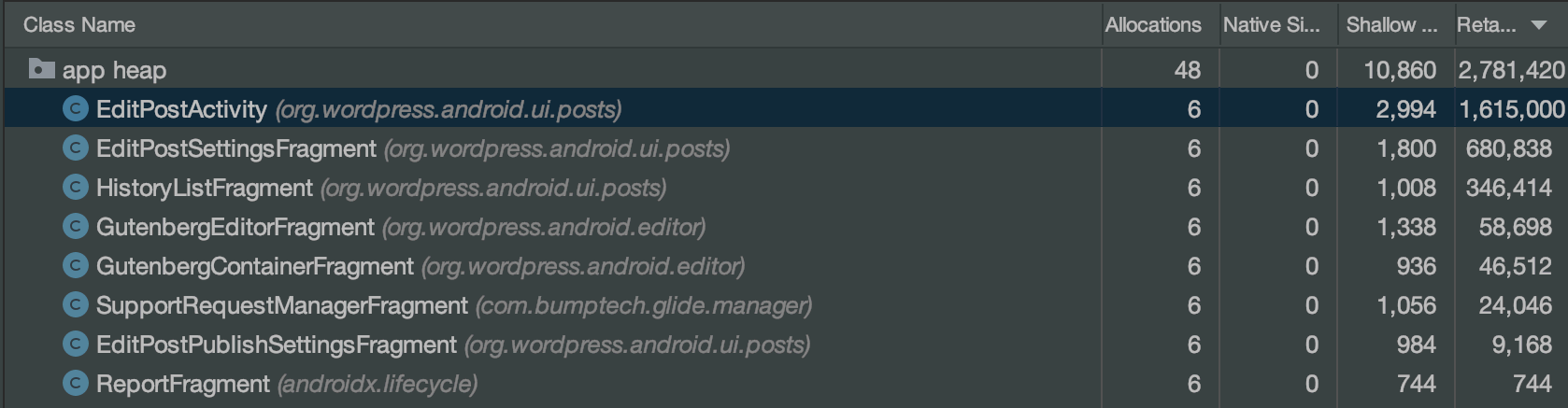
While investigating https://github.com/wordpress-mobile/gutenberg-mobile/issues/2200, I dug a little bit into the memory leak(s) reported there. I repeated the described steps (opening and closing the editor repeatedly) while profiling the app, and I took a heap dump after a garbage collection event. I confirmed that we are indeed leaking a few instances.
Suspected leaked classes
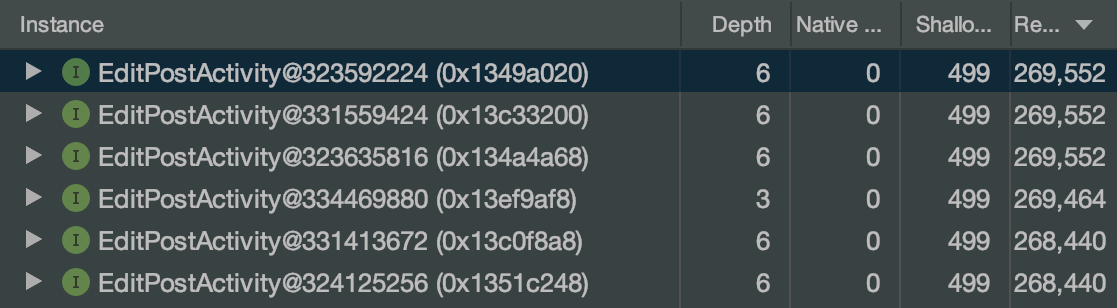
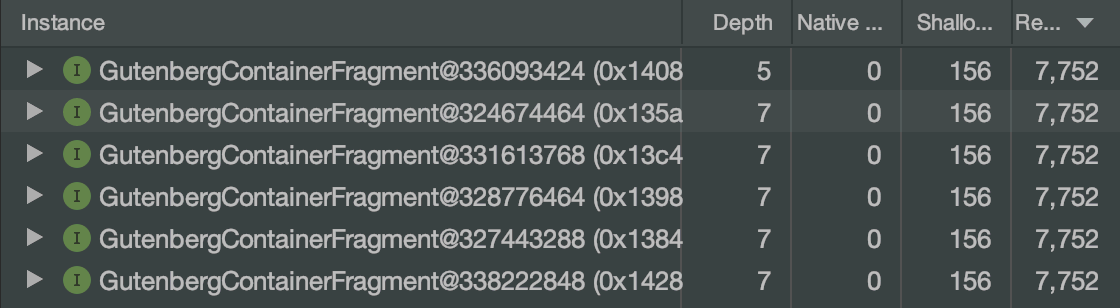
In the instance view, I observed a pattern which may be helpful. The depth of most instances (the ones likely to have been leaked) is 3 higher than the depth of a single instance which has a lower depth (likely the non-leaked instance, since the editor remained open while I took the heap dump). I first observed this pattern for EditPostActivity, but also found that it was present for other most of the other classes as well:
EditPostActivity instance view: depth 6 vs. 3
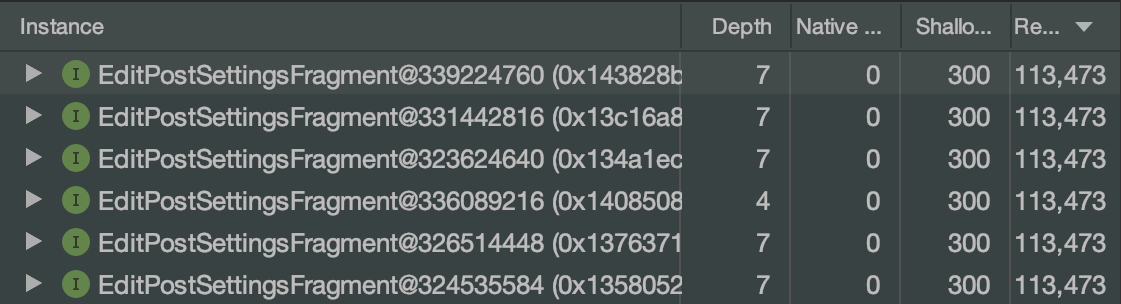
EditPostSettingsFragment: depth 7 vs. 4
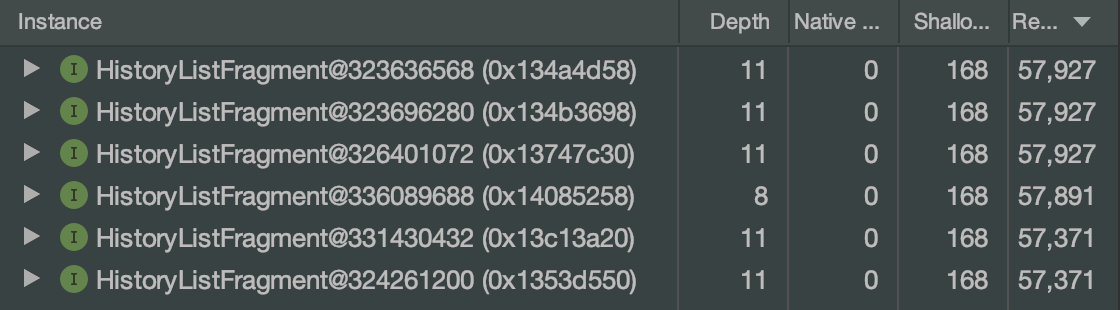
HistoryListFragment: depth 11 vs. 8
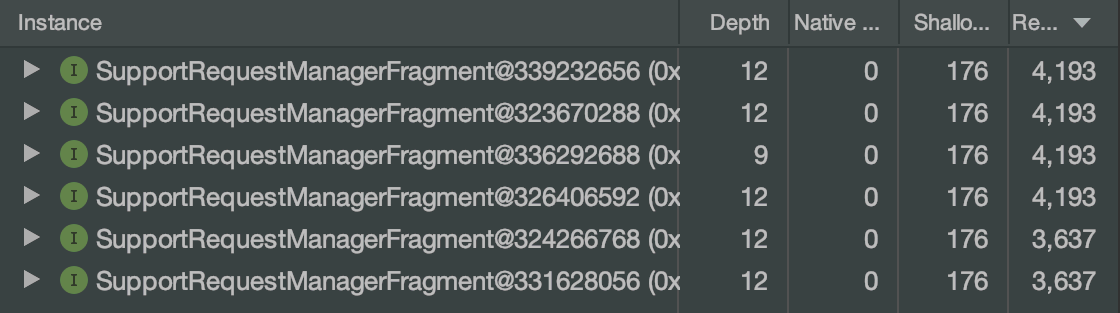
SupportRequestManagerFragment: depth 12 vs. 9
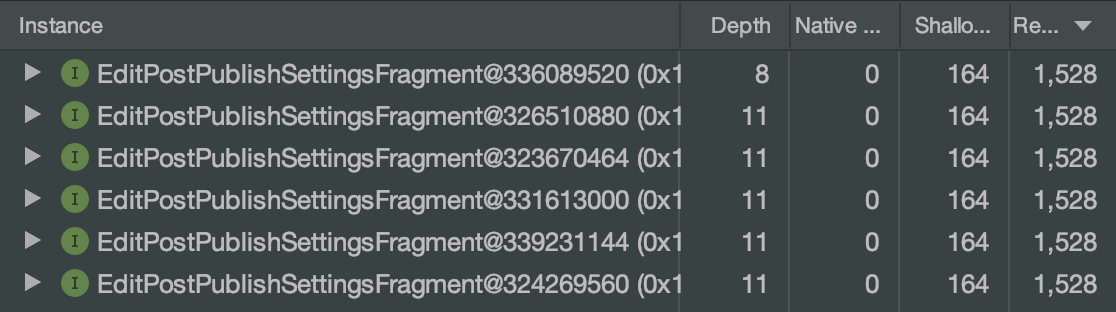
EditPostPublishSettingsFragment: depth 11 vs. 8
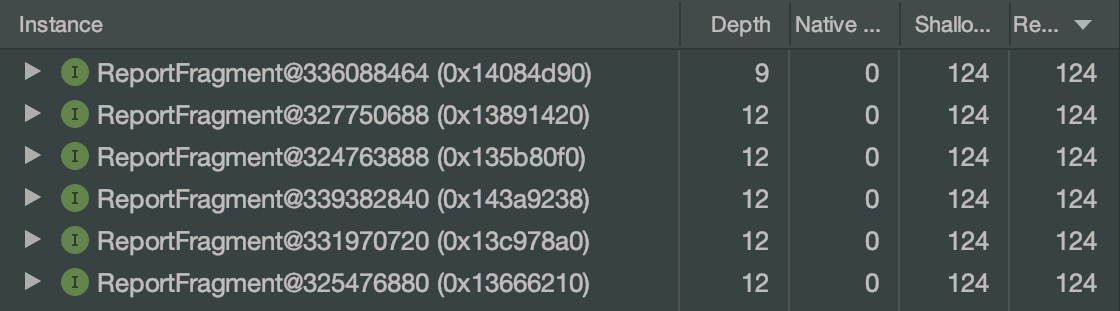
ReportFragment: depth 12 vs. 9
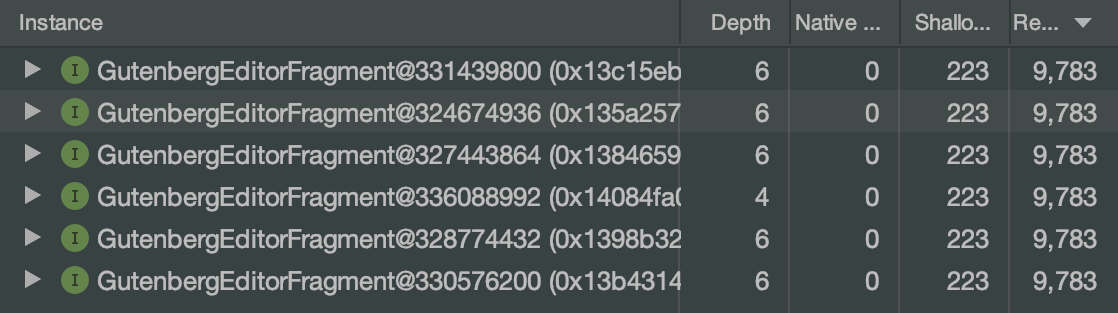
Interestingly, GutenbergEditorFragment and GutenbergContainerFragment instances showed a difference of depth of 2 instead of 3:
GutenbergEditorFragment: depth 6 vs. 4
GutenbergContainerFragment: depth 7 vs. 5
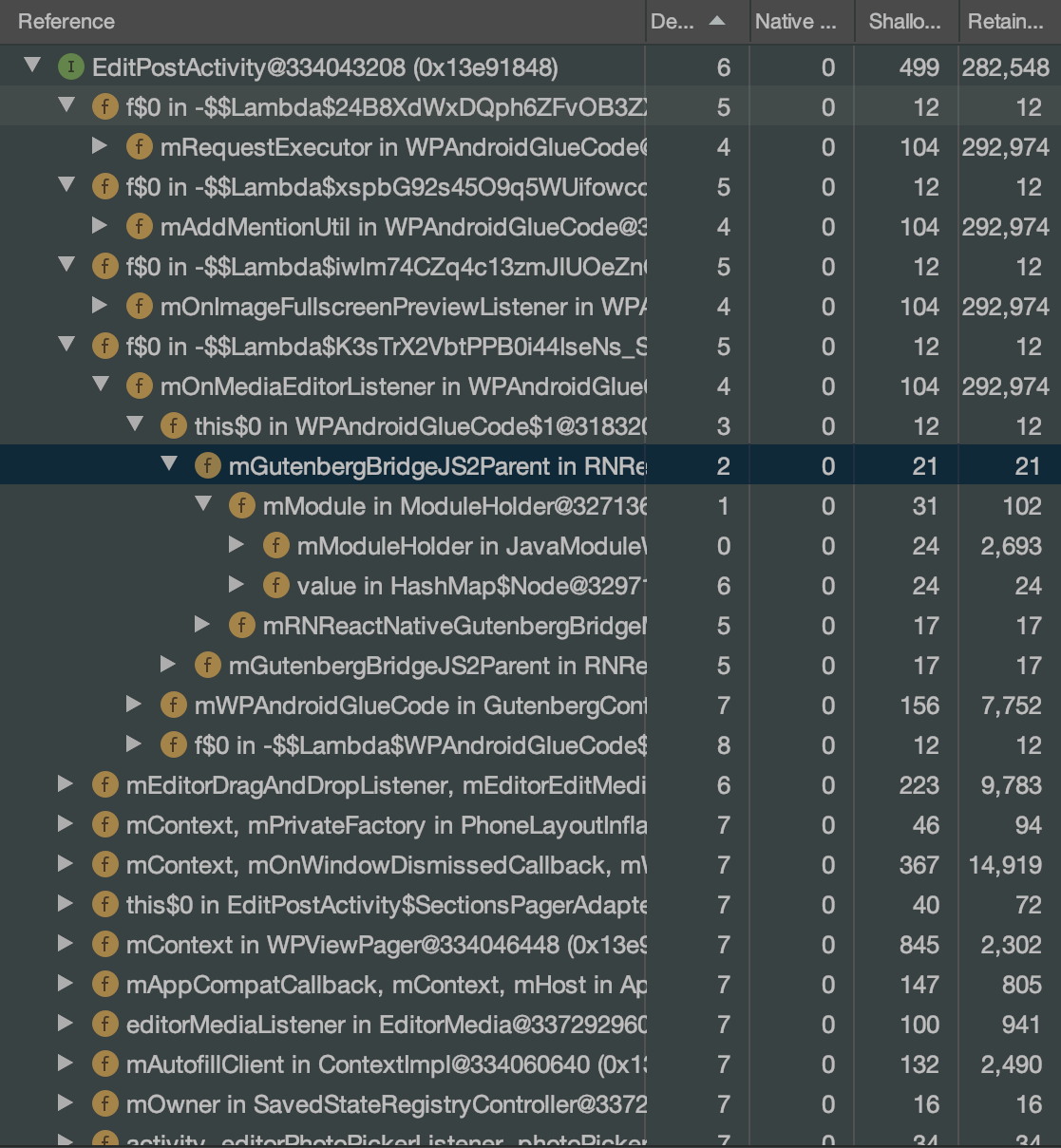
Starting with EditPostActivity, I examined the reference graph to search for long-living references that would outlive the lifecycle of the activity. The first few in the list were implicit references (all of the first few - those with depth 5 - are coming from WPAndroidGlueCode), so probably good candidates for a leak (btw, there are _many_ references to the activity at _many_ depths). Picking mOnMediaEditorListener somewhat arbitrarily, I drilled further towards the GC root, and it seems that at depths 0 and 1, we have React Native code holding internal references to our RNReactNativeGutenbergBridgeModule, at depth 2 our module holds a reference to mGutenbergBridgeJS2Parent, and at depth 3, the inner anonymous implementation of this holds a reference to mOnMediaEditorListener (depth 4) from the enclosing outer scope within WPAndroidGlueCode.
References
So, it seems that at least part of the problem is that all the listeners referenced within the instantiation of the anonymous inner class (new GutenbergBridgeJS2Parent) are kept alive by the implicit reference to the enclosing class (WPAndroidGlueCode), which in turn hold a reference to and outlive the lifecycle of GutenbergContainerFragment and GutenbergEditorFragment via their implicit reference to their enclosing scopes within the method call to attachToContainer.
from:
One solution that comes to mind is to implement a counterpart method to attachToContainer (perhaps a detachFromContainer) to ensure these implicit references do not outlive their platform intended lifecycle. I don't yet have a great sense of how much effort that will require, but I _do_ believe it is a cause of at least a _large_ proportion of these leaks.
 mkevins
on 4 Jun 2020
mkevins
on 4 Jun 2020
Related issues
 designsimply
·
4Comments
designsimply
·
4Comments
 alextheberge
·
4Comments
alextheberge
·
4Comments
 maxme
·
3Comments
maxme
·
3Comments
 pinarol
·
4Comments
pinarol
·
4Comments
pinarol
·
4Comments
pinarol
·
4Comments
Most helpful comment
While investigating https://github.com/wordpress-mobile/gutenberg-mobile/issues/2200, I dug a little bit into the memory leak(s) reported there. I repeated the described steps (opening and closing the editor repeatedly) while profiling the app, and I took a heap dump after a garbage collection event. I confirmed that we are indeed leaking a few instances.
Suspected leaked classes
In the instance view, I observed a pattern which may be helpful. The depth of most instances (the ones likely to have been leaked) is 3 higher than the depth of a single instance which has a lower depth (likely the non-leaked instance, since the editor remained open while I took the heap dump). I first observed this pattern for
EditPostActivity, but also found that it was present for other most of the other classes as well:EditPostActivity instance view: depth 6 vs. 3
EditPostSettingsFragment: depth 7 vs. 4
HistoryListFragment: depth 11 vs. 8
SupportRequestManagerFragment: depth 12 vs. 9
EditPostPublishSettingsFragment: depth 11 vs. 8
ReportFragment: depth 12 vs. 9
Interestingly,
GutenbergEditorFragmentandGutenbergContainerFragmentinstances showed a difference of depth of 2 instead of 3:GutenbergEditorFragment: depth 6 vs. 4
GutenbergContainerFragment: depth 7 vs. 5
Starting with
EditPostActivity, I examined the reference graph to search for long-living references that would outlive the lifecycle of the activity. The first few in the list were implicit references (all of the first few - those with depth 5 - are coming fromWPAndroidGlueCode), so probably good candidates for a leak (btw, there are _many_ references to the activity at _many_ depths). PickingmOnMediaEditorListenersomewhat arbitrarily, I drilled further towards the GC root, and it seems that at depths 0 and 1, we have React Native code holding internal references to ourRNReactNativeGutenbergBridgeModule, at depth 2 our module holds a reference tomGutenbergBridgeJS2Parent, and at depth 3, the inner anonymous implementation of this holds a reference tomOnMediaEditorListener(depth 4) from the enclosing outer scope withinWPAndroidGlueCode.References
https://github.com/wordpress-mobile/gutenberg-mobile/blob/a3a155d0053c75985960ae7ac8ecfaa2e3732efa/react-native-gutenberg-bridge/android/src/main/java/org/wordpress/mobile/WPAndroidGlue/WPAndroidGlueCode.java#L186
So, it seems that at least part of the problem is that all the listeners referenced within the instantiation of the anonymous inner class (
new GutenbergBridgeJS2Parent) are kept alive by the implicit reference to the enclosing class (WPAndroidGlueCode), which in turn hold a reference to and outlive the lifecycle ofGutenbergContainerFragmentandGutenbergEditorFragmentvia their implicit reference to their enclosing scopes within the method call toattachToContainer.https://github.com/wordpress-mobile/WordPress-Android/blob/dc41909f75cde15273d366494135ffb918e9a5d1/libs/editor/WordPressEditor/src/main/java/org/wordpress/android/editor/GutenbergEditorFragment.java#L348
from:
https://github.com/wordpress-mobile/WordPress-Android/blob/dc41909f75cde15273d366494135ffb918e9a5d1/WordPress/src/main/java/org/wordpress/android/ui/posts/EditPostActivity.java#L1723
One solution that comes to mind is to implement a counterpart method to
attachToContainer(perhaps adetachFromContainer) to ensure these implicit references do not outlive their platform intended lifecycle. I don't yet have a great sense of how much effort that will require, but I _do_ believe it is a cause of at least a _large_ proportion of these leaks.