Grpc-dotnet: Thread Safety of IServerStreamWriter.WriteAsync
I want to generate the contents of a stream across multiple threads or tasks. is IServerStreamWriter.WriteAsync thread/task safe? Do I need to setup a separate buffer to get all results onto the original thread?
 generatives
All 6 comments
No it it not thread safe, it’s be single producer at a time.
 davidfowl
on 3 Oct 2019
davidfowl
on 3 Oct 2019
You could wrap it in your own API and then ensure only one producer can access it at a time with a SemaphoreSlim.
There are problems with that:
- What happens if the call ends and there are still outstanding producers? They'll all error.
- What happens if producers are writing faster than the client is reading? Producers will hang on WriteAsync.
 JamesNK
on 3 Oct 2019
JamesNK
on 3 Oct 2019
It would be good to document this somewhere. I hit this exception when trying to write to a gRPC stream from multiple Tasks concurrently, and it took a while to find this GitHub issue:
Specified argument was out of the range of valid values. (Parameter 'bytes')
at System.IO.Pipelines.ThrowHelper.ThrowArgumentOutOfRangeException(ExceptionArgument argument)
at System.IO.Pipelines.Pipe.Advance(Int32 bytes)
at System.IO.Pipelines.Pipe.DefaultPipeWriter.Advance(Int32 bytes)
at Microsoft.AspNetCore.Server.Kestrel.Core.Internal.Infrastructure.PipeWriterHelpers.ConcurrentPipeWriter.Advance(Int32 bytes)
at Microsoft.AspNetCore.Server.Kestrel.Core.Internal.Http2.Http2OutputProducer.Advance(Int32 bytes)
at Microsoft.AspNetCore.Server.Kestrel.Core.Internal.Http.HttpProtocol.Advance(Int32 bytes)
at Microsoft.AspNetCore.Server.Kestrel.Core.Internal.Http.HttpResponsePipeWriter.Advance(Int32 bytes)
at Grpc.AspNetCore.Server.Internal.PipeExtensions.WriteHeader(PipeWriter pipeWriter, Int32 length, Boolean compress)
at Grpc.AspNetCore.Server.Internal.PipeExtensions.WriteMessageAsync[TResponse](PipeWriter pipeWriter, TResponse response, HttpContextServerCallContext serverCallContext, Action`2 serializer, Boolean canFlush)
at DnsTools.Worker.Tools.DnsTraversal.DoLookupImpl(DnsLookupRequest request, IServerStreamWriter`1 responseStream, CancellationToken cancellationToken, String serverName, IDnsQueryResponse responseForGlue, UInt32 level) in C:\src\dnstools.ws\src\DnsTools.Worker\Tools\DnsTraversal.cs:line 158
I think ChannelWriter could be used to handle writing just one message at a time (with multiple producers and one consumer that writes to the stream).
What happens if the call ends and there are still outstanding producers?
@JamesNK Wouldn't you want the call to wait for all the producers to complete?
 Daniel15
on 14 Jan 2020
Daniel15
on 14 Jan 2020
Bns
 Bob9098-source
on 14 Jan 2020
Bob9098-source
on 14 Jan 2020
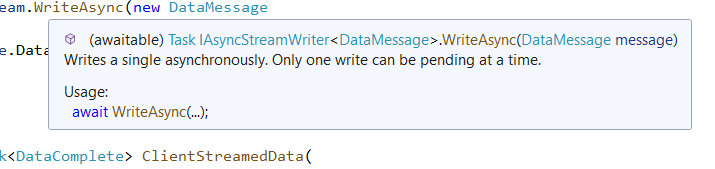
IServerStreamWriter.WriteAsync intelli-sense says that only one writer is allowed at a time:
I think ChannelWriter could be used to handle writing just one message at a time (with multiple producers and one consumer that writes to the stream).
Yes you could use channel. Here is an example I implemented that uses channel: https://github.com/grpc/grpc/blob/8577fe8f81399116f2f20fb0869ea3fa0f6dbc5f/src/csharp/Grpc.HealthCheck/HealthServiceImpl.cs
JamesNK
on 14 Jan 2020
IServerStreamWriter.WriteAsync intelli-sense says that only one writer is allowed at a time:
Oops, you're exactly right... I totally missed that.
Yes you could use channel.
This is what I ended up with. Need to do more testing, but it seems to work for my use case:
/// <summary>
/// Wraps <see cref="IServerStreamWriter{T}"/> which only supports one writer at a time.
/// This class can receive messages from multiple threads, and writes them to the stream
/// one at a time.
/// </summary>
/// <typeparam name="T">Type of message written to the stream</typeparam>
public class GrpcStreamResponseQueue<T>
{
    private readonly IServerStreamWriter<T> _stream;
    private readonly Task _consumer;

    private readonly Channel<T> _channel = Channel.CreateUnbounded<T>(
        new UnboundedChannelOptions
        {
            SingleWriter = false,
            SingleReader = true,
        });

    public GrpcStreamResponseQueue(
        IServerStreamWriter<T> stream,
        CancellationToken cancellationToken = default
    )
    {
        _stream = stream;
        _consumer = Consume(cancellationToken);
    }

    /// <summary>
    /// Asynchronously writes an item to the channel.
    /// </summary>
    /// <param name="message">The value to write to the channel.</param>
    /// <param name="cancellationToken">A <see cref="T:System.Threading.CancellationToken" /> used to cancel the write operation.</param>
    /// <returns>A <see cref="T:System.Threading.Tasks.ValueTask" /> that represents the asynchronous write operation.</returns>
    public async ValueTask WriteAsync(T message, CancellationToken cancellationToken = default)
    {
        await _channel.Writer.WriteAsync(message, cancellationToken);
    }

    /// <summary>
    /// Marks the writer as completed, and waits for all writes to complete.
    /// </summary>
    public Task CompleteAsync()
    {
        _channel.Writer.Complete();
        return _consumer;
    }

    private async Task Consume(CancellationToken cancellationToken)
    {
        await foreach (var message in _channel.Reader.ReadAllAsync(cancellationToken))
        {
            await _stream.WriteAsync(message);
        }
    }
}
Related issues
 heartacker
·
3Comments
heartacker
·
3Comments
 daltonks
·
3Comments
daltonks
·
3Comments
 nphmuller
·
5Comments
nphmuller
·
5Comments
 yshteinm
·
5Comments
yshteinm
·
5Comments
 shawnwildermuth
·
4Comments
shawnwildermuth
·
4Comments
Most helpful comment
Oops, you're exactly right... I totally missed that.
This is what I ended up with. Need to do more testing, but it seems to work for my use case: