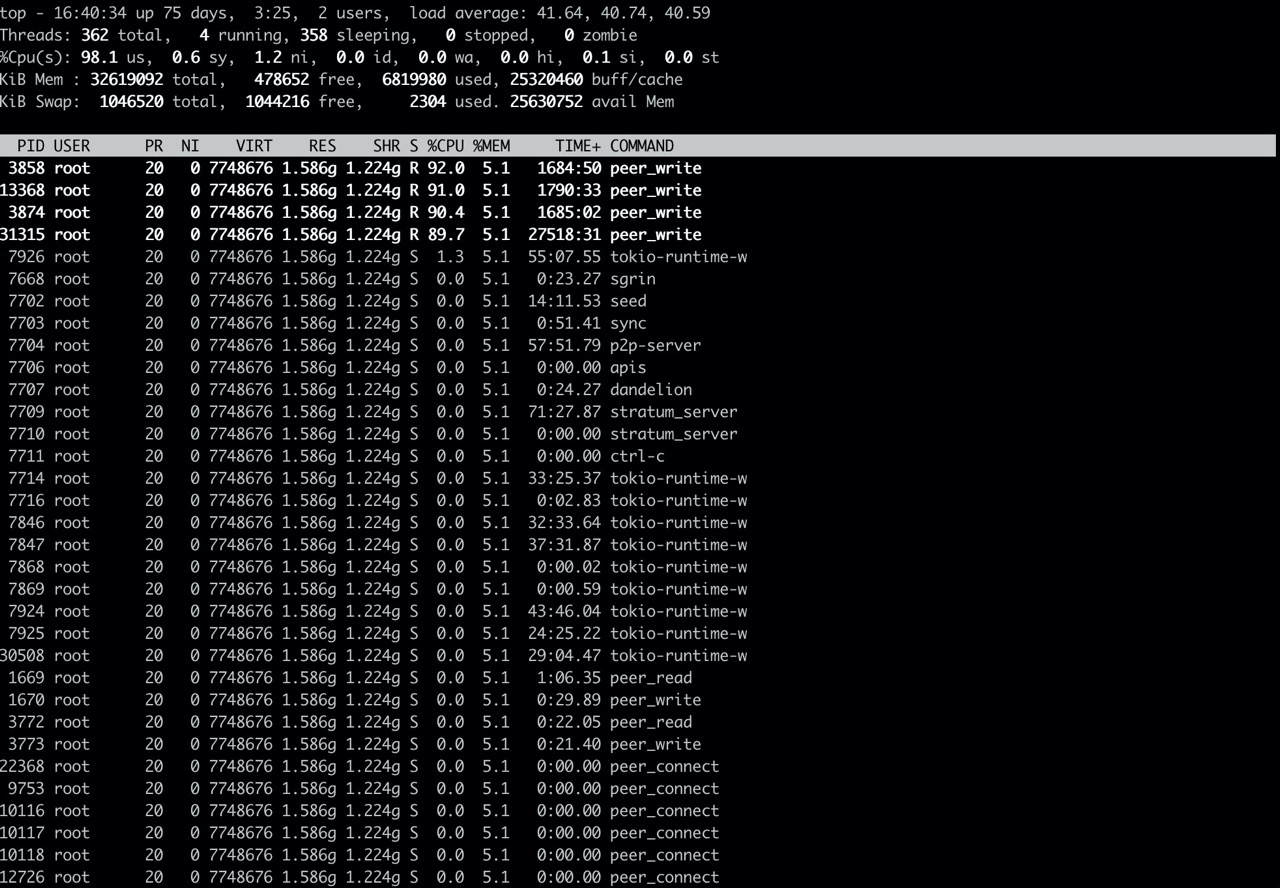
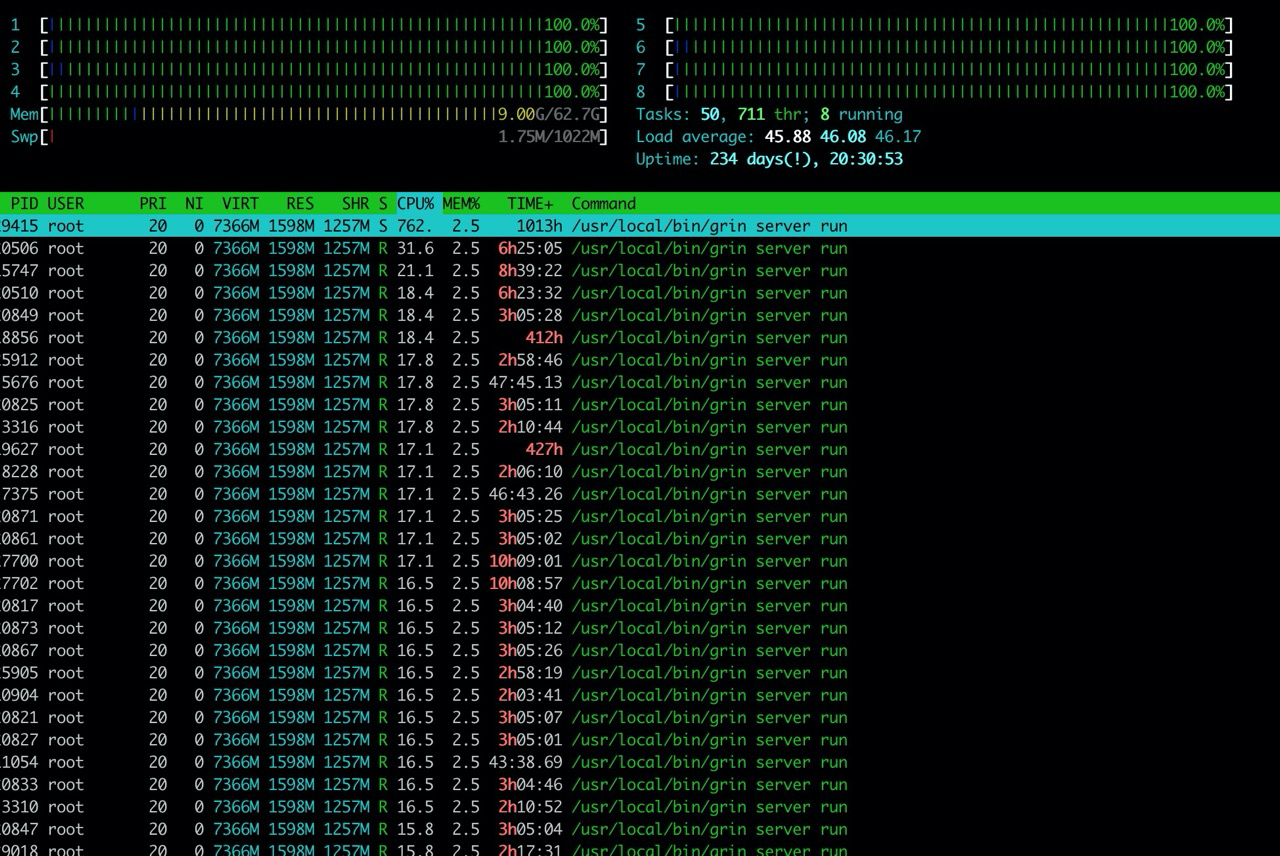
We have 8+ running Grin nodes (3.0.0) that every 4-20 days hang the entire server with 100% cpu usage (all available cores). Logs do not show anything significant, strace -f is also not showing any data about the threads being loaded. top -H -p displays this:
htop:
 shrikus
All 6 comments
I can vouch for this issue
Main reason the system gets unstable. ITX machine, dedicated node.

 bluimes
on 23 Feb 2020
bluimes
on 23 Feb 2020
Thanks for the detailed report. We are investigating.
 antiochp
on 24 Feb 2020
antiochp
on 24 Feb 2020
I see a node with similar behavior -
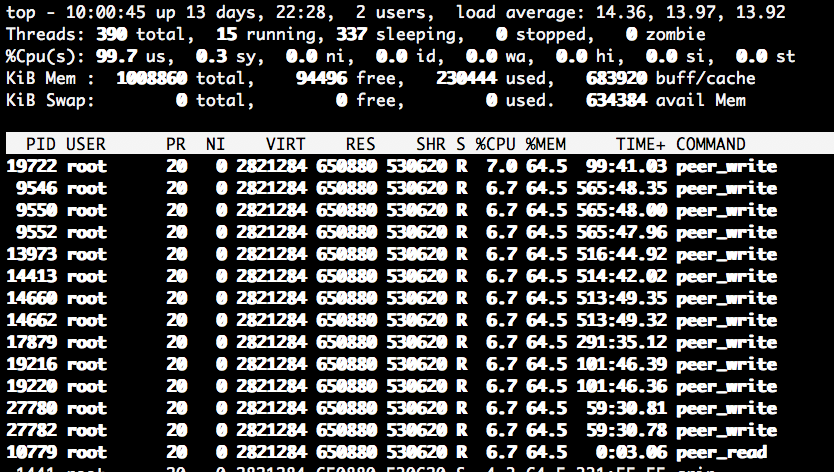
It suggests the peer_write threads are getting jammed up somewhere and taking up a bunch of the cpu and not letting it go.
I'll see if I can get a stacktrace of what is going on with these threads here.
antiochp
on 24 Feb 2020
Still attempting to reproduce on a node configured to give decent stack traces.
My gut feeling is this is related to blocking IO and we are retrying (likely writing to a socket) in a tight loop in a situation that is not recoverable in the peer_write thread.
i.e a non recoverable error is encountered and we keep retrying even though the socket will never recover.
Related - https://github.com/mimblewimble/grin/pull/3154
We may not have been seeing this pre #3154 due to blocking/non-blocking ambiguity.
Note: just speculation, no evidence to indicate this is _actually_ the underlying issue.
Specifically our call to write_message wrapped in try_break! which attempts to "retry" on WouldBlock and I _suspect_ we only see WouldBlock in non-blocking IO when we are in a non-recoverable state (i.e. connection has dropped). And if our end of the tcp stream is not aware that the connection has dropped then we may continue to retry indefinitely (albeit with a small 10ms sleep in the loop).
Pinging @hashmap for another pair of eyes on this.
antiochp
on 24 Feb 2020
I also bet that if the write_peer thread get locked up like this we can no longer reliably request compact blocks when we receive new block headers during broadcast.
In which case our node is extremely likely to start falling behind and getting out of sync (see gitter chat and various other seemingly unrelated bug reports).
antiochp
on 25 Feb 2020
Bunch of threads stuck in a loop doing the following -
(lldb) thread backtrace 21
  thread #21, name = 'peer_write', stop reason = signal SIGSTOP
    frame #0: 0x00007f9b96ac1ed9 libpthread.so.0`__pthread_cond_timedwait + 649
    frame #1: 0x00005644005a7181 grin`std::sys::unix::condvar::Condvar::wait_timeout::h9b1adf8fddc8b04c at condvar.rs:99
    frame #2: 0x0000564400595242 grin`std::thread::park_timeout::h1be532d836107941 [inlined] std::sys_common::condvar::Condvar::wait_timeout::h47c7d44ad248cf0c at condvar.rs:51
    frame #3: 0x0000564400595236 grin`std::thread::park_timeout::h1be532d836107941 [inlined] std::sync::condvar::Condvar::wait_timeout::hf9a83dd977ab4265 at condvar.rs:405
    frame #4: 0x000056440059521c grin`std::thread::park_timeout::h1be532d836107941 at mod.rs:1003
    frame #5: 0x00005644005a167d grin`std::sync::mpsc::blocking::WaitToken::wait_max_until::h29132948868d6846 at blocking.rs:75
    frame #6: 0x0000564400343ecc grin`std::sync::mpsc::sync::Packet$LT$T$GT$::recv::hef7c654ce2ea359f + 572
    frame #7: 0x000056440033c5aa grin`std::sync::mpsc::Receiver$LT$T$GT$::recv_timeout::h55d849c5bb0607a6 + 2250
    frame #8: 0x000056440033f6b3 grin`std::sys_common::backtrace::__rust_begin_short_backtrace::h83fa8a0c37ae5ebc + 275
    frame #9: 0x0000564400346785 grin`std::panicking::try::do_call::h7cd3f34e61222b1a (.llvm.2480943539170131300) + 37
    frame #10: 0x00005644005ab0fa grin`__rust_maybe_catch_panic at lib.rs:78
    frame #11: 0x0000564400358609 grin`core::ops::function::FnOnce::call_once$u7b$$u7b$vtable.shim$u7d$$u7d$::hbe008f988e800a1d + 137
    frame #12: 0x000056440059406f grin`_$LT$alloc..boxed..Box$LT$F$GT$$u20$as$u20$core..ops..function..FnOnce$LT$A$GT$$GT$::call_once::h7bfd6e98bcf6c67e at boxed.rs:1022
    frame #13: 0x00005644005aa1f0 grin`std::sys::unix::thread::Thread::new::thread_start::hbc75223688f972da [inlined] _$LT$alloc..boxed..Box$LT$F$GT$$u20$as$u20$core..ops..function..FnOnce$LT$A$GT$$GT$::call_once::h9979661149bbc525 at boxed.rs:1022
    frame #14: 0x00005644005aa1e4 grin`std::sys::unix::thread::Thread::new::thread_start::hbc75223688f972da [inlined] std::sys_common::thread::start_thread::had0bb4166c065276 at thread.rs:13
    frame #15: 0x00005644005aa16a grin`std::sys::unix::thread::Thread::new::thread_start::hbc75223688f972da at thread.rs:80
    frame #16: 0x00007f9b96abb6db libpthread.so.0`start_thread + 219
    frame #17: 0x00007f9b965cc88f libc.so.6`clone + 63
So this is the point where the peer_write thread is reading a msg off the mpsc channel receiver.
We do this via recv_timeout(CHANNEL_TIMEOUT) but if this errors out we immediately retry.
So this likely explains the tight loop and cpu usage.
https://doc.rust-lang.org/std/sync/mpsc/struct.Receiver.html#method.recv_timeout
Need to look at the code again but I think we may not be handling error conditions correctly when we call recv_timeout, specifically the case where "no more messages can ever be received on this channel."
If the corresponding Sender has disconnected, or it disconnects while this call is blocking, this call will wake up and return Err to indicate that no more messages can ever be received on this channel. However, since channels are buffered, messages sent before the disconnect will still be properly received.
https://doc.rust-lang.org/std/sync/mpsc/enum.RecvTimeoutError.html
Timeout
[−]
This channel is currently empty, but the Sender(s) have not yet disconnected, so data may yet become available.
Disconnected
[−]
The channel's sending half has become disconnected, and there will never be any more data received on it.
antiochp
on 25 Feb 2020
Related issues
 yeastplume
·
3Comments
yeastplume
·
3Comments
 Makadu59
·
6Comments
Makadu59
·
6Comments
 garyyu
·
4Comments
garyyu
·
4Comments
 DavidBurkett
·
6Comments
antiochp
·
3Comments
DavidBurkett
·
6Comments
antiochp
·
3Comments
Most helpful comment
I can vouch for this issue
Main reason the system gets unstable. ITX machine, dedicated node.