Gridcoin-research: Low network (balance) stake weight participation solution?
Lately we've been discussing stake weights and came to the conclusion in IRC that only approx 60-100mil GRC are staking at any one time out of the current total supply of 379,376,868 which works out to be 15.82 to 26.36 percent of total coin supply staking.
We could reach out to old users who may no longer be staking via the email marketing idea, but another idea that has been raised by the community is to potentially upgrade to the POSv3 system created by the Blackcoin developers.
The difference between POSv2 and POSv3 is that POSv3 attempts to increase staking participation by making POS rewards fixed instead of based on your staking balance (or coin age?), thus if you have a large balance you need to run it continuously in order to achieve your target yearly interest of 1.5%.
This would be a mandatory change if we attempted the change.
Related Blackcoin releases:
https://github.com/rat4/blackcoin/compare/v1.2.0...master
https://github.com/rat4/blackcoin/compare/v1.2.1...master
 grctest
All 171 comments
The plus side of this is that newbs with very low balances stake more often and get positive feedback for their efforts. The number one complaint of minnows is that they never stake and wonder if they are doing something wrong or if it's a scam. The downside is that relatively large fish can sit out and get a full PoS reward without supporting the chain.
 caraka
on 15 Aug 2016
caraka
on 15 Aug 2016
@caraka Indeed, with the current low 'balance' stake weight participation it's easier for 'newbies' with a low quantities of coins to stake, however, low balance staking participation could potentially put network consensus at risk if an individual acquires a large stake weight (either via DPOR (pool/cheater) or balance (exchange?) ).
To properly understand the risk behind low balance stake weight participation, we need to document the DPOR weight calculation: https://cryptocointalk.com/topic/49141-dpor-stake-weight-calculations/
grctest
on 16 Aug 2016
What happens with the amount of Stake that are not generated because 80% of the coins are not online and staking? Does the network compensate for this? If it doesn't compensate for it, it would mean that the network generates less coins?
 startailcoon
on 11 Sep 2016
startailcoon
on 11 Sep 2016
Its up to each individual to actually come online and stake to receive the .015% interest on their coin age. So no, the network will not compensate for this as the wallet will only pay interest on personal balances (not on a shared kitty).
Regarding newbies, the coin is capable of generating a special POR block with .01grc reward, but the feature has been waiting for our next mandatory.
Im not sold on the large stakeweight consensus risk problem yet; or at least, let me rephrase: We have bigger fish to fry for the time being. We need to prioritize things like having our 2nd dev finish all cross platform features, and bringing up the quant finance network, and adding our cosmetic features for newbies, and shoring up what we have before we can dream about "breaking changes" - things that end up getting us in a bunch of hot water.
 gridcoin
on 11 Sep 2016
gridcoin
on 11 Sep 2016
@startailcoon In a POSv3 system, if you did not actively stake, those potential rewards would be earned by others currently staking (your offline stake would earn 0 interest).
@gridcoin I don't think we should be granting any special newbie blocks nor newbie stake weight boosts - the 'newbie boost' was needed back when research was only tracked from when you first staked a block, but shortly after implementing the newbie rules you made it so that rewards were tracked from beacon advertisement onwards - negating the purpose of newbie boosts.
Regarding the large stakeweight consensus risk - if between 60 to 100 mil GRC (out of 387mil+) are staking on average, in order to '51% attack' the network via POS one would only require 30-50mil GRC. Those with that quantity of coins are the foundation and exchanges (and possibly one or two whales). I have not taken DPOR stake weight into account because DPOR stake weight documentation is unclear/unavailable.
Throwback perspective regarding network consensus: When I began acquiring an estimated 30-40% POW hash weight in classic via an ASIC (lol @ that wasted 20BTC) you accelerated the change to POS to combat the threat. Switching to POSv3 in a future planned&tested hard fork would create an incentive for investors to continuously stake & secure the network from 51% (really 7.75% to 12.92% right now) attacks.
Yeah, there's certainly development priorities such as porting functionality from Windows to Linux, improving load times, improving the UI, upgrading to qt5, neural network, etc, but that shouldn't prevent us from discussing these matters. As we become a more active community we'll pick up developers along the way that may be able to relieve you of some of the development burden.
I'm not sure about the priority of the Quant finance network nor if it should be built into the client rather than running on top of the client via op_return transactions & viewable from a web application, however I have no idea what this quant network entails.
grctest
on 14 Sep 2016
If 60-100Mil GRC on average are staking at any one time, then the following two users (with a combined balance of over 93Mil GRC) are capable of performing a 51% attack if they work together (perhaps on their own if stake weight is lower than usual):
PhilD : http://gridcoinstats.eu/cpid.php?a=view&id=9ce6f19e20f69790601c9bf9c0b03928
Test1235: http://gridcoinstats.eu/cpid.php?a=view&id=e6a4984e4c9bb7b53ac56e4b03f0cd4f
Who are these users & are they active in the community? How did they end up with such large sums of GRC?
grctest
on 17 Jan 2017
It's possible that the user Test1235 has even more coins since the CPID hasn't been used since 2015-10-29. The page can only track addresses that staked with that CPID once. Any new addresses that just collects PoS reward will not show up in the list of that CPID. The user was never really active on BOINC, just briefly in the period of Oktober 2015, hence why we can track some of the addresses to the same user.
By checking out some of the addresses you can see that the user actually was active as late as 2016-10-29 with this address.
I think going over to PoSv3 is a good idea and will support it.
PS. I will see if I can make some kind of calculated value of how many coins are in staking rotation and how many are inactive. It will give us a better estimate of the network health. DS.
startailcoon
on 17 Jan 2017
users concerned about this can participate until February 8 in this poll:
- Should we implement POSv3 to combat low network stake weight?
https://steemit.com/gridcoin/@erkan/gridcoin-poll-should-we-implement-posv3to-combat-low-network-stake-weight-vote-until-february-8
 Erkan-Yilmaz
on 18 Jan 2017
Erkan-Yilmaz
on 18 Jan 2017
@startailcoon
PS. I will see if I can make some kind of calculated value of how many coins are in staking rotation and how many are inactive. It will give us a better estimate of the network health. DS.
That would be extremely cool, would potentially freak people out though if the staking participation was low & on display though, eh? haha!
Blackcoin has been running POSv3 for more than 6 months at this point without issue, which is a good sign.
grctest
on 18 Jan 2017
Yes good for blackcoin, may not be good for other coins ;P
 janko33bd
on 18 Jan 2017
janko33bd
on 18 Jan 2017
I just talked with the blackcoin dev @janko33bd more, and he said Blackcoin's v3 approach can't be used directly, since it's too BLK specific.
All other coins which tried to use it had some problems.
So, more work is needed for implementation
Erkan-Yilmaz
on 18 Jan 2017
@grctest
That would be extremely cool, would potentially freak people out though if the staking participation was low & on display though, eh? haha!
True, might not be for public use. But if we are on the brink of having someone able to do a 51% attack, wouldn't you want to know rather than hoping it wasn't so? :P
@janko33bd
Yes good for blackcoin, may not be good for other coins ;P
Based on what assumption wouldn't it be good for other coins?
@Erkan-Yilmaz
I was afraid it wasn't that easy :D
startailcoon
on 18 Jan 2017
P2p networks are hard to simulate, because of different conditions of network providers in different parts of world, different community creates a different network environment with it's own problems.
janko33bd
on 18 Jan 2017
other coins that utilize PosV3:
ShadowCoin SDC:
https://www.reddit.com/r/Shadowcash/comments/5nphsx/sdc_uses_pos_version_30_from_blackcoin_here_is_an/?st=iy3c481z&sh=f7b9fec9
Erkan-Yilmaz
on 18 Jan 2017
POS vs DPOR stake weight balance?
Another factor that needs considered is POS:DPOR stake weight balance (huppdiwupp's posts are worth reading) : https://cryptocointalk.com/topic/49141-dpor-stake-weight-calculations/
Link to hupdiwup's initial post & following quote:
"If you have a low magnitude the probability to stake would be greater if you just ran an investor wallet. If you have a high magnitude the probability to stake is greater than running an investor node.
This was a little bit of a surprise to me. I thought that you would always have at least the probability to stake of an investor and the work you do for boinc crunching increases this probability. So that despite the imapct of "owed" the ratio between investor and cruncher would be constant, given a magnitude."
Proposal 1 conclusion:
"Now, if you are owed nothing the probability to stake is the same as if you were an investor. If owed is positive your probability goes up, if owed is negative it goes down. The impact of the variable owed is dependent on your magnitude, so it boosts small magnitude nodes more than large magnitude nodes.
The problem with this is that you could create a lot of gridcoin+boinc nodes with a small magnitude, close the wallets and then build up probability.The way it currently works you can also build up probability by crunching with the wallet closed. But since small magnitudes and small balances are being penalized it is more expensive. This is at the cost of newbies not staking blocks or having a newbie boost.
This is basically the same problem as with PoSv1 vs PoSv2, whether to use coinage or coin. So maybe we should eliminate the owed-variable from the equation."
Proposal 2 conclusion::
"The advantage of this would be that you cannot build up probability to stake. Regardless how long your wallet has been offline or what you are "owed" the probability stays the same.
But this would come down to the same discussion we had with the vote weight. What should the ratio between magnitude and balance be.
If ideally all coins would stake all the time it would be no problem if the weight was equal (p=1). But if only 20% of the total coin supply stake at one time it could be too much.I don't know if the total coin supply is easily accessible. If it is not it could be set as a constant but then the importance of Magnitude would slowly decay as more coins are created.
If there is a way to determin how many coins stake at a single time, we could use that metric instead of total coin supply. This would mean that you would have to have 51% coins staking plus 51% magnitude staking for an attack at any point in time.
Steemit thread
Fixed rewards to ensure the stated interest per year as advertised & to ensure maximum balance stake weight participation.
grctest
on 19 Jan 2017
I am currently in the process of using a script on a pi node to analyze how the network weight changes over a 24-48 hour period (to determine times when the network is relatively "weak"). I will be producing a graph when the test is finished if anyone is interested in this data.
 barton2526
on 19 Jan 2017
barton2526
on 19 Jan 2017
So we put in a confusing poll for this before we did our own research? LOL.
gridcoin
on 19 Jan 2017
Blame whoever created the poll
barton2526
on 19 Jan 2017
Yeah, its like creating a poll to see if we want to switch to POW from POS, and expecting someone to actually program it. Maybe check with the Programmers first next time, thanks.
Were not Blaming whose creating the poll, Im just making a point that putting a poll in is not accomplishing work or moving us forward.
gridcoin
on 19 Jan 2017
So we put in a confusing poll for this before we did our own research? LOL.
There's been an entire thread on POS:DPOR stake weight balance on cryptocointalk for months, users simply won't do research on the topic unless faced with a poll which requires them to read a couple posts on github/cryptocointalk.
The poll is indeed quite confusing, you're right - I'll create a couple polls which are simpler (fixed rewards, POS:DPOR stake weight balance, etc).
Yeah, its like creating a poll to see if we want to switch to POW from POS, and expecting someone to actually program it. Maybe check with the Programmers first next time, thanks.
Were not Blaming whose creating the poll, Im just making a point that putting a poll in is not accomplishing work or moving us forward.
The poll is not worded along the lines of "Should Rob Halford drop literally everything he's doing IRL and immediately focus on implementing POSv3 without pay?", we've held development/technical polls in the past which were not followed up with dramatic demands/mandates for development (splash image for example).
The poll doesn't accomplish nothing, it gets new users involved in the development/research process, gets users used to voting within the client, and helps to estimate the priority the network perceives this issue has.
You were previously involved in this github issue: https://github.com/gridcoin/Gridcoin-Research/issues/106#issuecomment-246200155 The reason that this issue has resurfaced is that users are concerned that two unknown users collectively have enough to potentially 51% attack the network if the initial staking balance estimates are accurate: https://github.com/gridcoin/Gridcoin-Research/issues/106#issuecomment-273182118
In terms of research that is required:
- We need to figure out how many coins on average are staking over a 24hr period to truly evaluate the risk of 51% attacks by whales. Several users are actively creating scripts to track this.
- Everyone should read huppdiwupp's two proposals on POS:DPOR stake weight balance (backed by graphs and research on cryptocointalk).
- We should all vote on the poll to further evaluate the network's staking behaviour (though, we can also deduce this from going through gridcoinstats.eu address transaction pages):
grctest
on 19 Jan 2017
Since my(huppdiwupp) posts on cryptocointalk came up I wanted to point out that I don't know if everything I wrote is right. I tried to understand the staking mechanism to the best of my knowledge but there haven't been any posts proving me right or wrong. I don't considering myself a blockchain expert so it would be great if someone with more knowlege and experience could take a look. Since there has not been much interest on cryptocointalk I didn't pursue the matter any further but if there is any interest I could share my idea on how we might get a dynamic stake weight. Dynamic in the sense that no matter how many coins are staking the probability to stake is almost 50:50 between magnitude and balance.
After looking at how pure POS coins estimate the amount of coins currently staking I believe there is no easy way to do the same with gridcoin. I think we would have to know the magnitude and the research owed for every wallet currently staking.
 skcin
on 19 Jan 2017
skcin
on 19 Jan 2017
I now have my chart for the first 24 hours of network stake weight logging. In the interest of security, I do not want to openly post them for the world to see. If you would like to receive a copy of the spreadsheet, raw data, or simply the graph, send me a message on irc or the forums. Username is barton26 on both.
Edit: Tomorrow at this time I will have the 48 hour logs as well.
barton2526
on 20 Jan 2017
@gridcoin , while I did not create the poll because I cannot, I do this it's a good mechanism to gather community sentiment. Based on what I have read from here and the multiple pages linked, I do find this topic interesting and I do think a couple major holders can drastically influence the network (particularly in polls - which this does not solve) because of the lack of active participation because the supermajority of GRC holders.
Given this, if it helps at all, I am going to vote yes on this item but I'm also willing to donate $50 or $100 to the development of this. While it's not much, maybe if other people are willing to do so it could be a bigger incentive.
I hope this doesn't come across as offensive.
 frank0051
on 20 Jan 2017
frank0051
on 20 Jan 2017
Here is the clean graph (no numbers) of 48 hours of network stake weight: http://imgur.com/a/Likya
Those wishing for the data or summarized data are welcome to contact me on irc.
barton2526
on 21 Jan 2017
We need to figure out how many coins on average are staking over a 24hr period to truly evaluate the risk of 51% attacks by whales. Several users are actively creating scripts to track this.
Here is the clean graph (no numbers) of 48 hours of network stake weight: http://imgur.com/a/Likya
This graph (alongside actual figures communicated in private) confirms that network POS stake weight is dangerously low & we need to figure out how to improve staking participation.
grctest
on 21 Jan 2017
I've seen the numbers for one of 24 hour periods, it's also interesting to me that today the network weight is at the highest I've ever seen it (156M) - it's almost like some large holders suddenly came online. At one point - particularly in the two weeks following the mandatory upgrade - I had seen the network weight as low as 60M.
Hopefully people take these concerns seriously and at least use the poll as a way to say this is something that this is something worth continued focus.
frank0051
on 21 Jan 2017
156/385 = 40.52% of coins staking.
This does not take into account the stakeweight generated by DPOR, however as discussed in this cryptocointalk thread the mechanism is not 100% understood (potentially unbalanced?)
Task: Create DPOR whitepaper
https://github.com/Erkan-Yilmaz/Gridcoin-tasks/issues/3
Perhaps low stake weight is caused by apathy towards staking, cold storage and users storing their coins on centralized exchanges?
Methods of encouraging staking participation:
- POSv3 route of fixed POS rewards & no interest gained when offline.
- Encouraging the use of decentralized exchanges & recommending keeping coins on centralized exchanges at a minimum.
Methods of improving staking:
- Potentially exploring rebalancing POS:DPOR via @skcin's proposals (or new proposals discussed in the cryptocointalk thread).
- Perhaps creating a monthly lottery (external payment/rain (sendmany) script) where by having staked a block is en entry into a lottery to win x GRC? We could take the addresses were used to stake as the reward address.
Any other ideas, people?
grctest
on 21 Jan 2017
other ways to improve staking participation:
Erkan-Yilmaz
on 22 Jan 2017
There is also 4th way, you can move onto blackcoin network
POSv3 route of fixed POS rewards (that's only one small part) & no interest gained when offline.
_coinage was removed in POS2.0_
janko33bd
on 24 Jan 2017
There is also 4th way, you can move onto blackcoin network
POSv3 route of fixed POS rewards (that's only one small part) & no interest gained when offline. coinage was removed in POS2.0
We (or anyone) could distribute a BOINC asset via project rain on any crypto platform which allows the creation of child assets. The issue is that this introduces centralization to the distribution of BOINC rewards.
The DPOR mechanism requires the clients to all download the whitelisted BOINC project statistics files on a daily basis (potentially a significant resource burden if we remove the team requirement in the future), summary BOINC data is stored on the blockchain daily and there is code to monitor the local BOINC client - most of these features would likely not be possible on the BLK network.
Were you proposing a merger or the issuance of GRC as a child token on the BLK network?
Gridcoin's currently 1 rank ahead of BLK on coinmarketcap, how about merging BLK into GRC? ;D haha
grctest
on 24 Jan 2017
The issuance is possible ;) , you don't have to be child, you can be independent, this way you can keep your coinmarketcap.. and get rid of issues..
janko33bd
on 24 Jan 2017
@gridcoin Can you clarify whether or not interest is built up whilst offline? Whilst POSv2.0 removed coinage, @jank033bd believes that it removed the offline interest buildup where as @skcin Believes the opposite https://github.com/Erkan-Yilmaz/Gridcoin-tasks/issues/23#issuecomment-275403340. Cheers.
grctest
on 26 Jan 2017
To clarify some things.
PoSv2 is a term used by blackcoin. There is a whitepaper for PoSv2: http://blackcoin.co/blackcoin-pos-protocol-v2-whitepaper.pdf
In section 4 they write about the changes made to the protocol: "Note that the system in Eq. 2 will not change the actual stake reward."
In gridcoin the reward is calculated in main.cpp in the function GetProofOfStakeReward.
You can check there too.
skcin
on 26 Jan 2017
In section 4 they write about the changes made to the protocol: "Note that the system in Eq. 2 will not change the actual stake reward."
Ah, gotcha. Well it's rather concerning that users such as this example user have an extremely high quantity of GRC interest (934k GRC) owed despite not participating in securing the network..
grctest
on 26 Jan 2017
@grctest Please be aware that the stats for the user you are linking to are inaccurate. The CPID page shows interest based on PoR blocks and this user no longer produces them sine a long time. They are however collecting interesting with PoS blocks, and has quite recently to. This is a know bug on the page today and will be fixed in the next big update in a few weeks.
I suggest not taking PoS/PoR interest history by the letter at this time. Sorry for this.
startailcoon
on 26 Jan 2017
Recent 7-day stake weight participation graph:

The above graph shows that over the 7 day period between 100mil & 150mil GRC were consistently staking (with the occasional whale staking - note the almost 50mil jump at several points); that's between 26-39% (52% for whale spikes) of coins securing the network (majority of coins not staking on a regular basis).
grctest
on 4 Feb 2017
@grctest Regarding that user with high interest. The new stats page takes PoS block in account, so the owed coins isn't that much. But rather 3months since last block tough.
startailcoon
on 6 Feb 2017
what is the ascending line in the middle? the trend?
i think we need a month-long graph. even just for curiosity's sake... but a graph like this would be a good tool to have on a site somewhere. gridresearchcorp could use a refresh... cough
 Peppernrino
on 6 Feb 2017
Peppernrino
on 6 Feb 2017
@Peppernrino Yes, it is a linear trendline representing the fact that network stake weight should always be increasing over time as more GRC are created.
barton2526
on 6 Feb 2017
well, i doubt it would keep rising... we need to keep a history of this somewhere! :)
Peppernrino
on 6 Feb 2017
@grctest What are the data that you base these numbers on? I imagine that the graphs represent amount of staked coins (the TX Value for the staking), but I can not figure out how you get these high numbers. I can only replicate this with about 60-80 mil GRC per day over January.
Ignore this comment. I used the wrong base data. I will do my calculations again some other day.
startailcoon
on 6 Feb 2017
@startailcoon I gathered the numbers you see in the graph above. I also gathered the numbers through the 24 and 48 hour logging experiments. My method is transcribed from above:
I am currently in the process of using a script on a pi node to analyze how the network weight changes over a 24-48 hour period (to determine times when the network is relatively "weak"). I will be producing a graph when the test is finished if anyone is interested in this data.
Feel free to message me on IRC or on the forums for more specifics.
barton2526
on 6 Feb 2017

The poll for implementing PoS v3 ended with ~13% of the network voting for Yes.
http://gridcoinstats.eu/voting.php?a=view&id=technical_poll_:_should_we_implement_posv3_to_combat_low_network_stake_weight?
startailcoon
on 9 Feb 2017
I've created 2 further polls:
Casual poll: Are you concerned regarding low network stake weight?
Technical poll: Should the DPOR:POS mechanism be rebalanced?
Regarding the 2nd (technical poll)
- The poll ends in 120 days (far longer than the previous poll), we could potentially set a longer mandatory minimum poll length for technical polls so that they reach more users.
- Poll options: (Note the checklist options & open-ended options)
- Checklist : Ive read github issue #106 fully
- Checklist : Ive read the cryptocointalk stake weight calculation thread
- I dont understand the topic
- Abstain
- I dont want the DPOR:POS stake weight balance to change
- We should implement huppdiwupps 1st proposal
- We should implement huppdiwupps 2nd proposal
- Alternative proposals or further research is required
- Alternative proposal placeholder option
EDIT: The voting mechanism within the Gridcoin client doesn't fully list each option (too long?).
IMO, I think huppdiwupp's 2nd proposal makes the most sense, and could help drive network stake weight participation up.
I'd appreciate additional community peer review of huppdiwupp's proposals and would love to read any alternative proposals anyone can come up with.
Regarding the POSv3 poll which passed it did not have a long enough poll duration and the participation (13.76%) was quite low. I am however concerned regarding the recent low stake weight measurements and don't believe we should be rewarding interest without participating in securing the network (I'm in favour of POSv3 over POSv2).
Cheers,
CM.
grctest
on 11 Feb 2017
User Test12345 (with approx 50.5mil GRC 😮 ) has become active recently:
Notable transaction (Staking) history recently:
2017-02-21 152 Tx (Total blocks that day: TBA ) (% blocks : TBA%) PoS 23,300.57 GRC
2017-02-20 338 Tx (Total blocks that day: 899) (% blocks : 37.6%) PoS 48,982.55 GRC
2017-02-19 228 Tx (Total blocks that day: 895) (% blocks : 25.47%) PoS 61,827.44 GRC
2017-02-18 220 Tx (Total blocks that day: 909) (% blocks : 24.44%) PoS 84,701.63 GRC
2017-02-17 261 Tx (Total blocks that day: 900) (% blocks : 29%) PoS 133,507.12 GRC
2017-02-16 366 Tx (Total blocks that day: 900) (% blocks : 40.67%) PoS 218,456.32 GRC
Some interesting observations:
- 40.67% of staked blocks on 16th Feb ⚠️
- 37.6% of staked blocks on 20th Feb ⚠️
- Exceeded daily distribution estimates (48k/day DPOR, ~16k/day POS) significantly (16th Feb was approx 1365.352% the daily estimated POS rewards).
If we moved to a fixed block reward structure, the individual would have earned the following:

grctest
on 21 Feb 2017
I think this is a good example on why we should implement a system that rewards active users and not accumulating interest over inactive time.
This user has been inactive for a long period of time and are now starting to collect interest, which was to be expected on its return. As the system is designed now, this is expected behaviour.
startailcoon
on 21 Feb 2017
Just a little something to show you these numbers in visual sense compared to the rest of the year.
Starts at 2017.01.01 and ends 2017.02.21.
Blue Line = Total PoR Rewarded for the day
Yellow Line = Total PoS Rewarded for the day

startailcoon
on 22 Feb 2017
I can create a poll if it would be helpful, but we already created two. In the casual poll, an investor (RHALFORD) that controls over 42M GRCs is not concerned about low network weight, ROFL. Poor RHALFORD - he just didn't want to do the programming work so he voted not concerned.
Just teasing, but it would be nice if Rob could explain why he's not concerned given the big payout that just went to test12345. He probably has a better sense of what's critical to development than someone like me. @gridcoin
frank0051
on 22 Feb 2017
⚠️ TRIGGER WARNING! ⚠️
@frank0051 wrote:
[ ... ]
Just teasing, but it would be nice if Rob could explain why he's not concerned given the big payout that just went to test12345. He probably has a better sense of what's critical to development than someone like me. @gridcoin
There's certainly been a perplexing shift in the community's attitude towards the real threat of 51% attacks; back in late 2014 I purchased a TITAN ASIC in order to secure the network (resulting in an estimated 40% POW weight (note recent 40.7% weight of test12345) if no other ASICS were pointed at GRC).
The community reacted (rather aggressively) by migrating from POW To POS within the 20 day window that existed before the ASIC was due to be delivered & took advantage of the situation to change the economic variables [1] [2] [3] [4] (speculation: to lock in established power ahead of the switch to POS?).
Now here we are with similar block creation centralization issues, except they're now semi-permanent (whales stake weight decreases as coin supply increases due to POS/DPOR) compared to POW centralization, yet the level of concern is entirely different; perhaps it's because the centralized power is in different hands this time around?
Edit: Though, back in POW days the significant increase in POW weight would have prevented many from earning their rewards within the 14day window.
grctest
on 22 Feb 2017
Well, now that the thread has gone political I will add my 2 cents so you can get a feel of my perspective :
1) @frank0051, I did not vote that I am not concerned because I dont want to do the programming (dont make that assumption). First, I dont necessarily agree that changing from POSv2 to a higher spec is going to "solve any problem" - nor do I necessarily believe we have a problem based on the evidence here.
2) I dont control 42 million grc; I have less than 25 million - and I recently gave a million GRC away as a gift to someone.
3) We promised to pay 1.5% interest to all GRC holders in perpetuity. My main concern with changing the stake algorithm is breaking that promise. Once you start monkeying with that the original investors lose confidence. Imagine if we said lets only pay interest to those nodes online and after one year you lose it, or things like that. People invested in the coin with the original assumption and I feel those things should not be changed even when there are community votes that catch a current wave of popularity- we dont know if those votes represent the broad section in all cases. I intended the voting mechanism to be used for new issues to replace a board steering committee, but not to be abused to change the entire technical blockchain program that was initially released.
4) There is a high percentage of (individual) coins that are lost per year because people lose hard drives and lose interest in crypto. I think its 25%. That figure alone is what drove me to vote that I was not concerned. This means people bought the crypto with good money and forgot about it or lost it. The remaining 75% of dedicated users deserve the 1.5% accrual whether staking or delayed staking occurs imo.
5) Right off the bat, technically speaking, there are inaccuracies in this thread as I see people confusing stake-weight for POR blocks and interest blocks. First of all, the POR block stakeweight is different than our POS stake weight. POR stake weight only gives a researcher a higher PRIORITY to stake the next block, while our POS interest blocks really do have stakeweight. So part of the credence for upgrading is gone. Additionally the person who said that I staked 4* the daily payout cap is not understanding that cap- we do not have a cap on interest - we have a cap on daily research payouts- so the payout is correct. I didnt stake interest for 30 days, thats why I received a few large payments.
6) You underestimate the gravity of changing the algo- its more disruptive than it appears.
7) @grctest, regarding the coincidence that we switched from POW to POR right when you ordered a titan, believe me, there was not a soul out there planning to block your titan for nefarious reasons: The entire cryptocommunity was in a state of flux, we originally chose POW before Peercoin and POS was popular (it seems as though in error), and the green nature of gridcoin PLUS the original naive code (remember we used to pay 150grc without a neural network and with no complex magnitude calc) caused us to have a look at restarting the chain - and taking advantage of upgrading the chain to POS, and that decision really made sense. Its hard to compare the current status quo to that era. I view the current system as an engine that is now running, and we really have to prioritize cross-platform port (get the code out of .net to c++), scalability (lower memory consumption) , fix crashes on PI, ease-of-use for new users, I feel those things should be done now, and this particular issue is : Not proven to be a solution, political in nature, not necessarily good for us, and therefore should not be considered with much weight.
Rob
gridcoin
on 22 Feb 2017
@gridcoin ,
1) I was clearly teasing - as the post stated.
2) Gridcoin stats disagrees and says 42M https://gridcoinstats.eu/cpid.php?a=view&id=784afb35d92503160125feb183157378
frank0051
on 22 Feb 2017
@frank0051, You may have been teasing, but the post invoked a long response as it appears you intended it to.
Regarding the 42M, it appears the stats page is not allowing assets to drop off after they are transferred to new wallets, and I have no idea why. Maybe ask RTM what his Grand total asset count shows as? It should appear to be higher than our genesis block if that is what is happening.
gridcoin
on 22 Feb 2017
@gridcoin, it's call scarism - bud. Hence why I lavished on afterwards with the "just teasing" and the complement re: "He probably has a better sense of what's critical to development than someone like me."
In any case, Rob = no fun today :-P
frank0051
on 22 Feb 2017
The calculation for a 51% network attack in POW is different than PoS, additionally we have POR to add to the calculation.
Assuming we only had PoS: To perform a successful 51% attack you have to maintain a stakeweight of over 51% for 10 CONSECUTIVE blocks given our current code. Once you stake a block your stakeweight is reduced by the staked coin amount. To achieve this you would need to have virtually every coin being presented for stake at any one time. It has been a long time since I performed the calculation but if I remember correctly using a 3 block attack you would have to have something over 81% stakeweight, at 10 blocks this would be significantly higher.
Adding PoR to the Mix: PoR adds to the stakeweight calculation, this means that in addition to having a massive stakeweight from supply you would also need to have a huge magnitude to not dilute your stakeweight. The code currently limits magnitude on a single CPID to 20% of the entire network, this means that in addition to the attacker needing well in excess of 80% of the coins being presented for stake at any one time, they would also need at least 1 CPID to be at the maximum magnitude.
Game Theory: The financial incentive to perform this attack does not exist. Assuming an attacker acquired enough supply and enough magnitude to perform this attack, which is mathematically almost impossible, the cost would far exceed the benefit.
 GridResearchCorp
on 22 Feb 2017
GridResearchCorp
on 22 Feb 2017
A note on Robs presumed holdings.
The address SFLRgjBx5HAtR5dedegRLUbQVS6ejvdu6j are reported as "Foundation Cold Wallet" by Gridcoin Asia. This address has once been linked to a CPID, as one more more blocks has had this CPID and the assigned address for output. This Forumpost also states this. The address will be unlinked and put on the page as a the "Foundation Cold Wallet".
Please remember that most of the data on Gridcoinstats are estimates and can very well be wrong.
I would like to thank Rob for his detailed respons, as well as GridResearchCorp for the details regarding staking attacks. With this at hand I'm more confident that there is no real danger and I assume most of this has been due to the fact that many have not been understanding if this could be threat or not, myself included.
startailcoon
on 22 Feb 2017
Apologies for the late reply.
@gridcoin (Rob) wrote:
@frank0051, I did not vote that I am not concerned because I dont want to do the programming (dont make that assumption). First, I dont necessarily agree that changing from POSv2 to a higher spec is going to "solve any problem" - nor do I necessarily believe we have a problem based on the evidence here.
I disagree, we're currently enabling an apathetic attitute towards staking rather than encouraging active participation (staking) and maximization of resources (bandwidth) available to the Gridcoin network.
I've had a look through Test1235's staked blocks and created a google spreadsheet highlighting sequential staked blocks; he was able to stake 5 times in a row recently (almost 9 in a row):

There are many instances of Test1235 staking 4 times in a row too, if this user was to collude with others or if the network stake weight was to dip he could potentially meet the 10 confirmation requirement for double spending.
@GridResearchCorp regarding your comment on the above topic, your claim of 3 concurrently staked blocks requiring 81% stake weight was miscalculated, Test1235 was able to stake 5 times in a row (366/900 = 40.67% of staked blocks in the day) and was one block off staking 9 times in a row.
Could a majority stake weight user attempt to maliciously fork the network? Or would orphans/re-orgs be the only possibility?
@gridcoin (Rob) wrote:
We promised to pay 1.5% interest to all GRC holders in perpetuity. My main concern with changing the stake algorithm is breaking that promise. Once you start monkeying with that the original investors lose confidence. Imagine if we said lets only pay interest to those nodes online and after one year you lose it, or things like that. People invested in the coin with the original assumption and I feel those things should not be changed even when there are community votes that catch a current wave of popularity- we dont know if those votes represent the broad section in all cases. I intended the voting mechanism to be used for new issues to replace a board steering committee, but not to be abused to change the entire technical blockchain program that was initially released.
The economic variables were changed between classic and research (breaking the previous economic variable promise) based on centralized forum polls with an AVG 13 participants, without taking user balance into account. I do not believe these polls hold sufficient mandate when referenced regarding the permenant state assigned to these economic variables. That said, the economic variables (interest/dpor p.a.) are not on topic in this discussion.
As the marketcap of GRC declines, are we to forever worry about 'original' investor confidence when many remain silent and inactive? The coins generated during the POW phase least represent verified BOINC Computation compared to newly generated coins.
It wouldn't be a case of "you lose your interest after 1 year", it'd be "You get nothing if you doesn't actively stake."; Why should we reward individuals massive rewards for failing to actively stake? Their lack of participation is detriemental to network health.
I don't believe the voting mechanism is currently being abused, it's just being used differently from your original intended purpose, somewhat similar to how Amitron was originally intended as a pesticide until it was discovered how toxic it was resulting in the development of VX.
The voting mechanism is certainly open to abuse - there's nothing stopping the creation of troll polls (explicit content, neverending polls, poll spam, etc). We've been fortunate thus far that such mischief has not occurred.
@gridcoin (Rob) wrote:
There is a high percentage of (individual) coins that are lost per year because people lose hard drives and lose interest in crypto. I think its 25%. That figure alone is what drove me to vote that I was not concerned. This means people bought the crypto with good money and forgot about it or lost it. The remaining 75% of dedicated users deserve the 1.5% accrual whether staking or delayed staking occurs imo.
25% of total coin supply per year? It's difficult to quantify destroyed/lost coins because they never move (How to differentiate between an apathetic investor & destroyed/worthless coins?).
If this estimate is accurate then surely the threat of whales gaining majority staking power in the network increases every year?
int Current_Coin_Supply = 387,805,274.04;
int Test1235_Supply = 50,797,905.02;
int AliveCoins = 0;
int InflationRate = 1.065;
int years=0;

For (int iteration = 0; AliveCoins <= Test1235_Supply; iteration++) {
    AliveCoins = 0.75 * (Current_Coin_Supply * InflationRate);
    years++;
}
System.out.println("Years until Test1235 represents 100% of network stake weight =" + years);
Result: Years until Test1235 represents 100% of network stake weight = 9
I disagree that users should accrue interest on balance when offline (not staking), they should participate in securing the network rather than leaving the task to the rest of the network. By keeping coins entirely offline they decrease the cost of attack against the GRC blockchain.
This is only regarding POS, DPOR earnings should still build up owed earnings when offline. A massive whale shouldn't find it difficult (nor a burden) to get a cheap VPS or a low power device to stake 24/7. You don't see POW cryptos (nor their pools) paying users for not participating in the mining process, regardless of how much they hold.
@gridcoin (Rob) wrote:
Right off the bat, technically speaking, there are inaccuracies in this thread as I see people confusing stake-weight for POR blocks and interest blocks. First of all, the POR block stakeweight is different than our POS stake weight. POR stake weight only gives a researcher a higher PRIORITY to stake the next block, while our POS interest blocks really do have stakeweight. So part of the credence for upgrading is gone.
Any inaccuracies or misunderstandings regarding the DPOR mechanism are due to the lack of DPOR documentation; there's a DPOR thread on CCT discussing the DPOR mechanism, it'd be great if you participated in said discussion.
One concern that was raised was 'If you have a low magnitude the probability to stake would be greater if you just ran an investor wallet.', which is detrimental to the user experience of new users with a small magnitude.
Addressing the raised concern, huppdiwupp created two proposals for re-balancing DPOR (github comment) and a poll was created to drive up community participation.
Perhaps an additional reason that users believe DPOR to provide stake weight is because DPOR is assigned vote weight in a quantifiable manner?
@gridcoin (Rob) wrote:
Additionally the person who said that I staked 4* the daily payout cap is not understanding that cap- we do not have a cap on interest - we have a cap on daily research payouts- so the payout is correct. I didnt stake interest for 30 days, thats why I received a few large payments.
If you're refering to my earlier comment in which I point out that the user 'Test1235' was earning massive POS rewards (200k one day in POS alone), this was refering to Test1235 not yourself (unless you're Test1235?).
If POS rewards were fixed per block, 1.5% interest per year would be:
Current_Coin_Supply = 387,805,274.04;
Blocks_in_day = 900 //Fluctuates between 850 and 1000.
POS_Reward_Per_Block = (((Current_Coin_Supply*1.06)-Current_Coin_Supply)/365)/Blocks_in_day; --> 70.83 GRC (w/ 900 blocks).
I acknowledge that we don't have a cap on interest and that this is intended functionality, however I do not believe we should reward users for inactivity and that in order to earn your 1.5% interest you should stake the quantity of blocks required to reach that 1.5% via fixed POS block rewards.
@gridcoin (Rob) wrote:
You underestimate the gravity of changing the algo- its more disruptive than it appears.
I'm not underestimating the changes, we're talking about changes which would require hardforking. Hardforks aren't impossible though (contrary to /r/Bitcoin mindset), we've had many in the past (planned/unplanned) and there's probably several hard forks we'll need to perform in the future which have nothing to do with this thread.
@gridcoin (Rob) wrote:
I view the current system as an engine that is now running, and we really have to prioritize cross-platform port (get the code out of .net to c++), scalability (lower memory consumption) , fix crashes on PI, ease-of-use for new users, I feel those things should be done now, and this particular issue is : Not proven to be a solution, political in nature, not necessarily good for us, and therefore should not be considered with much weight.
I agree with many of your development priorities and do not propose to impede their implementation, I don't agree with calling for discussions to end without participating in relevant discussions.
Not proven to be a solution --> It's currently implemented in Blackcoin (as of POSv3); @janko33bd do you not believe that fixed POS rewards have been beneficial to the BLK network?
Political in nature --> It certainly is, many large whales may express an opposition to such a proposal - at least it will get them actively participating in the community.
Not neccessarily good for us --> Subjective.
Best regards,
CM.
grctest
on 11 Mar 2017
No user should be rewarded for doing nothing. Everyone will differ in opinion at some point, it is to be expected but I don't see that there was intent to 'abuse' or manipulate. The politics needs to be ignored or the negativity created by it, will damage you guys and reduce your cognitive efficacy as well as causing confusion and delay. Not that there's any rush! The cat's in the bag.
VPS was mentioned; there are server farms in low cost electricity countries such as Estonia and Latvia with Bitmain Antminer S9's doing 16 Terra Hash per second, banks of the bloody things. 20 TH/s is here fall/winter 2017. Moore's law is being discussed in forums. Whales could be a big problem! (no pun intended).
 philipswift
on 12 Mar 2017
philipswift
on 12 Mar 2017
Anyone know about citation with DOI? https://guides.github.com/activities/citable-code/ ?
Plus, if it's OK with everyone, I'm sussing out 'PhilD' or 'ThePhilD' with relation to 'how did he get so many coins'
philipswift
on 12 Mar 2017
To make detecting sequences of staked blocks easier, I created a Haskell script to scrape gridcoinstats.eu for an individual CPID and detect sequences greater (or equal) to the quantity of blocks staked in a row.
Running the script for Test12345, and setting the blocks to 10 in a row:
- [85421,85422,85423,85424,85425,85426,85427,85428,85429,85430,85431,85432,85433,85434,85435,85436,85437,85438,85439,85440,85441,85442,85443,85444]
- [85923,85924,85925,85926,85927,85928,85929,85930,85931,85932,85933,85934,85935,85936,85937,85938,85939,85940,85941,85942,85943,85944,85945,85946,85947,85948,85949,85950,85951,85952,85953,85954,85955,85956,85957,85958,85959,85960,85961,85962,85963,85964]
- [85973,85974,85975,85976,85977,85978,85979,85980,85981,85982,85983,85984,85985,85986,85987,85988,85989,85990,85991,85992,85993,85994,85995,85996,85997,85998,85999,86000,86001,86002,86003,86004,86005,86006,86007,86008,86009,86010,86011,86012,86013,86014,86015,86016,86017,86018,86019,86020,86021,86022,86023,86024,86025,86026,86027,86028,86029,86030,86031,86032,86033,86034,86035,86036,86037,86038,86039,86040,86041,86042,86043,86044,86045]
These are very early blocks in the research blockchain, but it does show that the '10 block safety limit' has been breached in the past.
The script does not take into account:
- Close block sequences (split by one or two blocks).
- Collusion between users staking in a row.
grctest
on 16 Mar 2017
CM you aren't accounting for the huge noobie stakeweight we had in the beginning, remember it was for something like 25+ stakes and it was a boost bigger than the entire network weight, plus there wasn't much age on the network coins at the time. There is a reason you found it early in the chain.
GridResearchCorp
on 16 Mar 2017
I've created a couple additional Haskell scripts:
The scripts don't scrape gridcoinstats but rather dump the block details to disk then attempts to locate sequentially staked blocks.
Pastebin of '10 block' sequences in blockchain: http://pastebin.com/sPH17MWE
The last instance of an user staking over 10 blocks in a row was 247610, the frequency of sequentially staked blocks around these blocks may be due to the instabilities we experienced in the network prior to advertising on boincstats in oct/nov 2015 (and the resulting marketcap spike).
grctest
on 20 Mar 2017
Low stake weight?
Windows clients out of sync?
Please check your wallets! Anyone not staking please do make an effort to stake.
I'm on the latest block on one node, which shows the following for difficulties (not that low)
"difficulty" : {
    "proof-of-work" : 8.23948943,
    "proof-of-stake" : 14.51672105
},
Note: Analysis using above haskel scripts showed no greater sequence of blocks than 2 in a row, no attacks were being performed.
grctest
on 24 Mar 2017
@grctest one of my two clients are on linux and is out of sync. It's currently reindexing the block chain again. The one out-of-sync did have my CPID, the other is just an investor wallet. But as far as I can see this apparently does not matter.
The steep incline in the graph is because it counts clients count since 00:00, meaning it will build up during the day. I should perhaps change that.
startailcoon
on 24 Mar 2017
The week we need Test1235 the most & he's not been staking.. https://gridcoinstats.eu/cpid.php?a=view&id=e6a4984e4c9bb7b53ac56e4b03f0cd4f (Is he on .6 still?)
In the interests of transparency, an analysis of sequentially staked blocks:
How many blocks in a row do you want to find? 11
[[("854402","INVESTOR Rx37szWADUW3F6AEXGhPxTE7RRM8KqPBkq"),("854403","INVESTOR Rx37szWADUW3F6AEXGhPxTE7RRM8KqPBkq"),("854404","INVESTOR Rx37szWADUW3F6AEXGhPxTE7RRM8KqPBkq"),("854405","INVESTOR Rx37szWADUW3F6AEXGhPxTE7RRM8KqPBkq"),("854406","INVESTOR Rx37szWADUW3F6AEXGhPxTE7RRM8KqPBkq"),("854407","INVESTOR Rx37szWADUW3F6AEXGhPxTE7RRM8KqPBkq"),("854408","INVESTOR Rx37szWADUW3F6AEXGhPxTE7RRM8KqPBkq"),("854409","INVESTOR Rx37szWADUW3F6AEXGhPxTE7RRM8KqPBkq"),("854410","INVESTOR Rx37szWADUW3F6AEXGhPxTE7RRM8KqPBkq"),("854411","INVESTOR Rx37szWADUW3F6AEXGhPxTE7RRM8KqPBkq"),("854412","INVESTOR Rx37szWADUW3F6AEXGhPxTE7RRM8KqPBkq")]]
I was stuck at block 854401, so this appears to be the point at which we forked? Rather than the mandatory block 855000?
{
    "hash" : "e2a95c4040104a316b9e4e3dbb3dedb4487c5f1c9e59d6689aa6fdd2a8d5cd1b",
    "confirmations" : 1230,
    "size" : 965,
    "height" : 854402,
    "version" : 7,
    "merkleroot" : "b44cb20d61d61efaebff55cffbe5cc0ae57fdfe6bdd647027f4269aa1a3bdf64",
    "mint" : 6285.15547252,
    "time" : 1490571824,
    "nonce" : 16,
    "bits" : "1c31d646",
    "difficulty" : 5.13666683,
    "blocktrust" : "52301bbf7",
    "chaintrust" : "73e0f0cf86557b2bb40f58d5b9d39693c2c893c4fe568da6971718e32cc2b23",
    "previousblockhash" : "cfd01316377ded290de87c5dce2652cbfb22b65dbb54f76b860205b8701d907b",
    "nextblockhash" : "4d004a042d364765f81707882d4721007aefb2a47f5c4f13eb4d1aed8a24274d",
    "flags" : "proof-of-stake stake-modifier ",
    "proofhash" : "24afe6125048f0d725a8e14cf3f2af08a10dabe50531b4a545e79bbeeaadcb53",
    "entropybit" : 1,
    "modifier" : "4c4aa0bdd1c5c4cb",
    "modifierchecksum" : "48debf8b",
    "tx" : [
        "fb63877065ecfb0f21e6c5dc4ee9c9f552e83bcc68fb5825cc42a17ff66ecfcd",
        "fc1d8270f94857ce0e119eac5e2683d54e7515cedf532ad337c971d4e9f333c0",
        "f428a536e56030b29c42d513857e5bc5d0c3e3d9d676953c44f565fae24f53ee"
    ],
    "signature" : "3044022064ce57209ad9b3aff8ee3831c74b34c0c337d73e189efb5d915c64005cef1e9102202e1dfefd4ed9d3d8a22b2adff68b3cebaa4784d702808b4acd3b816b65382fb4",
    "CPID" : "INVESTOR",
    "Magnitude" : 0.00000000,
    "LastPaymentTime" : "1-1-1970 00:00:00",
    "ResearchSubsidy" : 0.00000000,
    "ResearchAge" : 0.00000000,
    "ResearchMagnitudeUnit" : 0.00000000,
    "ResearchAverageMagnitude" : 0.00000000,
    "LastPORBlockHash" : "0",
    "Interest" : 6285.16000000,
    "GRCAddress" : "Rx37szWADUW3F6AEXGhPxTE7RRM8KqPBkq",
    "ClientVersion" : "v3.5.8.7-g-research",
    "CPIDv2" : "b59c71815e3d8190ddf63e71da57ea52",
    "CPIDValid" : true,
    "NeuralHash" : "",
    "IsSuperBlock" : 0,
    "IsContract" : 0
}
Observations:
- First block where v3.5.8.7 appeared
- Last payment time 1-1-1970 00:00:00 ?
grctest
on 30 Mar 2017
Netdata scripts created for real-time monitoring network stake weight & pos/pow difficulties: http://45.76.182.98:19999
https://steemit.com/beyondbitcoin/@cm-steem/real-time-gridcoin-blockchain-charts-via-netdata-open-source
networkstake weight = 45,227,430/388,495,100 = 11.64% staking...
grctest
on 30 Mar 2017
< 30 mil stake weight & fork
since >2h we have 2 forks in the 3.5.8.8 version (see http://imgur.com/a/iMYen )
- the B chain is dying out slowly (see column E)
- but the total net weight decreased (column F) to 31 million for both: A + B chain
- very likely, the missing 33 mio net weight are now in the "stuck wallets" (or perhaps on a C chain?)
I have put below how to identify on which chain you are
My recommendation would now be:
- to let the B chain die out, and
- see if the "stuck wallets" can repair themselves onto the A chain with a restart (since the B chain weight is decreasing, fewer nodes will be on it).
Ravon will continue investigating the causes of the bug (see quoted text below) in the evening.
I've informed services to go into maintainance modeErkan
A chain
getblockhash 861738
hash = 173954d1c54e7b3876002201f793de36d56f938a84e4711338db7e19c48604ebB chain
getblockhash 861730
d9e082733892b7a351356978304b9d4b1be90a2627734e7bdfaa6fb9a5af3b35
grctest
on 4 Apr 2017
I can confirm that my nodes are not aligned with each other.
2 nodes (main + helper node) are on one chain and 1 node (dev node) is on another chain.
I will look further as I get back home.
startailcoon
on 4 Apr 2017
Preview of new stake chain alert feature on Gridcoinstats that will be implemented in a few days.

startailcoon
on 5 Apr 2017
looks neat, looking forward to checking this out upon release.
 iFoggz
on 5 Apr 2017
iFoggz
on 5 Apr 2017
I concur with Foggyx420
philipswift
on 5 Apr 2017
@startailcoon Looks great :)
grctest
on 6 Apr 2017
Shall I create a new poll specifically regarding fixed POS rewards?
Users like Test1235 have completely disregarded their responsibility to secure the network during periods of network distress (test1235 didn't bother staking once whilst the network was forking), yet they gain massive owed interest balances whilst small bag holders do all the work.
I realize that this proposal would require a hard fork and thus cannot be implemented without significant notice to exchanges/services/etc. That said, there are several changes which require hard forks which we could potentially bundle into the one.
grctest
on 11 May 2017
Fix pos rewards is good and all… maybe..
But your logic of using Test1235’s “responsibility” is illogical. Who are you (or rather anyone) to say what he/she can/cannot/must/must not” do with their wallet? Keeping your wallet running to help secure the network is a choice. You are not responsible for anyone’s coin but your own, no? You said it yourself, “owed interest”. What is owed must be paid, regardless of when.
From: CM [mailto:[email protected]]
Sent: Friday, 12 May 2017 12:51 AM
To: gridcoin/Gridcoin-Research Gridcoin-Research@noreply.github.com
Cc: Subscribed subscribed@noreply.github.com
Subject: Re: [gridcoin/Gridcoin-Research] Low network (balance) stake weight participation solution? (#106)
Shall I create a new poll specifically regarding fixed POS rewards?
Users like Test1235 https://gridcoinstats.eu/cpid/e6a4984e4c9bb7b53ac56e4b03f0cd4f have completely disregarded their responsibility to secure the network during periods of network distress (test1235 didn't bother staking once whilst the network was forking), yet they gain massive owed interest balances whilst small bag holders do all the work.
I realize that this proposal would require a hard fork and thus cannot be implemented without significant notice to exchanges/services/etc. That said, there are several changes which require hard forks which we could potentially bundle into the one.
—
You are receiving this because you are subscribed to this thread.
Reply to this email directly, view it on GitHub https://github.com/gridcoin/Gridcoin-Research/issues/106#issuecomment-300849827 , or mute the thread https://github.com/notifications/unsubscribe-auth/AIxvpNSl22ZXfQo90GA5gsssPM-aeIW-ks5r4zxagaJpZM4JkUNC . https://github.com/notifications/beacon/AIxvpCrx4XNUgcYvUiLRFmBObyE0TrbPks5r4zxagaJpZM4JkUNC.gif
 sEpuLchEr
on 11 May 2017
sEpuLchEr
on 11 May 2017
@sepulcher wrote:
But your logic of using Test1235’s “responsibility” is illogical. Who are you (or rather anyone) to say what he/she can/cannot/must/must not” do with their wallet? Keeping your wallet running to help secure the network is a choice. You are not responsible for anyone’s coin but your own, no?
Considering he has approximately 48 million (?!) GRC, she/he should be aiding in maintaining the network with such a significant sum of GRC. It certainly is a choice, but his/her choice to not participate in staking during the period of instability was/is detrimental to the network.
I am not proposing to hard fork the chain to erase his funds, nor am I demanding that he liquidate his position, nor am I proposing to remove his ability to earn his fair annual interest (there's nothing stopping him/her from staking), I'm proposing to incentivize staking through spreading the annual POS inflation over the year's POS block rewards.
@sepulcher wrote:
You said it yourself, “owed interest”. What is owed must be paid, regardless of when.
It's certainly owed right now, but if the fixed POS rewards were implemented he/she wouldn't be owed anything for refusing to secure the network via staking.
You certainly don't see Bitcoin rewarding users who don't participate in hashing, so why should we continue hemorrhaging GRC to those almost entirely uninterested in maintaining its security instead of rewarding users (who hold far less GRC) that actively participate in securing the network?
grctest
on 11 May 2017
@sEpuLchEr - total asshat comment.
I'm with CM, let's put the poll up there. If the community is in favor of not paying out rewards when you aren't staking, then hopefully our developers will implement. I'm personally in favor of it. I also think we should be raising the interest rate as the Fed Reserve keeps hiking - so perhaps both should be done at the same time: increase interest and require staking. That said, would this poll require in a significantly different outcome than the one that's already up there now on POS?
frank0051
on 11 May 2017
Should????? Should????? Should????? You said it’s a choice.. and then there’s “should”…. Which is which?
You will be “erasing” everyone’s interest with a hard fork… anyone that has not managed to stake any interest.
Bitcoin??? Huh??? What has bitcoin got to do with gridcoin? One is pow, one is pos. Apples and oranges. Also, bitcoin doesn’t penalised you for not running your wallet or for not mining. So, now just a thought, but if I were to go on an extended holiday… or if say… Singapore is hit with earthquake, tsunami, solar flare that brings the power grid down for months… I get penalised?
Look, I’m not against Fixed nor am I for. But you’ll need better reasoning/logic. As of your current position (using Test1235 as example), it’s just like sour grapes.
@sEpuLchEr https://github.com/sepulcher wrote:
But your logic of using Test1235’s “responsibility” is illogical. Who are you (or rather anyone) to say what he/she can/cannot/must/must not” do with their wallet? Keeping your wallet running to help secure the network is a choice. You are not responsible for anyone’s coin but your own, no?
Considering he has approximately 48 million (?!) GRC, he should be aiding in maintaining the network with such a significant sum of GRC. It certainly is a choice, but his/her choice to not participate in staking during the period of instability was detrimental to the network. I am not proposing to hard fork the chain to erase his funds nor am I demanding that he liquidate his position, I'm proposing to incentivize staking through spreading the annual interest over the year's blocks.
@sEpuLchEr https://github.com/sepulcher wrote:
You said it yourself, “owed interest”. What is owed must be paid, regardless of when.
It's certainly owed right now, but if the fixed POS rewards were implemented he/she wouldn't be owed anything for refusing to secure the network via staking. You certainly don't see Bitcoin rewarding users who don't participate in hashing, so why should we continue hemorrhaging GRC to those almost entirely uninterested in maintaining its security instead of rewarding users (with far less GRC) that actively participate in securing the network?
—
You are receiving this because you were mentioned.
Reply to this email directly, https://github.com/gridcoin/Gridcoin-Research/issues/106#issuecomment-300860746 view it on GitHub, or https://github.com/notifications/unsubscribe-auth/AIxvpOFKOOBZ6W9tmXdVM68AeKBoR1vRks5r40XLgaJpZM4JkUNC mute the thread. https://github.com/notifications/beacon/AIxvpC6w5-7yLoRTvWWZw7gwIZeWPLypks5r40XLgaJpZM4JkUNC.gif
sEpuLchEr
on 11 May 2017
Great! Pray you’ll never run out of electricity to run the wallet :D
From: frank0051 [mailto:[email protected]]
Sent: Friday, 12 May 2017 1:50 AM
To: gridcoin/Gridcoin-Research Gridcoin-Research@noreply.github.com
Cc: Winston Tew winston@tew.sg; Mention mention@noreply.github.com
Subject: Re: [gridcoin/Gridcoin-Research] Low network (balance) stake weight participation solution? (#106)
@sEpuLchEr https://github.com/sepulcher - total asshat comment.
I'm with CM, let's put the poll up there. If the community is in favor of not paying out rewards when you aren't staking, then hopefully our developers will implement. I'm personally in favor of it. I also think we should be raising the interest rate as the Fed Reserve keeps hiking - so perhaps both should be done at the same time: increase interest and require staking. That said, would this poll require in a significantly different outcome than the one that's already up there now on POS?
—
You are receiving this because you were mentioned.
Reply to this email directly, view it on GitHub https://github.com/gridcoin/Gridcoin-Research/issues/106#issuecomment-300866377 , or mute the thread https://github.com/notifications/unsubscribe-auth/AIxvpImU6JZu4lXvvT_ERqe0ALE30_pMks5r40pFgaJpZM4JkUNC . https://github.com/notifications/beacon/AIxvpCiBmUvloNAA9h3heVrFzGB_Lg2vks5r40pFgaJpZM4JkUNC.gif
sEpuLchEr
on 11 May 2017
I would support implementing fixed POS rewards. It's a more modern approach, proactively rewarding user involvement. A user who is continuously staking is more likely to vote. A user who is voting is more likely to get involved in Gridcoin related matters. An involved user is more likely to contribute to Gridcoin with his ideas and talents. Passive POSv2 staking feels like a thing of the past, kinda like "Can't be online all the time? Don't worry, you'll still get your interest". Well, it's 2017. and if the Proof-of-Stake is our thing then we must encourage staking, not offline wallets.
 Vortac2
on 11 May 2017
Vortac2
on 11 May 2017
@sEpuLchEr wrote:
Should????? Should????? Should????? You said it’s a choice.. and then there’s “should”…. Which is which?
Yes you should stake to secure the network, and with fixed rewards it would be your choice to not earn any interest by not staking.
@sEpuLchEr wrote:
You will be “erasing” everyone’s interest with a hard fork… anyone that has not managed to stake any interest.
Not everyone's interest, simply those that do not participate in staking. If the vote passed, that would be consent by the majority of the network to go ahead with it, regardless of the loss of owed interest.
@sEpuLchEr wrote:
Bitcoin??? Huh??? What has bitcoin got to do with gridcoin? One is pow, one is pos. Apples and oranges. Also, bitcoin doesn’t penalised you for not running your wallet or for not mining. So, now just a thought, but if I were to go on an extended holiday… or if say… Singapore is hit with earthquake, tsunami, solar flare that brings the power grid down for months… I get penalised?
It was a comparison which makes sense - you have to mine blocks to earn rewards in Bitcoin, you have to stake blocks to earn your rewards in Gridcoin, we shouldn't be rewarding users for not staking.
If you're worried about loss of interest, you should set up redundant VPS environments.
If a solar flare hit, how would your harddrive (and wallet.dat) survive?
But yes, with fixed rewards you would effectively be 'penalised' by not earning your rewards when you don't stake a block.
@sEpuLchEr wrote:
Look, I’m not against Fixed nor am I for. But you’ll need better reasoning/logic. As of your current position (using Test1235 as example), it’s just like sour grapes.
I certainly was sour when Test1235 failed to stake a single time during the period of forking whilst raking in owed interest; considering he/she owns so much GRC it's illogical that they would completely disregard the existence of GRC. Thankfully there were no reported attacks against services/exchanges, but that was down to myself and other members of the community such as Erkan working throughout multiple nights informing services/exchanges, organizing the community and trying to maintain the network with the minority GRC that we own.
grctest
on 11 May 2017
Wow. Great. So Gridcoin is only for 1st world countries then. Lucky I'm in Singapore. There is no chance of power failure and no chance the internet goes out. Singapore is one of the most connected countries in the world. Thank god. Wait... countries like US and UK do get power failures and internet outages every now and then too right?
And if staking a block still depends on luck, I pity the wallet with terrible luck. Or maybe I can run a few thousand wallets and play the number game? Maybe I'll win the lottery? I don't know.
sEpuLchEr
on 11 May 2017
@sEpuLchEr , that's the nice thing about alt currencies: there are plenty to choose from - these are the new labs of democracy. @grctest , go forth and conquer. Let's vote and see what happens. Even if it passes - as Rob as made painfully clear in the past - the developers aren't obligated to prioritize it for implementation,
frank0051
on 11 May 2017
@frank0051 my turn. Total asshat comment.
Yup. Plenty to choose from. Are you trying to drive away users or are you trying to attract them?
sEpuLchEr
on 11 May 2017
@sEpuLchEr - Touche. You're not required to use only one alt currency. If you don't like certain features of one, you can split your time and invest in another. Perhaps you like the PoW functions of GRC that are tied to BOINC (like I do) - then use BOINC and run the wallet. But, perhaps this gets implemented and you don't like it - then you can run a separate wallet for a separate alt currency that has better interest payments.
It's all just an giant experiment anyways: if the policy change somehow gets implemented (which is unlikely anyways if Rob doesn't support it and another developer isn't able to do the work), it can always be rolled back if it detrimentally hurts the currency. I mean we aren't talking about changing someone's livelihood here. Keep calm, dude ;-).
frank0051
on 11 May 2017
I am calm.
Think about it. How many times has your wallet shutdown while you're sleeping. How many times has the power gone off while you're sleeping. How many times has your computer/laptop/whatever shutdown while you're sleeping. How many times do you get dc from the internet? Or how many times have you mined on a fork?
With fixed pos, those downtime are "loses". Coins mined on a fork is lost. Fixed POS is essentially like POW but mining with coins instead of hashing hardware.
Really, I am not against it. But I'm putting my thoughts. You put your, I put mine.
Quick.. gives a thumbs down. You're Lit.
sEpuLchEr
on 11 May 2017
We can't advertise Gridcoin as "POSv2 - you can stake even if you have no power or Internet". The marketing value of such statements is near zero at best, negative at worst. Other cryptos, like decentralized storage ones (e.g. Siacoin), REQUIRE you to be online ALL the time, with your hard disks operating and hosting the contracted files. And they have larger marketcap than we do, investors find it attractive enough, despite those harsh 1st world requirements.
Vortac2
on 11 May 2017
We are Gridcoin. We do research on BOINC.. and guess what? BOINC can still work even if you only connect to the internet once a week. I can run BOINC in the middle of the dessert with solar panels and intermittent internet connection.... (It's an extreme eg.)
We advertise Gridcoin as.... Research.... Help save the world... but sorry, you can only save the world if you have 24hrs power and internet. We don't need if you don't.
sEpuLchEr
on 11 May 2017
@sEpuLchEr , I think you and I have different reads of the situation:
The issue I have with test12345 and not being on the network isn't that he is still entitled to interest payments for not doing anything to assist the network. It's one thing to be owed PoW for BOINCing (which is what GRC is intended to encourage) it's another to be awarded for doing nothing. GRC is about BOINCing, or supporting a network that supports BOINCing - that's what the coin's purpose is, not ensuring someone gets paid interest regardless of their ability to be online. Perhaps there is another coin out there that is better suited for providing interest that one could exchange their GRC for in order to get more preferable interest treatment. To your point, we are here for BOINC - not interest payments - and if you aren't staking on the network, you aren't helping GRC, which isn't helping BOINC.
That said, let it never be said that I'm not a sucker for creative solutions (keeping in mind none of this really matters if Rob or another developer isn't willing to implement):
- I am on record as supporting increasing the interest payments as the Federal Reserve hikes interest rates: see https://github.com/Erkan-Yilmaz/Gridcoin-tasks/issues/23
- Perhaps, if there is interest (pun intended), a tiered interest system could be developed. Perhaps there is a base interest rate paid, but if you are on the network you can a "bonus" interest rate for helping secure the network.
frank0051
on 11 May 2017
@frank0051 Everything aside... I for one sure don't want Test1235 to change his grc to something else..... do you know what's going to happen to the market if he does that? So please please please, please do not go around telling all our current investors to change their grc to something else.
tsk, I'm wondering if any of you would be even suggesting this if your bag is as large as his/hers? Now imagine, you purchased 1mil US worth of gridcoin knowing full well what your returns are, and now we are telling them, sorry, we are now changing the rules because we think you don't play fair.
You know what cold storage is? If you have a wallet that size, will you risk running it full time 24hrs a day? If I have a wallet that size... I sure as hell will not. The wallet file and everything else will be on countless backup that is lock behind a safe. And I will bring it out, run if from a clean os install, get my interest and it goes back into the safe... But that's just me.
sEpuLchEr
on 11 May 2017
@sEpuLchEr - I call your dodge, and again raise my tiered interest proposal. Would love to get your opinion if it's a willing compromise (leaving aside we have no idea if the community or Rob supports it).
That said, he also didn't purchase 1M USD of GRC. (maybe $400K...or maybe he just lucked into it being an early adopter), but you're point is taken. That said: honestly, no, I'm not too concerned if he stays or leaves. Because it's not really about it. People either supports BOINCing or they don't - that's the point of this particular alt currency. How they choose to use their money doesn't matter to me. I'd like to think I apply the Rawls' veil of ignorance to my decision making and propose what's most equitable to all parties involved. In this case, all parties benefit from a secure network - and we're not getting that due to the current existence of whales and the ability to get accrued interest payments. Not, with all that said, I've got to believe someone that has 43M in a coin met to support BOINCing truly supports the concept of BOINCing, so he could very well be in favor of the tiered interest proposal.
P.S. And, he cannot sell it anyways - the exchanges aren't liquid enough to support a dump. If he's only in it for the money, he's not going to react in the way you are alluding to. If anything, it will be a slow drain at the ask.
frank0051
on 11 May 2017
If the problem was only in the implementation, I could code it in two hours. I personally like the blockreward idea. But I am afraid there is more to it. And let me point out:
There is no way to prove you are helping the network (verifying transactions, distributing blocks). There is only a chance that proofhash of your coin gets below the target, then you get your stake block. If you can somehow predict when this will happen, you can fool the system.
Splitting your coins to 2 wallets won't increase your odds of staking. You'd get two tries, but half the chance on each. (Sybil attack prevention)
Besides that, I don't suggest creating any polls now.
 tomasbrod
on 11 May 2017
tomasbrod
on 11 May 2017
I have some questions/ideas:
- How is network weight calculated? My understanding is it's based on everyone that's online at a particular point in time. If so, how often is that calculation done, is it done with each block? And, is it captured anywhere? In other words, for each block that we add to the block (or each superblock) are we able to see who was online and contributing to network weight?
- If so, you could get points for that block or superblock for being online and securing the network. Those points would be accured and paid out when you stake.
- If there are a set amount of blocks that are mined each year, we could even tie those points to an interest rate. For instance, if 50,000 blocks are mined each year (and points are based on blocks), you could get 1%/50,000 * number of points since your last payout.
Again, the idea here is to reward people for being online.
frank0051
on 11 May 2017
Ok Im not a regular here, but going to give some opinions:
No one is required to stake regularly, interest per annum is interest per annum. I may not be online 24/7 for any number of reasons. Im still an investor with a stake in the coin, Im not flooding the exchanges.
Rewarding consecutive blocks is not healthy for the entire network, no-one wants that including whales. Im not a dev, far from it, but it seems if the wallet is auto-locked for 1 to 3 blocks after staking, then auto-unlocked, this is a way to stop consecutive stakes by a single wallet that has been offline or some time. Its an ugly solution, but it might help smarter brains find something more elegant.
 Scalextrix
on 12 May 2017
Scalextrix
on 12 May 2017
- The network weight is is calculated from difficulty and spacing of past 72 blocks. I don't suggest using that number for statistics as it may be calculated incorrectly. (main.cccp:GetPoSKernelPS2)
- It is not possible (or difficult) to know who is supporting the network (verifying transactions, distributing blocks) and trying to stake.
- Amount of block per year is not strictly set. But there is a block period target of 90 seconds. If network produced blocks faster (by more /heavier people staking), the network compensates by increasing the difficulty. Thus slowing down block production. Same for the other direction.
- When you stake a block the wallet stops staking for 4 minutes.
- When you stake with specific coin, you can't stake it again for 16 hours AND until you have more than 2.5grc (changes) of interest owed on that coin (or research reward on cpid).
It could be nice to reward people for actually securing the network, but as I said there is currently no way to prove that.
For average boinc-er it it good that heavy investors are offline. Because the difficulty is low, they are able to stake their boinc reward faster.
The Block Reward in most Proof of Stake systems is unfortunately based on Coin Age. In
theory, this is to distribute interest fairly by allowing nodes to receive latent payments
due. It is an attempt to keep a common APR. However, this system does not work
because nodes can stay disconnected and with many split inputs, reconnect to the network
and game the reward system. Also, it does not give nodes any incentive to stay connected.
In a decentralized system, the more nodes connected the better the security since it shifts
trust from a single entity to the network itself.
Solution from Proof of Stake 3.0:
The block reward was made a constant 1.5 coins per block. This was based proportional to the
supply of coins maintaining interest at %1.
-- Security Analysis of Proof-of-Stake Protocol v3.0. Blackcoin. 10/17/2016 Blackcoin-POS-3.pdf
Edit: gridcoin is PoSv2, not v3. I am not sure why I posted extract from v3 document.
tomasbrod
on 12 May 2017
Great digging, @tomasbrod!
 denravonska
on 12 May 2017
denravonska
on 12 May 2017
"When you stake a block the wallet stops staking for 4 minutes.", so that was my suggestion, Im not sure how anyone would stake consecutive blocks if the block target is set to 90 seconds...
Scalextrix
on 12 May 2017
@Scalextrix with modified wallet. It is easy to override that condition in the source and recompile. In fact, that is what I am doing on testnet. Or maybe that check is bugged and does not trigger for investors.
tomasbrod
on 12 May 2017
The stake weight is currently calculated as:
boincblock.RSAWeight := 100000 when newbie else 0; //GetRSAWeightByCPIDWithRA
RSA_WEIGHT := boincblock.RSAWeight + boincblock.Magnitude; //GetRSAWeightByBlock
Weight := (StakeKernel.nValue + (RSA_WEIGHT * COIN)) / 125000; //CheckStakeKernelHashV3
Then weight of single mature UTXO and your total staking weight is:
UTXOWeight := (UTXO.ValueGRC + Magnitude ) * 800;
Weight := Sum(AllMatureUTXOs.ValueGRC) + (Magnitude*Count(AllMatureUTXOs));
Which may not be what we want. The weight depending on the number or addresses (UTXOs).
tomasbrod
on 14 May 2017
When all the whales go online and start to stake non-stop the Difficulty will rise to 20 - 40. I fear that crunchers with low balances won't be able to stake and get their reward. There are questions every day in IRC "When I will stake? How long I have to wait to get my reward?". I imagine they get scared when we tell them that it may take few months. With the difficulty so high, it may take $100 of grc investment to make the 6 month deadline. This is repelling potential new users.
tomasbrod
on 14 May 2017
Indeed, such users would need to buy more grc, use a pool or just continuously stake until they do stake. This will be an issue regardless when we remove the team req & face scaling our userbase by an order of magnitude.
RE: Fixed pos block rewards, a similar idea with a bit of compromise could be limiting the max POS reward, preventing whales earning 1000's GRC per block after months of inactivity whilst still enabling users who suffer temporary downtime (tsunami/earthquake/power cut/internet outtage) to earn interest for short offline periods?
grctest
on 14 May 2017
An option to incentivise staking without removing PoS rewards would be to look at PoST frm Vericoin, I didnt read the white paper in detail, but nodes that are offline get a reduced interest rate I believe.
Scalextrix
on 14 May 2017
I have to agree with cm there. There is no easy solution for new users. It's the same with every coin. The more users we have, the more difficult it will be to get a block. You will either need to invest into GRC or hardware.
@grctest Limited POS reward.. hmm.. well, like we have a research age of 6 months, we could have the same for interest? But instead of 6, cut off at 1 month or something. This time limit would still enable users to do cold storage and have tsunami/earthquake/power cut/internet outtage :p
@frank0051 I do not really like the idea of increasing coin production. As it is, GRC is already open-ended. I'm not sure increasing any coin production will be ideal.
sEpuLchEr
on 14 May 2017
@sEpuLchEr - if, as others suggested this past week throughout the IRC channel, interest is a main factor in attracting investors, then surely keeping interest rates attractive is a necessary action given raising interest rates from the Federal Reserve...
frank0051
on 14 May 2017
This was a topic in the 30th community meeting:
suggestions to "convince whales more" could be:
- security audit of the client (since the client will run 24/7 and to minimize risks for the big wallet holders, but since the client code is not based on current code of another coin, we couldn't use their security audit which they'd have ordered/paid already. So, likely we'd have to do/pay a separate one)
- when seeing the increase in staking participation as a way of democratization which is perhaps seen to a disadvantage of the "whales", perhaps there could be a 2-class system, which still benefits the whales - e.g. in better rewarding since they offer more balance - but also the small holders ?
Erkan-Yilmaz
on 14 May 2017
Thinking as a whale, I would not want my whale balance exposed in a 24/7 wallet, and nor would I want to rotate stock between a cold wallet and a 24/7 wallet I might leave running to support the chain.
The problems occur when whales check in for staking after being in cold storage for a number of months and capture an inordinate percentage of blocks until they catch up with POS. I believe the risk of people re-compiling to avoid the 4 minute stand down is less of a risk. Most of our whales have the long term interest of the chain (and their investment) at heart, while non-whales have no incentive to tweak that setting in any case.
Blue Sky thought: Is there any way that a wallet left running 24/7 could act as a proxy for coins/addresses in cold storage without exposing those private keys to a hack? This would incentivise our whale/investor to keep a single wallet going 24/7 to receive regular POS while not exposing their entire balance. The proxy contract could pair the POS due to a particular address to a particular receiving address that is kept in a 24/7 wallet, and hold the maturity info as well.
caraka
on 15 May 2017
All the talking about the interest rate being an incentive for investing in a coin got me thinking. I don't believe that's true. The interest you "earn" is basically a compensation for the inflation of the coin.
Let's assume the USD market cap is constant, every coin is used to stake and we don't take POR reweards into account. That leads to an inflation of about 1.5%, right? And the number of coins each investor holds increases by 1.5%. So with a fixed market cap you have exaxtly the same as before in fiat currency. We of course don't live in a perfect world and there are coins that are sent to another address before staking and the interest is destroyed. So people staking once in a while will make a profit.
With a fixed block reward, the amount of coins generated each year is fixed (only depending on block generation time). That means that the inflation of the coin is decreasing as the total coin supply increases. From an investor point of view that might be more important than the interest rate.
I definitly see that a fixed block reward increases the incentive to run the wallet as often as possible. With a fixed block reward you can potentially earn more than the inflation rate, because not everyone is staking. So everyone who is staking will be rewarded everyone else not. And I think a healthy and secure blockchain is the most important thing for a cryptocurrency, otherwise it is worthless.
Some Numbers
coin supply: 390,287,782 GRC
approx. inflation: 0.015 x coin supply = 5,854,316.73 GRC
yearly paid PoR reward: 365 x 48000 GRC = 17,520,000 GRC
that leads approximately to a total inflation rate of:
(5,854,316.73 GRC + 17,520,000 GRC)/390,287,782 GRC x 100 = 5.98%
Of corse these numbers are theoretical because not every coin is staking, so the inflation by interest is less. But regardless of that most of the inflation is due to the PoR rewards. So every investor looses money due to inflation, regardless of fixed PoS reward or the current approach.
But in my opinion there is a important difference. With the current approach the interest rate is fixed. So as more coins come into existence, the number of coins generated through interest reward increases compared to the PoR reward. So the incentive to earn rewards by running BOINC decreases slowly compared to pure PoS.
With a fixed block reward this ratio is fixed. Additionaly the total inflation rate will decrease faster than it is now. Right now the inflation rate decreases because more coins being created and the research reward is fixed. If both stake reward and research reward are fixed the inflation rate will decrease faster. I think this is much more appealing to an investor.
@caraka There are coins that try to implement cold staking for bitcoin based cryptocurrencies. (I am not sure but I think I read something about nu and reddcoin. ) But there are some non bitcoin based cryptocurrencies that have this ability. NXT lets you rent out your balance to another account. the coins never leave you wallet but the staking rewards are payed to the address you lent your balance to. NEM on the other hand has a feature called delegated harvesting. You can stake on an insecure instance (even a public server) without the risk of loosing money and your private key never leaving your local machine. But I think something like that would require a lot of development work.
skcin
on 16 May 2017
Please take into account that the estimated network weight calculation may be well off. You can see on the screenshot that while I am staking 45kGRC on testnet, network weight is showing only 2670 GRC.

tomasbrod
on 17 May 2017
If GRC begins to be viewed as a value holder, it loses all value. The beauty of GRC is using computing power for real world progress. I think the focus should remain on the development of GRC instead of its value. GRC is one of the coins still around from 2014 because it never became a value oriented coin -- it was focused on BOINC and the dev team kept it focus toward improving those features.
Why do you want to raise the interest gained from staking?
The way I see it, if the blockchain is developed, if BOINC is developed, and if GRC UI is developed, stakers will come. Sure, you can encourage stake adoption through monetary incentives, but in the end is that what is wanted? I prefer community outreach and marketing to encourage adoption. Everyone I explain GRC/BOINC to, if they are at all technically inclined, sets up a wallet and BOINCS at night. It is a slower route to further stake security, but it is true stake security -- people are investing their time into GRC, into understanding it and respecting it. If people set up wallets for the higher interest, they might be a node for as long as GRC doesn't raise in price. Once they see their exit point, they'll sell and move to the next coin. So do we want to rush a change that focuses on the value of the coin instead of its function solely because crypto is getting a lot of attention right now? The GRC roadmap has a timeline out past 2018. Once we have a secure stake base built on active users instead of investors, I would agree with perhaps maybe talking about raising the interest rate. There are other ways to get investors to fund GRC development.
In regards to what's been said so far:
There are some questions that need to be agreed upon:
Who do we want to reward more, stakers or BOINCers? I like boincers
Who do we want to attract to GRC, investors or participators? I like participators
Do we care what the price of GRC is today? No.
I believe that variable rate is, sorry, a terrible idea. Particularly if it is tied to the fed and particularly at this time. Crypto has roots in the idea of not having a fed arbitrarily raising rates. Base it on math.
I believe that increased visibility and increased education will provide increased stake security and that 1.5% interest is fine, but whatever we decide upon should be fixed and if it is to be changed it should be a big deal (very big) and require an inclusive process and/or voting
I believe that if you don't have your wallet staking, you shouldn't receive interest. If you are not actively contributing, why do you get paid?
The idea of a tiered interest rate structure is interesting: the longer you are on the network the higher the interest paid to you, or something.
Changing interest rates is such a big deal in FIAT economies because it literally changes the economy. Usually pretty drastically. Is this something we're looking for?
EDIT:
To continue the thought, if we are in fact developing a workaround for the team requirements, imagine how it will feel to be a dedicated boincer jumping into GRC only to find that people that simply bought GRC and sat them in a closed wallet are rewarded more than someone with a 32/62 server just joining the GRC community. Lets give the dedicated processors a chance to form the stake base before we seek investors (greedy greedy investors).
 jring-o
on 17 Jun 2017
jring-o
on 17 Jun 2017
I agree we should be keeping well away from anything the fed is doing. Why would you let a centrally managed organisation influence the economy and the crypto currency at the same time?
Initially I was against changing to PoS 3 but now I'm of the opinion we should remove interest all together in favour for higher transaction fees. Then whoever stakes/forges a block earns the reward.
EDIT
By removing the interest the coin becomes more scarce and more valuable. Having transaction fees be the incentive to stake means the coins are paid to the staker from the existing Supply.
The way it is currently will cause huge problems with runaway inflation as compound interest starts to bite.
 3ullShark
on 17 Jun 2017
3ullShark
on 17 Jun 2017
Incentivising BOINC work is the heart of Gridcoin IMHO, the only reason to change the staking reward rate is to ensure that over time staking does not become more profitable than BOINCing. However the same result could be acheived by gradually increasing the daily coin reward for BOINC work. I prefer slowly reducing staking because it increases scarcity.
Stakers provide value in that they make the coin scarce, and they are just as invested in the success of the project.
Scalextrix
on 17 Jun 2017
Initially I was against changing to PoS 3 but now I'm of the opinion we should remove interest all together in favour for higher transaction fees. Then whoever stakes/forges a block earns the reward.
When you stake a block you earn the transaction fees within it already, there aren't enough transactions to make the reward large enough and we shouldn't try to replicate Bitcoin's fee market. I think we should move towards a fixed block reward rate (or something similar) to incentivize staking.
Stakers provide value in that they make the coin scarce, and they are just as invested in the success of the project.
This is true, however failing to stake for extended periods of time whilst gaining interest offline is not beneficial for the network.
grctest
on 21 Jun 2017
The current mechanisms are absolutely absurd. On one hand you have the PoS interest. This is a non competitive percentage reward which only requires you to stake when you feel like it. It doesn't matter if you do, coins just magically appear for nothing when you do. The limit is only in how many coins that currently exist, assuming that staking is done every once in a while.
On the other hand you have the research rewards which are fixed. There are a limited number of research coins created each day and the more people who get involved the harder it is to get to them. In addition, adding the inflation these rewards actually shrink over time.
That's a little skewed distribution for what the coin claims to be.
denravonska
on 22 Jun 2017
Yea, I have a heart for the new researchers. I would vote for removing interest, and adding a feature to mint more research coins, but only if that particular mint subsidy was backed by the amount of constant research days a CPID is seen consecutively. For example, maybe we could pay up to 50% more for research out to CPIDs seen longer than 30 days on the network, resulting in monetary expansion from 40k per day to 60k or even 80k per day, as long as it is backed by research growth. A cpid who drops off the chain might have to start over.
Something like an algorithm where 1-30 days results in the standard reward, 31-60 = 1.25, 61-90=1.50, 91+ = 2.00 with the daily kitty increased up to 2*?
Just ideas to create a growth environment.
gridcoin
on 22 Jun 2017
@gridcoin Great! We can continue discussing the replacement. Hopefully we can come up with something which both secures the chain and distributes rewards for work done.
denravonska
on 23 Jun 2017
I am personally not in favor of completely removing interest, nor increasing the research coin reward. The research reward already results in something like 4-5% inflation at current rates (though it's decaying) and I don't see a reason to potentially double that.
I'm definitely strongly in favor of moving to a fixed pool / block on the "investor" side, though - as long as it's combined with the "you must be online to stake" that we've also discussed. This would keep Gridcoin's ability to offer at least a token reward for participation to people who can't mine for some reason or another, which is unique to Gridcoin right now (as far as I know). And the fixed rewards would result in lower overall inflation, making everyone's coins more valuable -- miners or otherwise.
 nateonthenet
on 23 Jun 2017
nateonthenet
on 23 Jun 2017
I think some benefit should be provided to the investors (fixed based on actively staking, as has been discussed). Though it personally doesn't bother me to remove it entirely because I am primarily a miner, we do have investors like @nateonthenet who do want to contribute by staking and being rewarded for it.
The issue of increasing the minted coin for miners is tricky for me. In general, I am against doing something that just increases the current level of inflation without having some sort of plan in place to at least account for some of it in an offset (IE: burning transaction fees or something of the like).
What if we had the daily PoR rewards scale up with mining activity by some agreed-upon level? That would alleviate some of the inflation concerns because be tying your inflation to increases in people holding and mining GRC. Thus scarcity can still increase even though inflation exists. If that makes sense?
I don't think we should offset competition. I think you need to be competing for those coins, but if we at least trickled out some additional daily PoR based on growth in mining, we are at least helping to alleviate some of the problem and a lot of the griping that surrounds it.
 XaqFields
on 23 Jun 2017
XaqFields
on 23 Jun 2017
I think we can make it very simple and just change the percentage reward to a fixed reward. This makes the amount of coins created daily deterministic and reduces inflation over time (good, bad?). It it also a massive improvement to small wallets as they will get a substantial percentage boost in the stake payout. This comes at the cost of large stakers who will get a major drop.
While the scaling rewards sound interesting we should probably keep it simple. I am down for just getting paid for work done, be it on BOINC or on staking. The RAC sort of does the scaling but on a much longer time window.
We just have to check the stake code to see if the concerns made by @GridResearchCorp can be solved. That is, splitting a large wallet to stake more often and collect more fixed rewards.
denravonska
on 24 Jun 2017
I don't think we should close the book entirely on expanding the PoR rewards, though. It may be something where we make the crucial change (percentage reward to a fixed reward for staking) first, but let's explore changes to PoR as well, especially if we think we're getting close on removing the team requirement.
I think if we remove the team requirement, an adjustment to PoR that can scale the daily payout somehow would be a great thing to "package" with that change. That way we hopefully can accommodate an inflow of thousands of new miners without sorta shafting the people who are mining now. Like I said before, if you scale it in an intelligent way to coincide with an inflow of new miners, you aren't impacting scarcity of the coin so you shouldn't see the added inflation hurting peoples' returns.
Just my two cents. I think definitely the more complicated issue of PoR rewards could/should be discussed separately and possibly be packaged with lifting the team requirement.
XaqFields
on 26 Jun 2017
I think the wallet splitting problem is the reason to have PoS as a percentage, but the actual percentage received should relate to the number of blocks a node has actively been staking for. Leave the max reward at 1.5% if you were actively synced for the last 10,000 blocks (about 10 days), if you were on for the last 5,000 = 1.4%, last 4,000 = 1.3%, last 3000 = 1.2%, last 2,000 = 1.1%, last 1000 = 1%, less than 1000 = 0.5%. This means whales can potentially split their stakes and get a full 1.x % return on some of their balance and a lesser 0.5% on any offline funds added periodically for staking. Looking back 10,000 blocks doesnt seriously penalise anyone who cant stake for a few days in a month, and even if you are new you can get upto max staking reward in next to no time (in which time your RAC/Mag is growing anyway.
I dont know how technically hard it is to reliably measure if a node is syncd and keep a record, perhaps a longer term solution.
Scalextrix
on 28 Jun 2017
Algorithm to create and verify a proof of node being online and synced is not discovered yet.
The percentages you listed are very close to what moving some of the interest from coinage to fixed would accomplish. Keep in mind that higher balance wallets stake proportionaly more often (avg). Therefore thay get their fair interest in larger number of fixed reward blocks.
tomasbrod
on 29 Jun 2017
Just joining in to leave my 2 cents here as well. First of all, there seems to be no real method to nudge forward to a PoS reward change, despite this topic being over 11 months into the discussion now. The actual vote that was cast originally on changing the PoS reward system was left with the majority voting YES.
I don't really understand what there is to discuss. It is common sense to have a democratic vote win - whether it came from the devs or the community, correct me if I am wrong here.
https://gridcoinstats.eu/poll/Technical_Poll_:_Should_we_implement_POSv3_to_combat_low_network_stake_weight?
The people voted months ago and no effort has been made for implementation of a change. The result was a fork of the entire network because of lack of participation. Now instead of fixing a mission critical error, all of the development goes into other sectors. I would personally not invest in a coin that continues to put a blind eye to this issue, that has been raised multiple times by multiple very knowledgable people that have spent dozens of hours compiling a case for the devs to consider arranging it as a priority case.
What exactly is the problem now? The vote has been cast, the people have spoken, the problem has been seen, it has caused severe network problems and still nothing is being done about it.
I hope this will get addressed soon and won't take another year of quarreling that will lead nowhere.
 Vyazhan
on 26 Jul 2017
Vyazhan
on 26 Jul 2017
What exactly is the problem now?
The difficulty of producing superblocks is more important right now. Note that implementing PoSV3 will do nothing to the net weight in itself. One benefit is that rewards small crunchers proportionally more and whales proportionally less when staking a block compared to PoSV2. The _assumption_ is that more coins will stake, but personally I think that will result in more small _wallets_ staking and perhaps less coins overall. We have to understand that what we want is both a lot of coins and a lot of distribution.
denravonska
on 26 Jul 2017
@Vyazhan Gridcoin is not using blackcoins proof of stake PoS v2 nor v3. It is somewhat in between. The coin*age weight exploit was fixed maybe even before the poll started.
The interest is still paid from coin*age, but that can be trivially implemented (1 line to add fixed interest, 1 to disable coin*age one).
The cold-staking would be nice, but is not so easy to design and implement (unless straight copy).
There is new StakeModifier, which should better prevent pre-computation, but in my 10 minute review I came to conclusion that it is insecure (less secure than old stake modifier). So I don't suggest adopting this change.
Note that Gridcoin had completely removed and is not currently using (it did in past) a stake modifier (possible to create coins that will stake soon). There is a version in development branch fixing this and other exploits.
tomasbrod
on 26 Jul 2017
Hi guys,
I understand, that makes sense to me, thanks for clarifying this :) I seemed to be under the impression you still used the Peercoin source for staking and not a custom version of it.
@denravonska I was looking at it mainly from the side of having as many wallets online staking as possible, regardless of distribution and handout of PoS rewards, and that seemed to be the main issue discussed here. And PoSv3 seemed to me to have a very healthy effect on encouraging pos-staking for everyone, not just for whales, but it seems like it doesn't really matter, since coin-age is of no concern in this iteration of Pos, if I understand it all correctly.
Thanks for taking the time to reply to me!
Vyazhan
on 27 Jul 2017
Almost @Vyazhan.
Coin*age does not affect staking probability (since pos v 2). But it does affect the reward. For investors, not staking often is just as efficient as staking all time. And that is not good, we want them to stake as much as possible. Fixed block reward is hoped to solve this. Investors would need to stake 24/7 to recieve complete interest.
tomasbrod
on 27 Jul 2017
@tomasbrod yes, that is what I meant initially. So wouldn't it just take 1 line of code to change to a fixed staking reward as discussed previously? That doesn't sound that hard to do and then test out on the testnet and it would solve the complaints of this thread as well as secure the network, which has lead to previous forks.
I don't see a single downside to this other than a hard fork to implement the change, which previously a vote was cast on in favor of doing it, so without trying to run in circles, couldn't this be addressed after this superblock issue is resolved? What is the problem then? :)
Vyazhan
on 27 Jul 2017
in the last few days net weight was often >150 million
and 10h ago at 213.3 million net weight
Erkan-Yilmaz
on 14 Aug 2017
To implement fixed block rewards, I need 2 numbers:
- how much to reduce coin*age interest
- how high the fixed block reward should be
- and since when the change should be effective
tomasbrod
on 14 Aug 2017
Is there still plans to switch to fixed blocks? Or do we need to have a vote on this?
3ullShark
on 14 Aug 2017
@tomasbrod I'm no mathematician, but considering the total weight right now and if we wanna keep the roughly 1.5% interest, then a fixed block reward of 15GRC per stake would seem to come close, correct me if I am wrong. (Probably more around 12.5 to be on the safe side)
Hopefully the others can help with the more technical questions :)
Vyazhan
on 16 Aug 2017
Actually I don't think getting more users to stake 24/7 is not the number one reason to switch to a fixed block reward. It is the fact that at some point in the (distant) future the PoS rewards will be greater than the PoR rewards. The point of Gridcoin is to incentivice the BOINC participation. If we increase the supply be prepared to just put more sell presure on the GRC markets. Right now the only thing driving the price is increased interest from investors. If we want to make BOINC computations profitable we need to think of ways to increase the value of GRC. We have to create an unlimeted number of new coins, because we want to reward BOINC users, therefor we can't have a fixed cap on the coin supply. But what we can do is switch to a fixed block reward and have the monetary inflation decrease faster. Plus we make sure research pays more than stake. I think a fixed block reward of 1-5 GRC would be enough, the focus should be on the BOINC rewards. We definitley should think about burning the transaction fees. Every GRC that is burned increases the value of the remaining ones. I think we have to create mechanisms to make sure BOINC mining is profitable in the future and that is not by creating more coins but by destroying coins. If there was no influx of new money we ideally would see a burning of 50000 GRC every 1000 blocks, to keep the value constant.
skcin
on 17 Aug 2017
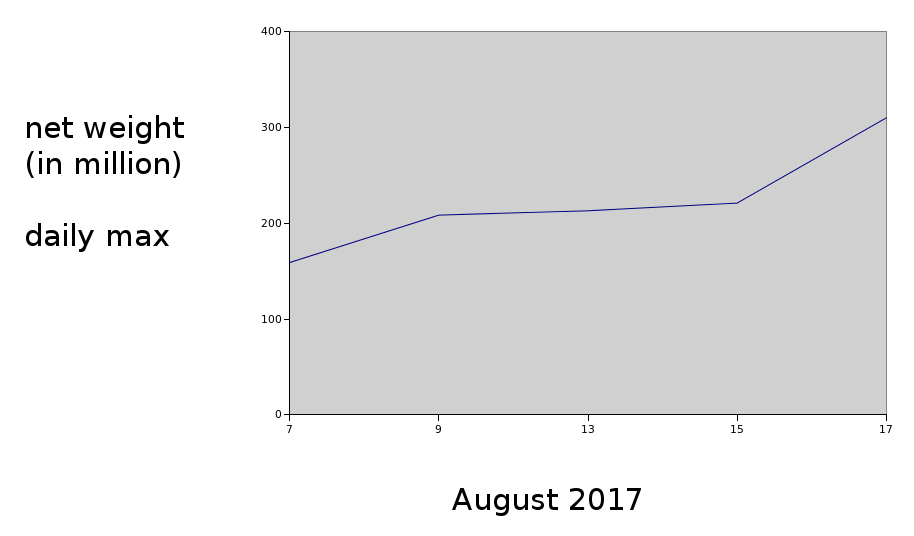 Erkan-Yilmaz
on 17 Aug 2017
Erkan-Yilmaz
on 17 Aug 2017
Burning transaction fees is not an option. Why would miners include then in the blocks?
tomasbrod
on 17 Aug 2017
Why would miners include tx for 0.0001 GRC?
3ullShark
on 18 Aug 2017
I think you are right though. Especially if filling blocks gets competitive.
3ullShark
on 18 Aug 2017
@tomasbrod @TheCharlatan @3ullShark Actually burning fees is an option. The incentive to include transactions into the block is that the value of your investment goes up once GRC are burned. So if you do not include transactions in the block the fees won't get burned and you hurt your investment. Burning coins has the same effect as distributing the same amount equally over all the existing coins. The difference would be that the miner would not get all the transaction fees but the value would be distributed amongst all GRC holders. But still the miner also gets his block reward.
So if you don't have more arguments against this I don't really see why this is a bad idea.
Here is an interesting blog post from Vitalik Buterin. In the second part he is discussing the distribution of fees:
https://blog.ethereum.org/2016/07/27/inflation-transaction-fees-cryptocurrency-monetary-policy/
skcin
on 18 Aug 2017
I've tried to get an overview of this issue and possible solutions, please comment if something is wrong or incomplete:
1) introducing fixed pos rewards instead of 1.5% p.a.
pro: - more secure chain
con: - more difficult to stake for newbies/small coin values because of higher net weight
2) remove interest completely, give it all to por
pro: - more rewards for active researchers
con: - (big) bag holders feel like getting robbed
3) less interest, more por rewards
pro: - more rewards for active researchers
con: - (big) bag holders feel like getting robbed, but not so drastically like 2)
4) no change to interest, increasing por rewards due to increasing RAC
pro: - more rewards for active researchers
con: - much higher inflation
5) leave it as it is
pro: - it's working as promised
con: - some cold wallets do not secure the chain, but get fully rewarded
- less rewards for researchers due to increasing competition
My personal favourite is 3)
Maybe we can spread the decreasing income for researcher due to increasing competition to por AND pos.
Actually (day 0), I think half of the newly minted coins go to pos and half of it to por (50:50).
An example:
Staker S gets 150 GRC interest a year for 10k.
Researcher R gets also 150 GRC a year for his work.
sum: 300 GRC
current situation, if RAC of Tream Gridcoin of every project would get doubled:
Staker S gets 150 GRC interest a year for 10k. (no change)
Researcher R only gets 75 GRC a year for the same work like above (halving)
Newbie N also gets 75 GRC a year for the same work like R
sum: 300 GRC
my suggestion for a solution:
Staker S gets 100 GRC interest a year for 10k. (decreasing amount due to higher boinc contribution)
Researcher R gets 100 GRC a year for the same work like above (more coins than like current situation)
Newbie N also gets 100 GRC a year for the same work like R (more coins than like current situation)
sum: 300 GRC (100 GRC for staking, doubled value for researchers)
pro:
- more rewards for active researchers
- more rewards for newbies
- decreasing rewards due to higher boinc contribution are spread over por AND pos (more fair?)
- no increasing inflation like 4)
- more secure chain because of researchers will get more weight and will stake more frequently (?)
con:
- staker will not get 1.5% interest like before (but researcher also don't get the same for his work like a year ago)
- securing chain will need time
problem: Which day should be day 0? Today? The day when an appropriate vote ends with a 'yes'? The day when a mandatory release with those changes gets releases? Or maybe a year ago?
 dc7dgrid
on 28 Aug 2017
dc7dgrid
on 28 Aug 2017
I've been around Gridcoin for a few months now. I have written about it extensively on Steemit, I have invested a meaningful portion of my life savings into GRC, and I have been actively involved in the community (most will better recognize me as ZenMercenary).
This discussion has been comprehensive and so many great ideas have been offered up. I have even offered up some suggestions of my own (or, rather, I've offered support of others' ideas). I do want to take a moment to share what I believe are some fundamental truths about Gridcoin that I've learned in my time here thus far:
- Gridcoin will never compete on mining profitability long-term, by its very nature: The PoR rewards mechanism can be improved, but I assure you that long-term the problem will remain the same with miners under-earning substantially compared to other coins on a "mine and dump" basis. Why? Because as we astutely point out to those who ask, there is an element of altruism involved in Gridcoin. Many in our community are here because they want to support science first, and make a profit second. This is a great thing for the health of the coin long-term, but it will always be a bad thing for miners. Every other CryptoCurrency, miners tend to hop around and mine whatever is most profitable. Once a coin's profitability starts to lag behind, miners simply shift to other coins. This is demonstrably false of Gridcoin, as we can prove through team RAC and pool signups that miners are flocking to us in record numbers every week. Not only are the number of miners growing, but they don't even seem to be slowing down. This phenomenon will always push GRC below other coins on mining profitability, again, on a "mine and dump basis."
- Gridcoin will be lucrative... if you hold your coins: The point I made in #1 that hurts the mining side of Gridcoin is a huge benefit for holders of the coin. The altruism associated with Gridcoin will always lead us to struggle with instant mining profitability, but it will reward those who either invest or operate on a "mine and hold" philosophy. Over the long-term, I would anticipate slow and steady growth in the price of GRC unless we make choices today to cripple that growth.
- None of this is "perverted" or against the fundamentals of Gridcoin: A lot of people will read my points #1 and #2 and think that that means we must change something to flip the script. They'll say we need to incentivize miners first and investors second (or not at all). And if the extent of what you want Gridcoin to be is a "mine and dump" coin where we focus on rewarding people who sell their GRC in a matter of days after they earn it, you're right. Long-term, though, that will send Gridcoin straight to irrelevance as it will likely lead us to over-inflate the coin to a level where it becomes useless to both investors and miners. The single-best thing for Gridcoin is that we build monetary policy to ensure this coin is actually worth something 10 years from now. So what if it isn't a coin popular with the "mine and dump" mentality? Gridcoin is the anti-mining coin --- it should not be expected to behave like the rest of the AltCoins. The answer to the concerns of "mine and dumpers" is to change their behavior and hold their GRC long-term because THAT is how you profit with Gridcoin.
Forget anything I've said in this thread until this point. I think there are improvements that can be made to the PoS and PoR system, but anything we do should be designed to be at least "inflation-neutral" if not reducing inflation slightly. Our coin provides an incentive to people to crunch for BOINC. The PoR makes that "mission accomplished." What we really need to focus on is policy to make sure the coin itself stays strong today and far into the future.
XaqFields
on 28 Aug 2017
Amen XaqFields the mine and dump crew just hurt the respective target currencies by creating constant sell pressure, perpetuating the need to constantly jump to another coin, personally I dont want that/Gridcoin isn't a get-rich-quick coin.
The only concern I have long-term is that PoS will reward will out perform PoR, so we need to rein in PoS somehow, either by reducing the PoS APR at predetermined block targets, fixing the block reward.
Of higher importance is banning a node from consecutive block staking IMHO.
Scalextrix
on 28 Aug 2017
Suggestion for the topic (Low network (balance) stake weight participation solution):
What if every block has a maximum of, let's say 10 GRC? If we can also block an address of having more than one block in a timespan of let's say 10 minutes, a major investor will have to run his wallet(s) 24/7, otherwise he won't get his owned earnings out of the system. People with lower stakeweight won't get affected in case of tsunami/earthquake/power cut/internet outage.
The height of the 10 GRC/10 min limits are only a quick suggestion and should be further discussed/calculated.
dc7dgrid
on 28 Aug 2017
With the change in stake weight values of 800 -> 80 in v8, some users are freaking out and others jumping on the fud train.
I think it'd be a good idea to switch to fixed rewards, fundamentally nobody should be earning GRC when not actively securing the network & if these concerns of severely low net stake weight (or at least network staking participants) are valid then network consensus is not that secure.
Approx 17 GRC/block (if 960 blocks/day) sounds fair to me (((395m * 0.015)/365)/960. Perhaps we should consider some form of POS reward increase schedule so as to maintain the 1.5% POS interest rate rather than having to schedule a future hardfork when 17 GRC/block is only 0.75% (in a few years). That said we could keep it simple first, and in a future hardfork introduce such a schedule.
Shall we put this specific change to a vote then? This issue has been open for over a year at this point, everyone should have enough information (at least from this issue alone) to vote.
It'd be a mandatory upgrade, but last mandatory went through quite well minus a slow initial response from exchanges/services. With a planned release instead of a sudden emergency release, it'll be far more stable a transition.
grctest
on 10 Sep 2017
CM I support this proposal and agree it should move to a vote
XaqFields
on 10 Sep 2017
I've created a poll lasting 21 days: https://gridcoinstats.eu/poll/technical_poll:_should_we_implement_fixed_pos_block_rewards?
grctest
on 11 Sep 2017
Is this an official/actionable poll? Is this an opinion poll? Does this poll have a proposal tied to it? What are we voting on? Are the figures mentioned by @grctest the figures we would be using in the FBR-PoS protocol?
We have tried to make the processes for making polls better by making channels on slack and begging people to seek input before creating a poll. We have also asked that polls be accompanied with in depth proposals and details regarding their content. In my eyes, a GitHub thread does not count as a proposal. At its best, using a Github thread as a proposal is lazy. At its worst, it is a form of voter suppression: you are asking the average user-base to sift through a years worth of cyclical "brainstorming", comments many of which are tangents of the initial post. Instead of simply taking action within an hour of posting a "should we X" comment and the "I did X", please, slow down and truly listen to input. Nothing good ever comes from blindly rushing into something.
I do not think we should make an actionable poll at this time.
I think we should make an opinion poll complete with extreme detail of the operation and benefits of all protocols being considered. At the moment, the two leading protocols seem to be "% Interest" and "Fixed Block Rewards. There are other options, some of which are short term projects and others which will take at least a year to develop. We are primarily exploring only the two options mentioned because they are short term projects -- we can implement them with relative ease when compared to switching to other, more complex blockchain security protocols.
There are variables and infrastructures within these protocols which greatly influence their effects. None of these effects have been seriously detailed in this thread. @dc7dgrid has posted the only content which weighs the pros and cons of different options. I think that before we make any decisions, we should invite more posts like theirs along with other, even more detailed proposals. Creating these proposals takes time. I vote we give people time to contribute before taking action. There are plenty of other things we could be focusing on in the meantime.
Changing THE critical protocol of a blockchain is a major decision. Despite the length of this thread, I do not think enough focused time and thought has gone into describing details of specific protocol proposals along with the effects that any changes to the blockchain protocol will have. I think this poll is premature. I will vote "abstain" in the currently listed poll.
jring-o
on 11 Sep 2017
This is --and should be-- an actionable poll. This thread is more than a full year old, and this issue has been discussed ad-nauseum and this thread has been linked no fewer than a dozen times on various mediums since I began participating in the community a few months ago. Everyone who is paying any amount of attention is fully aware of this discussion and has had ample time already to participate.
The idea that we need to "give people time to contribute before taking action" just seems silly, given all that. It's embarrassing that we have not taken action on this issue already, especially regarding fixed blocks as it seems to be nearly unanimously accepted by the community that we should.
I can appreciate your desire to control this process and apply a more methodical approach, but right now with network stake weight being of particular concern, we need to take action on this issue that has been discussed for over a year. By all means, vote "Abstain" if this is how you feel but you cannot unilaterally dismiss the poll itself.
XaqFields
on 11 Sep 2017
What are the details of the proposed FBR-PoS protocol?
jring-o
on 11 Sep 2017
@jring-o Please refer to the post that was made 3 posts prior to yours.
XaqFields
on 11 Sep 2017
https://github.com/Erkan-Yilmaz/Gridcoin-tasks/issues/158
Do you see what I'm saying?
jring-o
on 11 Sep 2017
Again, no.
The poll literally links to this thread/discussion and asks only one simple question: Should we implement Fixed POS Block rewards?
It couldn't be made more clear what the poll is asking.
XaqFields
on 11 Sep 2017
I agree with @jring-o : Of course, this thread is one year old, but I do not think that it is really discussed for one year. I cannot read any deeper implications fixed blocks will lead to. I would also like to read some opinions to my suggestions above. As long as there is no real discussion, I will vote 'no' because it is too early to vote. Also, there have to be ALL possible options/solutions and not only voted on one.
dc7dgrid
on 11 Sep 2017
I believe that this problem needs to be addressed. If we talk about this subject right up to nausea for so long, it is because a real problem persists. voting "no" resolves nothing, voting "yes" sets a guideline that does not necessarily have to be applied immediately and without reasoning. Firstly, here there is an inflation problem that urgently needs to be resolved. second, you must encourage the new and average user to keep their portfolio running. There is no point in staking if you don't have thousands of stored gridcoins. my niubbo fatigue is the same as that of a great investor, so it makes sense to reward equally with a gift that is commensurate with the difficulty of the network. This would benefit the price and dissemination of our beloved currency.
Apologize for my English, I use deeepl.com as an automatic translator
 EnzoCaricoTri
on 11 Sep 2017
EnzoCaricoTri
on 11 Sep 2017
I apologize if I seem aggressive as that's honestly not my intent. I have just become a bit frustrated with some of the anti-productive behavior of our community. It seems to me that when anybody ever takes initiative/leadership and tries to move progress forward they are chastised by a small portion of the community for not having gone through some sort of mythical governance structure we have never actually formulated or agreed upon.
I understand and appreciate the need to improve governance with Gridcoin, but at the same time we also have to be on the parallel path of actually progressing the coin. Every time someone wants to do something, I see the same people attempting to lay out road blocks because they have some vision in their heads for an altered/improved governance structure that doesn't exist yet, and they seemingly want all progress halted until such a time as that has been accomplished.
This is why the developers have had to move forward with certain critical-path upgrades to Gridcoin without necessarily involving the community. Can you imagine how long it would have taken us to come to a consensus on the v8 upgrade with the way things are right now? It seems we would rather watch Gridcoin burn to the ground as opposed to letting the community vote and pass simple improvements to enhance security and utility of the coin/blockchain.
As it relates to this issue specifically, here are the critical pros and cons again:
Pros:
- Provides incentive to stake 24-7 where that currently doesn't exist, thus increasing blockchain security
- Potentially solves the problem of PoS rewards becoming larger than PoR rewards in the future
- Removes the ability of large investors to "milk" their PoS rewards without ever meaningfully contributing to security of the blockchain.
Cons:
- Investors who are only holding GRC for the ability to collect 1.5% interest without doing anything may be more likely to dump their holdings.
- If all the large investors staked 24-7, the frequency of staking would decrease for smaller investors/miners
Keep in mind, though, that everything in the "Cons" list is speculative in nature while the "Pros" are known. I would also argue each of the Cons could be addressed with subsequent changes if they were to be a substantial problem.
XaqFields
on 11 Sep 2017
As I already posted at #158:
What I would like to know is, what are the consequences of a fixed block reward exspecially for big investors and small investors, for big boinc cruncher and small ones, for inflation/total money supply? Who will win, who will lose assuming everyone will run their wallet 24/7/365?
What about my proposal above: Only _limiting_ rewards to a _maximum_ per block and timeframe?
dc7dgrid
on 11 Sep 2017
Benefits of block rewards vs coin*age interest are:
- more investors will be staking regularly
- bunkerers will not be rewarded for what they are not doing
- they are not helping to secure network by going online once a year and collecting the accrued interest
- the absolute value of interest paid will stop increasing, like it is now
- in other words, inflation due to interest will be linear, as opposed to exponential
With Coin*Age interest, the Interest WILL overtake BOINC rewards.
tomasbrod
on 11 Sep 2017
Gridcoin has been developing at a record pace over the past months. I have seen very little obstruction when it comes to this progresses. I would hope, however, that when we start to crack open the base protocols we will slow down and take our time so we don't need to fix them again in a month. I would also hope that we try to include as much of the community as possible and provide ample time for counter-proposals and discussion. If we don't, we run the risk of forking GRC just like SegWit forked bitcoin. SegWit did not really give enough time for dissenters to form counter-proposals, so when SegWit activated without serious consideration for alternatives, those who dissented forked the coin so they could implement their own solutions when they are ready (I think in November). I do not think that anything discussed here is serious enough to cause a fork, but we should learn from the mistake of bitcoin and attempt to fix the process now instead of when a serious change is proposed. We should do this for the security of Gridcoin, not in favor of any one proposal or another.
That said, I have been working on the whitepaper along with a proposal over the past months. I was hoping to release everything together in a nice, neat, and accessible format. Because there is now an active poll regarding one of the base protocols, I can not wait. Here is a rough outline of what I have been working on with regards to proposals. I apologize for the format but I simply will not have enough time in the next 21 days to complete and refine the content. Also, if there is a better way to display pages of text without having to reformat everything, I'm all ears = ). I'm still new to GitHub.
EDIT ADD:
Interest earned on coins does not require the coin to stake within a specific time period. The 6 month limit is related to DPoR and beacons. This doesn't change much of the proposal outline's purpose, but it is misinformation. My apologies!



jring-o
on 11 Sep 2017
Coin*Age interest payment is not limited to 6 months. You seem to mix the Reward system with the Consensus system. DPoR is part of the chain, not a separate protocol, proof of it are the numerous recent forks where nodes disagreed on the reward amount. Please, @jring-o , Stop spreading the misinformation.
tomasbrod
on 12 Sep 2017
My mistake! After getting some clarification, it would seem that interest earned on coins does not require the coin to stake within a specific time period.
The 6 month limit is related to DPoR and beacons. I will update the post accordingly.
jring-o
on 12 Sep 2017
It seems as though your actual problem with this vote is that you were working on a different proposal over the course of months and you're upset that you hadn't finished it before somebody pulled the trigger on a vote. While I can understand your frustration, I would have more respect for it if you had led with that information instead of repeatedly trying to stall people by saying "this is just way too premature" because while the process can certainly be improved, by existing Gridcoin standards this topic has been discussed exhaustively and it's not unreasonable at all that we'd move to a vote on it.
Now, on to your proposal which I do commend you for preparing as it looks very well thought-out....
To be honest with you, I wouldn't agree that there's a very strong relationship between what you're proposing and what this vote is asking. This vote is addressing a longstanding problem with Gridcoin that has generated a lot of consternation particularly among the mining crowd that major GRC holders are not doing their part to secure the blockchain but are collecting hundreds of thousands of GRC per year in interest. It is widely understood that the "interest-based/APR" model is broken and needs to be addressed. I had an 8-hour long discussion with a fellow on Reddit about this subject... he was a long-time contributor to this community and had left the community several months ago. He cited this exact thread as an example of why he left Gridcoin: he felt like critical changes weren't being acted on even when it had become clear that the community was supportive.
Your proposal is far, far more broad. You are proposing eliminating the PoS rewards entirely and creating some alternative system of stake weight that prioritizes some yet-to-be-determined metric that helps miners stake, and you're basing it on the premise/assumption that we just flat-out don't need investors (non-miners) to help secure the blockchain. I would not agree with that premise, and I also would not agree that an "opinion poll" would tell us anything useful about it. If you were to create a poll asking people if they would stake more, less, or the same if PoS rewards were removed entirely, their answer inherently is going to be based on whether they agree with the idea of removing PoS rewards or not, as opposed to an honest/truthful answer about what they predict their behavior would actually be.
Even if we could agree in.... another year or two, maybe.... on the idea of removing PoS rewards entirely and figuring out some secure way to calculate stake weight for miners, you're ultimately going into this transition completely blind, not knowing whether or not you might have a mass-exodus of GRC holders, not knowing if you're properly incentivizing people to stake (or if you're incentivizing the right people, even).
Either way, as I've said before when I've perceived you as trying to lay out road blocks when others are trying to take action on an issue, your personal vision for how this could be done is going to take quite a while to sort through and educate everyone on. There's no reason why we can't move forward with a needed change and, on a parallel path, you could work on educating the community on your own proposal.
Just my two cents on the matter.
XaqFields
on 12 Sep 2017
@XaqFields who you mean by "you"? I feel that it is me, due to all my proposals, but I am not sure. This poll is only about block rewards, not any other proposal. Not about burning tx fees, not about changing the weight calculation (which was already changed). Please do not mix Reward and Consensus protocol. Yes, they are interconnected (changing rewards causes fork in consensus), but otherwise can be changed separately (with proper mandatory transition process).
tomasbrod
on 12 Sep 2017
This is --and should be-- an actionable poll. This thread is more than a full year old, and this issue has been discussed ad-nauseum and this thread has been linked no fewer than a dozen times on various mediums since I began participating in the community a few months ago. Everyone who is paying any amount of attention is fully aware of this discussion and has had ample time already to participate.
No, sorry, but that is wrong.
First of all GitHub is and was never the place where people were send to get information or discuss things.
GitHub also is not the center of the world. It it some outlying, fringe medium most people - if at all - know that you can download stuff.
Also if you send people to "read it" and point them to this thread they see something ONE YEAR old and close it. Or if they read on they see Rob saying "this is not important right now".
And so on.
This thread is NOT how people can make an informed decision. And no, it is also not a broad discussion with "the community". it is a throwing of thoughts from GitHubers.
For example has anyone here addressed the question WHY people are not staking their wallets 24/7? If you want to change that, you should know the reason, don't you think?
I also have one of those big wallets that is not on most of the time. Why? I don't have seen ONE of the three main reasons here. (And I wont tell you know, because you may start thinking about it and come up with other reasons then mine.)
The only concern I have long-term is that PoS will reward will out perform PoR, so we need to rein in PoS somehow, either by reducing the PoS APR at predetermined block targets, fixing the block reward.
Of higher importance is banning a node from consecutive block staking IMHO.
The PoS outrunning the PoR is actually a small problem, since we have only 1,5% inflation.
That means even after 10 years the PoS will only be ~20% higher then PoR. Under "ideal" situation, not counting those who don't stake (especially exchanges) and coins that get lost (there are always some).
But yes, we could decrease the PoS, but I am against any big change at one point. People have invested, counting on their interest. I won't argue about how many that actually are, but it is still a valid stakeholder group and should not be "robbed".
Regarding this my proposal (as I have written similar at the start of the coin) would be to slowly decreasing the interest.
We could decrease the interest by 0,1% roughly once per year until we are down to 0,5% yearly. Then in 2028 we could think again about that topic in a (I am sure) completely new environment. Of course that road could still be changed, but by this you are both reigning in interest and showing that you don't break promises. Gridcoin is a long term coin, so we both CAN do long term plans and have people planning with it long term.
I am full into not-consecutive staking.
 LennStar
on 12 Sep 2017
LennStar
on 12 Sep 2017
@LennStar
The PoS outrunning the PoR is actually a small problem, since we have only 1,5% inflation.
That is wrong. The monetary inflation is higher since you also have to count the research reward.
But yes, we could decrease the PoS, but I am against any big change at one point. People have invested, counting on their interest. I won't argue about how many that actually are, but it is still a valid stakeholder group and should not be "robbed".
I think investors should rethink if gridcoin in its current state is a good investment. Even if you collect your 1.5% interest you still loose in terms of the percentage of the marketcap you hold. That is because there is also the research reward. Your 1.5% interest does not compensate for the total monetary inflation.
@grctest I think 17 grc static block reward is too high. You have to keep in mind that the static block reward is payed all the time. Interest can be lost if you don't stake and send the coins before you do. Also we don't know how many coins are lost, so the interesst actually payed is not 1.5% of total coins supply. And we should think about the balance between research reward and interest.
skcin
on 12 Sep 2017
@XaqFields there appears to be a misunderstanding.
What I posted is an extremely rough and sloppy outline regarding potential ways to address the multiple issues that come with our PoS protocol. It's a list of 5 potential proposals. I've explored "no reward" first and most because no one had talked about it and yes, I find it the most interesting. The others have all been mentioned in various chats and community hubs.
I do not have the technical know-how for making an actual proposal. An actual proposal would come with lines of code and various definitions. There hasn't been an actual proposal made in this thread.
jring-o
on 12 Sep 2017
@LennStar I agree that if we use an incentive, we should make it non-consecutive staking.
Also, the idea for lowering interest over time is interesting. It is definitely important that we respect our past commitments.
I think that Gridcoin or some other coin will have broken profit priority from securing the blockchain in some way by 2020. Maybe we could get to %0 or near %0 by then? Either way, I would like to know more. Is there math behind your %0.1 reduction/year or is that just for an example? Do you foresee any problems or great benefits to taking this path of Fixed Reduced Interest?
jring-o
on 12 Sep 2017
The current economic situation is unsustainable in the long term. Large investors if they have joined the community of Gridcoin, it is not because they want to earn 1.5% (and maybe lose 30% of the value in a year because the market knows that Gridcoin has an inflationary problem and sells, or whatever else) no one would risk 100k or 1M of dollars to earn 1.5% annually against a high volatility. Gridcoin is not a bank. Investors who come into Gridcoin enter us because they believe that being valued only a few cents in the future can recreate the fairy tale that has already happened for Bitcoins and other currencies. It will happen to us as well, we are investing precisely for this, but the booom is delaying precisely because there is a fundamental problem. Investors, or anyone else, hope to see the value of their investment multiply, no one invests to earn through the miserable 1.5 percent with a high risk percentage.
P.S.
In Italia, the most secure bank of all banks offers an annual return of 1.65%. Do you have to deposit your big money to earn in a bank or encrypted currency without any guarantee? I would not do such a thing even if it were possible on bitcoins. the pos with interest system has nothing attractive, on the contrary. Maybe it is also one of the causes that prevents the BOOM of Gridcoin in the markets
Apologize for my English, I use the support of an automatic translator (deepl.com) to write here
EnzoCaricoTri
on 12 Sep 2017
@LennStar wrote:
This is --and should be-- an actionable poll. This thread is more than a full year old, and this issue has been discussed ad-nauseum and this thread has been linked no fewer than a dozen times on various mediums since I began participating in the community a few months ago. Everyone who is paying any amount of attention is fully aware of this discussion and has had ample time already to participate.
No, sorry, but that is wrong.
First of all GitHub is and was never the place where people were send to get information or discuss things.
I disagree, we've been using the gridcoin-research github repo for its issues and wiki functionality far more than we've used the cryptocurrencytalk development subforum (dead by comparison regarding core gridcoin topics).
@LennStar wrote:
GitHub also is not the center of the world. It it some outlying, fringe medium most people - if at all - know that you can download stuff.
It's the centre of Gridcoin's development, release and issue tracking - it holds far more legitimacy as a forum for discussing key gridcoin development topics than most other forums.
@LennStar wrote:
Also if you send people to "read it" and point them to this thread they see something ONE YEAR old and close it. Or if they read on they see Rob saying "this is not important right now".
And so on.
The same users would likely stumble across similar posts in page 2 of 10 on cryptocurrencytalk - users who won't bother informing themselves when provided sufficient information due to laziness aren't worth losing sleep over when it comes to voting.
@LennStar wrote:
This thread is NOT how people can make an informed decision. And no, it is also not a broad discussion with "the community". it is a throwing of thoughts from GitHubers.
GitHub users are key gridcoin community members who are actively contributing towards Gridcoin's development; It takes 5 mins max to make a github account & we've had discussions on this topic in multiple gridcoin hangouts over the last year.
Look at cryptocurrencytalk's related threads:
https://cryptocurrencytalk.com/topic/49141-dpor-stake-weight-calculations/?page=2
https://cryptocurrencytalk.com/topic/38341-brainstorming-gridcoin-dpor-distributed-proof-of-research-removing-the-load-off-of-netsoft/?page=3
Note the lack of participation compared to this issue? GitHub stands as the most productive platform for discussing technical gridcoin topics, perhaps with slack coming in a close second place (though good luck following a year old conversation on slack).
@LennStar wrote:
For example has anyone here addressed the question WHY people are not staking their wallets 24/7? If you want to change that, you should know the reason, don't you think?
Because they don't need to; a greedy whale can stake once a year and get their full year's POS rewards in a few blocks without bothering to secure the network. We effectively incentivize leeching rewards from the network.
@LennStar wrote:
I also have one of those big wallets that is not on most of the time. Why? I don't have seen ONE of the three main reasons here. (And I wont tell you know, because you may start thinking about it and come up with other reasons then mine.)
You won't tell the core gridcoin developers issues which keep you from staking continuously? Doesn't seem productive at all to keep 'secrets' to yourself, I doubt their existence if you maintain this attitude.
grctest
on 13 Sep 2017
Constant interest per block implemented in #617 .
tomasbrod
on 13 Sep 2017
The monetary inflation is higher since you also have to count the research reward.
Yes, but reasearch inflation is also 1.5% (from startpoint). 50/50
The difference between those two is small, that was the point in that statement regarding galloping inflation. (That is when the bread costs 5% more in the evening then in the morning. We Germans remember it in the bones ;) )
GitHub users are key gridcoin community members who are actively contributing towards Gridcoin's development;
Because they don't need to; a greedy whale can stake once a year and get their full year's POS rewards in a few blocks without bothering to secure the network. We effectively incentivize leeching rewards from the network.
Thank you for proving my point ;)
A fine POV bubble of "developers" you have here, but this is neither "the community" nor "the users".
And then yes, I will write down something and then you can see if smaller rewards will solve that and increase net weight.
LennStar
on 14 Sep 2017
Yes, but reasearch inflation is also 1.5% (from startpoint). 50/50
This is false.
XaqFields
on 14 Sep 2017
Stating that Github is "neither the community nor the users" is just ridiculous. There are plenty of us non-devs here too and Github has always been the best place for technical discussions, not just for Gridcoin, but for any crypto.
Vortac2
on 14 Sep 2017
My biggest concern long term is that staking is the only way to do research without trusting a pool. If the cost to stake keeps rising as it has been we could end up with nearly all users researching from a pool with a handful of whales ruling all transactions.
 voronoipotato
on 3 Jan 2018
voronoipotato
on 3 Jan 2018
@voronoipotato Please see Section 3. of Gridcoin Research 4.0 Proposals and the recent polls.
tomasbrod
on 4 Jan 2018
This is now considered done.
denravonska
on 8 Jan 2019
Related issues
iFoggz
·
4Comments
tomasbrod
·
4Comments
jring-o
·
3Comments
 Penumbra69
·
6Comments
grctest
·
4Comments
Penumbra69
·
6Comments
grctest
·
4Comments
Most helpful comment
Yea, I have a heart for the new researchers. I would vote for removing interest, and adding a feature to mint more research coins, but only if that particular mint subsidy was backed by the amount of constant research days a CPID is seen consecutively. For example, maybe we could pay up to 50% more for research out to CPIDs seen longer than 30 days on the network, resulting in monetary expansion from 40k per day to 60k or even 80k per day, as long as it is backed by research growth. A cpid who drops off the chain might have to start over.
Something like an algorithm where 1-30 days results in the standard reward, 31-60 = 1.25, 61-90=1.50, 91+ = 2.00 with the daily kitty increased up to 2*?
Just ideas to create a growth environment.