Graphql-flutter: WebSocketLink doesn't add headers from AuthLink
This scenario works in apollo-graphql, just by setting the right Authorization token on the WebSocketLink;
Here, for some reason, the Authorization header is not being sent to the server even when the AuthLink is present and is injecting the right headers.
This problem might be related to the underlying websockets client or the fact that websockets work by sending an initial connection request to the server.
I think we should add something similar to what AuthLink does with getToken() on WebSocketLink, like: getInitialConnectionHeaders(), so those headers are sent to the server when connection_init happens.
Error message:
E/flutter (17683): [ERROR:flutter/lib/ui/ui_dart_state.cc(148)] Unhandled Exception: {type: error, id: 2d90df21-b556-4291-98ad-f36cdc538b39, payload: {extensions: {path: $, code: start-failed}, message: cannot start as connection_init failed with : Missing Authorization header in JWT authentication mode}}
More insight about this issue:
https://github.com/hasura/graphql-engine/issues/994
 kevinrodriguez-io
All 15 comments
This link from apollo has more info
https://github.com/apollographql/graphql-subscriptions/blob/master/.designs/authorization.md
It’s not possible to provide custom headers when creating WebSocket connection in browser.
I too need to figure out how to do it, hope you can figure out a wasy. Cheers
 bsr203
on 10 Sep 2019
bsr203
on 10 Sep 2019
This happened to me on Hasura, I'll contact them and get back to this issue with more information.
kevinrodriguez-io
on 10 Sep 2019
I haven't worked with Hasura and Web Socket that much, but last week I came across a series of blogs post on Hasura and Flutter, for this library. Here are the links, you can skip the first two blog posts.
- https://blog.hasura.io/build-flutter-app-graphql-hasura-serverless-part1/
- https://blog.hasura.io/build-flutter-app-hasura-firebase-part2/
- https://blog.hasura.io/build-flutter-app-hasura-firebase-part3/
I will work to create a meaningful example soon on using Hasura and Flutter, I hope that helps in the meantime.
 mainawycliffe
on 10 Sep 2019
mainawycliffe
on 10 Sep 2019
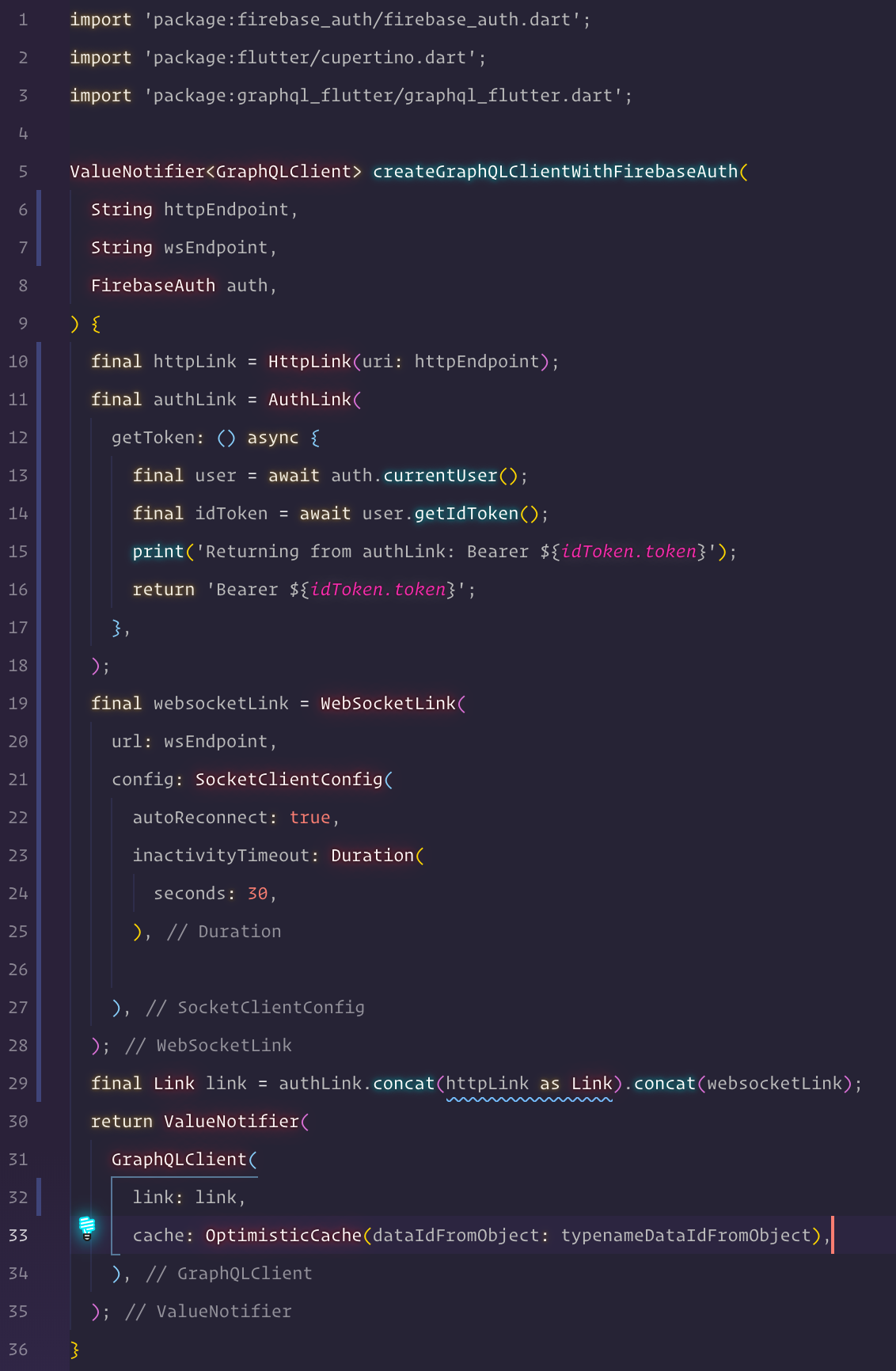
@mainawycliffe Thanks for the reference! In fact, I talked to Can Taşpınar (The author of that blogging series, who was very kind and helpful). This seemed to be working on v1 (^1.0.0), but latest versions throw that error. I'll look at the source code differences to know if we can get this to work. At the moment a workaround is to set the dep version to ^1.0.0
Attachment:
How my client and links look
kevinrodriguez-io
on 11 Sep 2019
It looks like setting headers for the SocketClientConfig was allowed earlier. However, it has been removed because "WebSocket headers are not usable in the browser". The suggestion is to use initPayload. I have tried these settings below and it worked out on 2.1.0!
      config: SocketClientConfig(
          autoReconnect: true,
          inactivityTimeout: Duration(seconds: 30),
          initPayload: {
            "headers": {"Authorization": 'Bearer ' + token}
          }),
I think setting up SocketClient with headers for Authorization to use with Subscriptions should be documented for clarification.
 cantaspinar
on 11 Sep 2019
cantaspinar
on 11 Sep 2019
@cantaspinar Yes, that was changed when flutter for web was announced. The docs are kind of a mess at the moment. I will dedicate some time to updating the docs and possibly a static site for the library of the coming weeks.
mainawycliffe
on 11 Sep 2019
@cantaspinar how would one refresh their token when it expires?
 kulture-rob
on 10 Oct 2019
kulture-rob
on 10 Oct 2019
@kulture-rob Hmm, I assume you are talking about Firebase tokens which expire after an hour. I have to find a way to deal with that too but haven't tried anything yet. I guess there is no way to mutate the links after they have been passed to GraphQLProvider. Maybe you can catch errors when making requests to GraphQL api and if the token is expired, reload the token and rebuild. Provider package might be handy to achieve that.
cantaspinar
on 10 Oct 2019
@cantaspinar how would one refresh their token when it expires?
What I do:
- I still use
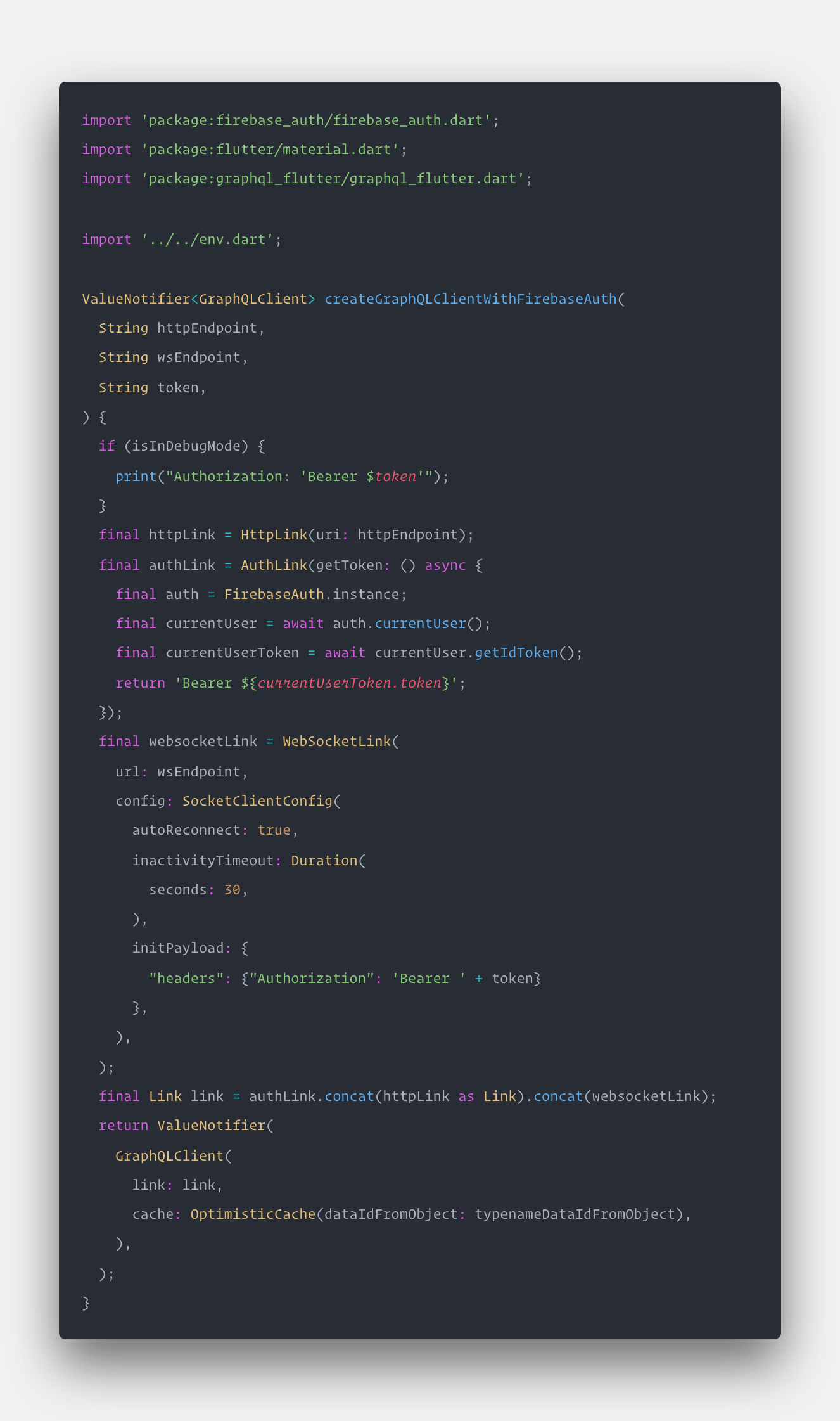
AuthLinkfor regular HTTP requests, and use firebase'sgetIdToken()function to refresh the token and send it over the HTTP request. - For WS Connections this works a little bit different, because the token is sent only on the initial web socket handshake. It is only sent once the connection is made. So you must get an updated token with
getIdToken()before creating the client. Then you don't need to worry about expiration because your connection via WS has already been authenticated.
kevinrodriguez-io
on 10 Oct 2019
This is how my client looks at this point:
kevinrodriguez-io
on 10 Oct 2019
for me initPayload don't work, don't send my custom header. any alternative to send headers on SocketClientConfig?
 EdoardoLopez
on 11 Oct 2019
EdoardoLopez
on 11 Oct 2019
This should definitely be documented!
 aljafor
on 25 Jan 2020
aljafor
on 25 Jan 2020
Once #546 gets merged in, you can do it like getToken()
kulture-rob
on 25 Jan 2020
Can we reopen this? Adding headers to initPayload doesn't add them to the request
    final WebSocketLink websocketLink = WebSocketLink(
      url: ApplicationConstants.graphqlSubscriptionURI,
      config: SocketClientConfig(
          autoReconnect: true,
          inactivityTimeout: Duration(seconds: 15),
          initPayload: {
            "headers": {"Authorization": 'Bearer ' + "FAKE TOKEN"}
          }),
    );
Headers from Charles
  | GET /graphql HTTP/1.1
-- | --
user-agent | Dart/2.8 (dart:io)
connection | Upgrade
cache-control | no-cache
accept-encoding | gzip
content-length | 0
sec-websocket-version | 13
host | localhost:20002
sec-websocket-extensions | permessage-deflate; client_max_window_bits
sec-websocket-key | [REDACTED]
sec-websocket-protocol | graphql-ws
upgrade | websocket
 KieranLafferty
on 1 Feb 2020
KieranLafferty
on 1 Feb 2020
@KieranLafferty it has been merged into beta, but hasn't been released.
kulture-rob
on 2 Feb 2020
Related issues
 Zony-Zhao
·
32Comments
mainawycliffe
·
16Comments
Zony-Zhao
·
32Comments
mainawycliffe
·
16Comments
 chimon2000
·
24Comments
chimon2000
·
24Comments
 nkwwk
·
20Comments
nkwwk
·
20Comments
 netwrkx
·
12Comments
netwrkx
·
12Comments
Most helpful comment
It looks like setting headers for the SocketClientConfig was allowed earlier. However, it has been removed because "WebSocket headers are not usable in the browser". The suggestion is to use initPayload. I have tried these settings below and it worked out on 2.1.0!
I think setting up SocketClient with headers for Authorization to use with Subscriptions should be documented for clarification.