Gorm: Tag `foreignkey` doesn't affect db.Modle.Related
As the belongs_to Foreign Key document shows, my example code below should be work. But it always notice * invalid association * error.
What's wrong here? Thanks for help!
```golang
package main
import(
"log"
"github.com/jinzhu/gorm"
_ "github.com/jinzhu/gorm/dialects/mysql"
)
type ApplicationGroup struct{
gorm.Model
Name string
}
type Application struct{
gorm.Model
Name string
GroupID int
Group   ApplicationGroup `gorm:"foreignkey:GroupID"`
}
func main() {
db, err := gorm.Open("mysql", "root:root@tcp(localhost:3306)/dbname?charset=utf8")
if err != nil {
log.Fatal(err)
}
app := Application{GroupID: 123}
var group ApplicationGroup
q := db.Model(&app).Related(&group)
log.Println(q.Error) //invalid association []
}
`
 athurg
All 9 comments
maybe you can try this
q := db.Model(&app).Related(&group, "GroupID")
 skanger
on 9 Mar 2018
skanger
on 9 Mar 2018
Yes, this works.
But I think it should get GroupID from the gorm tags, instead of manually specified.
athurg
on 9 Mar 2018
I ran into this too, I have to specify it manually. @jinzhu shouldn't it use the gorm:"foreignkey" tag value?
 dgoradia
on 24 Mar 2018
dgoradia
on 24 Mar 2018
same problem in version v1.9.14 @jinzhu
as per the source code:
// Related get related associations
func (s *DB) Related(value interface{}, foreignKeys ...string) *DB {
    return s.NewScope(s.Value).related(value, foreignKeys...).db
}
func (scope *Scope) related(value interface{}, foreignKeys ...string) *Scope {
    toScope := scope.db.NewScope(value)
    tx := scope.db.Set("gorm:association:source", scope.Value)

    for _, foreignKey := range append(foreignKeys, toScope.typeName()+"Id", scope.typeName()+"Id") {
        fromField, _ := scope.FieldByName(foreignKey)
        toField, _ := toScope.FieldByName(foreignKey)

        if fromField != nil {
            if relationship := fromField.Relationship; relationship != nil {
                if relationship.Kind == "many_to_many" {
                    joinTableHandler := relationship.JoinTableHandler
                    scope.Err(joinTableHandler.JoinWith(joinTableHandler, tx, scope.Value).Find(value).Error)
                } else if relationship.Kind == "belongs_to" {
                    for idx, foreignKey := range relationship.ForeignDBNames {
                        if field, ok := scope.FieldByName(foreignKey); ok {
                            tx = tx.Where(fmt.Sprintf("%v = ?", scope.Quote(relationship.AssociationForeignDBNames[idx])), field.Field.Interface())
                        }
                    }
                    scope.Err(tx.Find(value).Error)
                } else if relationship.Kind == "has_many" || relationship.Kind == "has_one" {
                    for idx, foreignKey := range relationship.ForeignDBNames {
                        if field, ok := scope.FieldByName(relationship.AssociationForeignDBNames[idx]); ok {
                            tx = tx.Where(fmt.Sprintf("%v = ?", scope.Quote(foreignKey)), field.Field.Interface())
                        }
                    }

                    if relationship.PolymorphicType != "" {
                        tx = tx.Where(fmt.Sprintf("%v = ?", scope.Quote(relationship.PolymorphicDBName)), relationship.PolymorphicValue)
                    }
                    scope.Err(tx.Find(value).Error)
                }
            } else {
                sql := fmt.Sprintf("%v = ?", scope.Quote(toScope.PrimaryKey()))
                scope.Err(tx.Where(sql, fromField.Field.Interface()).Find(value).Error)
            }
            return scope
        } else if toField != nil {
            sql := fmt.Sprintf("%v = ?", scope.Quote(toField.DBName))
            scope.Err(tx.Where(sql, scope.PrimaryKeyValue()).Find(value).Error)
            return scope
        }
    }

    scope.Err(fmt.Errorf("invalid association %v", foreignKeys))
    return scope
}
the code tries to figure out the first possible field name that containing the foreign key in the following order:
the second argument when calling the function Related()
the type name of the owner or owned type, appended by Id
we can see it definitely ignores the tags foreignkey and association_foreignkey
 ChipZhang
on 23 Jun 2020
ChipZhang
on 23 Jun 2020
@jinzhu
the official documentation is basically wrong:
To define a belongs to relationship, the foreign key must exists, default foreign key uses owner’s type name plus its primary key.
For the above example, to define a model that belongs to User, the foreign key should be UserID.
GORM provides a way to customize the foreign key, for example:
type User struct {
  gorm.Model
  Name string
}

type Profile struct {
  gorm.Model
  Name      string
  User      User `gorm:"foreignkey:UserRefer"` // use UserRefer as foreign key
  UserRefer uint
}
in fact, foreignkey has no use here!
ChipZhang
on 23 Jun 2020
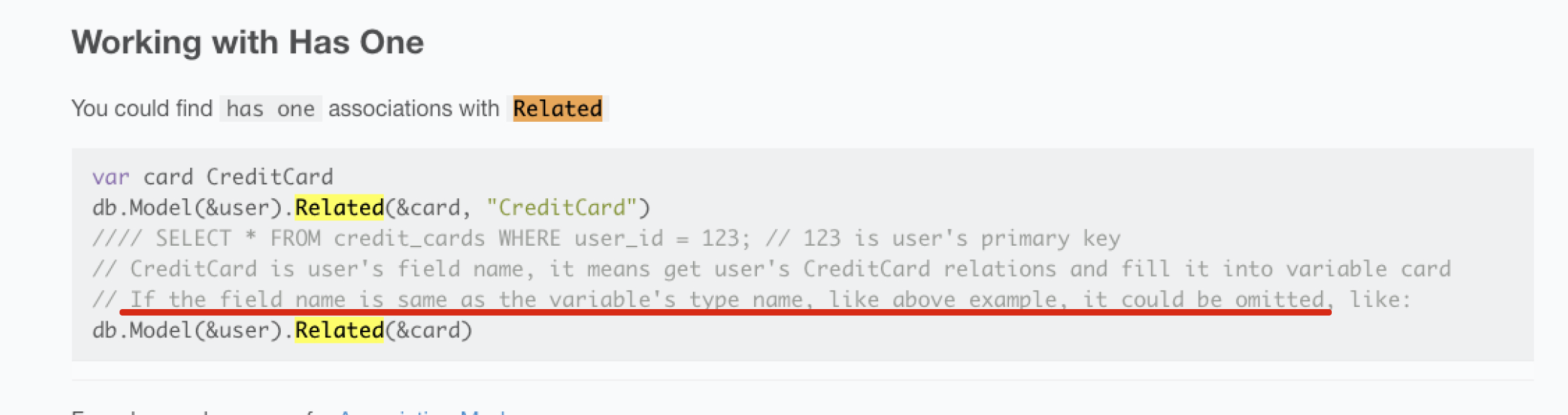
Yes, there is an issue, when I design the Related method, I thought it as a method to query associations with user-specified foreign key, the auto guessing foreign key is just sugar.
It should be used like db.Related(&user, "User"), db.Model(&app).Related(&group, "Group")
But I think I am not going to fix this one, as we dropped the Related support in v2, refer:
https://github.com/go-gorm/gorm/wiki/GORM-V2-Release-Note-Draft#association-mode
 jinzhu
on 23 Jun 2020
jinzhu
on 23 Jun 2020
Yes, there is an issue
you should at least point it out in the documentation. so many people encountered this bug before.
ChipZhang
on 23 Jun 2020
Actually it is mentioned in the document, but maybe not quite clear.
jinzhu
on 23 Jun 2020
It should specified that it won't use the setting from tags to make it more clear
 LaysDragon
on 23 Aug 2020
LaysDragon
on 23 Aug 2020
Related issues
 pjebs
·
3Comments
pjebs
·
3Comments
 rfyiamcool
·
3Comments
rfyiamcool
·
3Comments
 zeropool
·
3Comments
zeropool
·
3Comments
 bramp
·
3Comments
bramp
·
3Comments
 kumarsiva07
·
3Comments
kumarsiva07
·
3Comments
Most helpful comment
I ran into this too, I have to specify it manually. @jinzhu shouldn't it use the
gorm:"foreignkey"tag value?