Google-cloud-go: spanner/spansql: Minimize allocations in SQL()
We are using spansql.Query to SQL dynamic SQL queries, which has increased the readability of that code a lot which is great (compared to concatenating strings). However, after running some benchmarks on our services we noticed that the implementation of .SQL() accounts for 5% of the memory allocations (space) in our services.
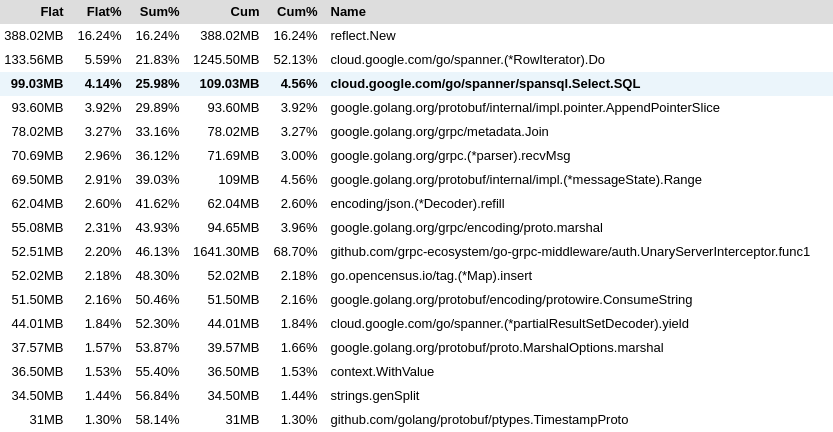
Digging a bit deeper reveals it is due to the string concatenation happening within that method:
  Total:     99.03MB   109.03MB (flat, cum)  4.56%
    244            .          .             if sel.Distinct {
    245            .          .                 str += "DISTINCT "
    246            .          .             }
    247            .          .             for i, e := range sel.List {
    248            .          .                 if i > 0 {
    249      35.01MB    35.01MB                     str += ", "
    250            .          .                 }
    251      48.51MB    57.01MB                 str += e.SQL()
    252            .          .                 if len(sel.ListAliases) > 0 {
    253            .          .                     alias := sel.ListAliases[i]
    254            .          .                     if alias != "" {
    255            .          .                         str += " AS " + ID(alias).SQL()
    256            .          .                     }
    257            .          .                 }
    258            .          .             }
    259            .          .             if len(sel.From) > 0 {
    260          4MB        4MB                 str += " FROM "
    261            .          .                 for i, f := range sel.From {
    262            .          .                     if i > 0 {
    263            .          .                         str += ", "
    264            .          .                     }
    265          5MB        5MB                     str += ID(f.Table).SQL()
    266            .          .                 }
    267            .          .             }
    268            .          .             if sel.Where != nil {
    269       6.50MB        8MB                 str += " WHERE " + sel.Where.SQL()
    270            .          .             }
    271            .          .             if len(sel.GroupBy) > 0 {
    272            .          .                 str += " GROUP BY "
    273            .          .                 for i, gb := range sel.GroupBy {
    274            .          .                     if i > 0 {
It would be great to see the allocations within this method reduced!
An alternative we have considered is to memoize the result from SQL, but the impact of such an optimization is very dependent on how little or much variance the queries have.
 ericwenn
All 7 comments
spansql was never written with efficiency in mind, but it is pretty easy to improve the hot spots here. Let me do a quick pass, and see how it looks in your situation after that.
 dsymonds
on 6 Oct 2020
dsymonds
on 6 Oct 2020
Totally understandable! Thanks for looking into this so swiftly, will give an update on this thread once the fix lands and I have tried it out. It looks promising!
ericwenn
on 6 Oct 2020
Can confirm this removed 75% of allocations from .SQL(). Great job!
ericwenn
on 7 Oct 2020
Cool. Can you identify any places in spansql that is still causing significant allocation for you? There's probably a few more easy wins that could be made.
dsymonds
on 9 Oct 2020
The top contender (using HEAD) is the following:
cloud.google.com/go/spanner/spansql.ID.addSQL
/home/ericwenn/go/pkg/mod/cloud.google.com/go/[email protected]/spansql/sql.go

  Total:     21.52MB    25.02MB (flat, cum)  1.13%
    492            .          .           func (id ID) addSQL(sb *strings.Builder) {
    493            .          .             // https://cloud.google.com/spanner/docs/lexical#identifiers
    494            .          .
    495            .          .             // TODO: If there are non-letters/numbers/underscores then this also needs quoting.
    496            .          .
    497            .     3.50MB             if IsKeyword(string(id)) {
    498            .          .                 // TODO: Escaping may be needed here.
    499            .          .                 sb.WriteString("`")
    500            .          .                 sb.WriteString(string(id))
    501            .          .                 sb.WriteString("`")
    502            .          .                 return
    503            .          .             }
    504            .          .
    505      21.52MB    21.52MB             sb.WriteString(string(id))
    506            .          .           }
    507            .          .
    508            .          .           func (p Param) SQL() string { return buildSQL(p) }
    509            .          .           func (p Param) addSQL(sb *strings.Builder) {
    510            .          .             sb.WriteString("@")
However, I'm not sure how much of a low-hanging fruit this is.
ericwenn
on 9 Oct 2020
Yeah, I think the only potential is to pre-allocate or reuse strings.Builders, which would be too invasive I think. Let's call this done for now.
dsymonds
on 9 Oct 2020
Agree, already great improvement. Thanks!
ericwenn
on 10 Oct 2020
Related issues
 IvanProdaiko94
·
4Comments
IvanProdaiko94
·
4Comments
 imkira
·
4Comments
imkira
·
4Comments
 purohit
·
4Comments
purohit
·
4Comments
 deelienardy
·
3Comments
deelienardy
·
3Comments
 3cham
·
3Comments
3cham
·
3Comments
Most helpful comment
spansqlwas never written with efficiency in mind, but it is pretty easy to improve the hot spots here. Let me do a quick pass, and see how it looks in your situation after that.