Go: runtime: scavenging doesn't reduce reported RSS on darwin, may lead to OOMs on iOS
What version of Go are you using (go version)?
go version go1.11.4 darwin/amd64
and
go version go1.11.4 linux/amd64
Does this issue reproduce with the latest release?
yes
What operating system and processor architecture are you using (go env)?
go env Output - linux
GOARCH="amd64"

GOBIN=""

GOCACHE="/root/.cache/go-build"

GOEXE=""

GOFLAGS=""

GOHOSTARCH="amd64"

GOHOSTOS="linux"

GOOS="linux"

GOPATH="/go"

GOPROXY=""

GORACE=""

GOROOT="/usr/local/go"

GOTMPDIR=""

GOTOOLDIR="/usr/local/go/pkg/tool/linux_amd64"

GCCGO="gccgo"

CC="gcc"

CXX="g++"

CGO_ENABLED="1"

GOMOD=""

CGO_CFLAGS="-g -O2"

CGO_CPPFLAGS=""

CGO_CXXFLAGS="-g -O2"

CGO_FFLAGS="-g -O2"

CGO_LDFLAGS="-g -O2"

PKG_CONFIG="pkg-config"

GOGCCFLAGS="-fPIC -m64 -pthread -fmessage-length=0 -fdebug-prefix-map=/tmp/go-build071389412=/tmp/go-build -gno-record-gcc-switches"
go env Output - MacOS
GOARCH="amd64"

GOBIN=""

GOCACHE="/Users/danielz/Library/Caches/go-build"

GOEXE=""

GOFLAGS=""

GOHOSTARCH="amd64"

GOHOSTOS="darwin"

GOOS="darwin"

GOPATH="/Users/danielz/golang"

GOPROXY=""

GORACE=""

GOROOT="/usr/local/opt/go/libexec"

GOTMPDIR=""

GOTOOLDIR="/usr/local/opt/go/libexec/pkg/tool/darwin_amd64"

GCCGO="gccgo"

CC="clang"

CXX="clang++"

CGO_ENABLED="1"

GOMOD=""

CGO_CFLAGS="-g -O2"

CGO_CPPFLAGS=""

CGO_CXXFLAGS="-g -O2"

CGO_FFLAGS="-g -O2"

CGO_LDFLAGS="-g -O2"

PKG_CONFIG="pkg-config"

GOGCCFLAGS="-fPIC -m64 -pthread -fno-caret-diagnostics -Qunused-arguments -fmessage-length=0 -fdebug-prefix-map=/var/folders/16/774hkyp521l6r1__tw4fllph4rwwk2/T/go-build437434626=/tmp/go-build -gno-record-gcc-switches -fno-common"
What did you do?
https://play.golang.org/p/K5ZvGZ4hmdH
What did you expect to see?
As expected, on linux, I see the delta in RSS roughly matching the memory returned to the OS by scavenger (calling debug.FreeOSMemory())
Starting 50000 goroutines
gc 1 @0.018s 64%: 46+20+0.73 ms clock, 278+10/41/0+4.4 ms cpu, 4->22->19 MB, 23 MB goal, 6 P
gc 2 @0.089s 59%: 0.16+31+0.65 ms clock, 0.97+65/32/0+3.9 ms cpu, 21->21->20 MB, 39 MB goal, 6 P
Waiting for them to finish...
Freeing OS memory...
gc 3 @0.164s 42%: 0.77+9.4+0.27 ms clock, 4.6+0/9.1/22+1.6 ms cpu, 25->25->19 MB, 41 MB goal, 6 P (forced)
scvg-1: 104 MB released
scvg-1: inuse: 20, idle: 104, sys: 125, released: 104, consumed: 20 (MB)
RSS before: 131932, after: 28404, delta: 103528
Starting 50000 goroutines
Waiting for them to finish...
Freeing OS memory...
gc 4 @3.302s 2%: 1.6+8.3+0.28 ms clock, 10+0/8.3/18+1.7 ms cpu, 26->26->19 MB, 38 MB goal, 6 P (forced)
scvg-1: 104 MB released
scvg-1: inuse: 20, idle: 104, sys: 125, released: 104, consumed: 20 (MB)
RSS before: 133836, after: 28768, delta: 105068
Starting 50000 goroutines
Waiting for them to finish...
Freeing OS memory...
gc 5 @6.416s 1%: 1.3+13+0.27 ms clock, 8.2+0/12/12+1.6 ms cpu, 26->26->19 MB, 38 MB goal, 6 P (forced)
scvg-1: 102 MB released
scvg-1: inuse: 20, idle: 104, sys: 125, released: 104, consumed: 20 (MB)
RSS before: 133080, after: 28140, delta: 104940
Starting 50000 goroutines
Waiting for them to finish...
Freeing OS memory...
gc 6 @9.585s 0%: 1.4+12+0.23 ms clock, 8.8+0/9.5/17+1.3 ms cpu, 26->26->19 MB, 38 MB goal, 6 P (forced)
scvg-1: 104 MB released
scvg-1: inuse: 20, idle: 104, sys: 125, released: 104, consumed: 20 (MB)
RSS before: 133472, after: 28372, delta: 105100
What did you see instead?
In contrast, on OSX I see the scavenger reporting memory being returned, but this is not reflected in RSS (and other places like ActivityMonitor and Instruments)
Starting 50000 goroutines
gc 1 @0.013s 84%: 73+8.4+0.15 ms clock, 881+65/22/0+1.8 ms cpu, 4->22->19 MB, 23 MB goal, 12 P
gc 2 @0.097s 81%: 0.10+8.6+0.11 ms clock, 1.2+52/22/0+1.3 ms cpu, 21->21->20 MB, 39 MB goal, 12 P
Waiting for them to finish...
Freeing OS memory...
gc 3 @0.159s 46%: 1.4+38+0.11 ms clock, 16+1.8/53/93+1.3 ms cpu, 27->28->19 MB, 41 MB goal, 12 P
gc 4 @0.204s 44%: 0.010+5.7+0.070 ms clock, 0.13+0/9.8/18+0.84 ms cpu, 19->19->19 MB, 39 MB goal, 12 P (forced)
scvg-1: 102 MB released
scvg-1: inuse: 20, idle: 102, sys: 122, released: 102, consumed: 20 (MB)
RSS before: 137264, after: 137404, delta: -140
Starting 50000 goroutines
Waiting for them to finish...
Freeing OS memory...
gc 5 @3.333s 3%: 3.0+40+0.094 ms clock, 36+0/46/28+1.1 ms cpu, 27->27->19 MB, 38 MB goal, 12 P (forced)
scvg-1: 101 MB released
scvg-1: inuse: 21, idle: 101, sys: 123, released: 101, consumed: 21 (MB)
RSS before: 137808, after: 137824, delta: -16
Starting 50000 goroutines
Waiting for them to finish...
Freeing OS memory...
gc 6 @6.502s 1%: 3.0+41+0.17 ms clock, 36+0/43/34+2.1 ms cpu, 27->27->19 MB, 39 MB goal, 12 P (forced)
scvg-1: 100 MB released
scvg-1: inuse: 22, idle: 100, sys: 122, released: 100, consumed: 22 (MB)
RSS before: 137844, after: 137844, delta: 0
Starting 50000 goroutines
Waiting for them to finish...
Freeing OS memory...
gc 7 @9.672s 1%: 3.1+41+0.094 ms clock, 37+0/48/23+1.1 ms cpu, 27->27->19 MB, 39 MB goal, 12 P (forced)
scvg-1: 100 MB released
scvg-1: inuse: 22, idle: 100, sys: 122, released: 100, consumed: 22 (MB)
RSS before: 137852, after: 137852, delta: 0
Starting 50000 goroutines
Waiting for them to finish...
Freeing OS memory...
gc 8 @12.861s 0%: 3.5+43+0.068 ms clock, 42+0/45/37+0.81 ms cpu, 27->27->19 MB, 39 MB goal, 12 P (forced)
scvg-1: 99 MB released
scvg-1: inuse: 22, idle: 99, sys: 121, released: 99, consumed: 22 (MB)
RSS before: 137856, after: 137860, delta: -4
Is this expected? Am I missing anything?
 DanielZlotin
All 22 comments
Furthermore, using gomobile
gomobile version +dc07713 Mon Jan 7 16:22:57 2019 +0000 (android,ios); androidSDK=/opt/android_sdk/platforms/android-28
Running similar code on iOS (replacing ps calls by looking at the memory instrumentation provided by Xcode) I see the same pattern as in OSX. Scavenger report for example returning ~180MB to the OS but instruments show this is not the case. This basically means we have a memory leak on iOS / OSX apps.
Confirmed on android this is not the case, ie, works the same as on linux.
DanielZlotin
on 21 Jan 2019
Can you try Go 1.12beta2? https://golang.org/dl/#go1.12beta2
 bradfitz
on 22 Jan 2019
bradfitz
on 22 Jan 2019
Reproduced with Go 1.12beta2 on OSX. same thing..
DanielZlotin
on 22 Jan 2019
I'm not sure this demonstrates an actual bug.
We use madvise(MADV_FREE) on Darwin. That tells the OS that it can take back memory pages if it wants to, but it doesn't have to. The OS will only take the pages back if it needs to give those pages to other processes. So if you have no other memory-hungry load on your system, I wouldn't expect the RSS to go down.
It's kind of an unfortunate state. It would be really nice if Darwin reported "committed RSS" or some such stricter meaning of RSS. Without that, we're left guessing if Go is really keeping those pages to itself or not.
Loading up the system with other memory-hungry programs might shed some light on whether we're actually releasing memory correctly or not. That's tricky to do reliably, but might be the only way to make progress here.
See #14521.
 randall77
on 23 Jan 2019
randall77
on 23 Jan 2019
I was able to get the OS to take back the memory. Modify your program to add this loop at the end of the existing loop (so we just give back the memory and sit idle):
        for {
            rssAfter := getRss()
            fmt.Printf("RSS before: %d, after: %d, delta: %d\n", rssBefore, rssAfter, rssBefore-rssAfter)
            time.Sleep(3 * time.Second)
        }
Then run the following program with argument 10 (to use ~10GB of DRAM):
package main

import (
    "fmt"
    "os"
    "strconv"
)

func main() {
    n, _ := strconv.Atoi(os.Args[1])
    b := make([]byte, n<<30)
    for {
        fmt.Printf("loop\n")
        for i := 0; i < n<<30; i++ {
            b[i] = 1
        }
    }
}
(My machine has 32GB DRAM, YMMV.)
The program prints its original memory size until I run the memory hog program, then transitions to a much lower memory usage:
RSS before: 137600, after: 137968, delta: -368
RSS before: 137600, after: 137968, delta: -368
RSS before: 137600, after: 137988, delta: -388
RSS before: 137600, after: 31832, delta: 105768
RSS before: 137600, after: 31832, delta: 105768
RSS before: 137600, after: 31832, delta: 105768
@randall77 Thanks, I'll try your suggestion, but in the meanwhile I'll give some more context.
This bug(?) reproduces on iOS on a very memory constrained process (15MB max) which gets killed by the OS with OOM error, so I'm not sure your theory holds there.
I tried playing around with runtime/mem_darwin and printing sysUnused while checking vmmap on the PID of the running program, comparing the output before and after allocating and releasing a bunch of G, and I noticed madvice getting called with chunks of around 64MB (which matches scavenger reports) but vmmap diffs shows these chunks are still there in VM_ALLOCATE regions.
Just some hunch, I'm still quite confused with what goes on here...
DanielZlotin
on 23 Jan 2019
Confirmed your memhog program makes the OS (on darwin) take back the memory. On iOS however (arm64) I'm getting oom.. Any suggestions of where to go from here?
DanielZlotin
on 23 Jan 2019
Thinking about replacing madvise calls with munmap, if possible.. (given, much more expensive operation but will allow me to be sure memory was freed), that would probably require a large rewrite and I don't have experience with this so I'm not sure it's feasible.
DanielZlotin
on 23 Jan 2019
reproduced memory hog in iOS/arm46, had to find the sweet spot of allocating a large enough amount of memory to trigger OS to take back these pages without causing OOM. Even then, not all memory that is released by scavenger is returned, it seems the OS takes some of it, and the amount is not stable across runs..
Any other ideas will be appreciated
DanielZlotin
on 23 Jan 2019
CC @aclements @mknyszek
 ianlancetaylor
on 23 Jan 2019
ianlancetaylor
on 23 Jan 2019
OK I think I found a way to make OSX and iOS behave as expected:
Changing the flag passed to madvise from MADV_FREE to MADV_FREE_REUSABLE (from 0x5 to 0x7) in mem_darwin
running this C code on these platforms and instrumenting it will clearly show the difference in memory returned to OS, no other memory pressure is needed:
        while (true) {
            int size = 1024*1024*10;
            u_char *x = mmap(NULL, size, PROT_READ|PROT_WRITE, MAP_ANON|MAP_PRIVATE, -1 ,0);

            memset(x, 1, size);

            sleep(2);
            madvise(x, size, MADV_FREE_REUSABLE);
            sleep(2);
        }
I agree with @randall77, AFAICT this is working as intended.
On Linux for go1.11.4 and below we always use MADV_DONTNEED which causes an immediate drop in RSS, which is why this seems to do what you expect on Linux. However, MADV_DONTNEED is not very performant because it kicks out those pages immediately too, so page faults to get those pages back are expensive. For go1.12 we use MADV_FREE on Linux 4.5+ as well, so this behavior is going to become more common. There's a debug flag, however, to go back to MADV_DONTNEED (#28466).
Replacing madvise with munmap directly would be complicated. The runtime assumes that pages that are mapped into the virtual address space are never unmapped, so it would be a significant change to start unmapping pages. Also, I suspect (but am not positive) that mapping and unmapping pages like that will incur a greater performance cost.
With that said, I haven't heard of MADV_FREE_REUSABLE, so thank you for finding it! Switching over to that would be only a small change, but I'd like to gather more details about it's precise behavior and I'm having trouble finding documentation. The darwin source has _some_ hints but it's still pretty vague: https://github.com/apple/darwin-xnu/blob/master/bsd/sys/mman.h#L192. I'll dig into this a little more.
 mknyszek
on 23 Jan 2019
mknyszek
on 23 Jan 2019
MADV_FREE_REUSABLE sounds like exactly what we need.
It doesn't appear in the madvise man page, which makes me a bit nervous. Usually that's where I go to find out whether all of our supported Darwin versions understand a feature.
Is there some way we can verify that this is expected and supported behavior? All I can find is one line in /usr/include/sys/mman.h:
#define MADV_FREE_REUSABLE 7 /* pages can be reused (by anyone) */
I found (through StackOverflow [1]) an old version of libmalloc which gives _some_ indication: https://opensource.apple.com/source/libmalloc/libmalloc-53.1.1/src/magazine_malloc.c.auto.html
It appears that you need to first call madvise(MADV_FREE_REUSABLE) followed by madvise(MADV_FREE_REUSE) when you need to use it again. It doesn't say so explicitly, but this is my hunch just based on the fact that it says the user needs to signal the OS about reuse. The other unfortunate thing about the comment on that page is that on iOS that MADV_FREE_REUSABLE just maps to MADV_FREE, and MADV_FREE_REUSE (I think) is a no-op. :( I tried looking in newer libmalloc code for more info but haven't found anything yet.
The fact that it's not in the manpage makes me nervous too, but apparently Chrome is using it (https://github.com/chromium/chromium/blob/master/base/memory/discardable_shared_memory.cc#L377). I also found this through StackOverflow [1].
[1]: https://stackoverflow.com/questions/7718964/how-can-i-force-macos-to-release-madv-freed-pages
mknyszek
on 23 Jan 2019
Well, looks like Chromium has more information on this, which confirms my suspicions: https://github.com/chromium/chromium/blob/master/base/memory/discardable_shared_memory.cc#L254
The comment there then links to https://bugs.chromium.org/p/chromium/issues/detail?id=823915. Following the trail of Chromium bugs finally leads me to https://bugs.chromium.org/p/chromium/issues/detail?id=708797#c25, where it seems the suggestion was made by someone who knows about Darwin kernel internals.
It still would be nice to get official information about these flags, but I don't know where to look at this point.
If we're to add this, the plan would be to update sysUnused on Darwin to use MADV_FREE_REUSABLE and sysUsed to call madvise with MADV_FREE_REUSE. I can make this change now, unless there are any objections.
mknyszek
on 23 Jan 2019
@mknyszek with the current implementation of sysUnused doing MADV_FREE and sysUsed being a noop, how is reclaiming supposed to happen?
How come this didn't cause weird segfaults if the OS released those pages?
When me and @DanielZlotin experimented on this today, we changed sysUnused implementation to use munmap and it caused segfaults (like you mentioned would happen).
Does the runtime handle segfaults in a graceful way if the memory is still mapped?
 omribahumi
on 23 Jan 2019
omribahumi
on 23 Jan 2019
When madvise(MADV_FREE) is applied to a memory region it tells the OS that it can release the physical memory backing the virtual memory region, but the virtual memory region remains as part of the memory map. All the OS does is manage some bookkeeping, and change the protections on the virtual memory region so that the next access faults. It's then free to do whatever it wants with the physical memory that was backing it.
Later, when an application then touches a page in that region, one of two things can happen:
- If the OS took away the physical page backing that portion of the virtual memory region and used it for something else, then it needs to find a new physical page to back it. It zeroes the page, lets the touch happen, and it updates its bookkeeping to consider the virtual page no longer "free".
- If the OS never even took away the physical page, then it doesn't need to do all that. It just resets the protection bits.
For an example of system that needs sysUsed, take a look at mem_windows.go. Windows has you manage memory differently: you can reserve a virtual memory region ahead of time, then you can commit it or decommit it, basically indicating that you are using that region (so it should be backed by physical pages) or that you aren't (so the OS can use the pages for something else). If you try to access decommitted memory, then you will segfault as you expect. Note that decommitting isn't the same as unmapping though. If you try to mmap in sysUsed (you need to use MAP_FIXED here) and munmap in sysUnused, you're (probably) going to get an error (at least on some systems) that the region is already mapped, whereas recommitting memory that hasn't been decommitted is totally safe and legal.
mknyszek
on 23 Jan 2019
Thanks a lot for taking the time for this thorough explanation.
Everything makes much more sense now.
omribahumi
on 23 Jan 2019
Change https://golang.org/cl/159117 mentions this issue: runtime: use MADV_FREE_REUSABLE on darwin
 gopherbot
on 23 Jan 2019
gopherbot
on 23 Jan 2019
OK, so I uploaded a change which moves the runtime to using MADV_FREE_REUSABLE, but there's a caveat.
The program at the top of this issue isn't "fixed" because it's output still reports that the RSS doesn't decrease.
MADV_FREE_REUSABLE only updates the reported RSS to be correct when checked via task_info, which means the RSS will show correctly in the Activity Monitor and in memory-infra (as noted in the Chromium code). I have confirmed this is true by watching the Activity Monitor: the RSS hovers around 22 MiB which I believe is what you expect. It seems like ps doesn't actually use this call, and so it reports an incorrect RSS.
@omribahumi @DanielZlotin Please feel free to try out the patch and confirm. I haven't tried it on iOS, but it seems to work on amd64 Macs.
mknyszek
on 23 Jan 2019
Thank you all for the thorough explanation and prompt responses.
Can confirm the patch mitigates the issue on both macOS and iOS.
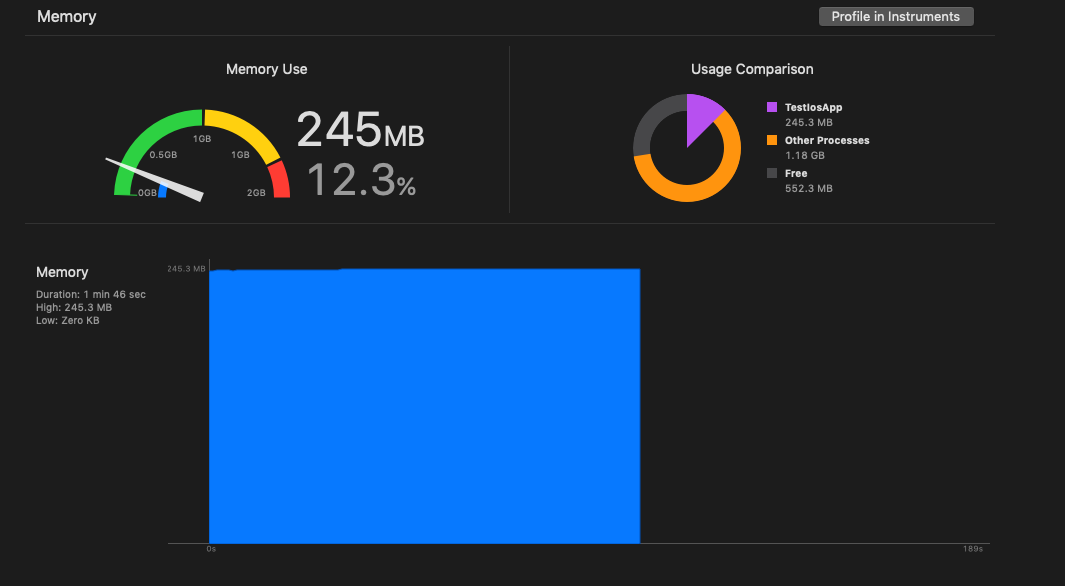
Running this on a clean iOS app produces the following memory graphs (which closely matches the RSS behavior on linux):
before the patch:
with the patch:
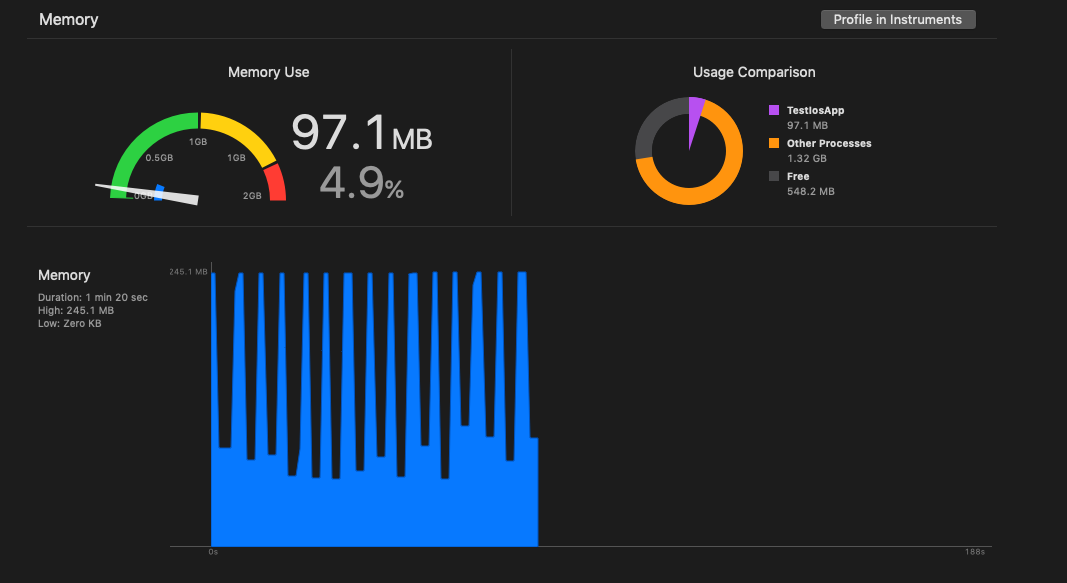
FYI, instead of using ps -o rss= to check resident memory, we now use vmmap ${PID} | grep "Physical footprint:" which correctly reflects RSS usage on macOS.
DanielZlotin
on 27 Jan 2019
I guess we can close this once the patch lands
DanielZlotin
on 27 Jan 2019
Related issues
 bbodenmiller
·
3Comments
bbodenmiller
·
3Comments
 natefinch
·
3Comments
natefinch
·
3Comments
 longzhizhi
·
3Comments
longzhizhi
·
3Comments
 dominikh
·
3Comments
dominikh
·
3Comments
 enoodle
·
3Comments
enoodle
·
3Comments
Most helpful comment
When
madvise(MADV_FREE)is applied to a memory region it tells the OS that it can release the physical memory backing the virtual memory region, but the virtual memory region remains as part of the memory map. All the OS does is manage some bookkeeping, and change the protections on the virtual memory region so that the next access faults. It's then free to do whatever it wants with the physical memory that was backing it.Later, when an application then touches a page in that region, one of two things can happen:
For an example of system that needs
sysUsed, take a look atmem_windows.go. Windows has you manage memory differently: you can reserve a virtual memory region ahead of time, then you can commit it or decommit it, basically indicating that you are using that region (so it should be backed by physical pages) or that you aren't (so the OS can use the pages for something else). If you try to access decommitted memory, then you will segfault as you expect. Note that decommitting isn't the same as unmapping though. If you try tommapinsysUsed(you need to useMAP_FIXEDhere) andmunmapinsysUnused, you're (probably) going to get an error (at least on some systems) that the region is already mapped, whereas recommitting memory that hasn't been decommitted is totally safe and legal.