Go-ipfs: Separate identity values from configuration file
Version information:
go-ipfs version: 0.4.20-
Repo version: 7
System version: amd64/linux
Golang version: go1.12.4
Type:
Enhancement
Description:
The Identity section of the current configuration file should be moved to a separate file.
{
    "Identity": {
        "PeerID": <peer_id>,
        "PrivKey": <priv_key>
    },
    ...
}
The identity section prevents the simple configuration of ipfs nodes in cloud-native environments, i.e Kubernetes. Fundamentally, I want to be able to have an ipfs config.json in Consul/k8s ConfigMap and have all ipfs nodes spun up to use that, injected via an env var and using ipfs daemon --init flag to generate a key pair if one doesn't exist within IPFS_PATH. Currently, I have to run a k8s init container, which starts up before every ipfs container, to run ipfs init and then make the config changes, which are hardcoded in the script because there are no env vars for config values either. See here and here for code of what I just explained.
Related: #744, #783.
This obviously didn't happen or it did and the separation never occurred.
@whyrusleeping how should this move forward? To clearly state my agenda, I am not interested in 'where' the identity information goes per se as long as it is no longer in the configuration file.
Happy to make this change myself, I would just need some assistance in finding where to make this change, I am guessing go-ipfs-config but I am not sure about the discussion in #744 about keys being stored in the blockstore or #783 mentioning them going in the repo.
/cc @Stebalien
 lanzafame
All 17 comments
We absolutely should split identity from config but that part of the config has been stable since forever so this probably isn't the simplest fix (it'll require a config migration, announcement, light audit of downstream projects, etc.).
However, js-ipfs ran into a similar issue and came up with a different solution: https://github.com/ipfs/js-ipfsd-ctl/pull/303#discussion_r233553928
We already allow passing a config on init but, unfortunately, we don't actually try to _merge_ the config (which is why that won't work in both this case and js-ipfs's case. Would something like that work for you?
The one annoying part is that go-ipfs currently accepts ipfs init /path/to/config.json while js-ipfs accepts ipfs init {json config} and I'm pretty sure you want the former (well, you need ipfs daemon --init --config /path/to/config.json). We'll have to discuss that with the js-ipfs team.
cc @hugomrdias
 Stebalien
on 26 Apr 2019
Stebalien
on 26 Apr 2019
well, you need ipfs daemon --init --config /path/to/config.json
Yes, this. Well really, in my head, and this may be incorrect due to some missing pieces, but I don't actually see the necessity of the init command once you separate the identity out of the config.
The logic of what I want the ipfs daemon command to do is as follows:
- check if there is an identity file,
- if no, generate keys
- if yes, use
- check if there is a configuration file,
- if yes, start with the values of those two files
- if no
- check if there is an
IPFS_CONFIG_FILEenv var set
- if yes, use that file
- if no, generate a file with default values
- check if there is an
Regarding, https://github.com/ipfs/js-ipfsd-ctl/pull/303#discussion_r233553928, I would have thought that having env vars for all configuration variables would be the easier option, instead of trying to json patch (merge) the configuration. To use @hugomrdias's example, what I am proposing would result in,
$ env $IPFS_CONFIG_FILE ipfs daemon
for passing in files. If we went whole hog and add env var support for the ipfs config, the
ipfs init '{"Addresses":{"Swarm":["/ip4/0.0.0.0/tcp/4003"]}}'
ipfs daemon
example would become
env ADDRESSES_SWARM=/ip4/0.0.0.0/tcp/4003 ipfs daemon
which looks ugly, in the context of invoking it manually, but in the context of a cloud environment where Consul or etcd or something similar is present, this is very clean.
lanzafame
on 26 Apr 2019
We use envconfig in Cluster to handle having env vars overwrite the json configuration file as a side note.
lanzafame
on 26 Apr 2019
I'll try to explain the needs on the js side.
Tests are super super slow!!
One of the reason for this is how ipfsd-ctl handles start and stop of different types of daemons (go, js, in-process js).
The start fase goes like this:
- we need to know the current/default config, so we run
ipfs config showand we get JSON - after we need to change the config according to the user input
ipfs config replace - after we run
ipfs init - finally
ipfs daemon
This is super slow because we spawn 4 child processes.
My personal end goal is to reduce this to 1 ipfs daemon --init --config '{"key":"value"}'.
The big problem here is if we merge the input with the defaults or not !?
If we don't merge i need to get the defaults and merge myself the only way is to run ipfs config show. I could keep a file inside ipfsd-ctl with the defaults but then this file would need to be kept up to date, js and go probably have conflicts here etc...
So, im fine with ipfs daemon --init --config /path/to/json but will this merge with the defaults? A deep merge with or without array concatenation is fine here really.
 hugomrdias
on 5 Jun 2019
hugomrdias
on 5 Jun 2019
@hugomrdias have a look at JSON Patch? If it gives you the flexibility to make the on-the-fly changes that you need to make, it may be a viable option as a way of updating the config file.
lanzafame
on 8 Jul 2019
Yeah I know what json patch is but we don't normally use it in js.
But right now I just need ipfs daemon --init --config /path/to/json with or without mergeing because I found a sane way to keep a file with the defaults from go.
hugomrdias
on 8 Jul 2019
@hugomrdias
Just to be clear, is something along the lines of this what you're looking for?
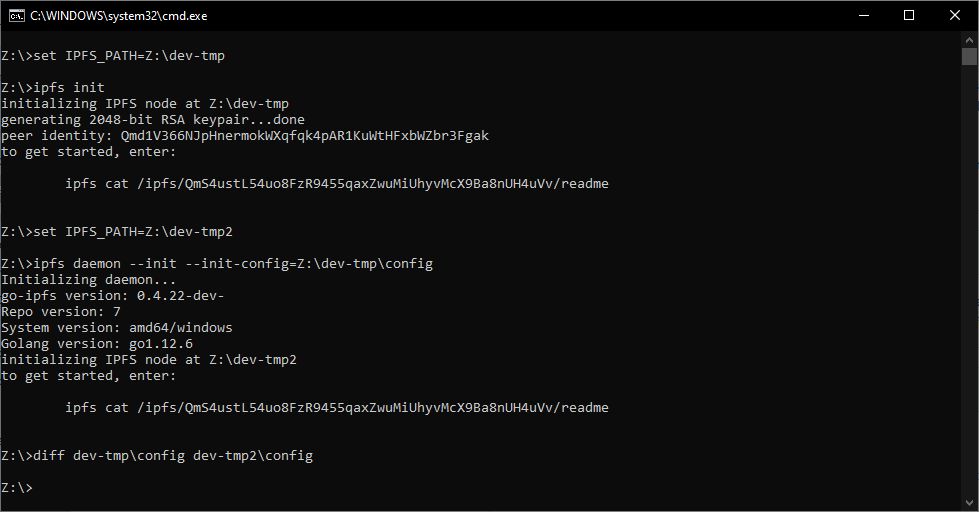
https://github.com/djdv/go-ipfs/tree/feat/init-with-config-file
At current this just covers the daemon command, not init itself.
 djdv
on 8 Jul 2019
djdv
on 8 Jul 2019
Yes
ipfs init is suppose to already have --config right?
Just to be sure the config file overrides everything and doesn't merge with anything, right? So the file passed needs to have all the options needed to start a daemon?
hugomrdias
on 8 Jul 2019
Wait the daemon doesn't stay up? I would like to init and start daemon (and keep it running) in one go
hugomrdias
on 8 Jul 2019
ipfs init is suppose to already have --config right?
it has --profile but no --config, I can add that though.
Edit: Correction, --config is a global parameter, which I believe uses that config for the request.
Just to be sure the config file overrides everything and doesn't merge with anything, right?
Yes, right now we just substitute the default config during init, with the one passed in to us.
Wait the daemon doesn't stay up? I would like to init and start daemon (and keep it running) in one go
This is interesting, it's supposed to remain. I need to see why it's going down right away.
Edit:
I was doing the initialization successfully, but returning early. Fixed in djdv@ce4fff8
djdv
on 8 Jul 2019
ipfs daemon --init --init-config=${PATH} and ipfs init --config-file=${PATH} should be working now.
https://github.com/djdv/go-ipfs/commit/18d03498265990e9250ac494c80f0899010135a6
Names where picked arbitrarily and should probably be changed to something. Suggestions?
--config is reserved as a global command parameter so we can't use that nor -c.
djdv
on 8 Jul 2019
If init has --config-file, daemon should be --init-config-file
hugomrdias
on 8 Jul 2019
If init has --config-file, daemon should be --init-config-file
Current:
ipfs daemon --init --init-config-file=${PATH}
ipfs init --config-file=${PATH}
https://github.com/djdv/go-ipfs/commit/f1f726cd70ea7cf1c62d0c20a2a8613fb889b89e
djdv
on 8 Jul 2019
@djdv Do these changes actually separate the identity from the .ipfs/config file? For the initial use case of this issue, cloud deploys of go-ipfs, the —init-config-file or —config-file flags do not solve that problem, unless you implemented merging?
lanzafame
on 9 Jul 2019
Instead of a complete merge, we can do a single-level merge to get most of the way there. @djdv, could you submit this in a PR so we can discuss it there.
Stebalien
on 9 Jul 2019
@lanzafame
Do these changes actually separate the identity from the .ipfs/config file?
Negative. I like the behaviour you laid out here https://github.com/ipfs/go-ipfs/issues/6262#issuecomment-486952412
But was requested for the config flag ;^)
I'd like to help push towards this separation though, and maybe move away from our explicit identity+config initialization for a more implicit one. (if exists, use, otherwise generate).
@Stebalien
Up: https://github.com/ipfs/go-ipfs/pull/6489
djdv
on 10 Jul 2019
@lanzafame's original issue still remains
Fundamentally, I want to be able to have an ipfs config.json in Consul/k8s ConfigMap and have all ipfs nodes spun up to use that, injected via an env var and using ipfs daemon --init flag to generate a key pair if one doesn't exist within IPFS_PATH. Currently, I have to run a k8s init container, which starts up before every ipfs container, to run ipfs init and then make the config changes
The common goal here is to be able to init and start the daemon with a single command, and be able to pass in some overrides, and let ipfs fill out the rest of the config, especially the Identity, which must be unique per node, so is a chore for the user to manage explicitly if the just want to spin up n nodes.
Pulling the Identity block out seems like a special of case of "Please generate some defaults for me and let me override some others
Would something like
$ ipfs daemon --init --init-config-overrides '{ "Datastore": { "StorageMax: 180GB" }, { " Swarm": "ConnMgr": { "HighWater": 2000 }}}'
get us to a less horrible DX for kubernetes et al if it created a default config with a generated Identity, and then merged in the overrides?
Or are there other reasons to extract the identity that are strong enough to warrent doing the work that @Stebalien highlighted
We absolutely should split identity from config but that part of the config has been stable since forever so this probably isn't the simplest fix (it'll require a config migration, announcement, light audit of downstream projects, etc.)
We aleady got towards an agreement on this...
Instead of a complete merge, we can do a single-level merge to get most of the way there. @djdv, could you submit this in a PR so we can discuss it there.
@lanzafame would a single level merge get us close enough to be useful? There is still the JSON merge vs env vars discussion to bottom out.
 olizilla
on 15 Oct 2019
olizilla
on 15 Oct 2019
Related issues
 emelleme
·
3Comments
emelleme
·
3Comments
 whyrusleeping
·
4Comments
whyrusleeping
·
4Comments
 ArcticLampyrid
·
3Comments
ArcticLampyrid
·
3Comments
 magik6k
·
3Comments
magik6k
·
3Comments
 slrslr
·
3Comments
slrslr
·
3Comments
Most helpful comment
Yes, this. Well really, in my head, and this may be incorrect due to some missing pieces, but I don't actually see the necessity of the
initcommand once you separate the identity out of the config.The logic of what I want the
ipfs daemoncommand to do is as follows:IPFS_CONFIG_FILEenv var setRegarding, https://github.com/ipfs/js-ipfsd-ctl/pull/303#discussion_r233553928, I would have thought that having env vars for all configuration variables would be the easier option, instead of trying to json patch (merge) the configuration. To use @hugomrdias's example, what I am proposing would result in,
for passing in files. If we went whole hog and add env var support for the ipfs config, the
example would become
which looks ugly, in the context of invoking it manually, but in the context of a cloud environment where Consul or etcd or something similar is present, this is very clean.