Fsharpplus: Are nat-dependent types possible?
I am writing a matrix type and a matrix multiplication function. What I would like is to have types Matrix<n,m> indexed by positive integers n, m so that the multiplication has signature
Matrix<n,m> -> Matrix<m,p> -> Matrix<n,p>
(so trying to multiply matrices of incompatible dimensions is a type error).
I have seen an implementation of this in F# (https://www.youtube.com/watch?v=3zdlQ_HjKl4 ) but the approach is quite hacky... Is it possible to do this neatly with F#+?
 nasosev
All 27 comments
I had a quick look at that implementation.
It seems to me that it uses type providers, which should be a clean way to go.
Have you tried it? If so, which part is the hacky part? (at user level)
 gusty
on 10 Aug 2019
gusty
on 10 Aug 2019
I have not tried using it, but looking at the source, the type definitions seem quite strange, eg.
type Matrix<'t, 'd10,'d9, 'd8, 'd7, 'd6, 'd5, 'd4, 'd3, 'd2, 'd1, 'e10,'e9, 'e8, 'e7, 'e6, 'e5, 'e4, 'e3, 'e2, 'e1
    when 'd10 :> Base10Digit and 'd9 :> Base10Digit and 'd8 :> Base10Digit and 'd7 :> Base10Digit and 'd6 :> Base10Digit
    and 'd5 :> Base10Digit and 'd4 :> Base10Digit and 'd3 :> Base10Digit and 'd2 :> Base10Digit
    and 'd1 :> Base10Digit and 'e10 :> Base10Digit and 'e9 :> Base10Digit and 'e8 :> Base10Digit and 'e7 :> Base10Digit and 'e6 :> Base10Digit
    and 'e5 :> Base10Digit and 'e4 :> Base10Digit and 'e3 :> Base10Digit and 'e2 :> Base10Digit
    and 'e1 :> Base10Digit and 't : struct and 't: (new: unit -> 't) and 't:> ValueType and 't :> IEquatable<'t> and 't :> IFormattable>(dim0: N10<'d10, 'd9, 'd8, 'd7, 'd6, 'd5, 'd4, 'd3, 'd2, 'd1>, dim1:N10<'e10, 'e9, 'e8, 'e7, 'e6, 'e5, 'e4, 'e3, 'e2, 'e1>, items:'t[,]) =
    ...
(https://github.com/allisterb/Sylvester/blob/master/src/Base/Sylvester.Tensors/Matrix.fs)
It would be nice to define the Matrix type as simply Matrix<'t,n,m>, i.e. without the base-10 expansion of the numbers.
nasosev
on 10 Aug 2019
Oh, I see.
So it's not that clean, in that it has a limit of 100000000 dimensions.
We could use Peano numbers, but I didn't find a way to encode them with type providers, although I'm not a skilled type provider developer.
Units of measure could be another way to explore.
gusty
on 10 Aug 2019
The "Live Checking Tooling" of the TensorFlow API for F# (https://github.com/fsprojects/fsharp-ai-tools) may be another approach but they also describe it as a hack which uses an external tool: "Build the VS tooling with the extensibility "hack" to allow 3rd party tools to add checking and tooltips".
nasosev
on 10 Aug 2019
Well, if it requires 3rd party extensions we can rule it out, as this is a base library.
I think in the video he mentions that Peano numbers would kill the compiler. That's certainly true if you use big numbers, for for tiny ones maybe it's not a concern.
So it seems to me that he did that hack in order to make it usable for big numbers, it's a compromise, because that hack seems to leak to the end user.
gusty
on 10 Aug 2019
I had once written type-level peano naturals with TP support and a fixed-size vector type with them https://github.com/cannorin/FSharp.Dependent
 cannorin
on 10 Aug 2019
cannorin
on 10 Aug 2019
@cannorin That looks interesting.
@nasosev How are you planning to use this? Are you going to use big dimensions?
gusty
on 10 Aug 2019
@gusty it is for an experimental topology library, dimensions not more than 100. But I think even this limited dependent typing could be very widely applicable.
nasosev
on 10 Aug 2019
I agree, I have no doubt that it's very useful.
In my mind I can't think of a Vector or matrix type without this.
I'm just worried about the compiler performance. But we should definitely give it a try.
It looks like @cannorin implementation is a good place to start with.
gusty
on 10 Aug 2019
I think I can help with this (once #174 is done)
cannorin
on 11 Aug 2019
I think in the video he mentions that Peano numbers would kill the compiler. That's certainly true if you use big numbers, for for tiny ones maybe it's not a concern.
Why not use a more efficient representation of natural numbers?
Representing strictly natural numbers as binary trees is far more efficient: N = I (N) | O (N) | H.
H is 1, and you can add least significant digits, I being 1 and O being 0.
Numbers are encoded in reverse binary.
For example:
- 2 would be: OH (2 is 10 in binary)
- 5 would be HON (5 is 101 etc...).
Arithmetic operations can be implemented more efficiently.
I think this has serious benefits in terms of speed, memory and efficiency compared to the Peano numbers.
 jbotto94
on 15 Aug 2019
jbotto94
on 15 Aug 2019
Well, such kind of representations might seem more efficient, but they tend to introduce far more complicated constraints needed to be solved by the compiler than peano numbers. This is why nearly all of the existing type level programming libraries (such as GHC.TypeLits) are using peano numbers.
cannorin
on 15 Aug 2019
@nasosev @gusty do you think we need to support unknown (only known at runtime) type-level naturals e.g. SomeNat :: KnownNat n => Proxy n -> SomeNat in GHC.TypeLits? The implementation strategy would be very different depending on this.
cannorin
on 23 Aug 2019
I was thinking only in known at compile-time, but can you exemplify in which scenario they would be useful?
gusty
on 23 Aug 2019
I'm thinking of the case when we want to use user's input value as the dimension of matrix.
cannorin
on 23 Aug 2019
I see.
I would rule it out for now as it might be too much :)
I have the impressions that I would complicate more than what it would help.
But that's just my opinion.
gusty
on 23 Aug 2019
Okay, I'll stick to compile-time ones for now.
cannorin
on 23 Aug 2019
@cannorin @gusty For my use case, in principle all data can be known at compile-time, but I’m unsure if a compile-time solution can be effective. E.g. the kernel function for matrices has type Ker : Matrix<m,n> -> Matrix<m, a>, where a is the nullity of the matrix--a number that must be computed at runtime.
I agree that a compile-time solution is still interesting.
nasosev
on 23 Aug 2019
@nasosev Matrix<m, n> -> Vector<m> list is not enough?
cannorin
on 23 Aug 2019
@cannorin you are right, in many cases Matrix<m, n> -> Vector<m> list would be enough.
nasosev
on 23 Aug 2019
Implementation started at https://github.com/cannorin/FSharpPlus/tree/nat-dependent-types/ .
cannorin
on 2 Sep 2019
@nasosev I would really appreciate it if you could give me some advice on #201 :pray:
cannorin
on 25 Sep 2019
Progress report:
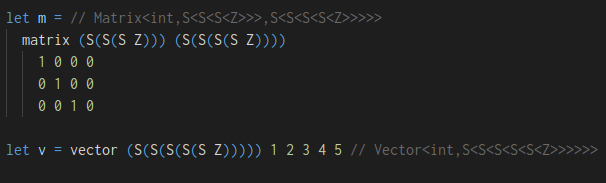
cannorin
on 14 Oct 2019
Looks sweet 😃
 wallymathieu
on 14 Oct 2019
wallymathieu
on 14 Oct 2019
So, I was able to create another version which takes tuple as argument and infers the dimension.
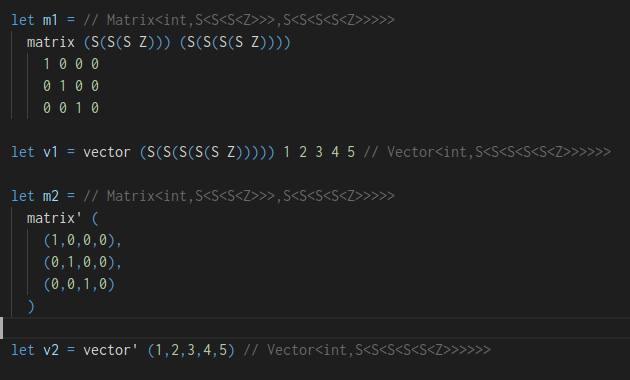
Which do you think looks better?
cannorin
on 14 Oct 2019
That's great. To me the tuple version looks much better and flexible.
gusty
on 14 Oct 2019
Also, note that you might be able to switch curried and tupled with uncurryM and curryM ;)
gusty
on 14 Oct 2019
Related issues
 DunetsNM
·
9Comments
DunetsNM
·
9Comments
 btrepp
·
3Comments
cannorin
·
5Comments
btrepp
·
3Comments
cannorin
·
5Comments
 ShalokShalom
·
4Comments
ShalokShalom
·
4Comments
 NickDarvey
·
3Comments
NickDarvey
·
3Comments
Most helpful comment
That's great. To me the tuple version looks much better and flexible.