Fsharp: Use of nameof changes name resolution rules
It seems using nameof makes symbol resolved using type name resolution rules first.
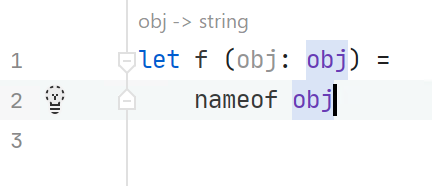
let f (obj: obj) =
    nameof obj
In this example obj inside the function is resolved to type, which is unexpected, making local obj value unused:
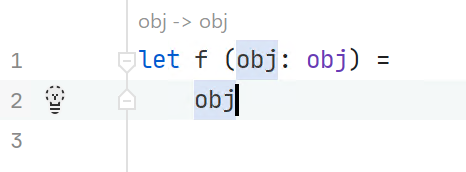
Without nameof it works as expected:
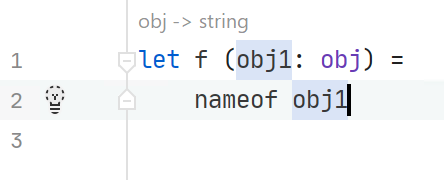
When there's no matching type to resolve to is found, it also works as expected:
 auduchinok
All 7 comments
@dsyme @TIHan we'll want to look at this one in the next sprint I think, especially if we can focus on finishing up some design concerns around nameof
 cartermp
on 5 Mar 2020
cartermp
on 5 Mar 2020
But is it really an issue in practice? nameOf works on types as well as identifiers. And obj as variable is still accessible, and the returned string should be "obj" in either case; alternatively one might consider the ambiguity an error, after all, there's no way to know whether the user intended one over the other.
 abelbraaksma
on 5 Mar 2020
abelbraaksma
on 5 Mar 2020
But is it really an issue in practice?
It can be. This is a close to minimal repro which doesn't look too bad on its own indeed. But it clearly shows a different behavior which, together with a more subtle names clash, can make features like Rename refactoring work very wrong.
auduchinok
on 5 Mar 2020
can make features like Rename refactoring work very wrong.
Didn't think of that, good point.
abelbraaksma
on 5 Mar 2020
Thanks for this bug report
 dsyme
on 23 Jul 2020
dsyme
on 23 Jul 2020
Thanks again for this report, I made the appropriate fix and update to the RFC, see https://github.com/fsharp/fslang-design/pull/488
dsyme
on 27 Jul 2020
I'll close this report as it is now part of the RFC update at https://github.com/dotnet/fsharp/pull/8754
dsyme
on 27 Jul 2020
Related issues
 dhwed
·
3Comments
dhwed
·
3Comments
 smoothdeveloper
·
3Comments
smoothdeveloper
·
3Comments
 viktorvan
·
3Comments
viktorvan
·
3Comments
 AaronEshbach
·
3Comments
AaronEshbach
·
3Comments
 drguildo
·
3Comments
drguildo
·
3Comments
Most helpful comment
It can be. This is a close to minimal repro which doesn't look too bad on its own indeed. But it clearly shows a different behavior which, together with a more subtle names clash, can make features like Rename refactoring work very wrong.