Fsharp: Cannot use new F# 4.7 features under .NET Core 3.0 FSI
It seems like the newly introduced F# 4.7 features do not work under FSI (or .fsx files) with the latest .Net Core SDK 3.0.100
Repro steps
- Install latest .Net Core SDK 3.0.100 from here
- Run
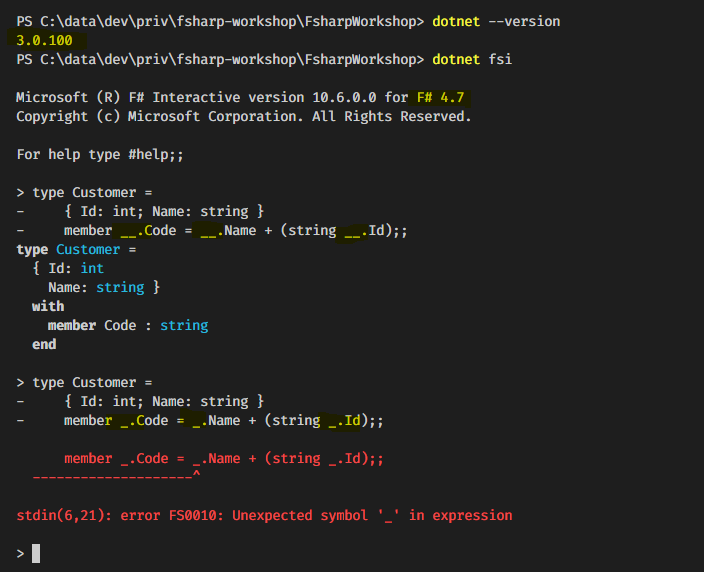
dotnet fsifrom the CLI - Check that FSI uses newest F# 4.7
- Try to run the following F# snippet (supposedly supported by F# 4.7 as per the blog post here)
open System
type Customer =
    { Id: int; Name: string }
    member _.Code = _.Name + (string _.Id)
The same issue was observed when using the built-in FSI support in ionide-fsharp 4.1.0 and VS2019 16.3.1
Expected behavior
The code snippet above should be successfully interpreted.
Actual behavior
Getting error FS0010: Unexpected symbol '_' in expression, as shown on the screenshot below:
Known workarounds
None to date.
Related information
- Windows 10
- .Net Core SDK 3.0.100
- ionide-fsharp 4.1.0
- Visual Studio Professional 2019 16.3.1
 Youenn-Bouglouan
All 8 comments
I'm not 100% sure, but I thought the change in language semantics was that the single underscore was allowed as placeholder for the member declaration for cases where you don't need to access the class instance; but not as a self reference itself (like with _.Name). Just like you cannot access it when it is used in a function declaration as argument placeholder.
In other words, I think this error is expected. If you want to access the self identifier, use double underscore, or any other allowed identifier.
 abelbraaksma
on 29 Sep 2019
abelbraaksma
on 29 Sep 2019
Hi @abelbraaksma , it was not allowed prior to F# 4.7, but if I understood the blog post here correctly, it is possible now. It is illustrated by the snippet below:
// Broke: F# 4.6 and lower
type C() =
    member __.M() = ()

// Woke and Bespoke: F# 4.7 and higher
type C'() =
    member _.M() = ()
Please note that I also tried various variations, like using single underscore on the left-hand of the equality and double underscore or 'this' on the right hand (and vice-versa), but none was working.
Youenn-Bouglouan
on 29 Sep 2019
It is correct that the purpose of allowing a single underscore as the self identifier was for cases where you are not going to use the self identifier. The same error message is also given for the following function definition.
let add1 _ = _ + 1;;
In the case above, as you are adding a method to a record and you are accessing the fields of the record, you need to have a self identifier which has a name, and the single underscore wildcard identifier is not named. The use of a double underscore works in your example because the double underscore is not the wildcard identifier, and, thus, has the name of __.
 TheJayMann
on 30 Sep 2019
TheJayMann
on 30 Sep 2019
The point of having the convention with double underscore was exactly to indicate that a self reference was not needed and not used. Using the double underscore for referencing self in the manner shown, is a breach of that convention. The compiler didn't catch that kind of misuse. After all, it was only a convention, so there was always the danger of someone misusing double underscore, potentially introducing hard to find issues. This has been dealt with in this latest version. The given snippet is indeed proof that the new syntax works. You are not allowed to use underscore for self reference, but must choose a name, thereby making it clear that you are using self reference. You don't have to read through the implementation to know whether self is (potentially) referenced or not.
 BentTranberg
on 30 Sep 2019
BentTranberg
on 30 Sep 2019
Thank you @TheJayMann and @BentTranberg for your clarifications, I undertand where the problem comes from now. Indeed, the following snippet works just fine:
type Customer =
    { Id: int; Name: string }
    member _.Code = "CODE"
VS Code + Ionide still shows an error in the editor, but this is probably because the rules haven't been updated just yet. I haven't tried it in VS.
I believe I can close the issue.
Youenn-Bouglouan
on 30 Sep 2019
To close the loop, yes @Youenn-Bouglouan FCS/FSAC/Ionide need to be updated with these changes. That'll be happening this week.
 baronfel
on 30 Sep 2019
baronfel
on 30 Sep 2019
This can be seen as by design or as a bug, depending on your view of the following two function definitions:
let f __ = __ // Compiles: 'val f : __:'a -> 'a'
let f' _ = _ // Error: Unexpected symbol in '_' in binding
The behavior reported in this issue is consistent with the function definitions above. However, if the second function definition is seen as something that should work, then this would be a bug.
 cartermp
on 1 Oct 2019
cartermp
on 1 Oct 2019
@cartermp this is exactly what confused me when reading the original post.
Youenn-Bouglouan
on 1 Oct 2019
Related issues
 randrag
·
3Comments
randrag
·
3Comments
 viktorvan
·
3Comments
viktorvan
·
3Comments
 smoothdeveloper
·
3Comments
smoothdeveloper
·
3Comments
 GennadyGS
·
3Comments
GennadyGS
·
3Comments
 vasily-kirichenko
·
3Comments
vasily-kirichenko
·
3Comments