Fsharp: Lookup on object of Action<T> is broken
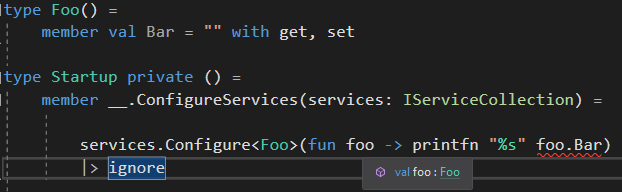
Somehow compiler cannot get member of successfully inferred type:
Repro steps
Provide the steps required to reproduce the problem
- Create project file:
<Project Sdk="Microsoft.NET.Sdk.Web">
  <PropertyGroup>
    <TargetFramework>netcoreapp2.1</TargetFramework>
  </PropertyGroup>
  <ItemGroup>
    <Compile Include="Program.fs" />
    <PackageReference Include="Microsoft.AspNetCore.App" />
  </ItemGroup>
</Project>
- Create
Program.fs
module WebApplication2

open Microsoft.AspNetCore
open Microsoft.AspNetCore.Hosting
open Microsoft.Extensions.DependencyInjection

type Foo() =
    member val Bar = "" with get, set

type Startup private () =
    member __.ConfigureServices(services: IServiceCollection) =

        services.Configure<Foo>(fun foo -> printfn "%s" foo.Bar)
        |> ignore

[<EntryPoint>]
let main args =
    WebHost
        .CreateDefaultBuilder(args)
        .UseStartup<Startup>()
        .Build()
        .Run()
    0
dotnet build
These two files in attach:
WebApplication2.zip
Expected behavior
It should compile
Actual behavior
Compiler actually inferred foo type in lambda correctly, but fails to access type properties
Known workarounds
- Add type annotation
- Explicitly wrap lambda in Action
ctor
Related information
Provide any related information
- Win 10
- .NET Core 2.1.500
- Visual Studio 15.9.3
 Szer
Szer
All 6 comments
Inference with class members never works (though arguably it could work perhaps on sealed classes, but to the best of my knowledge that has not been implemented). If you change your poco to a record or DU, type inference will work correctly.
 abelbraaksma
on 30 Nov 2018
abelbraaksma
on 30 Nov 2018
@abelbraaksma If I just create C# library with this method

and call it like this (with same class definition)

It works OK. So there is something else beside being Foo a class
Szer
on 30 Nov 2018
I spoke too soon, you're right. Though I'm unsure whether both examples are fully interchangeable, and it's a common nuisance I have that with class members type inference often fails. But with the syntax you use, it ought to work correctly, I agree.
abelbraaksma
on 1 Dec 2018
Definitely feels like a bug in the compiler if it works for a generic action you define yourself.
 cartermp
on 1 Dec 2018
cartermp
on 1 Dec 2018
A workaround is this:
    member this.ConfigureServices(services: IServiceCollection) =
        services.Configure<Foo>(configureOptions = fun foo -> printfn "%s" foo.Bar)
        |> ignore
Annotating the parameter with configureOptions seems to resolve it.
I believe this might have something to do with overloading, because I can reproduce it when I add an overload method:
type Foo() =
    member val Bar = "" with get, set

type TestClass() =

    member __.Test<'T when 'T : not struct>(f: System.Action<'T>) = ()
    member __.Test<'T when 'T : not struct>(name: string) = ()

    member this.Do() =
        this.Test<Foo>(fun foo -> printfn "%s" foo.Bar) // same error
        this.Test<Foo>(f = fun foo -> printfn "%s" foo.Bar) // works
Removing the overload, everything works.
type Foo() =
    member val Bar = "" with get, set

type TestClass() =

    member __.Test<'T when 'T : not struct>(f: System.Action<'T>) = ()

    member this.Do() =
        this.Test<Foo>(fun foo -> printfn "%s" foo.Bar) // works
        this.Test<Foo>(f = fun foo -> printfn "%s" foo.Bar) // works
Feels like a bug to me. If it's by design then we should probably improve the behavior.
 TIHan
on 2 Dec 2018
TIHan
on 2 Dec 2018
It's by design. For overloaded methods, the type is propagated into lambdas if all method overloads accept a lambda. However in this case the overloads take string and Action, and the type is not pre-inferred. Just add the type annotation.
 dsyme
on 5 Dec 2018
dsyme
on 5 Dec 2018
Related issues
 drguildo
·
3Comments
abelbraaksma
·
3Comments
drguildo
·
3Comments
abelbraaksma
·
3Comments
 randrag
·
3Comments
randrag
·
3Comments
 TysonMN
·
3Comments
TysonMN
·
3Comments
 mrakgr
·
3Comments
mrakgr
·
3Comments