Framework: [Laravel 8.x] Arr::set() vs. data_set() different results on same array
- Laravel Version: 8.3.0
- PHP Version: 7.4.1
- Database Driver & Version: MySQL 5.7.31
Description:
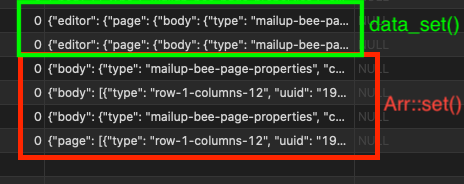
Arr::set() and data_set() seem to be returning different array structures setting the same nested property. Arr::set() is returning an array at the level of the property you are setting where as data_set() is returning the entire array with the nested property set as expected.
Steps To Reproduce:
Given the following array
[
    'editor' => [
        'page' => [
            'body' => [],
            'rows' => [],
            'title' => 'Fragment Base',
            'template' => [],
            'description' => '',
        ],
    ],
];
When I try to set any nested value inside editor, it returns me an array at that level
Example: I try to set rows using Arr::set($array, 'editor.page.rows', ['my test array']) and it returns me an array of
[
    'body' => [],
    'rows' => ['my test array'],
    'title' => 'Fragment Base',
    'template' => [],
    'description' => '',
]
However, using data_set($array, 'editor.page.rows', ['my test array']), the returned array is expected.
[
    'editor' => [
        'page' => [
            'body' => [],
            'rows' => ['my test array'],
            'title' => 'Fragment Base',
            'template' => [],
            'description' => '',
        ],
    ],
];
 therobfonz
All 7 comments
Hey there,
Unfortunately we don't support this version anymore. Please check out our support policy on which versions we are currently supporting. Can you please try to upgrade to the latest version and see if your problem persists? We'll help you out and re-open this issue if so.
Thanks!
 driesvints
on 30 Oct 2020
driesvints
on 30 Oct 2020
Thanks for the quick response! I just tested on Laravel 8.3 and the problem persists. Updating the above issue with the correct version number.
therobfonz
on 30 Oct 2020
@therobfonz these are two different functions which don't mimic each other's behavior.
driesvints
on 30 Oct 2020
Correct, however, the documentation for each method has the example like I have outlined above and shows the same results
https://laravel.com/docs/8.x/helpers#method-data-set
https://laravel.com/docs/8.x/helpers#method-array-set
When I use the documentation example in Laravel 8.3 for Arr::set() as noted
$array = ['products' => ['desk' => ['price' => 100]]];

Arr::set($array, 'products.desk.price', 200);

// ['products' => ['desk' => ['price' => 200]]]
it only returns
['price' => 200']
not the array noted as the documented example output. This could just be a documentation issue, but if the documentation is supposed to be the correct output, it would be a bug.
therobfonz
on 30 Oct 2020
@therobfonz
I tested in a fresh Laravel 8 app and I can somehow replicate the unexpected behavior:
~~~php
// ./routes/console.php
use Illuminate\Support\Facades\Artisan;
use Illuminate\Support\Arr;
Artisan::command('app:test', function () {
$array = [
'editor' => [
'page' => [
'body' => [],
'rows' => [],
'title' => 'Fragment Base',
'template' => [],
'description' => '',
],
],
];
$return = Arr::set($array, 'editor.page.rows', ['my test array']);

\dd($array, $return);
});
~~~
Which outputs different results for the $array and $return variables:
~bash
$ php artisan app:test
array:1 [
"editor" => array:1 [
"page" => array:5 [
"body" => []
"rows" => array:1 [
0 => "my test array"
]
"title" => "Fragment Base"
"template" => []
"description" => ""
]
]
]
array:5 [
"body" => []
"rows" => array:1 [
0 => "my test array"
]
"title" => "Fragment Base"
"template" => []
"description" => ""
]
~
I also would expect both values to be the same. I tried tweaking the code to try getting the same value but with no luck.
I must confess that I never relied on the return value and always used it like this:
~~~php
$array = [/some data/];
Arr::set($data, 'my.key', 'value');
return $data;
~~~
As I expected it to change the parameter by reference. So maybe not relying on its return value is the way to go.
 rodrigopedra
on 30 Oct 2020
rodrigopedra
on 30 Oct 2020
So, this is an interesting curiosity; however, I'm not sure we will really take any action on it. Making any change to it would be a breaking change for seemingly little benefit. Like the comment above, I've never relied on the returned value and the method doc blocks don't even describe what the return value is "supposed" to be. I actually wasn't even aware these methods had a return value until this issue was raised. 😆
So, for now, I think we will probably take no action. The safest course IMO is to use Arr::set and then use Arr::get afterwards to get exactly what you want from the array.
 taylorotwell
on 30 Oct 2020
taylorotwell
on 30 Oct 2020
Thanks for the explanation Taylor. I'll proceed as you have outlined above.
therobfonz
on 30 Oct 2020
Related issues
 Anahkiasen
·
3Comments
Anahkiasen
·
3Comments
 gabriellimo
·
3Comments
gabriellimo
·
3Comments
 Fuzzyma
·
3Comments
Fuzzyma
·
3Comments
 lzp819739483
·
3Comments
lzp819739483
·
3Comments
 progmars
·
3Comments
progmars
·
3Comments
Most helpful comment
So, this is an interesting curiosity; however, I'm not sure we will really take any action on it. Making any change to it would be a breaking change for seemingly little benefit. Like the comment above, I've never relied on the returned value and the method doc blocks don't even describe what the return value is "supposed" to be. I actually wasn't even aware these methods had a return value until this issue was raised. 😆
So, for now, I think we will probably take no action. The safest course IMO is to use Arr::set and then use Arr::get afterwards to get exactly what you want from the array.