Framework: Pagination data missing from api resource.
- Laravel Version: 7.8.1
- PHP Version: 7.4.2
- Database Driver & Version: MySql & 5.7
Description:
When sending an eloquent query to an api resource with pagination the pagination data is missing from the result.
Laravel 6.x
{
  "current_page": 1,
  "data": [
    {
      "id": 10000196,
      "name": "John Doe",
    }
  ],
  "first_page_url": "http://www.mysite.com/users?page=1",
  "from": 1,
  "next_page_url": "http://www.mysite.com/users?page=2",
  "path": "http://www.mysite.com/users",
  "per_page": 1,
  "prev_page_url": null,
  "to": 1
}
Laravel 7.x
[
  {
    "id": 10000196,
    "name": "John Doe",
  }
]
Steps To Reproduce:
Using a fresh laravel app with the default user table and at least one user in the database.
$resource = \App\Http\Resources\User::collection(\App\User::query()->paginate(1));

dd($resource->toJson());
 ChristopherCarranza
All 7 comments
Hey there,
Can you first please try one of the support channels below? If you can actually identify this as a bug, feel free to report back and I'll gladly help you out and re-open this issue.
Thanks!
 driesvints
on 27 Apr 2020
driesvints
on 27 Apr 2020
Experiencing a similar issue when using JsonResource::collection.
Here's a reproduction for Laravel 6 and 7:
Project Setup
$ git clone [email protected]:laravel/laravel
$ git checkout (6.x|7.x)
$ cd laravel
$ nano .env
$ composer install
$ php artisan key:generate
$ php artisan migrate
$ php artisan tinker

>>> User::create(['name' => 'Test', 'email' => '[email protected]', 'password' => Hash::make('secret') ]);
[!] Aliasing 'User' to 'App\User' for this Tinker session.
=> App\User {#3016
     name: "Test",
     email: "[email protected]",
     updated_at: "2020-04-28 02:40:07",
     created_at: "2020-04-28 02:40:07",
     id: 1,
   }
Laravel 6
>>> \Illuminate\Http\Resources\Json\JsonResource::collection(User::paginate(10))->toJson()
=> "{"current_page":1,"data":[{"id":1,"name":"Test","email":"[email protected]","email_verified_at":null,"created_at":"2020-04-28 02:51:20","updated_at":"2020-04-28 02:51:20"}],"first_page_url":"http:\/\/localhost?page=1","from":1,"last_page":1,"last_page_url":"http:\/\/localhost?page=1","next_page_url":null,"path":"http:\/\/localhost","per_page":10,"prev_page_url":null,"to":1,"total":1}"

>>> \Illuminate\Http\Resources\Json\JsonResource::collection(User::paginate(10))->response()->getContent()
=> "{"data":[{"id":1,"name":"Test","email":"[email protected]","email_verified_at":null,"created_at":"2020-04-28 02:51:20","updated_at":"2020-04-28 02:51:20"}],"links":{"first":"http:\/\/localhost?page=1","last":"http:\/\/localhost?page=1","prev":null,"next":null},"meta":{"current_page":1,"from":1,"last_page":1,"path":"http:\/\/localhost","per_page":10,"to":1,"total":1}}"
Laravel 7
>>> \Illuminate\Http\Resources\Json\JsonResource::collection(User::paginate(10))->toJson()
=> "[{"id":1,"name":"Test","email":"[email protected]","email_verified_at":null,"created_at":"2020-04-28T02:40:07.000000Z","updated_at":"2020-04-28T02:40:07.000000Z"}]"

>>> \Illuminate\Http\Resources\Json\JsonResource::collection(User::paginate(10))->response()->getContent()
=> "{"data":[{"id":1,"name":"Test","email":"[email protected]","email_verified_at":null,"created_at":"2020-04-28T02:40:07.000000Z","updated_at":"2020-04-28T02:40:07.000000Z"}],"links":{"first":"http:\/\/localhost?page=1","last":"http:\/\/localhost?page=1","prev":null,"next":null},"meta":{"current_page":1,"from":1,"last_page":1,"path":"http:\/\/localhost","per_page":10,"to":1,"total":1}}"
 cwilby
on 28 Apr 2020
cwilby
on 28 Apr 2020
As a note, it may be that ResourceCollection is the preferred approach according to the documentation.
https://laravel.com/docs/7.x/eloquent-resources#pagination
It does still leave questions around the usage of JsonResource::collection.
cwilby
on 28 Apr 2020
Re-opening this. Currently a bit strapped on time so appreciating anyone helping out here.
driesvints
on 28 Apr 2020
Hey there, we document that you need to use an actual collection to do this:
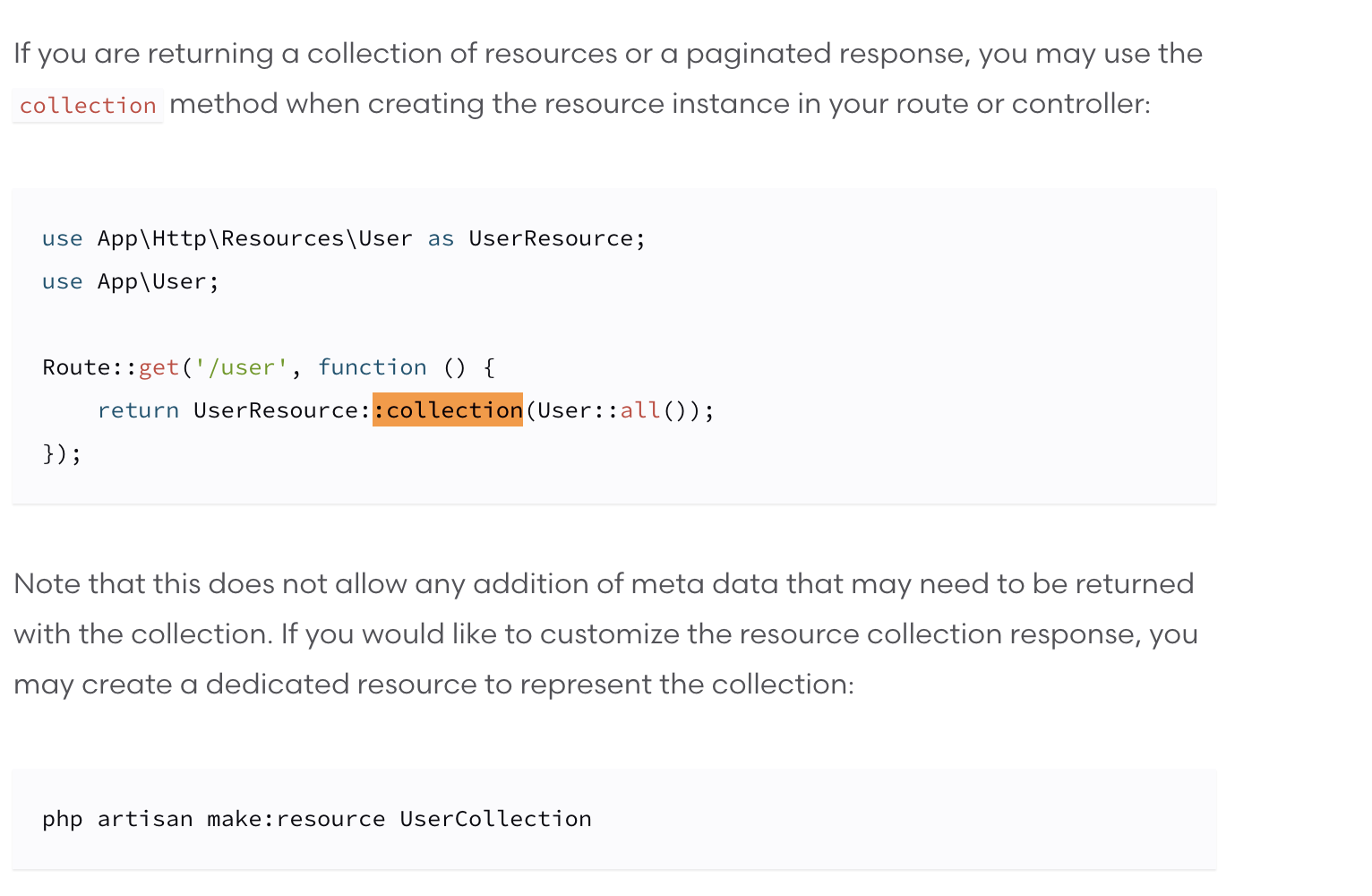
Note the section about no extra metadata being added.
Pagination documentation:
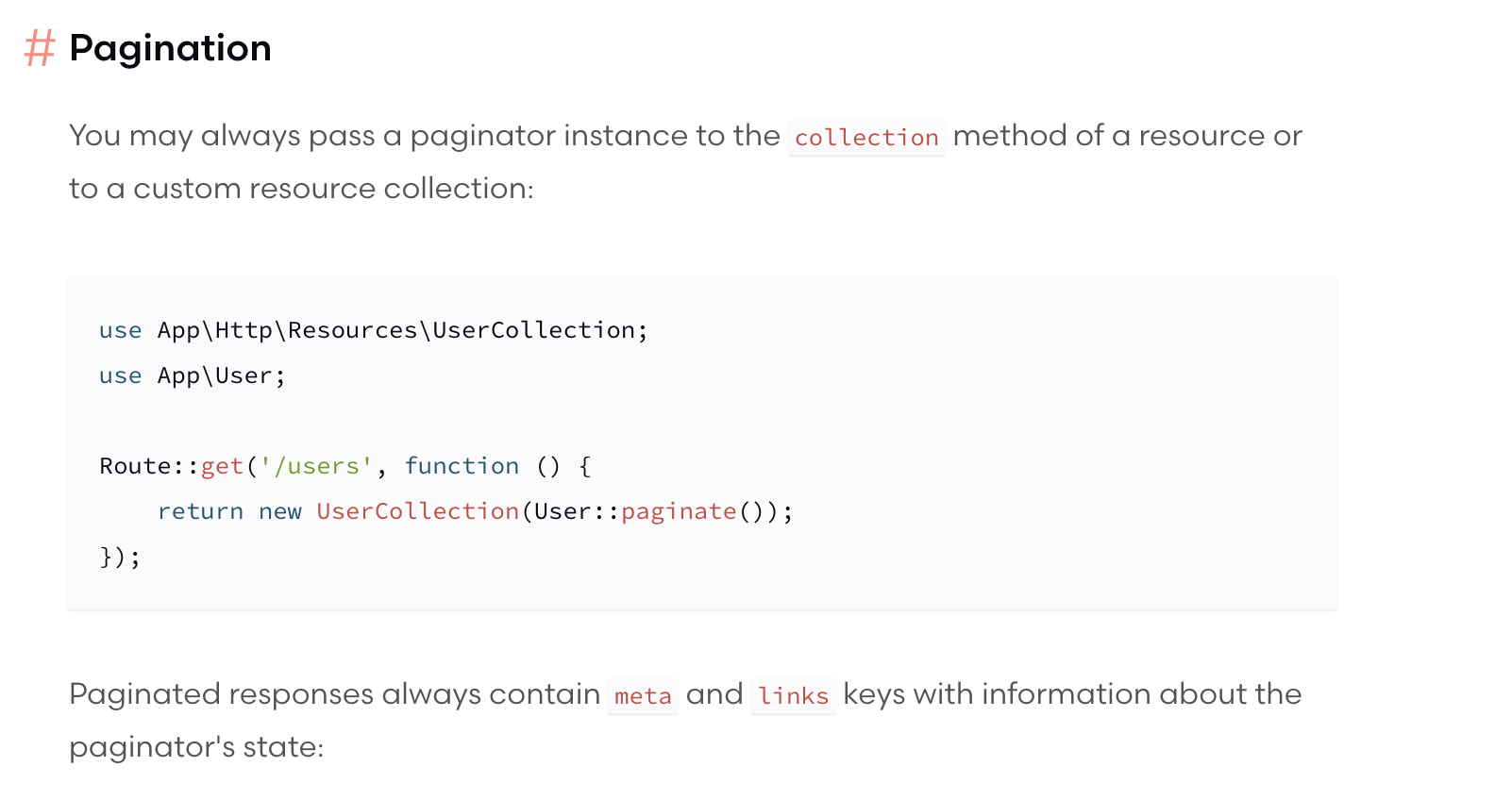
 taylorotwell
on 28 Apr 2020
taylorotwell
on 28 Apr 2020
Although even this works for me on latest Laravel 7:
return UserResource::collection(User::paginate(10));
Thanks, returning paginated resources from routes does work 👍
Route::get('/users', function() {
    return \Illuminate\Http\Resources\Json\JsonResource::collection(
        \App\User::paginate(10)
    );
});
Calling toJson directly still returns only the paginated rows without meta. Personally, I don't use this feature but some might outside the context of controllers.
return UserResource::collection(User::paginate(10))->toJson();
Takeaway for me is - in those scenarios, just use resource collections.
cwilby
on 28 Apr 2020
Related issues
 JamborJan
·
3Comments
JamborJan
·
3Comments
 YannPl
·
3Comments
YannPl
·
3Comments
 SachinAgarwal1337
·
3Comments
SachinAgarwal1337
·
3Comments
 felixsanz
·
3Comments
felixsanz
·
3Comments
 fideloper
·
3Comments
fideloper
·
3Comments
Most helpful comment
Hey there, we document that you need to use an actual collection to do this:
Note the section about no extra metadata being added.
Pagination documentation: