Framework: Calling `$model->save()` does not work if the `$model` object does not have the `id` attribute
- Laravel Version: 5.5
Description:
If you retrieve a Model object (in my example User) using ::where() instead of ::find() without specifying that you want to retrieve the id field, any subsequent $user->save() call will fail silently without showing any error.
For newcomers (and perhaps even more advanced users) this is a huge time wasting problem since it relies on the implicit knowledge that id should be retrieve beforehand.
Steps To Reproduce:
Using that code:
// Get the user
$user = User::where([
    ['username', '=', $dataJSON['username']],
])->first(['api_token']);

// Write the new API Token
$apiToken = str_random(60);
$user->api_token = $apiToken;
$user->save(); // This fails silently, no errors shown
To fix that, you just need to change:
$user = User::where([
    ['username', '=', $dataJSON['username']],
])->first(['api_token']);

// to:
$user = User::where([
    ['username', '=', $dataJSON['username']],
])->first(['api_token', 'id']); // Added `'id'` here
The ->save() method should either:
- complain that it has no way of finding that specific user to update, or
- fail since it tries to find a record with a primary key of
null, or - the
$userobject should keep a link to the data somehow so that retrieving'id'is not necessary.
Lastly, the documentation about updates could show an example where ::where() is used to retrieve, modify then save the model.
Or at least it could say that id is needed in order for save() to work correctly.
 AlexandreBonneau
All 11 comments
This is not an error with the framework. You need to define a custom primary key for your model like this:
protected $primaryKey = 'my_custom_key';
 srmklive
on 1 Nov 2017
srmklive
on 1 Nov 2017
@srmklive I don't think that is the issue in this case.
To test the given issue, just open tinker and do the following, with any regular model that has a standard incrementing id:
$user = App\User::where('email', '[email protected]')->first(['name']);
// returned $user will be an instance of App\User, but will only contain a 'name'.
// App\User #323 {
//    'name': 'Clay Stone'
//}
$user->favorite_color = 'blue';
$user->save();
// the save method will not fail and TRUE will be returned, however the model instance isn't actually updated.
I really don't think it is something that needs to be fixed, but maybe documented more clearly. The User model that is returned is basically a new instance with a 'name' property. It's not the actual instance representing that row in the database. We could possibly always make sure the primary key is included, but probably not worth the trouble.
 devcircus
on 1 Nov 2017
devcircus
on 1 Nov 2017
I agree with @devcircus. I don't understand why the save() method would return true if it hasn't done anything.
 sedkis
on 1 Nov 2017
sedkis
on 1 Nov 2017
I think save() here creates a new model?
 themsaid
on 3 Nov 2017
themsaid
on 3 Nov 2017
Probably so. I didn't check it but that makes sense.
devcircus
on 3 Nov 2017
Quick tests on tinker show eloquent just tries to update a user with id "NULL"
>>> $user = App\User::first();
=> App\User {#748
     id: 1,
     name: "test",
     email: "[email protected]",
     created_at: "2017-11-03 13:14:52",
     updated_at: "2017-11-03 13:14:52",
   }
// select * from `users` limit 1;

>>> $user = App\User::select('name')->first();
=> App\User {#752
     name: "test",
   }
// select `name` from `users` limit 1;

>>> $user->save();
=> true
// no query executed

>>> $user->name = 'test2';
=> "test2"
>>> $user->save();
=> true
// update `users` set `name` = 'test2', `updated_at` = '2017-11-03 13:18:56' where `id` is null;

>>> App\User::all();
=> Illuminate\Database\Eloquent\Collection {#749
     all: [
       App\User {#99
         id: 1,
         name: "test",
         email: "[email protected]",
         created_at: "2017-11-03 13:14:52",
         updated_at: "2017-11-03 13:14:52",
       },
     ],
   }
// select * from `users`;

>>> dump($user)
App\User {#752
  #fillable: array:3 [
    0 => "name"
    1 => "email"
    2 => "password"
  ]
  #hidden: array:2 [
    0 => "password"
    1 => "remember_token"
  ]
  +exists: true
  +wasRecentlyCreated: false
  #attributes: array:2 [
    "name" => "test2"
    "updated_at" => "2017-11-03 13:18:56"
  ]
  #original: array:2 [
    "name" => "test2"
    "updated_at" => "2017-11-03 13:18:56"
  ]
  #changes: array:2 [
    "name" => "test2"
    "updated_at" => "2017-11-03 13:18:56"
  ]
// truncated for brevity
}
=> null
My guess is, since "exists" is set to true, Eloquent tries the update and there's no null check for the id. Out of curiosity, I tried calling refresh() on the model:
>>> $user->refresh()
Illuminate\Database\Eloquent\ModelNotFoundException with message 'No query results for model [App\User] '
Fixing this would require always selecting the id field and storing it, even if the user didn't ask for it. That might be breaking if someone is relying on a specific list of columns to be fetched and iterated through instead of directly accessed by name.
 36864
on 3 Nov 2017
36864
on 3 Nov 2017
Yeah, so make sure the ID is always selected for this to work, I don't think we want to enforce that in the core, but you can suggest it in laravel/internals if you want.
themsaid
on 6 Nov 2017
I'm not sure why this is issue is closed.
The problem is still present : no errors whatsoever are shown when using save() without an id.
I understand that you guys are not willing to 'fix' that by always selecting the id (although perhaps Laravel could store that in a way that could not add any side effects), but at least a notice or warning should be shown when save() is used with a null id, don't you think?
AlexandreBonneau
on 6 Nov 2017
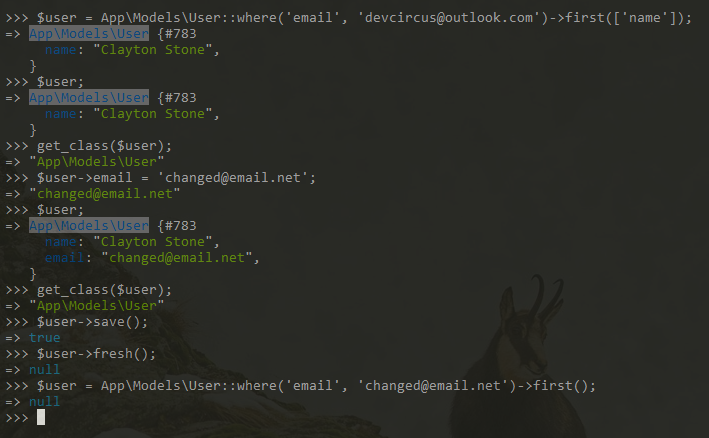
Seems like something should be tweaked here, but not sure what. I've attached a screenshot showing the progression in tinker. @themsaid
It's actually quite easy to follow what's going wrong, isDirty() evaluates to true, but performUpdate expects a primary key to be available. Also, at the end of performUpdate, it just returns true regardless.
Personally, I would never expect this code to work and would have never tried it without first seeing this issue, but I can see how it can be confusing.
devcircus
on 18 Nov 2017
I think my commit above is the appropriate solution. By simply throwing an exception we prevent the problem and make developers aware of a bug in their existing apps.
 hastinbe
on 19 Nov 2017
hastinbe
on 19 Nov 2017
$signup=new Signup;
    $signup->email= $request->email;
    $signup->password= $request->pass;
    $signup->save();
not working help me
 Niwantha97
on 20 Sep 2020
Niwantha97
on 20 Sep 2020
Related issues
 PhiloNL
·
3Comments
PhiloNL
·
3Comments
 JamborJan
·
3Comments
JamborJan
·
3Comments
 fideloper
·
3Comments
fideloper
·
3Comments
 progmars
·
3Comments
progmars
·
3Comments
 iivanov2
·
3Comments
iivanov2
·
3Comments
Most helpful comment
I'm not sure why this is issue is closed.
The problem is still present : no errors whatsoever are shown when using
save()without anid.I understand that you guys are not willing to 'fix' that by always selecting the
id(although perhaps Laravel could store that in a way that could not add any side effects), but at least a notice or warning should be shown whensave()is used with anullid, don't you think?